Using LLMs for Real-Time Market Analysis: A Practical Guide
Learn how Large Language Models transform crypto market analysis — from news summarization and sentiment extraction to risk assessment. Practical workflows using LLMs alongside CoinXSight's AI modules. Essential crypto technical analysis for smarter trading.
KZ
Dr. Kevin ZhangPrincipal AI & Quantitative Researcher·May 19, 2026 · 12 min read · Updated Oct 6
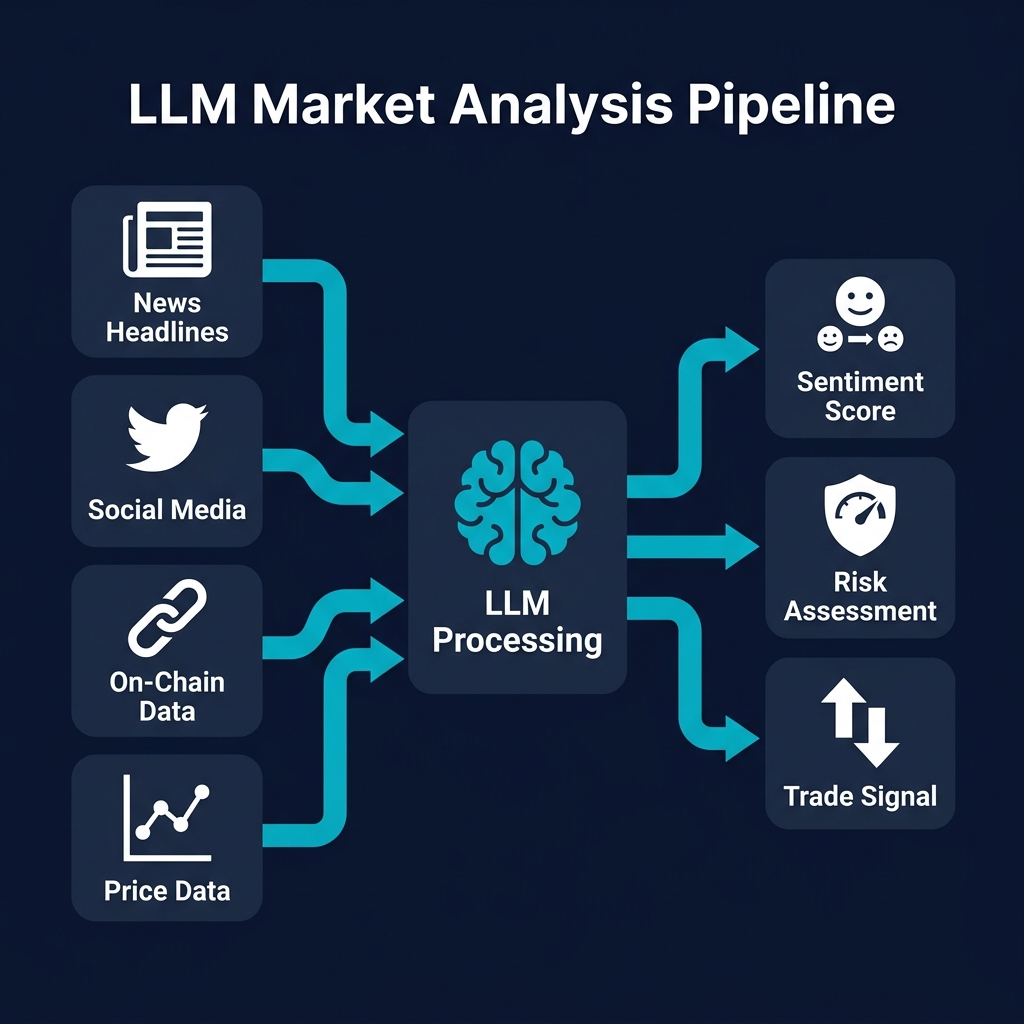
Large Language Models (LLMs) like GPT-4, Claude, and Gemini are AI systems trained on massive text datasets to understand and generate human language. For traders, they represent a paradigm shift: the ability to process, interpret, and act on unstructured information at a scale no human can match.
Every day, the crypto market generates thousands of data points that affect price:
50+ major news articles across Bloomberg, CoinDesk, The Block
10,000+ tweets from influential accounts, whale alerts, and protocol announcements
Dozens of regulatory updates from the SEC, MiCA framework, and global jurisdictions
No human can read, contextualize, and act on all of this within the window that matters. A market-moving headline has a 30-second to 5-minute alpha window before the information is priced in. LLMs can process and classify that information in under 2 seconds.
The 4 Core LLM Applications in Crypto Trading
1. News Summarization and Classification
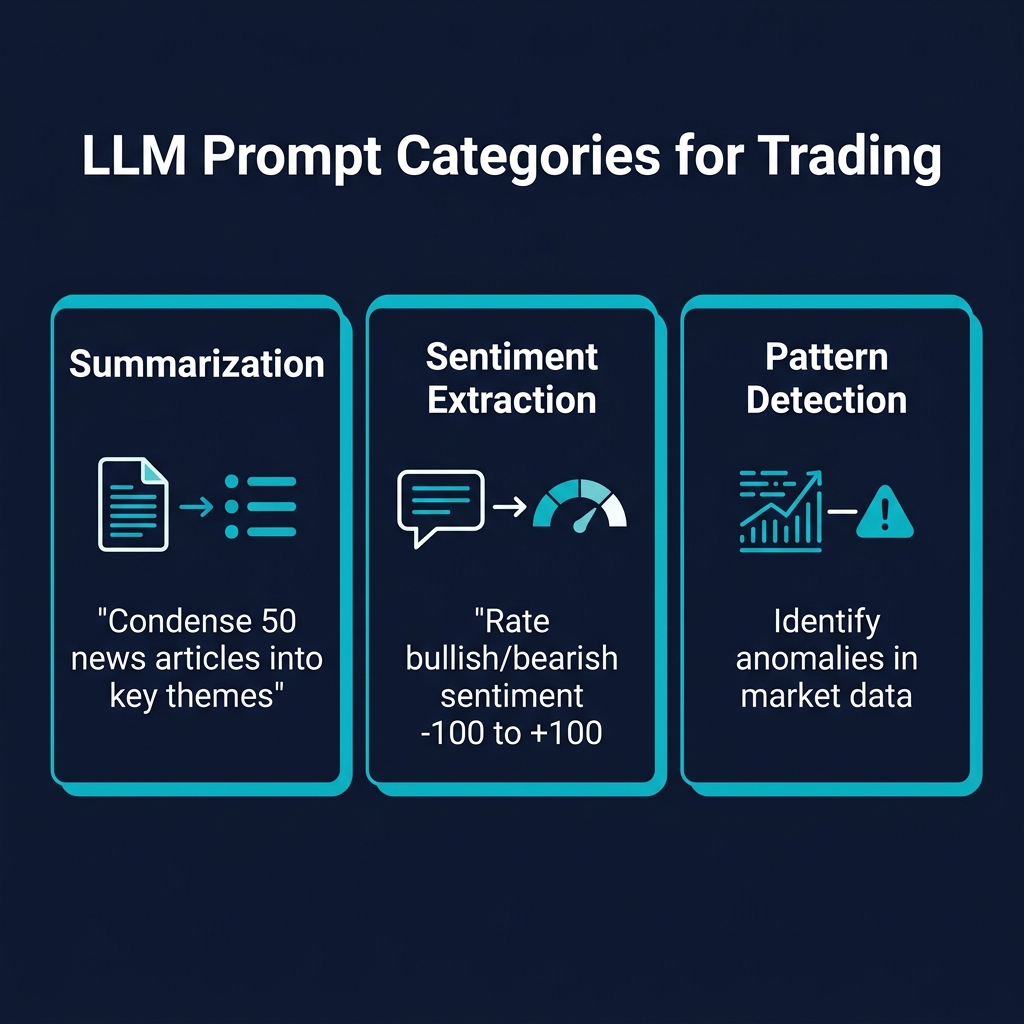
The most immediately valuable LLM application is turning noise into signal. Instead of reading 50 articles, an LLM can:
Summarize each article to 2-3 key points
Classify sentiment (bullish/bearish/neutral)
Identify which tokens are mentioned and whether the mention is positive or negative
Input: "The SEC has approved BlackRock's amended S-1 filing for its
spot Ethereum ETF, with trading expected to begin within 14 days.
Commissioner Peirce noted this sets a precedent for additional
crypto asset ETFs."

LLM Output:
- Asset: ETH (primary), BTC (secondary — ETF precedent)
- Sentiment: Strongly Bullish (+85/100)
- Impact Level: HIGH (regulatory approval)
- Time Horizon: 14 days (immediate catalyst)
- Action: Bullish ETH, watch for rotation from BTC
CoinXSight's AI Analysis module performs this classification automatically, feeding results into the ASI Score computation.
2. Sentiment Extraction from Social Media
Twitter/X remains the fastest information channel in crypto. LLMs can process tweet streams to detect:
Narrative shifts — when a sector (AI tokens, DeFi, memecoins) starts trending before price moves
Influencer consensus — when multiple respected analysts converge on the same thesis
Fear/greed extremes — when retail sentiment becomes unanimously bullish (potential top) or bearish (potential bottom)
The key advantage over traditional keyword-based sentiment tools: LLMs understand context and sarcasm. "ETH going to $10k 🚀" and "ETH going to $10k just like last time 🤡" have opposite meanings that simple word counting cannot distinguish.
3. On-Chain Event Interpretation
Raw on-chain data is difficult to interpret without context. When a whale moves 10,000 ETH to Binance, is it:
Profit-taking after a rally?
Position restructuring for DeFi participation?
Market-making operations?
LLMs can combine the raw transaction data with historical context (who is this wallet? what have they done before?) and current market conditions to provide probabilistic interpretation rather than raw alerts.
4. Risk Assessment and Scenario Analysis
Perhaps the most underrated application: asking LLMs to evaluate scenarios and edge cases.
Example prompt:
Given current market conditions (BTC at $106K, ETH at $2,450,
funding rates positive, open interest at ATH), what are the
3 most likely downside scenarios in the next 72 hours?
For each, estimate probability and potential drawdown.
This forces structured thinking about risks that traders often ignore during euphoric periods. The LLM won't predict the future, but it will articulate scenarios you haven't considered.
Building an LLM-Enhanced Trading Workflow
Understanding Building an LLM is a key part of crypto technical analysis. Most professional trading indicators on any crypto trading platform will help you apply these concepts in real time.
The Morning Briefing (10 minutes → 2 minutes)
Traditional workflow:
Open 5 news sites, scan headlines (8 minutes)
Check Twitter for overnight developments (5 minutes)
Review on-chain alerts (3 minutes)
Form a market bias (2 minutes)
Total: 18 minutes
LLM-enhanced workflow:
Feed overnight news + tweets + on-chain events to LLM
Receive: 3-paragraph market briefing, top 5 most impactful events, suggested watchlist
Cross-reference with CoinXSight's Discovery module for quantitative validation
Total: 2 minutes
The Real-Time Analysis Loop
During active trading sessions, LLMs can maintain a running interpretation of the market:
Every 15 minutes:
1. Scan new tweets from top 50 crypto accounts
2. Check news feeds for breaking stories
3. Compare current sentiment vs. 1-hour-ago sentiment
4. Flag significant shifts (>15 point sentiment change)
5. Correlate with price action — is sentiment leading or lagging?

If significant shift detected:
→ Alert trader with context and recommended action
→ Cross-reference with CoinXSight Alpha Hunter signals
The Post-Trade Review
After closing a trade, use LLMs to analyze your decision quality:
Prompt:
I entered LONG on SOL at $168 based on Alpha Hunter BUY signal
(ASI 72). I exited at $175 after 18 hours for +4.2% gain.
Review the market context during this period and evaluate:
1. Was the entry timing optimal?
2. Did I leave money on the table?
3. What risk did I take that I may not have recognized?
This creates an automated trading journal analysis that's more objective than self-reflection.
Prompt Engineering for Trading Analysis
The quality of LLM output depends entirely on the quality of your prompt. Here are proven templates:
Template 1: Market Context Brief
You are a crypto market analyst. Analyze the following overnight
developments and provide:

1. MARKET BIAS: Bullish/Bearish/Neutral with confidence (0-100)
2. TOP 3 EVENTS: Ranked by likely price impact
3. SECTORS TO WATCH: Which crypto sectors are most affected
4. RISK FACTORS: Anything that could invalidate the current trend
5. ACTIONABLE: 1-2 specific trade ideas with entry logic

Data:
[paste news summaries, tweet thread, on-chain alerts]
Template 2: Token Deep Dive
Analyze [TOKEN] based on the following data. Provide a structured
assessment:

Technical: [paste price data, indicator readings]
On-Chain: [paste whale movements, exchange flows]
Sentiment: [paste social sentiment scores]
Fundamental: [paste protocol metrics, TVL, revenue]

Output format:
- Overall Rating: Strong Buy / Buy / Hold / Sell / Strong Sell
- Confidence: 0-100%
- Key Drivers: Top 3 factors supporting your rating
- Key Risks: Top 3 factors that could invalidate your thesis
- Time Horizon: When the thesis should play out
Template 3: Contrarian Challenge
I'm currently LONG [TOKEN] with the following thesis: [your thesis].

Challenge this thesis aggressively. Find every reason it could be
wrong. For each counter-argument:
1. How likely is it? (%)
2. What would it look like if this risk materializes?
3. What early warning signs should I monitor?

Be brutal. I want to stress-test my conviction, not confirm my bias.
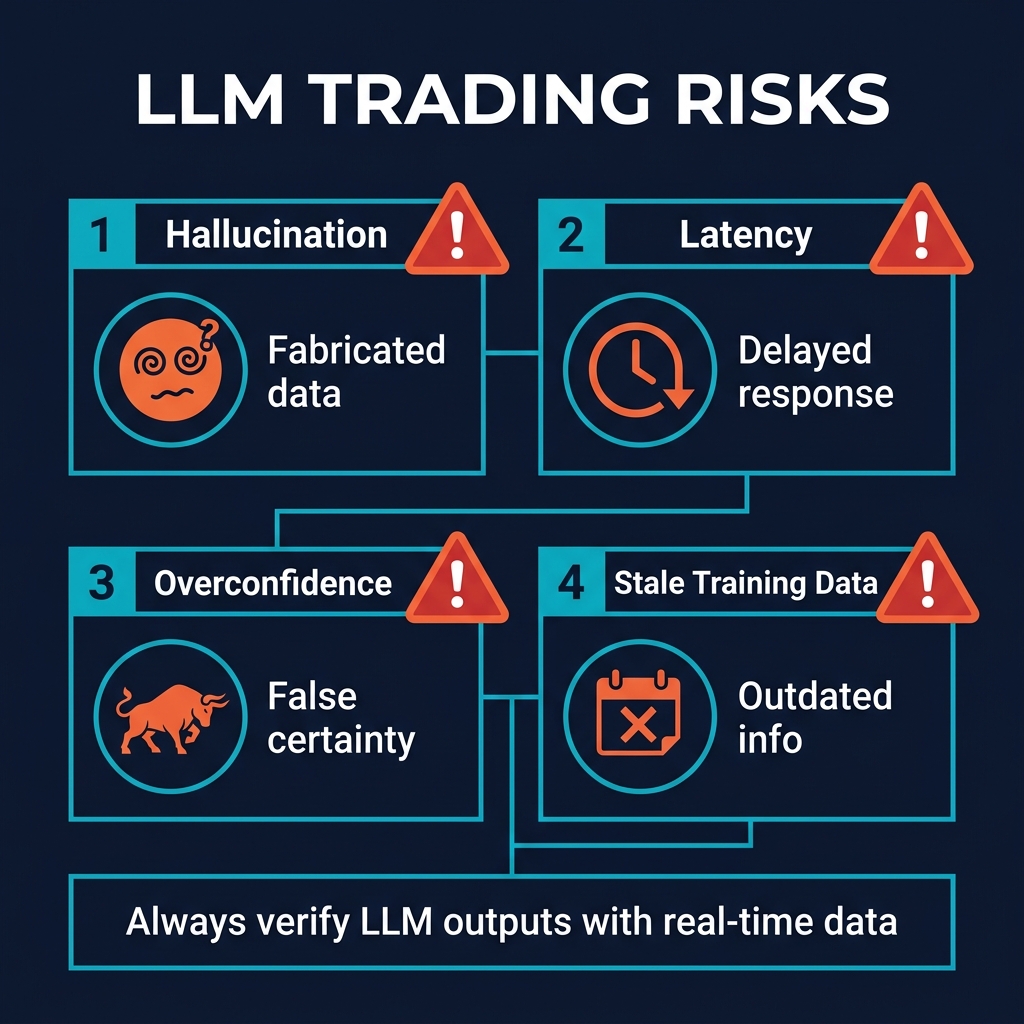
LLM Limitations Every Trader Must Understand
1. Hallucination Risk
LLMs can generate plausible-sounding but completely fabricated information. In a trading context, this could mean:
Citing price levels that never existed
Referencing partnerships or events that didn't happen
Mitigation: Never trade on LLM output alone. Always verify factual claims against real-time data from CoinXSight's Dashboard or trusted data sources.
2. Training Data Cutoff
Most LLMs have a training data cutoff — they don't know about events after their training date. A model trained through December 2025 won't know about a protocol hack that happened in January 2026.
Mitigation: Always provide current data in your prompt. Use RAG (Retrieval-Augmented Generation) workflows that inject live data before the LLM processes it.
3. Overconfidence in Predictions
LLMs express opinions with high confidence regardless of actual prediction accuracy. A model saying "BTC has an 85% probability of reaching $120K" is generating a confident-sounding number, not a calibrated probability.
Mitigation: Use LLMs for analysis and scenario generation, not price predictions. The value is in the reasoning process, not the specific number.
4. Latency in Time-Sensitive Markets
API calls to LLMs take 2-10 seconds. For strategies requiring sub-second execution (scalping, arbitrage), LLMs are too slow for real-time decision-making.
Mitigation: Use LLMs for strategic analysis (pre-market, post-market) and CoinXSight's real-time Order Flow and Alpha Hunter signals for execution timing.
LLMs vs. CoinXSight's Built-In AI: When to Use Which
Use LLMs for post-trade review and journal analysis
Building Your LLM Trading Stack
Beginner Stack (Free)
ChatGPT Free or Claude Free for morning briefings
Copy-paste news headlines and ask for analysis
Manual workflow — no automation
Cross-reference with CoinXSight's free Dashboard
Intermediate Stack ($20-50/month)
ChatGPT Plus or Claude Pro for higher rate limits and better models
Create saved prompt templates for consistent analysis
Use the model's web browsing capability for real-time data
Integrate with CoinXSight's AI Analysis for validation
Advanced Stack ($100+/month)
API access (GPT-4, Claude API) for programmatic analysis
Custom RAG pipeline feeding live news and on-chain data
Automated morning briefings delivered to Telegram/Discord
Real-time sentiment monitoring with threshold alerts
Full integration with CoinXSight's trading pipeline
Common Mistakes When Using LLMs for Trading
1. Treating LLMs as Oracles
LLMs don't predict the future. They synthesize available information into coherent analysis. If you ask "Will BTC go up?" you'll get an answer, but it's not a prediction — it's a persuasive summary of bullish arguments.
2. Confirmation Bias Amplification
If you prompt with a bias ("Analyze why ETH will reach $5,000"), the LLM will generate supporting arguments. Always use the contrarian challenge template to stress-test your thesis.
3. Ignoring Context Window Limitations
LLMs can only process a limited amount of text per query. Dumping 100 articles into a single prompt degrades quality. Summarize inputs first, then analyze the summaries.
4. Over-Automating Without Guardrails
Fully automated LLM → trade execution pipelines are dangerous. LLMs can hallucinate, misinterpret data, or generate contradictory signals. Always include a human review step before execution.
5. Not Iterating on Prompts
Your first prompt template won't be optimal. Track the quality of LLM outputs over time and refine your templates based on which analyses proved most useful.
Frequently Asked Questions
Can LLMs replace traditional technical analysis?
No. LLMs excel at processing text and generating qualitative analysis. They cannot perform precise mathematical calculations like RSI, MACD, or Fibonacci levels. Use LLMs for narrative and context; use CoinXSight for technical signals.
Which LLM is best for crypto trading analysis?
As of 2026, Claude and GPT-4 produce the highest quality financial analysis. For coding and data transformation tasks, Claude tends to be stronger. For creative scenario generation, GPT-4 has an edge. Both are excellent for market analysis.
How do I avoid LLM hallucinations about price data?
Never ask an LLM to recall specific price data from memory. Always provide the current data in your prompt. For example: "BTC is currently at $106,500 (data from CoinXSight). Given this price level and the following context, analyze…"
Can I connect an LLM directly to CoinXSight?
CoinXSight's AI modules already use advanced ML models optimized for market analysis. Using an external LLM as a complementary analysis layer (not a replacement) provides the best results. The AI Analysis guide covers the built-in capabilities.
How much does it cost to use LLMs for trading analysis?
Basic usage with free tiers costs nothing. Intermediate usage (ChatGPT Plus/Claude Pro) costs $20-30/month. Advanced API usage typically costs $50-200/month depending on query volume and model selection.
Summary
LLMs are the most significant new tool available to crypto traders since on-chain analytics. They don't replace quantitative systems like CoinXSight — they complement them by adding qualitative understanding, narrative analysis, and structured thinking to the trading process.
The winning combination is clear: use CoinXSight's real-time AI signals for WHAT to trade and WHEN to enter, and use LLMs for WHY the opportunity exists and what RISKS might invalidate it.
Start with the morning briefing workflow — it delivers the highest value-to-effort ratio. Then gradually expand to real-time monitoring and post-trade analysis as you develop your prompt templates.
Key takeaways:
LLMs process unstructured text (news, tweets, reports) into tradeable insights
The highest value applications are summarization, sentiment extraction, and scenario analysis
Never trade on LLM output alone — always verify with real-time data
Combine LLMs for qualitative context with CoinXSight for quantitative signals
Principal AI & Quantitative Researcher·Deep Alpha Engine Labs
Ph.D. in Computational Statistics. Leads machine learning architecture, regime-switching detection, and automated execution systems at CoinXSight Labs.
QUANTITATIVE SUITE // DEEP ALPHA ENGINEACTIVE
BTC/USDT // LIVE SCANNER
CONFLUENCE 81
LIVE SPOT PRICE$82,384.73MODERATE_SELL
TP2
$72,279.50
+-12.53%
TP1
$78,493.97
+-5.01%
ENTRY
$82,636.95
ZONE
SL
$84,708.44
2.51%
Auto-detect Order Blocks, Fair Value Gaps and risk-adjusted DCA ladders in < 5s.