Trading Psychology: How to Master Your Emotions in Crypto Markets
Learn how to control FOMO, fear, and revenge trading in crypto. Practical trading psychology techniques used by professional traders to stay disciplined.
MC
Marcus ChenSenior Quantitative Strategist·May 17, 2026 · 10 min read · Updated Oct 6
Most traders spend 90% of their time searching for the perfect strategy and 10% on psychology. Professional traders do the opposite. The reason is simple: a mediocre strategy executed with discipline will outperform a brilliant strategy executed emotionally, every single time.
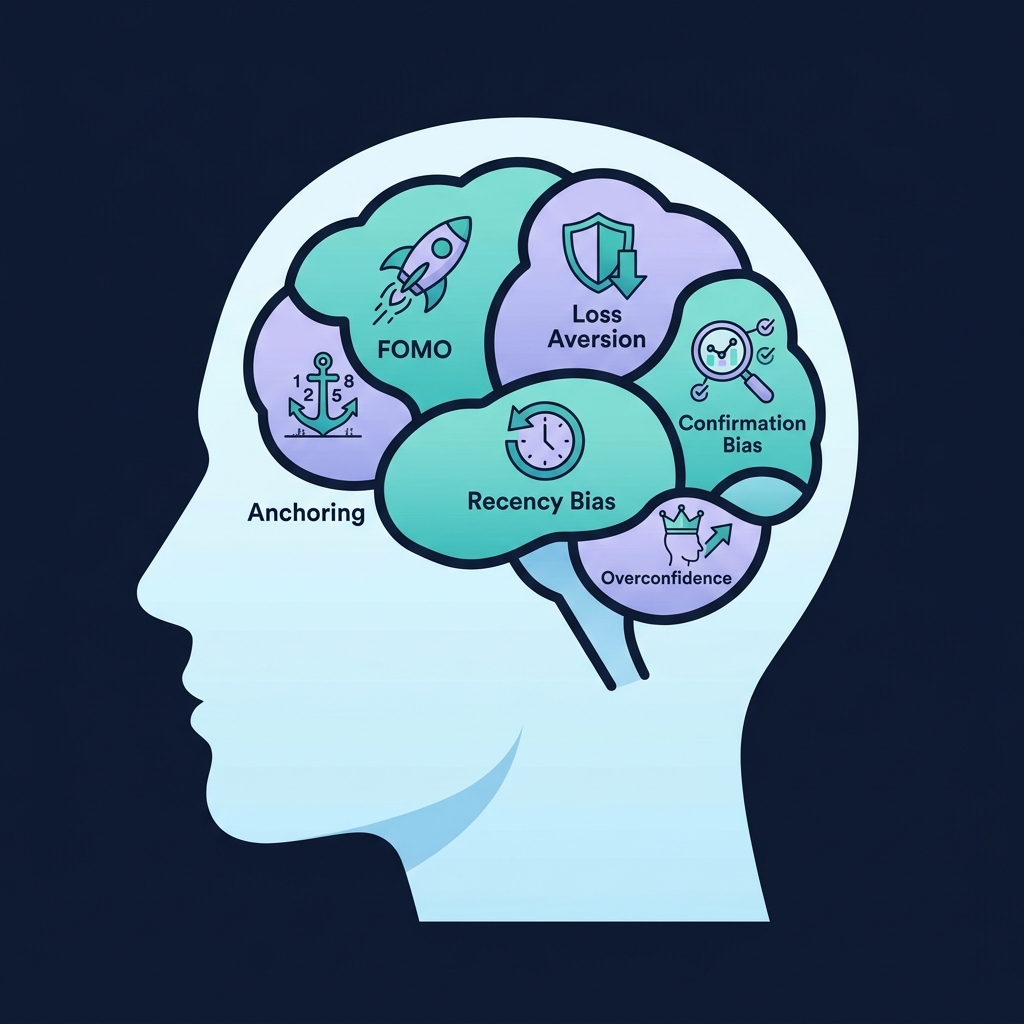
Research from behavioral finance consistently shows that retail traders underperform the market not because they lack information, but because they make predictable emotional mistakes. The crypto market amplifies these mistakes because it operates 24/7, moves faster than traditional markets, and is heavily influenced by social media narratives.
This guide covers the specific psychological traps that destroy crypto traders and the practical techniques professionals use to overcome them. These are not abstract theories — they are actionable workflows you can implement starting today.
The 5 Emotional Traps That Destroy Crypto Traders
1. FOMO — Fear of Missing Out
FOMO is the most expensive emotion in crypto. It triggers when you see a coin pumping 50% and feel compelled to buy at the top because "it might keep going." The pattern is predictable:
You see a coin trending on social media
You check the chart and see it already moved 40-80%
You feel anxiety about missing the move
You buy without analysis, at inflated prices
The price reverses and you're holding a losing position
Why FOMO is so powerful in crypto: Unlike stocks, crypto pumps happen faster and are amplified by influencer posts, Telegram groups, and Twitter threads. The 24/7 market means FOMO can strike at 3 AM when your defenses are lowest.
The antidote: Before entering any trade, ask yourself: "Would I take this trade if I hadn't seen the price move?" If the answer is no, you're trading on FOMO, not analysis. CoinXSight's Alpha Hunter V2 helps eliminate FOMO by providing signals before major moves happen — not after they've already occurred.
2. Fear and Panic Selling
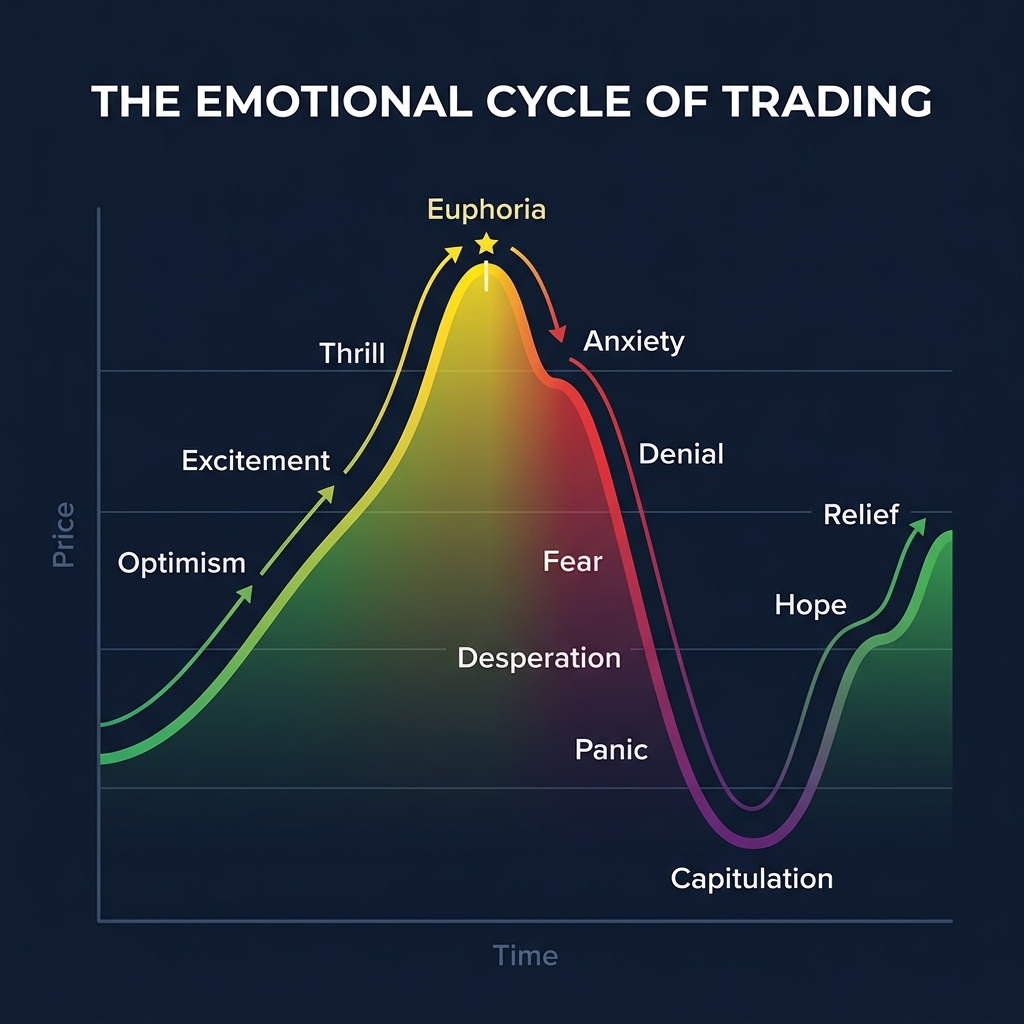
The opposite of FOMO. When the market drops 15% in a day, fear triggers the impulse to sell everything immediately to "stop the bleeding." This is how retail traders consistently sell bottoms.
The pattern:
Market drops sharply
Social media fills with bearish predictions and "crash" headlines
You feel physical anxiety — racing heart, inability to focus
You sell at the worst possible price
The market recovers within days
Why it's dangerous: Crypto markets routinely drop 20-30% during healthy bull markets. These drawdowns are normal, but they feel catastrophic in the moment. Traders who panic sell during corrections miss the recovery rallies that generate the majority of returns.
The antidote: Pre-define your stop-loss levels before entering any trade. If BTC is at $80,000 and your stop is at $75,000, then a drop to $77,000 is not a reason to panic — it's within your plan. Use CoinXSight's Risk Management tools to calculate exact stop-loss levels based on your risk tolerance.
3. Revenge Trading
After taking a loss, many traders immediately enter another trade to "win it back." This is revenge trading, and it's one of the fastest ways to blow up an account.
The psychology: A loss creates emotional pain, and the brain seeks immediate relief. Taking another trade creates the illusion of control and the hope of erasing the loss. But revenge trades are made with emotional urgency, not analytical clarity.
The cycle:
Take a loss on Trade A
Immediately enter Trade B to recover
Trade B is poorly analyzed → another loss
Enter Trade C with even larger size to recover both losses
Account drawdown accelerates
The antidote: Implement a mandatory cooldown period after any losing trade. Professional traders often use a "two-loss rule" — after two consecutive losses, they stop trading for the rest of the day. The market will be there tomorrow. Your capital might not be if you keep revenge trading.
4. Overconfidence After Wins
A winning streak is surprisingly dangerous. After 5-6 profitable trades, your brain starts believing you've "figured it out." You increase position sizes, skip analysis, and ignore risk management. Then a single large loss wipes out all previous gains.
The pattern:
String of winning trades → feeling invincible
Increase position sizes beyond your risk rules
Skip the analysis process because "you can feel the market"
One bad trade at oversized position → massive loss
Emotional spiral begins
The antidote: Keep position sizes consistent regardless of recent results. Your edge is statistical — it works over hundreds of trades, not a handful. CoinXSight's Backtest Engine shows you the realistic win rate and drawdown of your strategy across hundreds of historical trades, keeping your expectations grounded in data rather than recent emotions.
5. Analysis Paralysis
The opposite of impulsive trading. Some traders become so afraid of making a mistake that they never execute. They spend hours analyzing every possible scenario, waiting for "perfect" confirmation that never comes, and watch profitable setups pass by.
Why it happens in crypto: The sheer amount of data available — price charts, on-chain metrics, social sentiment, whale movements — can overwhelm decision-making. When every indicator must align perfectly before you trade, you'll rarely trade at all.
The antidote: Define your entry criteria in advance with a maximum of 3-4 conditions. If those conditions are met, execute the trade. Accept that no trade will ever be "perfect" — the goal is to be right more often than wrong, not to be right every time. The Confluence Scoring System on CoinXSight automates this by combining 12+ indicators into a single confidence score, reducing the analysis burden.
Building a Trading Plan That Removes Emotion
A trading plan is your defense against every emotional trap listed above. Without a written plan, you're making decisions in real-time under emotional pressure. With a plan, you're simply executing pre-made decisions.
Essential Components of a Crypto Trading Plan
1. Entry Rules (Maximum 3-4 conditions)
What specific conditions must be true before you enter?
If all conditions are not met, no trade. No exceptions.
2. Position Sizing Formula
Risk no more than 1-2% of total capital per trade
Calculate exact position size before entering
Never increase size based on "feeling confident"
3. Exit Rules (Both Profit and Loss)
Pre-defined take-profit levels (e.g., TP1 at 1:2 R:R, TP2 at 1:3)
Hard stop-loss that is set immediately after entry
Never move your stop-loss further away from entry
4. Daily Trading Limits
Maximum number of trades per day (e.g., 3)
Maximum loss per day (e.g., 3% of capital → stop trading)
Mandatory break after 2 consecutive losses
5. Review Schedule
Weekly journal review: what worked, what didn't, what emotions arose
Monthly performance review: actual results vs plan expectations
Use CoinXSight's Backtest module to validate strategy changes before implementing them live
Practical Psychology Techniques for Traders
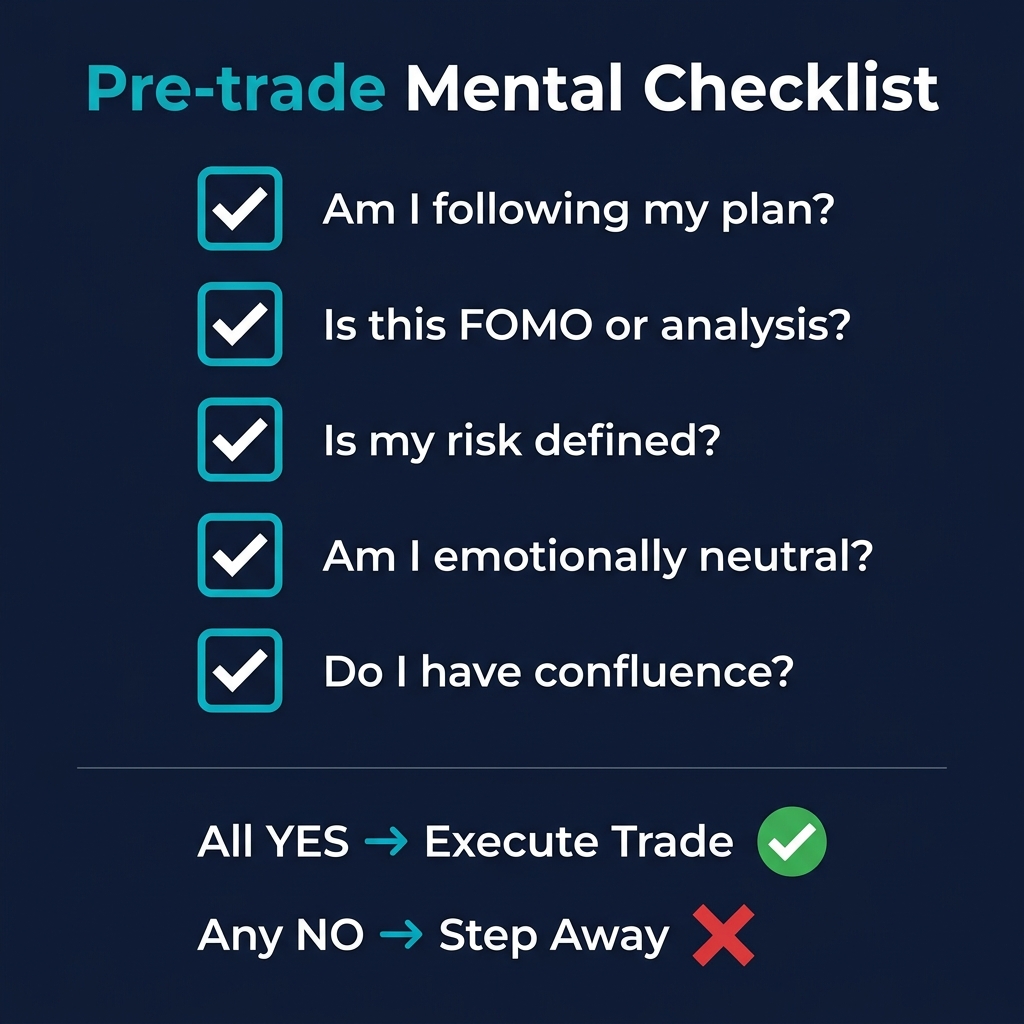
The Pre-Trade Checklist
Before every trade, complete a simple 5-point checklist:
✅ Does this setup match my trading plan criteria?
✅ Have I calculated my exact position size?
✅ Is my stop-loss set?
✅ Am I trading based on analysis, not emotion?
✅ Would I take this trade if I just woke up with no context?
If any answer is "no," don't take the trade. This 30-second process eliminates most emotional trades.
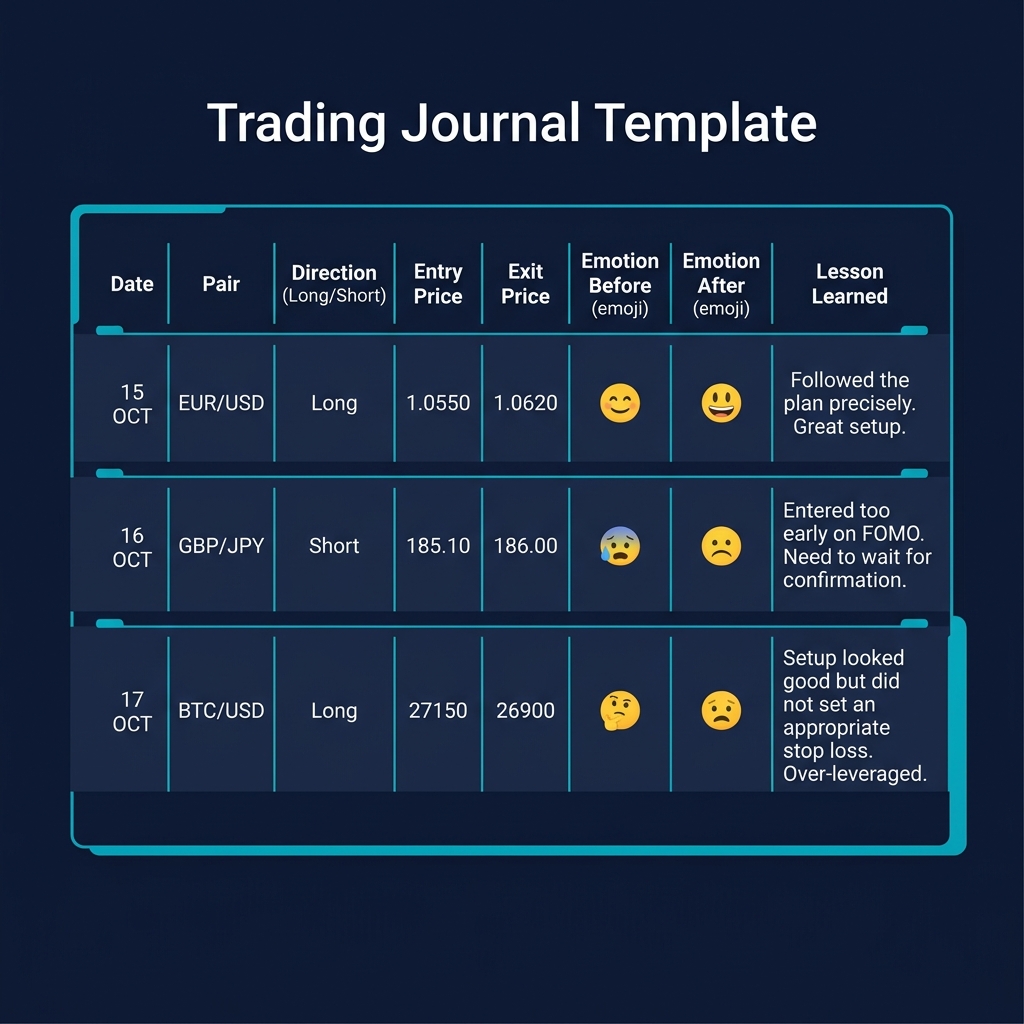
The Trading Journal
Keep a simple journal for every trade with three fields:
Setup: Why did you enter? What was the signal?
Emotion: What were you feeling? Confident? Anxious? Impulsive?
Outcome: What happened? Was the process correct, regardless of result?
The key insight: judge trades by process quality, not outcome. A trade that followed your plan but lost money is a good trade. A trade that broke your rules but made money is a bad trade.
The Cooling Period
When you feel strong emotion — excitement, fear, anger — set a timer for 15 minutes. Do not touch your trading interface during this time. After 15 minutes, reassess. Most impulsive urges fade within 10 minutes. The trades you don't take often save you more money than the trades you do.
Using AI to Remove Emotional Bias
One of the most powerful applications of CoinXSight's AI engine is reducing emotional decision-making. The AI doesn't experience FOMO, fear, or revenge. It evaluates every token using the same objective criteria every time.
When the AI Analysis module gives a token an ASI score of 85 during a market panic, that score is based purely on technical, on-chain, and sentiment data — not on the emotional climate of Twitter. This objective anchor helps traders stay rational when the market is irrational.
Similarly, the Discovery module surfaces opportunities based on data velocity, not hype velocity. Tokens trending in the Discovery scanner are gaining traction in objective metrics (volume, whale interest, price momentum) rather than just social media noise.
Common Psychology Mistakes by Experience Level
Beginner Mistakes (0-6 months)
Trading with money you can't afford to lose
No stop-losses on any position
Following influencer calls without understanding the analysis
Switching strategies after every losing trade
Intermediate Mistakes (6-18 months)
Overcomplicating analysis with too many indicators
Increasing position sizes after a winning streak
Ignoring the macro environment (BTC dominance, market mood)
Not journaling trades consistently
Advanced Mistakes (18+ months)
Becoming attached to positions ("I'm right, the market is wrong")
Holding conviction trades through invalidation levels
Ignoring risk management because "I know what I'm doing"
Trading too frequently during choppy/ranging markets
Frequently Asked Questions
How do I stop FOMO trading?
Create a rule: never buy a coin that has already moved more than 20% in the timeframe you trade. If you trade 4H charts, a coin that pumped 20% in 4 hours is not an opportunity — it's a trap. Wait for pullbacks to support levels, or use CoinXSight's Alpha Hunter to catch signals before the move.
What position size should beginners use?
Risk 1% of your total capital per trade. If you have $10,000, your maximum loss per trade should be $100. This means if your stop-loss is 5% away from entry, your position size is $2,000. This keeps you in the game long enough to learn.
How many consecutive losses should I accept before stopping?
Most professional traders use a 2-3 loss daily limit. After 2 consecutive losses, take a mandatory 4-hour break. After 3 losses in a day, stop trading until the next day. Your capital preservation is more important than any single opportunity.
Is it normal to feel anxious when trading?
Yes, especially in the beginning. Anxiety usually indicates your position size is too large relative to your comfort level. Reduce your position size until you can check price action without feeling physical stress. If you can't sleep because of an open position, the position is too big.
How do I know if my strategy works or if I'm just lucky?
Run your strategy through CoinXSight's Backtest Engine across at least 90 days of historical data. A statistically valid strategy should show consistent performance across different market conditions — not just the most recent bull run.
Summary
Trading psychology is not a soft skill — it's the foundation that determines whether your technical analysis and strategy research actually translates into profits. The five emotional traps (FOMO, panic selling, revenge trading, overconfidence, and analysis paralysis) are predictable and preventable with the right systems.
Build a written trading plan, use a pre-trade checklist, keep a trading journal, and leverage CoinXSight's AI tools to anchor your decisions in data rather than emotion. The traders who survive long enough to become profitable are not the smartest — they're the most disciplined.
Master risk management for crypto trading. Learn position sizing formulas, stop-loss strategies, and how CoinXSight's Portfolio module tracks your risk…