Impermanent Loss Explained: The Hidden Cost of LP Positions
Understand impermanent loss in DeFi liquidity pools. Learn how AMMs work, calculate your IL exposure, and discover strategies to minimize losses when providing liquidity on Uniswap, Raydium, and other DEXs.
FR
Felix RomeroDeFi Risk & Protocol Strategist·May 19, 2026 · 10 min read · Updated Oct 6
Impermanent loss (IL) is the difference in value between holding tokens in your wallet versus providing those same tokens as liquidity to a decentralized exchange (DEX) pool. When you provide liquidity, the AMM (Automated Market Maker) continuously rebalances your position as the token prices change — and this rebalancing can leave you with less total value than if you had simply held the tokens.
The key insight: If you deposit ETH and USDC into a liquidity pool and ETH's price increases 100%, you would have been better off just holding your original ETH + USDC. The pool's rebalancing mechanism automatically sold some of your ETH as the price rose, locking in a lower average value.
It's called "impermanent" because the loss only becomes permanent when you withdraw. If the price returns to its original level, the loss disappears. In practice, however, prices rarely return to exactly where they started, making the loss very often permanent.
How AMMs Create Impermanent Loss
To understand impermanent loss, you first need to understand how AMMs work.
The Constant Product Formula
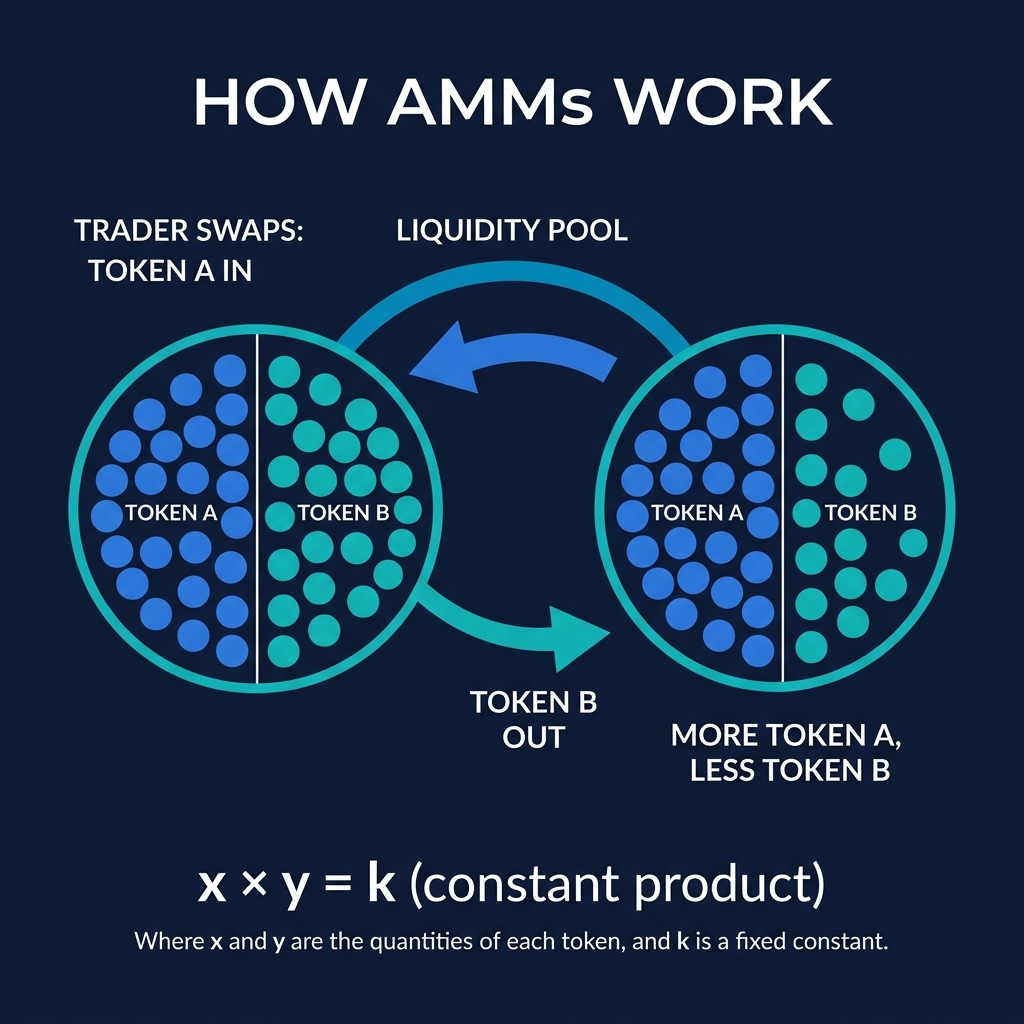
Most AMMs (Uniswap V2, Raydium, PancakeSwap) use the constant product formula:
x × y = k
Where:
x = quantity of Token A in the pool
y = quantity of Token B in the pool
k = a constant that never changes
When someone buys Token A, they add Token B to the pool and remove Token A. This changes x and y, but k stays the same. The price is determined by the ratio of the two tokens.
A Practical Example
Initial deposit:
You provide liquidity: 1 ETH ($2,000) + 2,000 USDC
Total portfolio value: $4,000
Pool constant: 1 × 2,000 = 2,000
After ETH price doubles to $4,000:
The pool rebalances to maintain k = 2,000
New pool state: ~0.707 ETH + ~2,828 USDC
Your position value: (0.707 × $4,000) + $2,828 = $5,656
If you had just held instead:
1 ETH at $4,000 = $4,000
2,000 USDC = $2,000
Total: $6,000
Your impermanent loss: $6,000 – $5,656 = $344 (5.7%)
You still made money ($5,656 vs. original $4,000), but you made $344 less than you would have by simply holding. That gap is impermanent loss.
The Impermanent Loss Curve
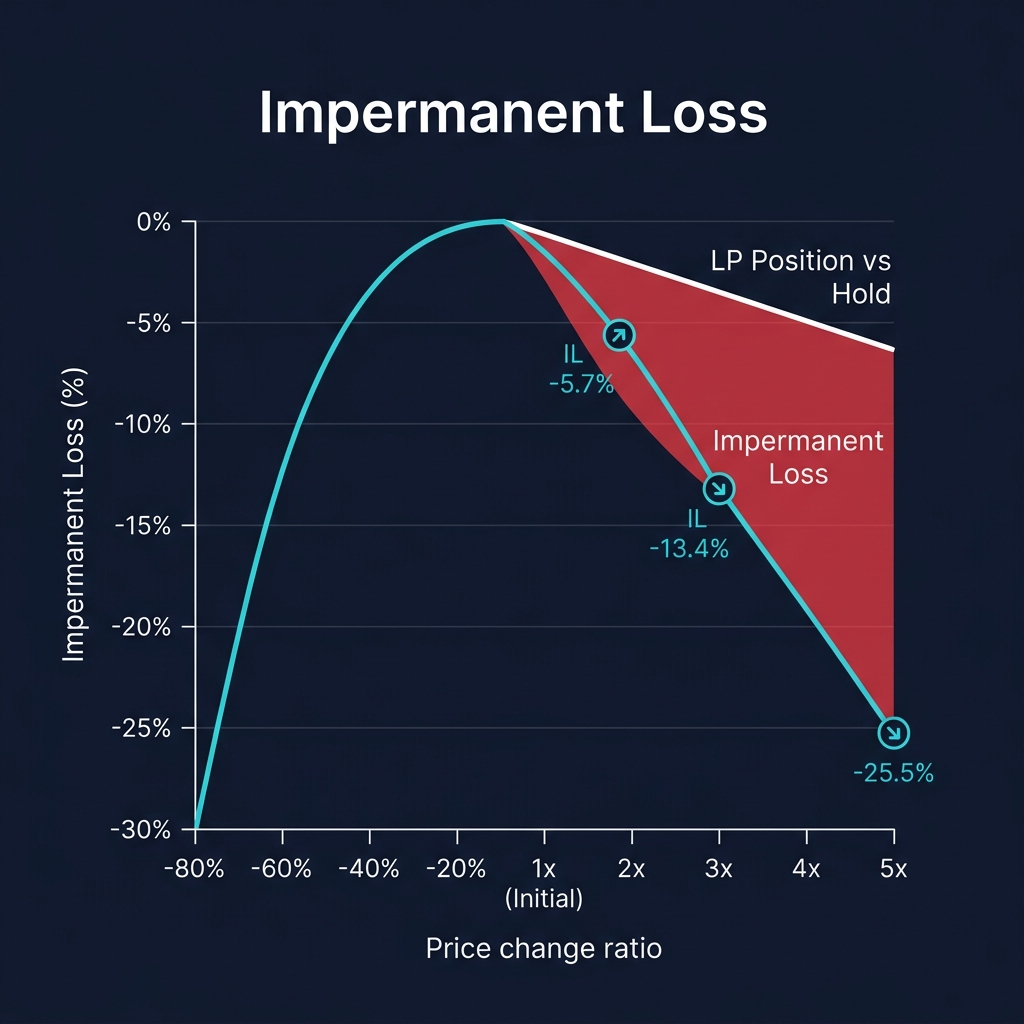
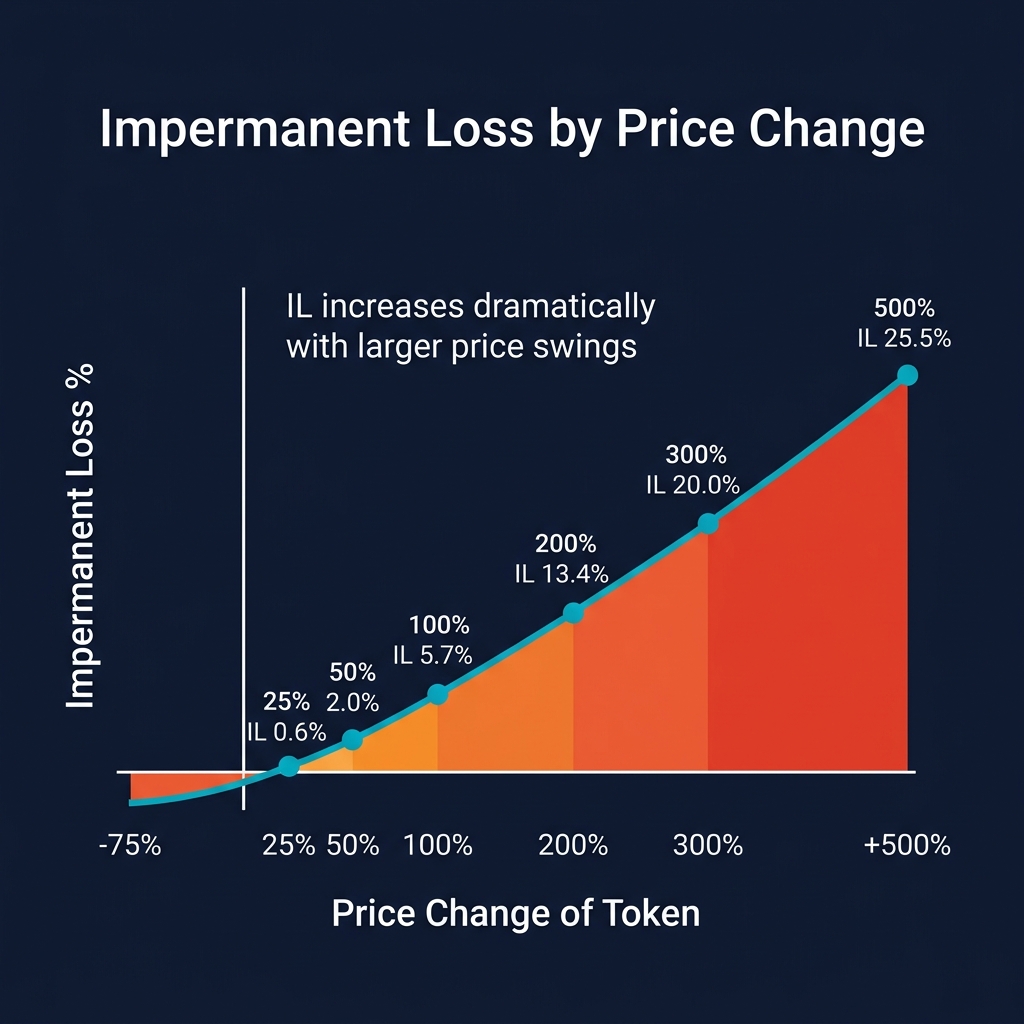
IL increases non-linearly with price divergence. Small price changes cause minimal IL, but large moves create significant losses:
Price Change
Impermanent Loss
±10%
0.11%
±25%
0.6%
±50%
2.0%
±100% (2x)
5.7%
±200% (3x)
13.4%
±300% (4x)
20.0%
±500% (5x)
25.5%
Critical observations:
IL below 25% price change is negligible — don't stress about minor movements
IL accelerates rapidly after 100% price change — this is where it becomes a real concern
A 5x price move results in losing 25.5% compared to holding — massive for a bull market token
IL is symmetrical: a 50% drop causes the same IL as a 50% rise
During bull markets, your volatile token (ETH, SOL) gets sold by the AMM as it rises
You're effectively selling your winner into a stablecoin
The more the volatile token rises, the worse your IL becomes
Meme coin pools:
Meme coins can move 200-500%+ in days
IL can reach 20-25% within a single week
If you're providing liquidity for SOL-based memecoins tracked by CoinXSight's Meme Hunter, factor IL into your expected returns
Newly launched tokens:
Price discovery phase creates extreme volatility
IL during the first 48 hours of a new pool can exceed 30%
Low-IL Scenarios (Generally Safe)
Stablecoin pairs (USDC/USDT, DAI/USDC):
Price deviation between stablecoins is minimal (usually <1%)
IL is negligible — typically 0.01-0.1%
Yield is almost pure profit
Correlated asset pairs (ETH/stETH, SOL/mSOL):
These assets track each other closely
IL is minimal because both sides move together
Yield is almost entirely additive to your returns
Calculating: Do Fees Offset Your IL?
The whole point of providing liquidity is earning trading fees. The question is whether those fees exceed your impermanent loss.
The Break-Even Analysis
Net LP Return = Trading Fees Earned - Impermanent Loss

If positive: LPing was more profitable than holding
If negative: You would have been better off just holding
Fee Revenue Estimation
Pool Type
Typical Fee Tier
Daily Volume/TVL
Annual Fee Yield
Major pairs (ETH/USDC)
0.3%
0.1-0.5x
10-50% APR
Volatile pairs (MEME/SOL)
1%
0.5-5x
100-1000% APR
Stablecoin pairs (USDC/USDT)
0.01-0.05%
0.5-2x
3-10% APR
Worked Example: Is ETH/USDC LP Profitable?
Scenario: You LP $10,000 in ETH/USDC on Uniswap for 30 days. ETH rises 50%.
Impermanent Loss: 2.0% × $10,000 = -$200
Fee Revenue: Assume the pool earns 0.3% on $5M daily volume, with $50M TVL.
Daily fees: $5M × 0.3% = $15,000 total pool fees
Your share: ($10,000 / $50M) × $15,000 = $3/day
30-day fees: $90
Net result: $90 – $200 = -$110 (IL exceeded fees)
Verdict: In this scenario, holding ETH + USDC would have been $110 more profitable than LPing. You needed either:
Higher daily volume (more fees to offset IL)
Or lower ETH price movement (less IL)
Or a higher fee tier
When LPing Beats Holding
The sweet spot for liquidity provision:
Moderate volatility (10-30% monthly price range): IL stays manageable
High relative volume (daily volume > 20% of TVL): Fees accumulate quickly
Short time horizons during sideways markets: IL resets with each rebalance
Strategies to Minimize Impermanent Loss
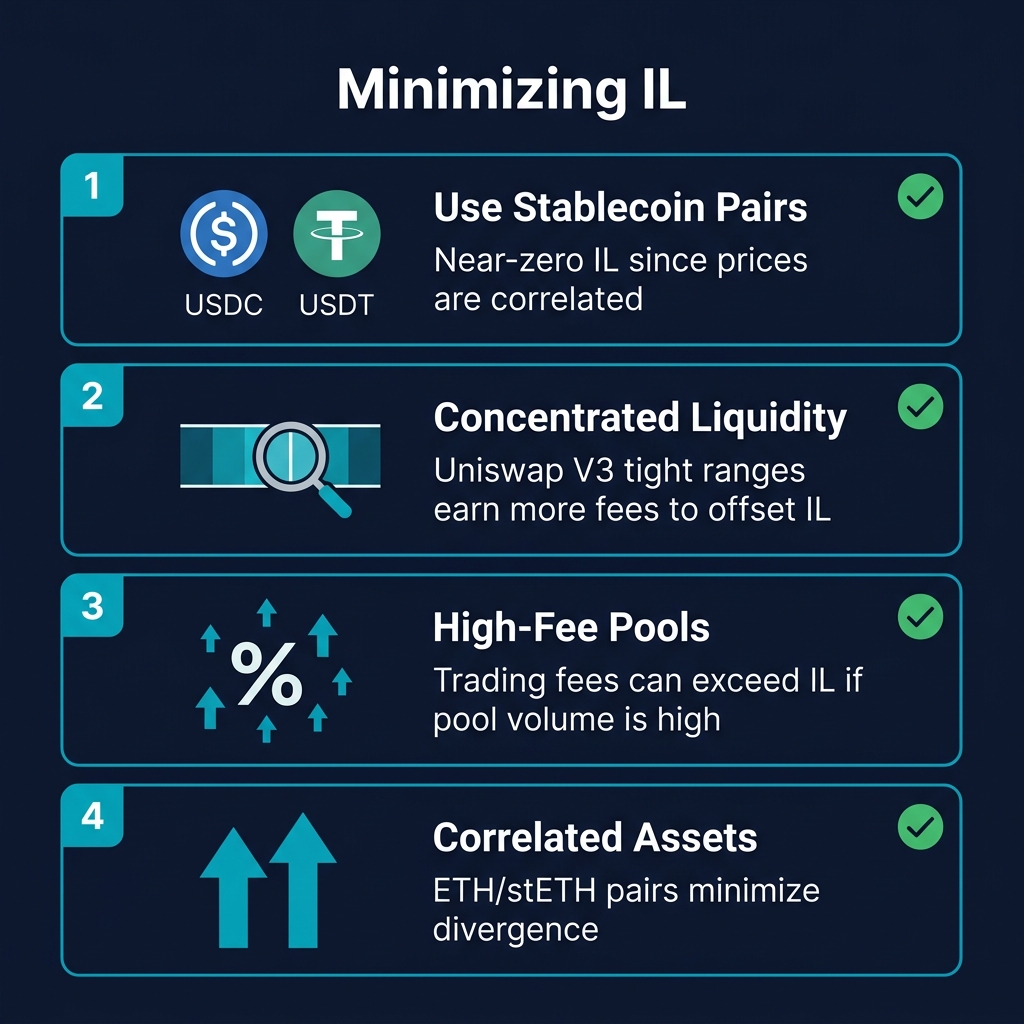
Strategy 1: Choose Stablecoin or Correlated Pairs
The simplest IL mitigation: LP in pools where both tokens move together.
Pair Type
Expected IL
Fee Yield
Net Return
USDC/USDT
~0%
3-8% APR
Almost pure yield
ETH/stETH
~0.1%
2-5% APR
Low risk, steady returns
ETH/WBTC
1-3% (correlated)
5-15% APR
Moderate, usually positive
ETH/USDC
2-10%
10-50% APR
Variable — depends on volatility
MEME/SOL
10-30%+
100-500%+ APR
High risk, potentially profitable
Strategy 2: Use Concentrated Liquidity (Uniswap V3, Raydium CLMM)
Concentrated liquidity lets you provide liquidity in a specific price range instead of the full range. This dramatically increases your fee earnings per dollar of capital.
The trade-off: Concentrated positions earn 10-50x more fees per unit of capital, BUT if price moves outside your range, you stop earning fees entirely AND your IL is amplified.
Best practice:
Set your range to ±15-25% around current price for volatile pairs
Set ±2-5% for stablecoin pairs
Monitor daily and rebalance when price approaches range boundaries
Use CoinXSight's price alerts to notify you when rebalancing is needed
Bancor V3: Single-sided liquidity with IL insurance (protection increases to 100% over 100 days)
Thorchain: Provides IL protection for LPs who stay in pools for 100+ days
Maverick Protocol: Dynamic concentration that automatically adjusts your range
Strategy 5: Hedge with Derivatives
Advanced strategy: offset potential IL by holding a derivatives position.
Example for ETH/USDC LP:
Provide $10,000 in ETH/USDC liquidity
Open a small ETH perpetual long position ($2,000-$3,000) on a CEX
If ETH rises significantly, your perp profits partially offset the IL
If ETH falls, you experience losses on both — this hedge only works for upside IL
Who this is for: Advanced traders who understand both LP mechanics and derivatives. Not recommended for beginners.
Impermanent Loss Across DeFi Protocols
Uniswap V2 (Full Range)
Classic AMM, IL follows the standard curve exactly
No concentration risk, but lower capital efficiency
IL is predictable and follows the formulas above
Uniswap V3 (Concentrated Liquidity)
Higher fee earnings per dollar, but amplified IL when price exits range
Position management is active — you need to monitor and rebalance
Out-of-range positions earn zero fees and behave like limit orders
Curve Finance (StableSwap)
Optimized for assets with similar prices (stablecoins, LSTs)
IL is nearly eliminated by the StableSwap curve design
Lower fees but extremely stable returns
Raydium CLMM (Solana)
Concentrated liquidity on Solana with lower gas costs
Frequent rebalancing is affordable ($0.01-0.05 per transaction)
IL mechanics are identical to Uniswap V3
Protect your assets: Store crypto in a hardware crypto wallet for maximum security. Never keep large amounts on a crypto exchange.
Track everything: Use a crypto portfolio tracker like CoinXSight to monitor your DeFi positions, staking rewards, and crypto exchange balances in one place.
Frequently Asked Questions
Is impermanent loss always bad?
No. IL is one component of the LP return equation. If trading fees exceed IL, you're still better off LPing than holding. Many pools — especially stablecoin pairs and high-volume pools — generate returns that far exceed IL.
Can I avoid impermanent loss entirely?
You can minimize it to near-zero with stablecoin pairs or correlated assets (ETH/stETH). You cannot eliminate it entirely in any pool where token prices can diverge.
How often should I check my LP positions?
For volatile pairs (ETH/USDC): at least daily. For stablecoin pairs: weekly is sufficient. Use CoinXSight's Dashboard for price monitoring and set alerts for significant price movements.
Is impermanent loss worse in bear or bull markets?
IL is equal for equivalent price movements in either direction. A 50% drop causes the same IL as a 50% rise. However, in bull markets, IL feels worse because you're "selling your winners" — the AMM sells your appreciating token into the depreciating one.
Should beginners provide liquidity?
Start with stablecoin pairs to earn yield with minimal IL risk. Once comfortable, experiment with a small allocation to volatile pairs. Never LP more than 10-20% of your crypto portfolio in volatile pools. Understand the risks first with CoinXSight's risk management guide.
How is IL calculated for multi-asset pools (Balancer)?
Pools with 3+ assets (Balancer weighted pools) have more complex IL dynamics. Generally, pools with more assets and more equal weighting have lower IL per-asset than two-asset pools.
Summary
Impermanent loss is the fundamental cost of providing liquidity in DeFi. It's not a bug — it's a feature of how AMMs work. The AMM rebalances your position as prices change, effectively selling your winners and buying your losers compared to simply holding.
The practical question isn't "how to avoid IL" but "do trading fees compensate for IL?" For stablecoin pools and correlated assets, the answer is almost always yes. For volatile pairs, it depends on volume, fees, and the magnitude of price movement.
Use IL as a filter for your DeFi yield farming strategy: calculate expected IL based on your price outlook, compare against expected fee revenue, and only LP when the net return is positive.
Key takeaways:
IL = value difference between holding tokens and providing liquidity
The formula x × y = k causes the AMM to "sell your winners" as prices change
IL increases non-linearly: 2x price change = 5.7% IL, 5x = 25.5% IL
Stablecoin and correlated pairs have near-zero IL
LP profitability = Trading Fees – Impermanent Loss (must be positive)
During sideways markets, LPing is most profitable (low IL, steady fees)
The DeFi yield farming landscape has fundamentally shifted from inflationary token rewards to sustainable, real-yield models. Learn which strategies generate…
Master risk management for crypto trading. Learn position sizing formulas, stop-loss strategies, and how CoinXSight's Portfolio module tracks your risk…