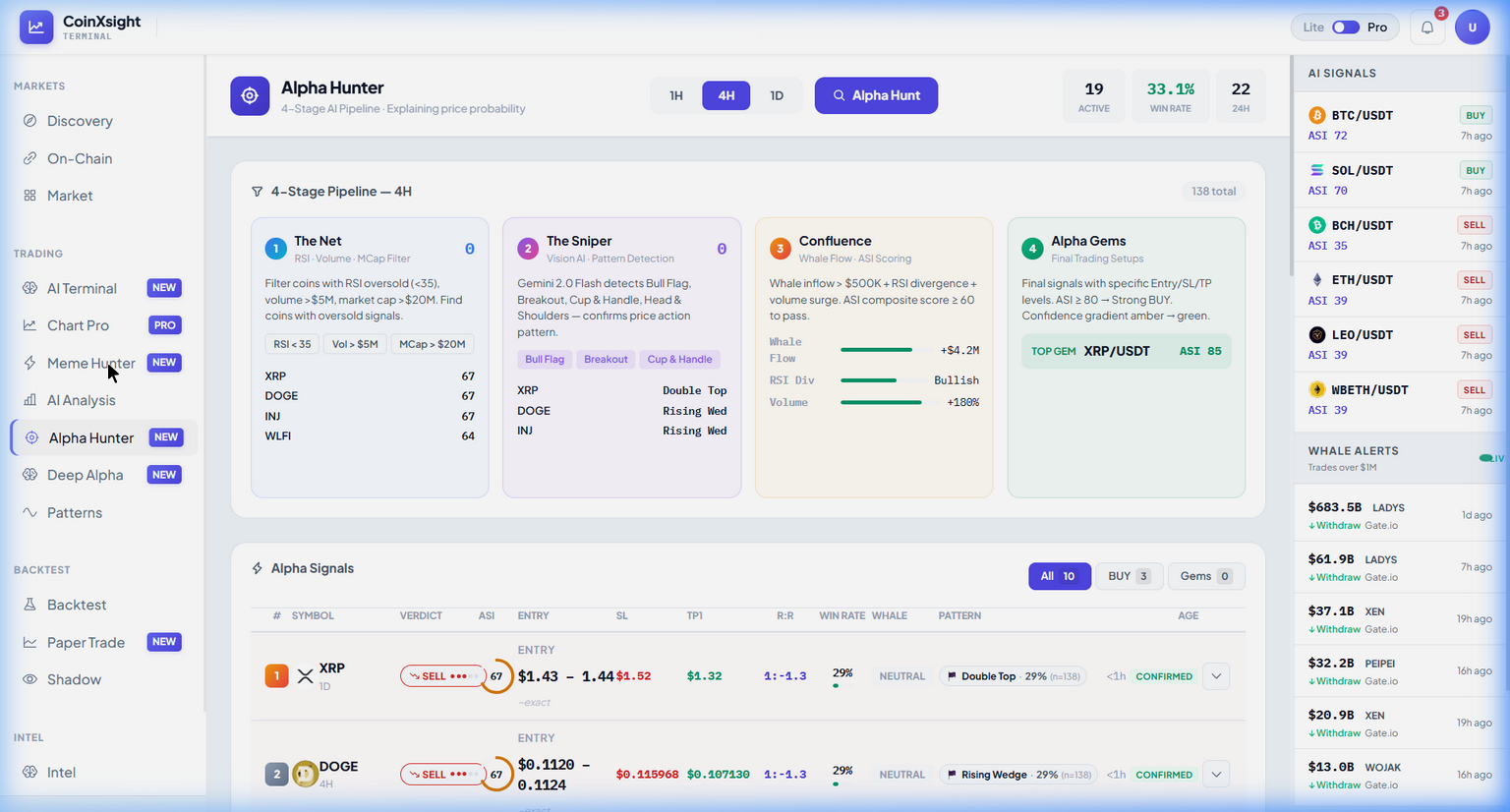
Crypto signals are actionable trade alerts that tell you exactly when to buy or sell — and at what price. CoinXSight's Alpha Hunter V2 delivers the best crypto signals in the market by using a 4-stage AI pipeline to generate specific, actionable crypto trading signals complete with precise entry prices, take-profit targets, stop-loss levels, and AI confidence ratings.
Unlike free crypto signals found on Telegram groups or social media, AI crypto signals from Alpha Hunter are backed by on-chain data, technical analysis, and sentiment scoring. Think of the difference this way: the Discovery module is your radar (it shows you what is moving), AI Analysis is your microscope (it tells you why), and Alpha Hunter is your sniper scope (it tells you exactly where to enter and exit).
Alpha Hunter V2 uses a rigorous 4-stage AI pipeline that filters thousands of potential opportunities down to the highest-quality crypto signals. On any given day, the AI scans over 10,000 tokens but typically produces only 5–15 signals that pass all four stages. This selectivity is by design — quality over quantity.
The 4-Stage Alpha Pipeline
Stage 1: Universe Screening
The AI begins by scanning the entire crypto market — over 10,000 tokens across all major exchanges. In this first pass, it eliminates tokens that do not meet minimum thresholds for:
Liquidity: Sufficient order book depth to execute trades without excessive slippage
Volume: Minimum 24-hour trading volume to ensure the signal is tradable
Market cap: Filters out dust tokens and dead projects with zero real activity
This stage typically reduces the universe from 10,000+ tokens to approximately 500–1,000 candidates.
Stage 2: Pattern Recognition
Advanced machine learning models analyze chart patterns across multiple timeframes for each surviving candidate:
Breakout detection: Price consolidating near resistance with building volume
Wedge patterns: Falling wedges (bullish) and rising wedges (bearish)
Head-and-shoulders: Classic reversal patterns with confirmation criteria
Cup-and-handle: Continuation patterns suggesting the next leg of a move
The AI evaluates these patterns across 1H, 4H, and 1D timeframes simultaneously using the multi-timeframe analysis framework. Only tokens showing clear, high-probability patterns survive to Stage 3.
Stage 3: Confluence Validation
This is the stage that separates Alpha Hunter from basic screeners. Every surviving signal must pass three independent confluence checks — powered by the Confluence Scoring System:
Volume confirmation: The pattern must be supported by rising volume. A breakout on declining volume is a false signal — the AI filters these out automatically.
On-chain validation: Whale activity must support the direction. A bullish technical signal with simultaneous whale selling is a red flag. The AI cross-references whale tracking data and smart money flow.
Sentiment alignment: Social and news sentiment should not be strongly contradicting the technical signal. A bullish pattern during a major negative news event gets flagged for review.
Signals that fail any of the three confluence checks are eliminated. Each signal receives an ASI Score that quantifies overall conviction — the same scoring framework used across the entire platform.
Stage 4: Risk Assessment
Each signal that survives the first three stages receives a comprehensive risk/reward analysis:
Entry price: The optimal price zone for entering the trade
Take-profit targets: Multiple TP levels for scaling out (TP1, TP2, TP3)
Stop-loss level: The recommended SL to limit downside risk
Win probability: AI-estimated likelihood of reaching TP1
Expected return: Calculated risk/reward ratio based on entry, TP, and SL levels
Only signals with a risk/reward ratio of at least 2:1 (potential reward is at least twice the potential risk) make it to your screen.
Understanding Signal Cards
Each Alpha signal card contains all the information you need to evaluate and execute a trade:
Field
What It Means
Coin & Pair
The trading pair (e.g., BTC/USDT)
Signal Type
Long (buy) or Short (sell)
Entry Zone
Optimal price range for entering — not a single price, but a zone
TP1, TP2, TP3
Three take-profit levels for scaling out of the position
Stop-Loss
Maximum loss level — always set this before entering
AI Confidence
Percentage score (0–100%) indicating how strongly the AI believes in this setup
Timeframe
The timeframe the signal is optimized for (1H, 4H, or 1D)
Reasoning
Natural-language explanation of the AI's logic behind the signal
Reading the AI Reasoning
The reasoning section is one of the most valuable parts of each signal. It specifically references:
Which technical patterns triggered the signal
What on-chain data supports it (whale flows, exchange data)
Sentiment context at the time of signal generation
Historical accuracy of similar setups on this specific token
For example:
"BTC/USDT Long — 4H. Bollinger Band squeeze with price at lower band. RSI at 32 showing bullish divergence on 4H. Whale outflows +$85M in last 8 hours. Volume 45% above 7-day average. Similar setups on BTC 4H have produced 3.2% average return over the last 90 days."
Best Practices for Trading Alpha Signals
1. Never Skip the Stop-Loss
Even signals with 90% AI confidence can fail. Crypto markets are inherently unpredictable — black swan events, exchange hacks, and regulatory announcements can invalidate any technical setup instantly. Always set your stop-loss before entering the trade, and never move it further from your entry.
Do not try to catch the entire move. The three take-profit levels are designed for progressive profit-taking:
TP1: Take 40% of your position off. This locks in a profit and reduces your risk to near-zero on the remaining position.
TP2: Take another 30% off. Move your stop-loss to breakeven.
TP3: Let the remaining 30% ride with a trailing stop. This is where the big wins come from.
3. Cross-Validate with AI Analysis
Before taking any crypto signal, spend 60 seconds in the AI Analysis module:
Check the ASI Score — is it above 70?
Verify multi-timeframe alignment — do 4H and 1D agree?
Read the AI reasoning — does it make logical sense?
Multi-confirmation setups (Alpha signal + high ASI + timeframe alignment) historically show 15–20% higher win rates on the platform.
4. Track Your Results
The signal history page shows outcomes for every signal the AI has generated. Use this data to:
Identify which signal types (breakout, reversal, momentum) work best for your trading style
Determine which tokens the AI is most accurate on
Calculate your actual win rate vs. the AI's estimated probability
Refine your position sizing based on historical performance
5. Filter by Timeframe
Not all signals are equal for all traders:
1H signals: Best for day traders. Faster entries and exits, but more noise. Expect smaller gains per trade.
4H signals: Best for swing traders. Balanced risk/reward with moves lasting 1–3 days.
1D signals: Best for position traders. Larger moves over 3–14 days, but slower entry and fewer signals per week.
Choose the timeframe that matches your availability and risk tolerance.
How Alpha Hunter Connects to Backtest
Every Alpha Hunter signal can be backtested using the AI Backtest Engine. This allows you to:
See how similar signals performed historically on the same token
Test different position sizing and stop-loss strategies
Calculate the expected Sharpe Ratio and maximum drawdown for a signal-following strategy
Build confidence in the AI pipeline before committing real capital
The connection between Alpha Hunter and Backtest is what transforms signal following from gambling into systematic trading.
Common Mistakes to Avoid
Taking every signal without filtering. Not all signals are equally strong. Focus on signals with AI confidence above 75% and risk/reward ratios above 3:1 for the highest probability of success.
Entering after the price has already moved past the entry zone. If the price has already reached TP1, the signal's risk/reward has degraded significantly. Wait for the next setup instead of chasing.
Averaging down on losing positions. If the price hits your stop-loss, the setup has failed. Accept the loss and move on. Averaging down turns small losses into portfolio-destroying disasters.
Over-leveraging based on confidence scores. A 95% confidence signal is not an invitation to use 50x leverage. Keep leverage conservative (5x maximum) and position sizes small (1–3% of portfolio per trade).
Frequently Asked Questions
How many signals does Alpha Hunter generate per day?
Typically 5–15 signals per day across all timeframes and tokens. The number varies based on market conditions — trending markets produce more signals than range-bound markets.
What is the average win rate of Alpha signals?
Platform-wide historical win rate for signals with AI confidence above 70% is approximately 62–68%, with an average risk/reward ratio of 2.3:1. Individual results vary based on execution timing and risk management.
Can I receive signal notifications?
Yes. Premium users can configure push notifications, email alerts, and Telegram bot integration for new signals matching their filters (specific tokens, minimum confidence level, timeframe).
What is the difference between Alpha Hunter and Deep Alpha?
Alpha Hunter V2 provides individual crypto trading signals with specific entry/exit levels. Deep Alpha provides market-wide strategic intelligence — sector rotation, market regime detection, and correlation analysis. Alpha Hunter is the sniper; Deep Alpha is the radar.
Are signals available for short (sell) positions?
Yes. Alpha Hunter generates both long and short signals. Short signals are clearly labeled and include the same entry/TP/SL structure as long signals.
Summary
Alpha Hunter V2 is the execution layer of CoinXSight's AI pipeline. The 4-stage filtering process — universe screening, pattern recognition, confluence validation, and risk assessment — ensures that only the highest-quality signals reach your screen. By following disciplined risk management, scaling out at TP levels, and cross-validating with AI Analysis, you can transform these signals into a systematic trading edge.
Key takeaways:
The 4-stage pipeline filters 10,000+ tokens down to 5–15 actionable signals per day
Always set stop-losses and scale out at TP1, TP2, and TP3
Cross-validate every signal with the AI Analysis module before entering
Track your results and focus on the signal types that match your trading style
Master risk management for crypto trading. Learn position sizing formulas, stop-loss strategies, and how CoinXSight's Portfolio module tracks your risk…