AI Sentiment Analysis: Reading Crypto Twitter Before the Move
How AI-powered sentiment analysis tools process millions of social media posts, news articles, and forum discussions to generate actionable trading signals. Learn to interpret sentiment data, avoid noise, and combine sentiment with technical analysis.
MC
Marcus ChenSenior Quantitative Strategist·May 19, 2026 · 12 min read · Updated Oct 6
Traditional stock markets are driven primarily by earnings, revenue, and macroeconomic data. Crypto markets are driven disproportionately by narrative and sentiment. A single tweet from a major figure, a trending meme, or a viral thread about a new protocol can move token prices 20-50% in hours.
This makes crypto uniquely suited for sentiment-based trading. But manually monitoring Twitter, Telegram, Discord, Reddit, and news sites across thousands of tokens is impossible for a human trader. This is where AI sentiment analysis becomes a genuine edge.
How AI Sentiment Analysis Works
The Pipeline
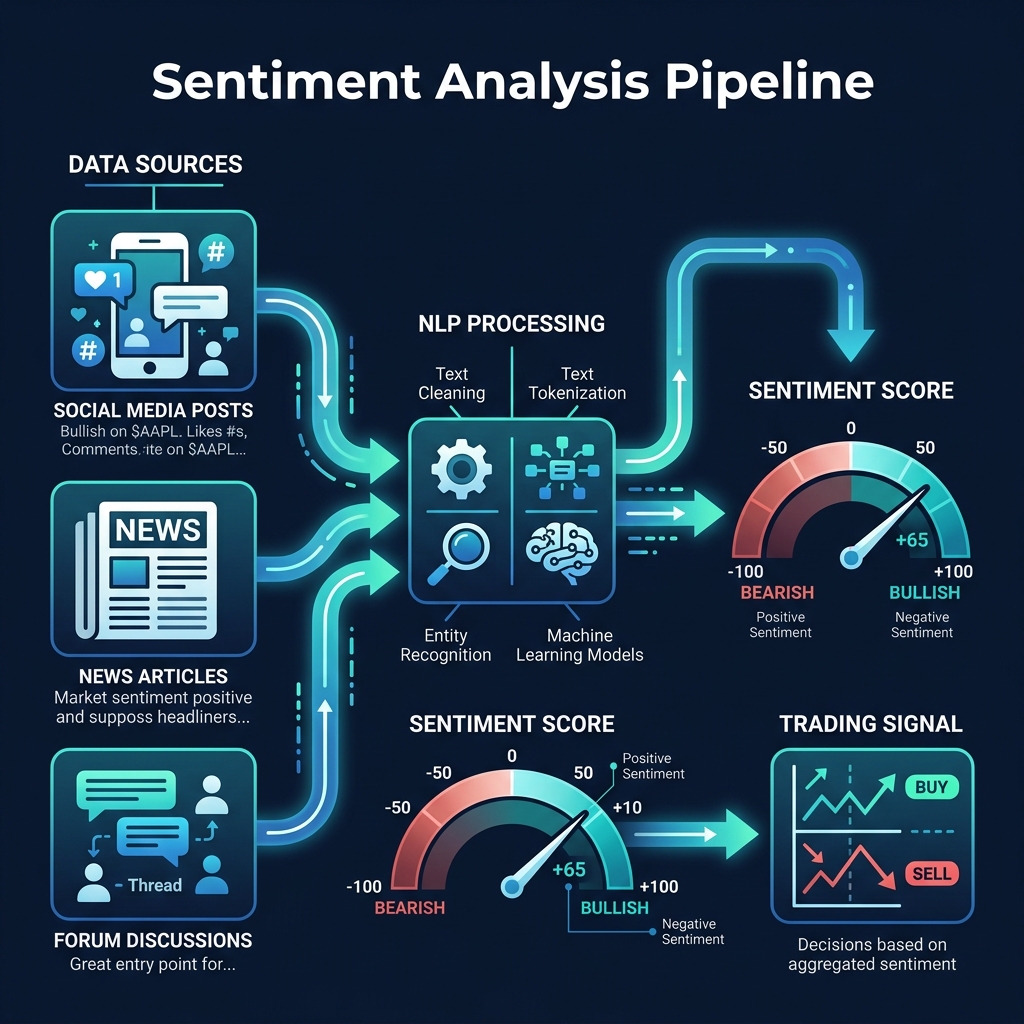
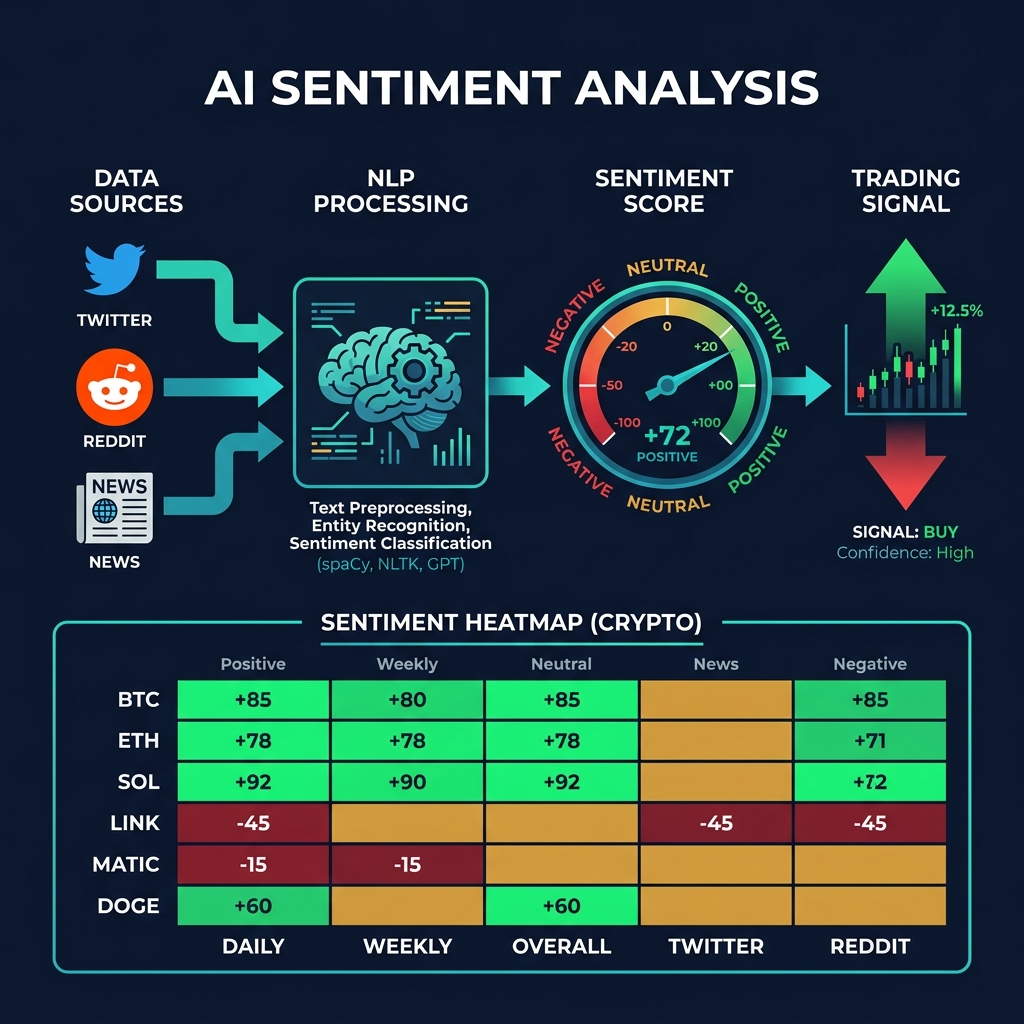
Data Collection → NLP Processing → Sentiment Scoring → Signal Generation
1. Data Collection
AI systems continuously scrape millions of data points from:
Twitter/X posts and engagement metrics
Telegram group messages
Discord server activity
Reddit threads and comments
Crypto news sites and blogs
On-chain governance forums
2. Natural Language Processing (NLP)
Modern LLM-based NLP models go beyond simple keyword counting. They understand:
Context: "BTC is going to the moon" (bullish) vs "BTC is going to the moon? More like going to zero" (bearish)
Sarcasm: "Great, another rug pull — exactly what we needed" (negative despite positive words)
Nuance: "I'm cautiously optimistic about ETH after the upgrade" (weakly bullish)
Influence weighting: A post from a wallet with $100M on-chain carries more weight than an anonymous account
3. Sentiment Scoring
Each data point receives a sentiment score, typically on a scale from -1 (extremely bearish) to +1 (extremely bullish). These scores are aggregated at the token level, creating a real-time sentiment index.
4. Signal Generation
Sentiment signals are generated when:
Sentiment shifts rapidly (e.g., from neutral to strongly bullish within hours)
Sentiment diverges from price action (e.g., sentiment turning bearish while price is still rising)
Sentiment volume spikes (sudden increase in mentions, indicating narrative formation)
CoinXSight's ASI Score incorporates sentiment as one of its core components, blending social signals with technical and on-chain data.
Types of Sentiment Signals
Modern crypto analytics platforms integrate these signals with additional data layers — combining trading indicators, on-chain metrics, and AI analysis for higher-probability entries.
1. Momentum Confirmation
What: Sentiment aligns with price direction and both are accelerating.
How to trade: Use as confirmation for technical setups identified through confluence scoring. When both your chart analysis AND sentiment point the same direction, the probability of a successful trade increases.
2. Sentiment Divergence
What: Sentiment moves opposite to price action.
Bearish divergence: Price making new highs, but sentiment is declining. Social media enthusiasm is fading even as price rises. This often precedes corrections.
Bullish divergence: Price making new lows, but sentiment is stabilizing or improving. Social media is shifting from panic to cautious optimism. This often precedes recoveries.
How to trade: Divergence signals are contrarian — they suggest the current price trend is losing its narrative support and may reverse.
3. Narrative Formation
What: A new narrative emerges rapidly, with mention volume for specific keywords exploding from baseline.
New meme coin narrative → Solana meme ecosystem pumps
How to trade: Narrative formation is the earliest sentiment signal. CoinXSight's Discovery module tracks emerging narratives through sector-level sentiment shifts, allowing you to identify trends before they reach mainstream awareness.
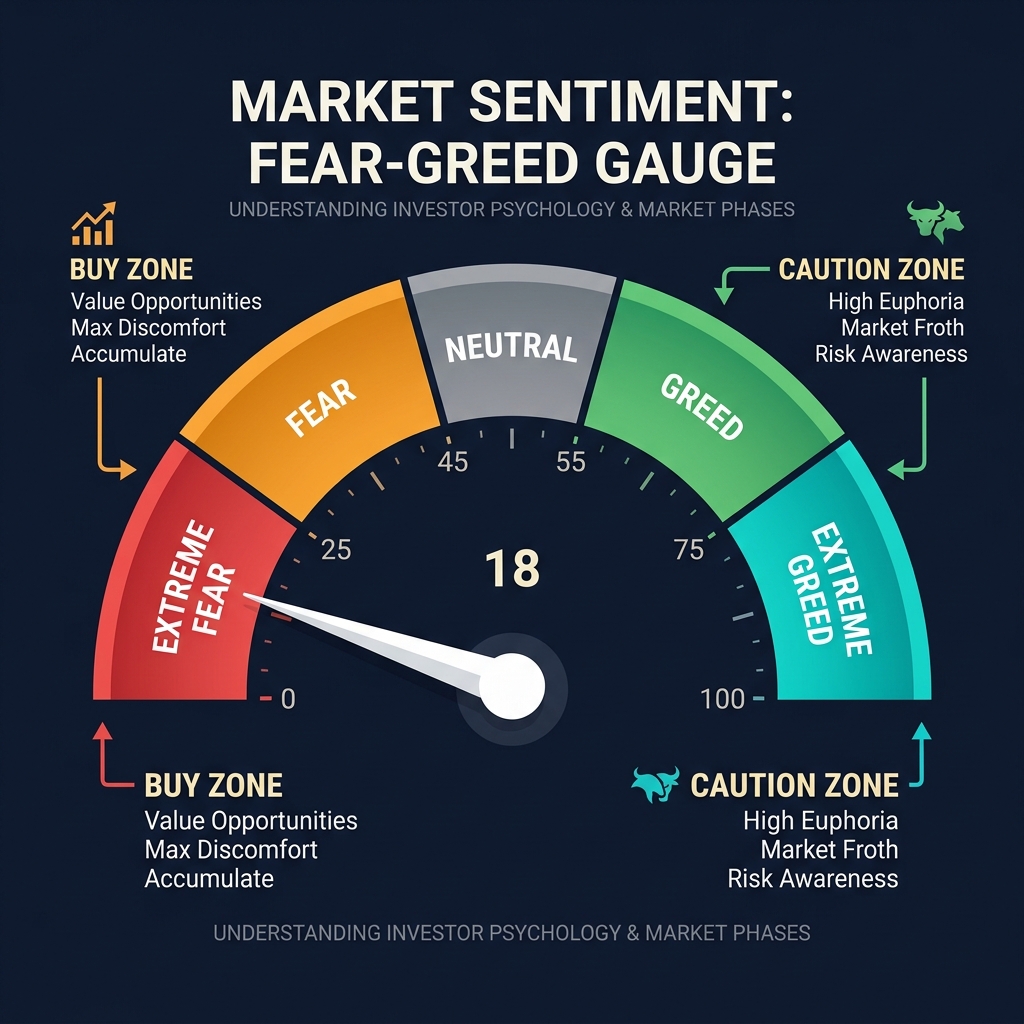
Extreme fear (sentiment index < 20): Historically a buying opportunity for BTC and large-cap alts. Corresponds to the "blood in the streets" phase.
Extreme greed (sentiment index > 80): Historically precedes corrections. "Everyone is bullish" means most potential buyers have already bought.
How to trade: Contrarian positioning at extremes, combined with technical support/resistance levels for entry timing.
The Noise Problem (and How to Solve It)
Why Raw Sentiment Is Unreliable
Social media is full of noise:
Bot armies: Projects deploy bots to create artificial positive sentiment
Paid promoters: Influencers shill tokens for payment without disclosure
Echo chambers: Crypto communities self-reinforce bullish narratives regardless of fundamentals
Coordinated FUD: Competitors or short sellers spread fear to crash prices
Filtering Techniques
1. Source weighting: Posts from verified wallets with significant on-chain activity carry more weight than anonymous accounts.
2. Engagement quality: A tweet with 1,000 likes but 50 comments may be bot-amplified. A tweet with 200 likes and 200 thoughtful comments indicates genuine engagement.
3. Cross-platform confirmation: If sentiment is bullish on Twitter but neutral/bearish on developer-focused platforms (GitHub activity, governance forums), the Twitter signal may be speculative noise.
4. On-chain validation: Bullish sentiment should be confirmed by on-chain activity — whale accumulation, exchange outflows, increasing DeFi TVL.
5. Temporal filtering: Flash sentiment spikes that revert within hours are noise. Sustained sentiment shifts over 24-72 hours are more likely to be genuine.
CoinXSight's AI engine applies these filtering techniques automatically, presenting you with noise-reduced sentiment signals rather than raw social media data.
Sentiment + Technical Analysis: The Combination Framework
Sentiment alone is insufficient for trading. Combined with technical analysis, it becomes powerful:
Technical Signal
Sentiment Confirmation
Combined Signal Strength
Price at support + RSI oversold
Sentiment stabilizing after fear spike
Strong buy signal
Price at resistance + RSI overbought
Sentiment euphoric, mentions at ATH
Strong sell/reduce signal
EMA crossover (bullish)
Sentiment shifting from neutral to positive
Moderate buy signal
Breakout from consolidation
Sentiment volume spike (narrative forming)
Strong breakout confirmation
Price declining with low volume
Sentiment still neutral (no panic)
Likely a pullback, not reversal
Workflow Integration
Start with technical analysis — Identify setups on your chart
Check sentiment alignment — Does the AI sentiment score confirm your directional bias?
Score the confluence — Use CoinXSight's Confluence Score which already integrates all three layers
Execute only on high confluence — 7+ score with sentiment alignment
Common Sentiment Trading Mistakes
Mistake 1: Trading on Individual Posts
A single influential tweet can cause a temporary spike, but trading on individual posts is gambling, not strategy. Wait for aggregate sentiment shifts confirmed across multiple sources.
Mistake 2: Confusing Volume with Quality
100,000 mentions of a meme coin doesn't mean it's a good investment. High mention volume often correlates with the peak of a pump-and-dump cycle. Look at sentiment quality (bullish/bearish ratio) and source credibility, not just volume.
Mistake 3: Ignoring Negative Sentiment
Traders naturally gravitate toward bullish sentiment and dismiss bearish signals. In crypto, negative sentiment from credible sources (security researchers, protocol auditors, on-chain analysts) often provides the most valuable alpha.
Mistake 4: Lagging Sentiment
By the time sentiment analysis confirms a trend, the easy money has often been made. The highest-value sentiment signal is the early shift — sentiment moving from neutral to weakly positive (not from strongly positive to euphoric).
Summary
AI sentiment analysis transforms the chaotic noise of crypto social media into structured, actionable trading intelligence. By processing millions of data points through NLP models, sentiment tools identify narrative formations, momentum confirmations, and dangerous divergences that human traders would miss.
Key principles:
Sentiment is one input, not the whole picture — combine with technical and on-chain analysis