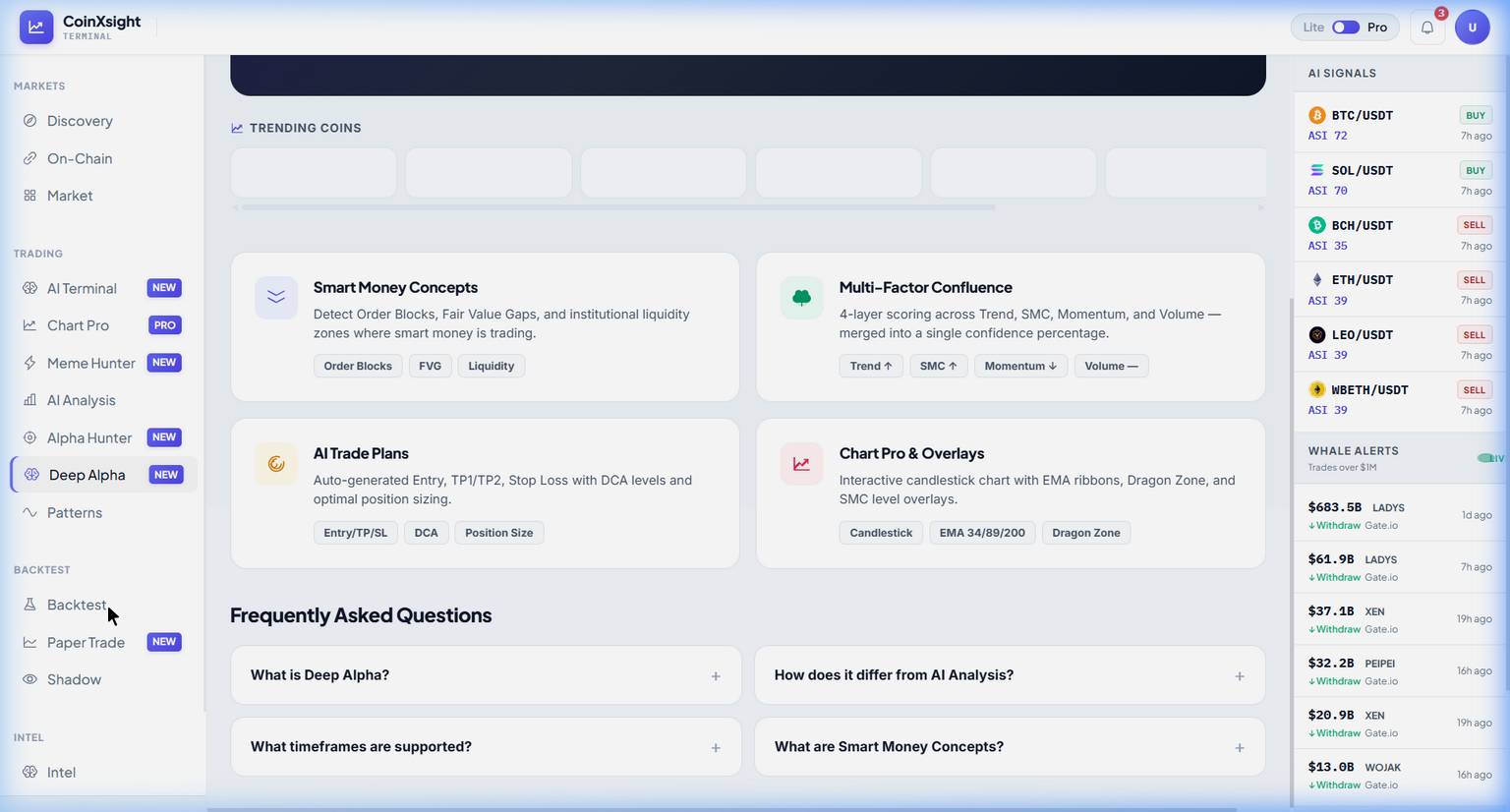
While Alpha Hunter V2 focuses on individual trade signals — specific coins, specific entry points, specific exits — the Deep Alpha module takes a step back and provides market-wide strategic intelligence. It answers the bigger questions: Which sectors are gaining momentum? Is the market trending or ranging? How are tokens correlated? What strategy should I deploy right now?
Think of the difference as a sniper rifle versus a radar system. Alpha Hunter is the sniper — precise, individual shots at specific targets. Deep Alpha is the radar — it shows you the entire battlefield, where the action is moving, and which direction the wind is blowing.
Professional traders do not just look for individual setups. They first assess the market environment, identify which sectors and themes are in play, and then select strategies that match the current conditions. Deep Alpha automates this entire process.
Core Features of Deep Alpha
1. Sector Rotation Analysis
Crypto markets move in rotational patterns. Capital does not enter all sectors simultaneously — it flows from one theme to another. Deep Alpha tracks these flows in real time:
Layer 1 protocols (BTC, ETH, SOL, AVAX)
DeFi (UNI, AAVE, MKR, CRV)
AI tokens (FET, RENDER, AGIX)
Meme coins (DOGE, SHIB, PEPE, WIF)
Gaming/Metaverse (AXS, SAND, IMX)
Infrastructure (LINK, GRT, FIL)
The sector rotation heatmap shows you at a glance which sectors are receiving capital inflows and which are experiencing outflows. When you see strong inflows into a sector, the tokens within that sector are more likely to produce profitable setups in Alpha Hunter.
How to read the heatmap:
Bright green cells — Strong capital inflows, positive momentum, volume increasing
Light green cells — Moderate positive flow, early accumulation phase
Gray cells — Neutral, no significant capital movement
Orange/red cells — Capital outflows, declining momentum, potential distribution
2. Market Regime Detection
This is one of the most powerful features in Deep Alpha. The AI classifies the current market into one of four regimes:
Best strategies: Reduced position sizes, wider stop-losses, event-driven hedging
Avoid: Tight stops (they get triggered by noise), large position sizes, leverage above 3x
Understanding the current regime before you trade is like checking the weather before you sail. The best strategy in the wrong conditions will lose money.
3. Correlation Analysis
Deep Alpha calculates real-time correlations between tokens and between sectors:
BTC correlation: How closely a token moves with Bitcoin. High correlation (>0.8) means the token follows BTC's direction. Low correlation (<0.3) means it trades independently.
Sector correlation: How tokens within the same sector move together. This helps with portfolio diversification — holding five highly correlated tokens is not diversification.
Cross-sector dynamics: When DeFi tokens decouple from Layer 1 tokens, it often signals a sector-specific catalyst or rotation.
4. Momentum Rankings
Relative strength rankings compare every token's momentum against the broader market:
Outperformers: Tokens gaining more than the market average — these are sector leaders and potential momentum plays
Underperformers: Tokens lagging the market — potential rotation candidates (capital may flow in) or weakening assets (capital may flow out permanently)
Momentum shifts: Tokens transitioning from underperformer to outperformer — these early-stage rotations are among the highest-probability setups
Real-Time Market Sentiment Map
This is where crypto technical analysis becomes practical — a quality crypto analytics platform will display these signals in real time, helping you act on setups as they form.
The sentiment map visualizes market emotion across all categories using a proprietary NLP engine. This engine processes millions of data points in real time:
Social media posts across Twitter/X, Reddit, and Telegram
News articles from crypto-specific publications
Community growth metrics and engagement rates
Developer activity signals from GitHub
Green zones indicate strong bullish sentiment. Red zones signal fear and bearish sentiment. Neutral zones suggest indifference or confusion.
The most profitable opportunities often appear at extreme sentiment readings:
Extreme fear in a sector with strong on-chain accumulation = potential bottom
Extreme greed in a sector with declining whale activity = potential top
Based on the current market regime, sector flows, and sentiment conditions, Deep Alpha provides actionable strategy suggestions tailored to the environment:
In trending markets: "Focus on Layer 1 momentum plays. Current sector rotation favors SOL ecosystem. Use Alpha Hunter 4H signals with trailing stops."
In range-bound markets: "Mean-reversion opportunities in DeFi sector. Buy at support zones using support/resistance framework. Avoid breakout chasing."
In high-volatility periods: "Reduce position sizes by 50%. Consider hedging altcoin exposure with BTC. Monitor whale flows for directional clues."
These suggestions are not just generic advice — they reference specific sectors, tokens, and platform modules based on live data analysis.
The Deep Alpha Workflow
Step 1: Check Market Regime
Before any trading activity, identify the current market phase. This single step eliminates the majority of strategy mismatches — the number one cause of trading losses.
Step 2: Identify Strong Sectors
Use sector rotation data to focus your attention. Do not fight the trend — position yourself in sectors receiving capital inflows.
Once you have identified the right sector and confirmed confluence, switch to Alpha Hunter V2 to find specific entry and exit points on individual tokens within that sector.
Step 5: Validate with Backtest
Before committing significant capital, test your sector-based strategy using the Backtest Engine. Run historical simulations to verify that the approach would have been profitable in similar market conditions.
Common Mistakes to Avoid
Ignoring the market regime. Trading a momentum strategy in a range-bound market is like bringing a surfboard to a lake. Always check Deep Alpha's regime classification first.
Fighting sector rotation. When capital is clearly flowing out of a sector, hoping your favorite token in that sector will be the exception is dangerous. Swim with the current, not against it.
Over-diversifying within correlated sectors. Holding five different DeFi tokens is not diversification — they all move together. Use correlation data to build truly diversified portfolios.
Ignoring sentiment extremes. When everyone is greedy, be cautious. When everyone is fearful, start looking for opportunities. Sentiment extremes have been some of the most reliable contrarian signals in crypto markets.
Frequently Asked Questions
What is the difference between Deep Alpha and Alpha Hunter?
Deep Alpha provides market-wide intelligence — sector rotation, market regime, correlations, and strategy suggestions. Alpha Hunter provides individual trade signals with specific entry/exit levels. Use Deep Alpha to decide what to trade; use Alpha Hunter to decide when to trade.
How often is sector rotation data updated?
Sector rotation and momentum data update every 15 minutes. Market regime classifications update every hour. Sentiment data is processed in real time.
Can Deep Alpha help with portfolio construction?
Yes. The correlation analysis and sector rotation data are specifically designed for portfolio-level decisions — which sectors to overweight, which to underweight, and how to maintain genuine diversification.
Is Deep Alpha available on the free tier?
Basic market regime and sector overview are available for free. Advanced features like correlation analysis, AI strategy suggestions, and historical regime data require a premium subscription.
How accurate is the market regime detection?
The regime classification has historically matched actual market behavior with approximately 75–80% accuracy over rolling 30-day windows. The AI is most accurate in clearly trending markets and least accurate during regime transitions.
Summary
Deep Alpha transforms your trading from individual signal-chasing to systematic, regime-aware strategy execution. By understanding which sectors are in play, what market regime is dominant, and how tokens are correlated, you can select the right strategy for the right conditions — and then execute with precision using Alpha Hunter.
Key takeaways:
Always check market regime before trading — it determines which strategies will work
Follow sector rotation to position yourself in capital-inflow sectors
Use correlation data to avoid false diversification
Combine Deep Alpha's strategic view with Alpha Hunter's tactical execution
Master multi-timeframe analysis for crypto trading. Learn the 3-timeframe rule, top-down analysis flow, timeframe alignment signals, and how to combine…