AI crypto trading is no longer a futuristic concept — it's the present reality reshaping how profitable traders operate. While retail traders still manually scroll through charts and refresh Twitter feeds, every serious AI crypto trading tool is processing millions of data points per second, identifying patterns invisible to the human eye, and generating actionable signals in real-time. From AI crypto trading bots to machine learning crypto models, the landscape has transformed dramatically.
But here's what most AI trading strategy content gets wrong: AI doesn't replace human traders. The most successful approach is human-AI collaboration — using AI as an intelligence co-pilot while maintaining human judgment for context and risk management. Understanding AI vs human trading dynamics is crucial for finding this balance.
This guide provides an honest, practical breakdown of how AI is used in crypto trading today. No hype, no promises of guaranteed returns — just a clear explanation of what works, what doesn't, and how you can integrate AI into your own trading workflow using tools like CoinXSight's AI analysis engine.
How AI Is Actually Used in Crypto Trading
There are four primary applications of AI in crypto trading, each solving a specific problem that human traders struggle with:
1. Signal Generation: Pattern Recognition at Scale
The human eye can analyze maybe 5-10 charts per hour with meaningful depth. An AI system can scan 500+ tokens across multiple timeframes in seconds, identifying technical setups, breakout patterns, and confluence zones that no human could process manually.
What the AI does:
Scans every token across 1H, 4H, and Daily timeframes simultaneously
Identifies classic chart patterns (head and shoulders, double bottoms, flag breakouts)
Ranks signals by probability based on historical pattern accuracy
Real-world example on CoinXSight:
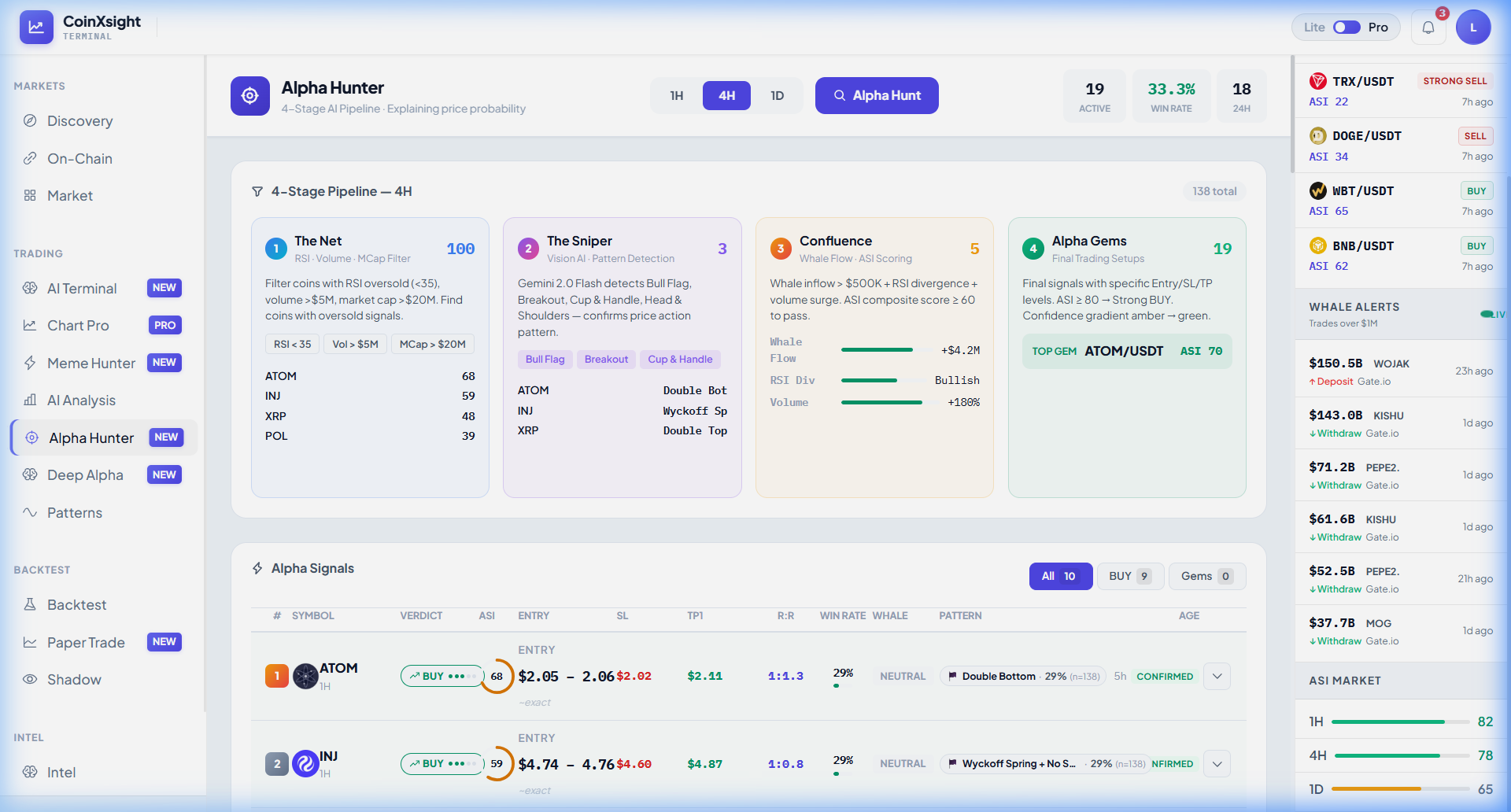
The Alpha Hunter module uses a 4-stage AI pipeline to filter signals from 500+ tokens down to a handful of high-conviction opportunities:
The live Alpha Hunter pipeline starts with 138 tokens, filters through four stages — The Net (RSI/Volume/MCap) → The Sniper (Vision AI pattern detection: Double Bottom, Wyckoff Spring, Double Top) → Confluence (Whale Flow + ASI scoring ≥ 60) → Alpha Gems (final trading setups with Entry/SL/TP). From 138 candidates, only 19 active signals survive — a 86% rejection rate ensuring only the strongest setups reach the trader.
2. Sentiment Analysis: NLP Reading Thousands of Sources
Natural Language Processing (NLP) is the AI technology that reads and understands human text. AI sentiment analysis in crypto monitors:
Telegram: Key influencer channels and community groups
News headlines: CoinDesk, The Block, Bloomberg Crypto
On-chain governance: DAO proposals, protocol discussions
The AI classifies each piece of content as bullish, bearish, or neutral, then aggregates these signals into a sentiment score. The key insight is that extreme sentiment readings are contrarian indicators — when everyone is panicking, it's often a buying opportunity, and when everyone is euphoric, risk is elevated.
3. Risk Scoring: Multi-Factor Probability Assessment
AI excels at combining multiple risk factors into a single, actionable score. A human trader might check 3-4 indicators before making a decision. CoinXSight's ASI (Alpha Signal Index) score combines 12+ data sources into one number:
This multi-factor approach produces more reliable signals than any single indicator alone, as explored in the Confluence Scoring System guide.
4. Bias Removal: Emotion-Free Analysis
Perhaps the most underappreciated benefit of AI in trading. Human traders are prone to FOMO, fear, revenge trading, and overconfidence (Trading Psychology Guide). AI doesn't experience any of these emotions.
When the market drops 20% and Twitter is filled with "crypto is dead" posts, the AI evaluates the same data it always does — objectively. If the on-chain data shows whale accumulation and the technical indicators show oversold conditions at major support, the AI will generate a bullish signal regardless of the fear in the market.
What AI Cannot Do (Honest Assessment)
It's equally important to understand AI's limitations:
Black Swan Events
AI models are trained on historical data. Events that have never happened before — exchange hacks, sudden regulatory bans, stablecoin depegs — are by definition outside the training data. AI will not predict these events.
Narrative Understanding
AI can detect that a token is trending on social media, but it struggles to understand why. A human trader can distinguish between genuine adoption news and a pump-and-dump scheme based on contextual clues that NLP systems miss.
Market Manipulation
Sophisticated manipulation tactics (spoofing, wash trading, coordinated group pumps) can fool AI systems that rely on volume and price data. The AI sees the data at face value — it can't detect intentional deception as reliably as an experienced human trader.
Overfitting Risk
AI models can "learn" patterns that worked in the past but won't work in the future. This is called overfitting. A model that achieves 90% accuracy on historical data might achieve only 50% on live data if it learned noise rather than genuine market structure.
Practical Walkthrough: AI-Assisted Trading Day on CoinXSight
Here's exactly how to integrate AI into your daily trading workflow using CoinXSight's modules. This is not theoretical — these are the actual steps with real interface screenshots.
Step 1: Morning Macro Check — AI Terminal Dashboard
Start your trading day by checking the AI Terminal for an instant macro overview:
What to look for:
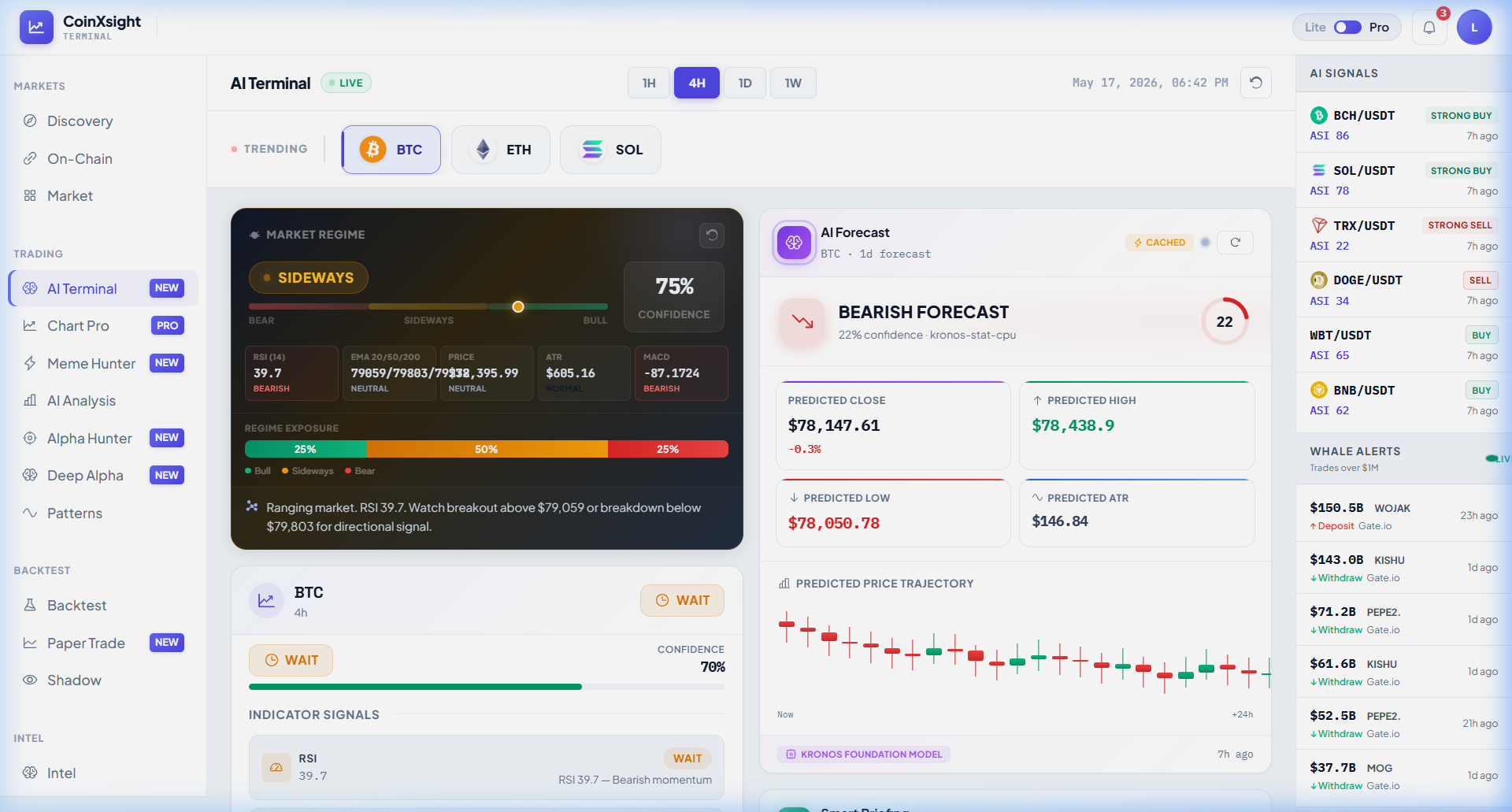
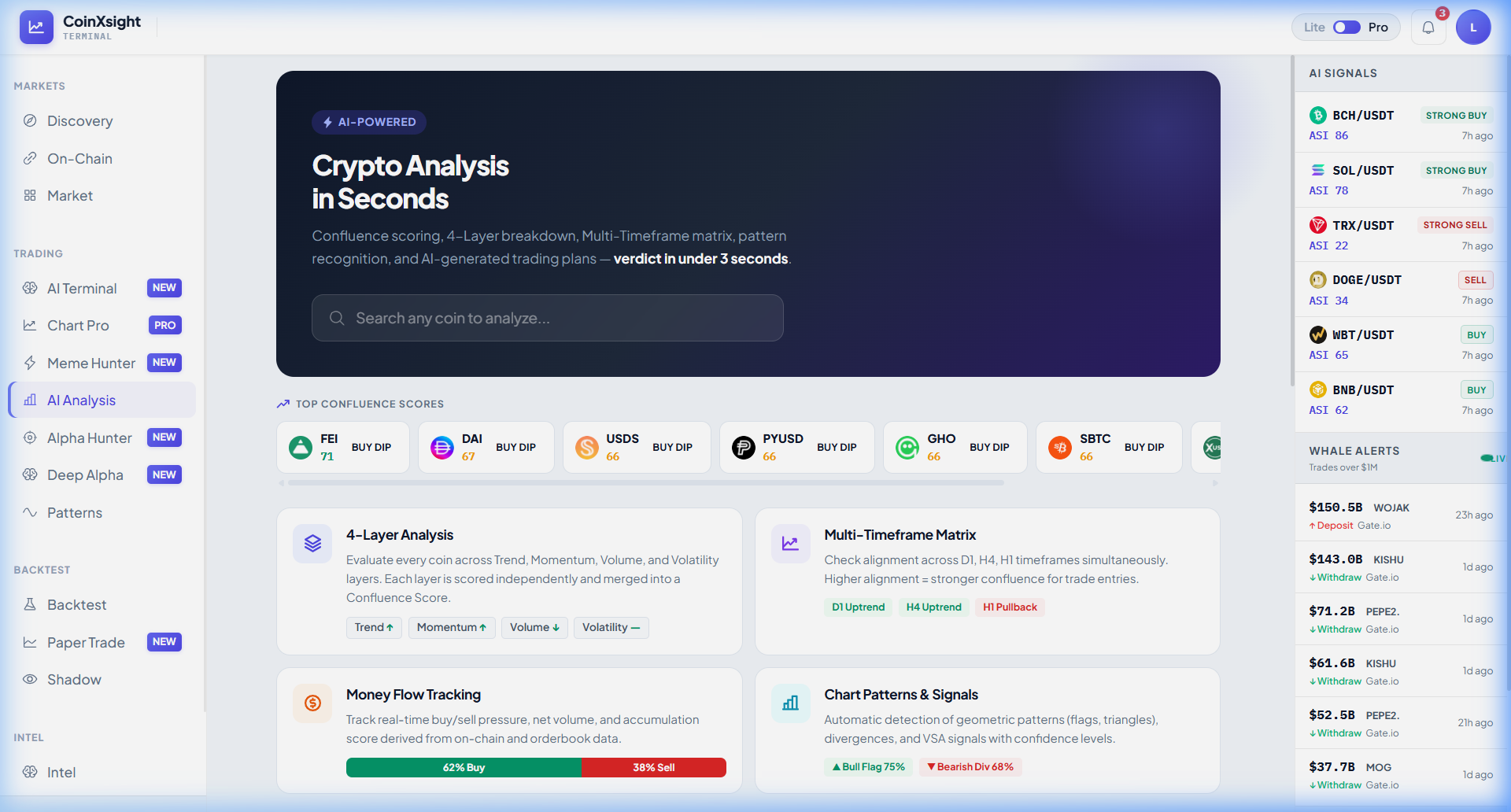
Market Regime: The dashboard currently reads SIDEWAYS with 75% confidence — meaning the market is range-bound with no clear directional bias. In this regime, mean-reversion strategies work best while trend-following should be paused.
ASI Market Index: The sidebar shows real-time ASI scores — BCH at 86 (Strong Buy), SOL at 78 (Strong Buy), TRX at 22 (Strong Sell). These scores update continuously across 1H, 4H, and 1D timeframes.
AI Forecast: The Kronos Foundation Model produces a BEARISH forecast with 22% confidence — low confidence means the prediction is uncertain, so weight it less in your decision.
Whale Alerts: $150B+ WOJAK deposit, $143B KISHU withdrawal — large movements that may impact specific tokens.
Decision: With a SIDEWAYS regime and low-confidence bearish forecast, reduce position sizes and focus on range-bound setups rather than directional bets.
Step 2: Scan AI Signals — Alpha Hunter
Open Alpha Hunter to see what the AI pipeline has identified:
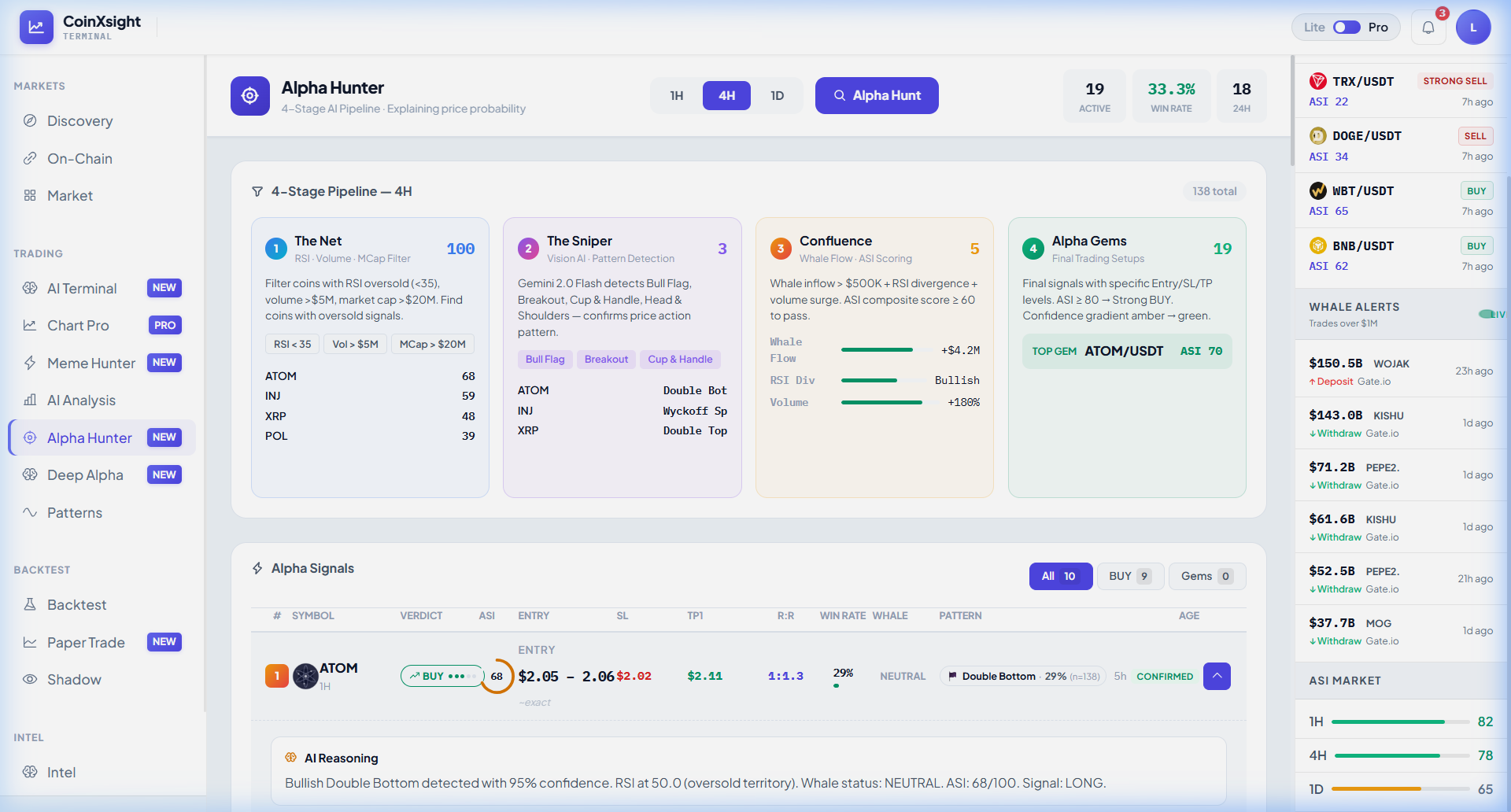
What to evaluate on each signal (real example — ATOM):
ASI Score (68): Above 60 indicates a moderate-to-strong setup. Scores above 80 are rare and represent the highest conviction.
AI Reasoning: "Bullish Double Bottom detected with 95% confidence" — the AI explains the specific pattern and its confidence level. Here, 95% confidence in pattern detection (not price prediction) means the geometric pattern is clearly formed.
RSI at 50.0: Mid-range RSI means the token is not overbought — the entry isn't chasing an extended move.
Whale Status: NEUTRAL: No strong whale accumulation or distribution detected. This is acceptable but not a strong confirmation.
Pattern: Double Bottom CONFIRMED (n=138): Confirmed means the pattern has broken its neckline. n=138 means this pattern was tested across 138 historical instances.
Risk/Reward 1:1.3: Moderate — acceptable for a swing trade but not exceptional.
Decision: ASI 68 with confirmed pattern and neutral whale status = worth a small position. The moderate R:R suggests using a reduced position size rather than full conviction sizing.
Step 3: Deep Dive — AI Analysis Module
For any signal you're considering, open the AI Analysis module for a comprehensive token analysis:
Select the token to trigger the AI's 4-layer analysis. The system processes:
Technical Layer: EMA trends, RSI, MACD, Bollinger position
On-Chain Layer: Whale flows, exchange reserves, holder distribution
Sentiment Layer: Social media sentiment, news tone, community activity
Volume Layer: Volume profile, abnormal activity detection, breakout probability
The result is a comprehensive analysis with specific trade parameters:
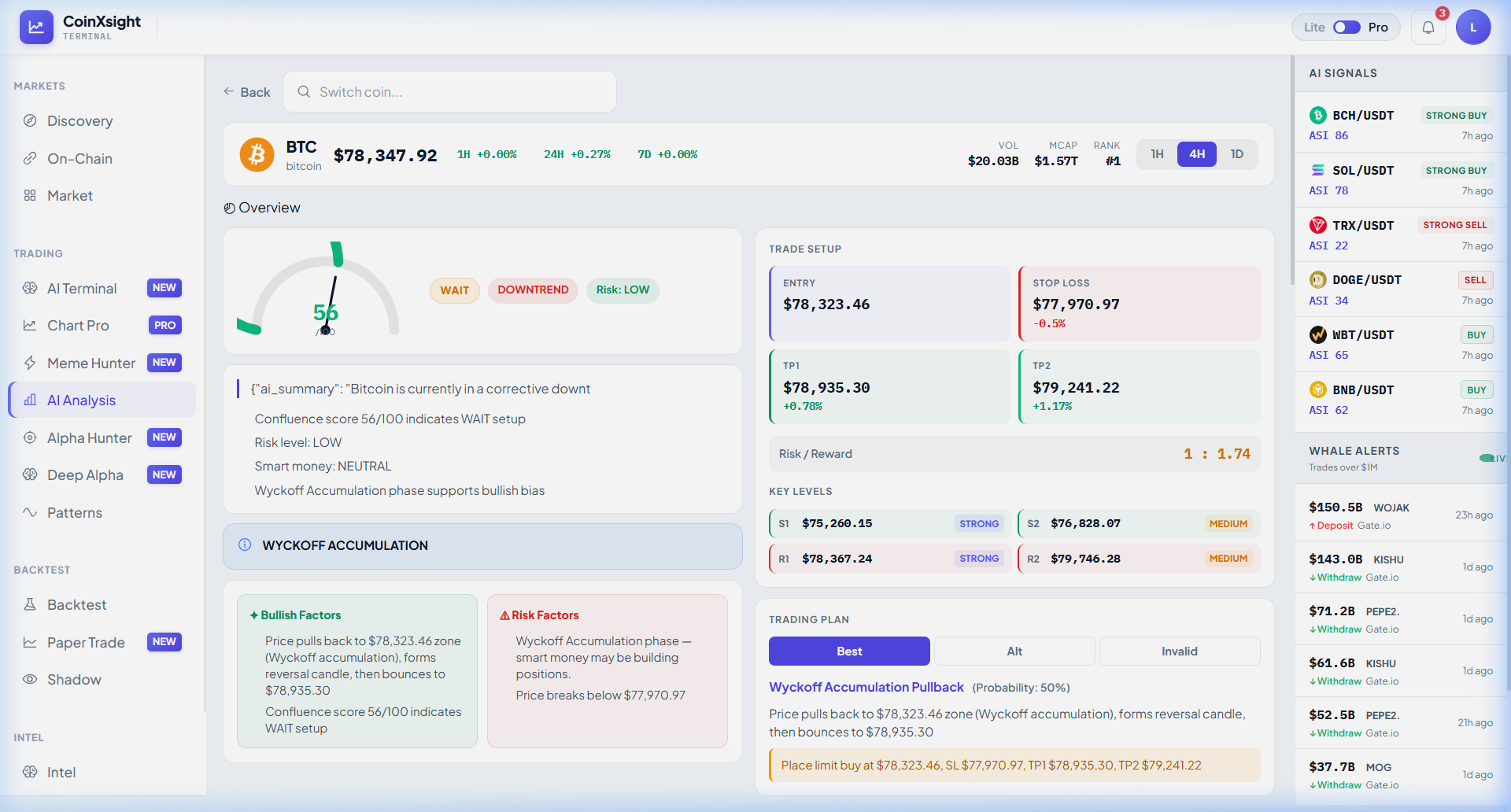
What to extract from this real BTC analysis:
Confluence Score 56/100 → WAIT: The AI doesn't force a trade when conditions are uncertain. A score of 56 means mixed signals across the 4 layers — wait for clearer alignment before entering.
Trade Setup with exact levels: Entry at $78,323, Stop-Loss at $77,970 (-0.5% risk), Take-Profit targets at $78,935 and $79,241. Risk/Reward ratio: 1:1.74.
Key Levels (S1/S2/R1/R2): AI-identified support at $75,260 (STRONG) and $76,828 (MEDIUM), resistance at $78,367 (STRONG) and $79,746 (MEDIUM).
Trading Plan: The AI identifies a Wyckoff Accumulation Pullback with 50% probability — it even provides the specific trade instruction: "Place limit buy at $78,323.46, SL $77,970.97, TP1 $78,935.30, TP2 $79,241.22"
Step 4: Chart Confirmation — AI Overlays
Before executing, verify the AI's analysis on the chart with advanced overlays:
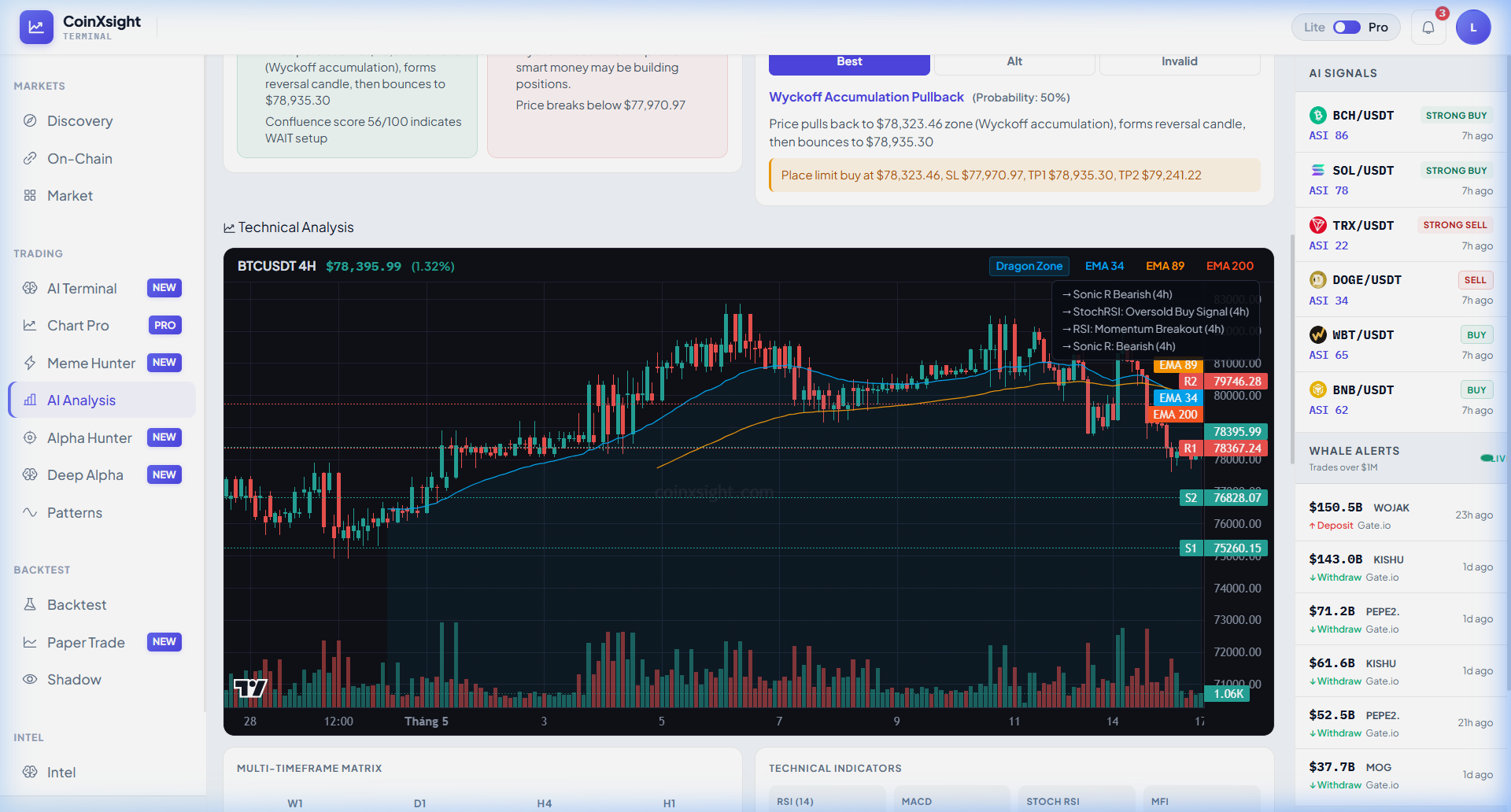
CoinXSight's AI Analysis chart provides real-time overlays:
Dragon Zone: Highlighted area where price is consolidating between EMA 34 and EMA 89 — a critical decision zone where breakout or breakdown is imminent.
EMA Overlay (34/89/200): The three EMAs show BTC trading below EMA 89 and EMA 200 (bearish positioning) but above EMA 34 (short-term support). This aligns with the WAIT recommendation.
AI Pattern Annotations: The chart flags multiple signals — Sonic R Bearish, StochRSI Oversold Buy Signal, and RSI Momentum Breakout. These conflicting signals explain the moderate ASI score of 56.
Key Level Integration: The S1/S2/R1/R2 levels from the analysis are plotted directly on the chart for visual confirmation.
Decision: The chart confirms the AI's WAIT recommendation — BTC is trapped between support ($75,260) and resistance ($79,746) with conflicting indicator signals. Wait for a decisive breakout above EMA 89 or breakdown below S2 before entering. (Risk Management Guide).
Step 5: Execute and Monitor
With macro, signal, analysis, and chart all aligned:
Enter the position at the AI's recommended entry level
Set stop-loss at the AI-identified invalidation level
Set take-profit at the recommended targets (TP1 at conservative, TP2 at extended)
Monitor the Alpha Hunter panel for any signal status changes
Journal the trade with the AI's reasoning for future reference
AI Trading vs Algorithmic Trading: What's the Difference?
These terms are often confused but represent fundamentally different approaches:
Aspect
Algorithmic Trading
AI Trading
Logic
Fixed rules (IF price > EMA50 THEN buy)
Learned patterns from data
Adaptability
Static — rules don't change
Dynamic — model updates with new data
Complexity
Simple to moderate
High — multi-layer pattern recognition
Best for
Executing a defined strategy automatically
Discovering patterns humans can't see
Risk
Strategy goes stale if market changes
Overfitting to historical data
CoinXSight's approach: The platform combines both. Algorithmic rules handle execution logic (stop-loss triggers, position sizing formulas), while AI handles pattern recognition and signal generation. This hybrid approach captures the reliability of algorithms with the adaptability of machine learning.
The Human-AI Collaboration Model
The most effective AI trading approach isn't full automation — it's collaboration. Here's the framework used by professional traders:
When to Trust the AI
High-confluence signals (score 80+) with clear reasoning
Trending markets where patterns are most reliable
Macro-aligned signals where 1H, 4H, and Daily ASI agree
On-chain confirmation (whale activity supports the direction)
When to Override the AI
Breaking news that the AI hasn't processed yet (regulatory announcements, hacks)
Extremely thin markets (holidays, low-volume periods) where patterns break down
Black swan indicators (stablecoin depeg risk, exchange solvency concerns)
Personal risk limits exceeded — AI doesn't know your account size or risk tolerance
The 3-Check Framework
Before every trade, apply this simple framework:
AI Check: What does the AI signal/analysis say? (Remove initial human bias)
Human Context Check: Is there any news, narrative, or macro context the AI might miss?
Alignment Check: If both agree → full conviction trade. If they disagree → reduce size or skip.
This framework represents the future of systematic crypto trading — where AI handles data processing while humans provide strategic oversight.
The Future of AI in Crypto Trading
Autonomous AI Agents
AI agents in crypto trading can execute trades independently based on predefined risk parameters. Currently experimental, but advancing rapidly. CoinXSight keeps the human in the loop today, but the infrastructure supports autonomous execution when the technology matures.
On-Chain AI
AI models running directly on blockchain infrastructure, providing verifiable, transparent analysis that anyone can audit. This eliminates the "black box" concern around AI trading decisions.
Predictive Models
Moving beyond pattern recognition to genuine prediction — using machine learning to forecast price movements based on causal relationships rather than historical correlations. Still early, but promising.
Multi-Modal AI
Combining text (news, social), numerical (price, volume, on-chain), and visual (chart patterns) data into unified AI models. CoinXSight's multi-layer approach is an early version of this architecture.
Frequently Asked Questions
Can AI guarantee profitable trades?
No. AI improves the probability of successful trades by identifying patterns and removing emotional bias, but no system can guarantee profits. Markets are inherently uncertain, and AI models have known limitations (black swan events, manipulation, overfitting). Treat AI as a tool that improves your edge, not a guarantee.
Do I need programming skills to use AI trading tools?
No. CoinXSight's AI tools are designed for traders, not programmers. The interface presents AI analysis results in plain language — ASI scores, buy/sell recommendations, and specific price levels. You don't need to understand how the neural network works to use its output effectively.
How accurate is CoinXSight's AI analysis?
Accuracy varies by market condition. In trending markets, AI signal accuracy is highest because patterns are clearest. In choppy or event-driven markets, accuracy decreases. The Alpha Hunter's 4-stage pipeline rejects ~95% of initial candidates specifically to maintain signal quality over quantity.
Should I use AI for day trading or swing trading?
AI-generated signals work best for swing trading (1-14 day holds) because the analysis layers need time to play out. For day trading, use the AI's macro assessment (bullish/bearish market regime) to determine your directional bias, then use shorter-timeframe technical analysis for precise entries.
How is AI trading different from copy trading?
Copy trading replicates another person's trades — you're dependent on their skill and psychology. AI trading generates independent analysis based on data, not human opinion. The AI doesn't have bad days, emotional biases, or conflicting incentives. You maintain full control over position sizing and risk management.
What data does CoinXSight's AI use?
The AI processes technical indicators (12+ indicators across multiple timeframes), on-chain data (whale movements, exchange flows, holder distribution), sentiment data (social media, news, community activity), and volume analytics (abnormal activity detection, breakout probability scoring).
Summary
AI has fundamentally changed crypto trading by solving four problems human traders face: limited analysis capacity, emotional decision-making, information overload, and inconsistent risk assessment. The most successful approach is human-AI collaboration — using AI for data processing, pattern recognition, and objective scoring while maintaining human judgment for context, risk management, and final decision-making.
CoinXSight's AI engine demonstrates this approach through its integrated modules: the AI Analysis module for deep token evaluation, Alpha Hunter for automated signal generation, and the AI Terminal for macro market assessment. Each module is designed to augment human trading intelligence, not replace it.
The practical workflow is simple: check macro regime → scan AI signals → deep dive on candidates → verify with chart overlays → execute with proper risk management. This systematic approach removes guesswork and emotional trading while maintaining the human oversight that pure automation lacks.