AI Agents in Crypto: How Autonomous Systems Trade in 2026
The year 2026 represents a major shift in digital asset management, where traditional algorithmic bots are being replaced by self-directed, intelligent entities. AI agents in crypto are autonomous software programs that analyze market conditions, process qualitative and quantitative data, manage risk, and execute transactions on-chain without human intervention.
To remain competitive, modern quantitative traders must understand the underlying systems, operational loops, and safety protocols of these AI-native structures. This guide explores how autonomous agents interact with decentralized finance (DeFi) protocols, use multi-agent architectures, and integrate with CoinXSight to maximize returns.
1. Algorithmic Trading vs. Autonomous AI Agents
Algorithmic trading executes orders based on static rules, whereas autonomous AI agents adapt their actions dynamically using machine learning and LLM reasoning. Traditional bots are rigid, executing a trade whenever a simple condition is met, such as a moving average crossover. If a protocol gets exploited or a regulatory flashpoint occurs, these bots fail to adapt and often incur heavy losses.
By contrast, an AI agent operates with cognitive awareness. It processes unstructured data—such as social media updates, smart contract code updates, and on-chain whale activity—and correlates this with technical indicators to adjust its exposure instantly. The table below compares these two approaches:
| Feature | Traditional Algorithmic Bots | Autonomous AI Agents (2026) |
|---|---|---|
| Data Processing | Numeric inputs only (prices, volumes, order books). | Multimodal (news, on-chain metrics, social sentiment, code). |
| Logic & Decisions | Static rules (e.g., "Buy when SMA 50 crosses above SMA 200"). | Dynamic reasoning via LLMs, planning loops, and RAG. |
| Adaptability | High failure rate during regime shifts; requires manual adjustment. | Autonomous adjustment to new market regimes and black swan events. |
| Execution | Single exchange/API execution; static orders. | Multi-protocol routing, MEV mitigation, gas-fee optimization. |
2. Multi-Agent Architectures for Crypto Trading
A multi-agent architecture splits complex trading workflows into specialized, independent sub-agents coordinated by a central manager. Deploying a single model to handle ingestion, analysis, risk, and execution is inefficient and increases the risk of system collapse. By dividing responsibilities, each agent executes its task with maximum precision.
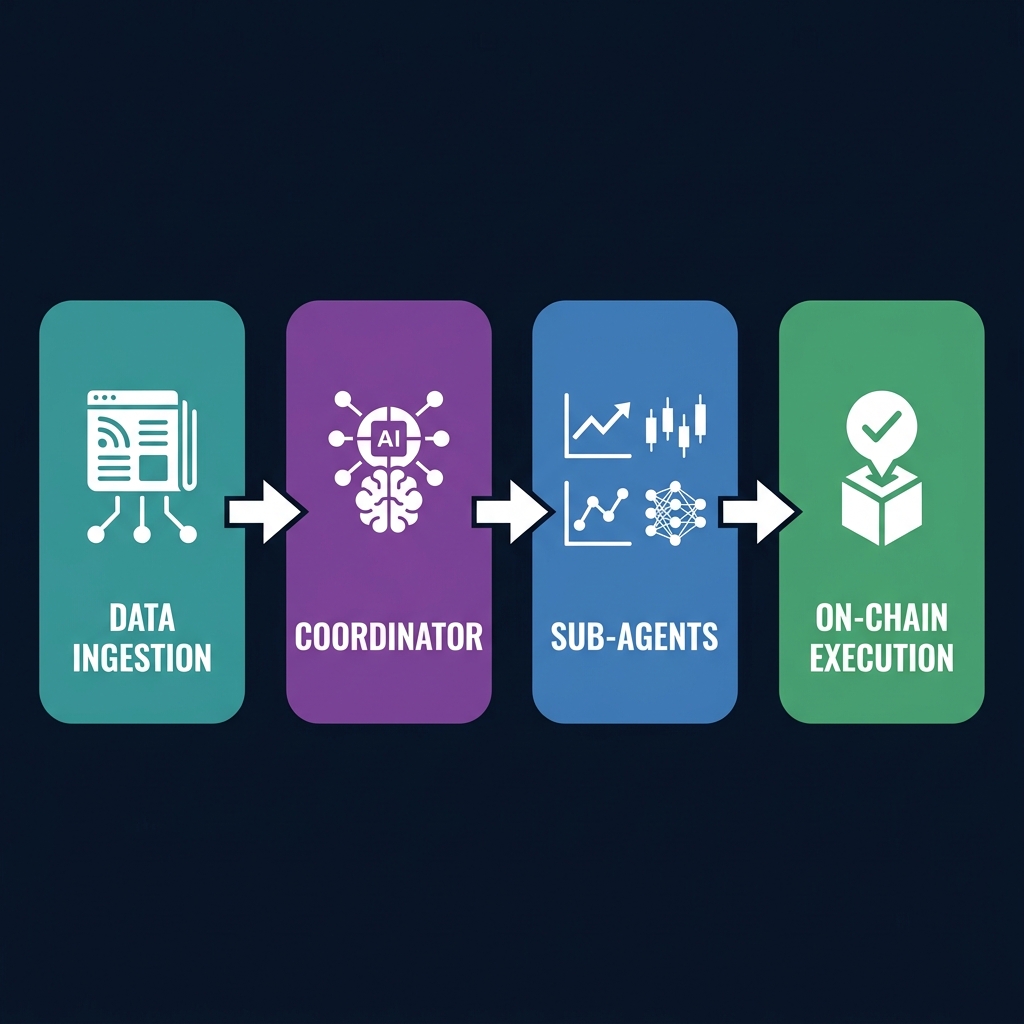
The Coordinator Agent
The coordinator acts as the central orchestrator of the system. It delegates tasks to sub-agents, monitors system health, and maintains global state. It reads user-defined parameters, such as a mandate to maintain a delta-neutral position on a crypto trading platform, and translates this into discrete tasks.
The Research Agent
The research agent monitors qualitative data streams. It parses news headlines, developer commits on GitHub, and social media sentiment. Using Retrieval-Augmented Generation (RAG) and LLM classification, it translates unstructured text into normalized sentiment signals.
The Analyst Agent
The analyst agent focuses on crypto technical analysis. It ingests price feeds, identifies classic chart patterns (such as order blocks or fair value gaps), and tracks momentum oscillators. Rather than executing orders directly, it passes structural reports to the coordinator.
The Risk Manager Agent
The risk manager is the safety valve of the network. It audits all proposed trades against hard-coded parameters, evaluating portfolio concentration, liquidity depth, slippage, and smart contract safety scores. If a proposed transaction violates exposure limits, the risk manager vetoes it.
The Execution Agent
The execution agent handles the mechanics of on-chain interaction. It queries DEX aggregators, calculates gas parameters, and routes orders through private RPC nodes to shield transactions from Maximal Extractable Value (MEV) bots on the best crypto exchange.
3. On-Chain Execution Loops and Smart Contract Interaction
On-chain execution loops represent the mechanical interface that allows off-chain AI models to securely trigger blockchain transactions. Direct execution via private keys presents severe security risks. If an agent's server is compromised, the entire wallet balance is vulnerable.
To mitigate this, developers use smart accounts and account abstraction, governed by the ERC-4337 standard specification. This allows users to delegate transaction-signing authority to the AI agent under restrictive conditions:
- Session Keys: The agent receives signing authority that expires after a set time (e.g., 24 hours) or after reaching a transaction limit.
- Contract Whitelists: The agent is restricted to interacting with specific protocols (e.g., Uniswap V4 or Aave) and cannot execute arbitrary calls.
- Slippage Enforcement: The smart account itself rejects any transaction where slippage exceeds predefined bounds, protecting capital.
The Execution Lifecycle
The following Python script illustrates how an autonomous execution agent queries a DEX aggregator for pathing, validates slippage metrics, and signs a transaction:
import json
import requests
from eth_account import Account
from web3 import Web3

class AutonomousExecutionAgent:
    def __init__(self, rpc_url, private_key, smart_account_address):
        self.w3 = Web3(Web3.HTTPProvider(rpc_url))
        self.account = Account.from_key(private_key)
        self.smart_account = smart_account_address

    def build_swap_payload(self, token_in, token_out, amount_in):
        # Query DEX aggregator for execution path and calldata
        url = f"https://api.aggregator.xyz/v1/swap?tokenIn={token_in}&tokenOut={token_out}&amount={amount_in}"
        response = requests.get(url).json()

        return {
            "to": response["tx"]["to"],
            "data": response["tx"]["data"],
            "value": int(response["tx"]["value"]),
            "estimatedSlippage": response["slippage"]
        }

    def execute_transaction(self, tx_payload):
        # Verify slippage fits within risk parameters (< 0.5%)
        if tx_payload["estimatedSlippage"] > 0.005:
            raise ValueError("Slippage exceeds risk parameters. Execution aborted.")

        # Estimate gas using the transaction payload
        gas_estimate = self.w3.eth.estimate_transaction({
            'from': self.account.address,
            'to': tx_payload["to"],
            'data': tx_payload["data"],
            'value': tx_payload["value"]
        })

        # Construct transaction payload
        transaction = {
            'chainId': self.w3.eth.chain_id,
            'gas': int(gas_estimate * 1.1),  # 10% safety buffer
            'maxFeePerGas': self.w3.eth.gas_price,
            'maxPriorityFeePerGas': self.w3.to_wei('2', 'gwei'),
            'nonce': self.w3.eth.get_transaction_count(self.account.address),
            'to': tx_payload["to"],
            'data': tx_payload["data"],
            'value': tx_payload["value"]
        }

        # Sign and broadcast the transaction
        signed_tx = self.w3.eth.account.sign_transaction(transaction, self.account.key)
        tx_hash = self.w3.eth.send_raw_transaction(signed_tx.rawTransaction)

        return self.w3.to_hex(tx_hash)
4. Incorporating Technical Analysis and Indicators
Autonomous agents utilize quantitative metrics to validate qualitative data before execution. By feeding calculated trading indicators into the agent's observation space, we give the model structured context to confirm narrative triggers.
- Dynamic Indicator Thresholds: Traditional systems use static boundaries, like buying when the Relative Strength Index (J. Welles Wilder Jr.'s RSI indicator) drops below 30. AI agents adjust these levels based on macro market regimes. In a strong bull market, the oversold threshold might shift to 45 to capture trend pullbacks.
- VWAP and Liquidity Confluence: The agent uses Volume Weighted Average Price (VWAP) to avoid buying at local tops. If sentiment is highly bullish but price trades far above daily VWAP, the execution agent waits for a mean-reversion pullback.
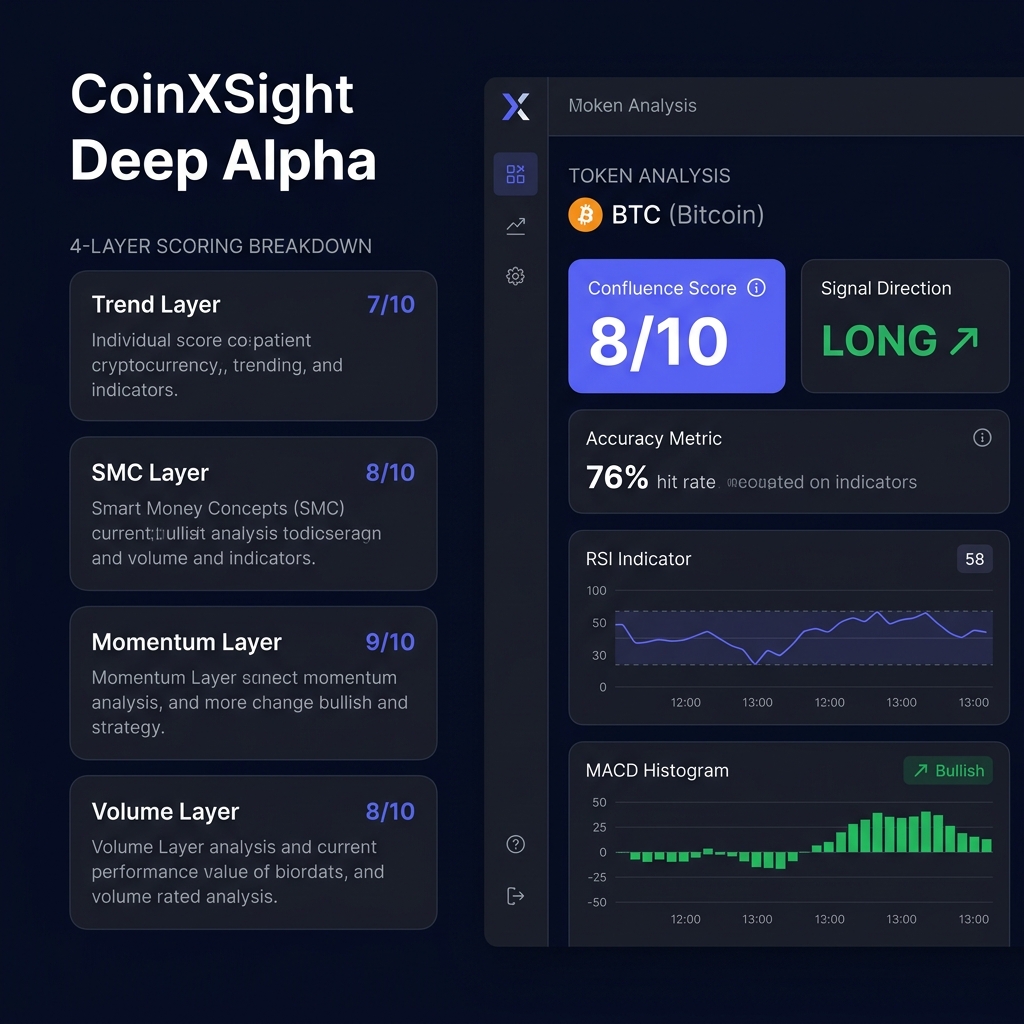
- Confluence Scoring Integration: On CoinXSight, technical, on-chain, and sentiment indicators are aggregated into a single metric: the Confluence Score. Rather than tracking multiple disconnected indicators, the AI agent reads this multi-layered metric (ranging from 0 to 10) to make size adjustments.
Example — BTC Bearish Divergence on CoinXSight Chart Pro (May 2026)
On May 14, 2026, BTC printed a higher high at $68,900, but the 4-hour RSI indicator on Chart Pro printed a lower high of 58 (down from 72). The AI analyst agent flagged this bearish divergence, while the CoinXSight Confluence Score dropped from 8/10 to 3/10. The system halted new buys and executed a partial hedge. Within 72 hours, BTC retraced 6.8% to $64,200, protecting the portfolio from drawdown.
5. Key Risks of Agentic Trading and Guardrails
Deploying autonomous agents introduces specific risks—such as execution slippage, MEV exploitation, and data hallucinations—that require engineered guardrails.
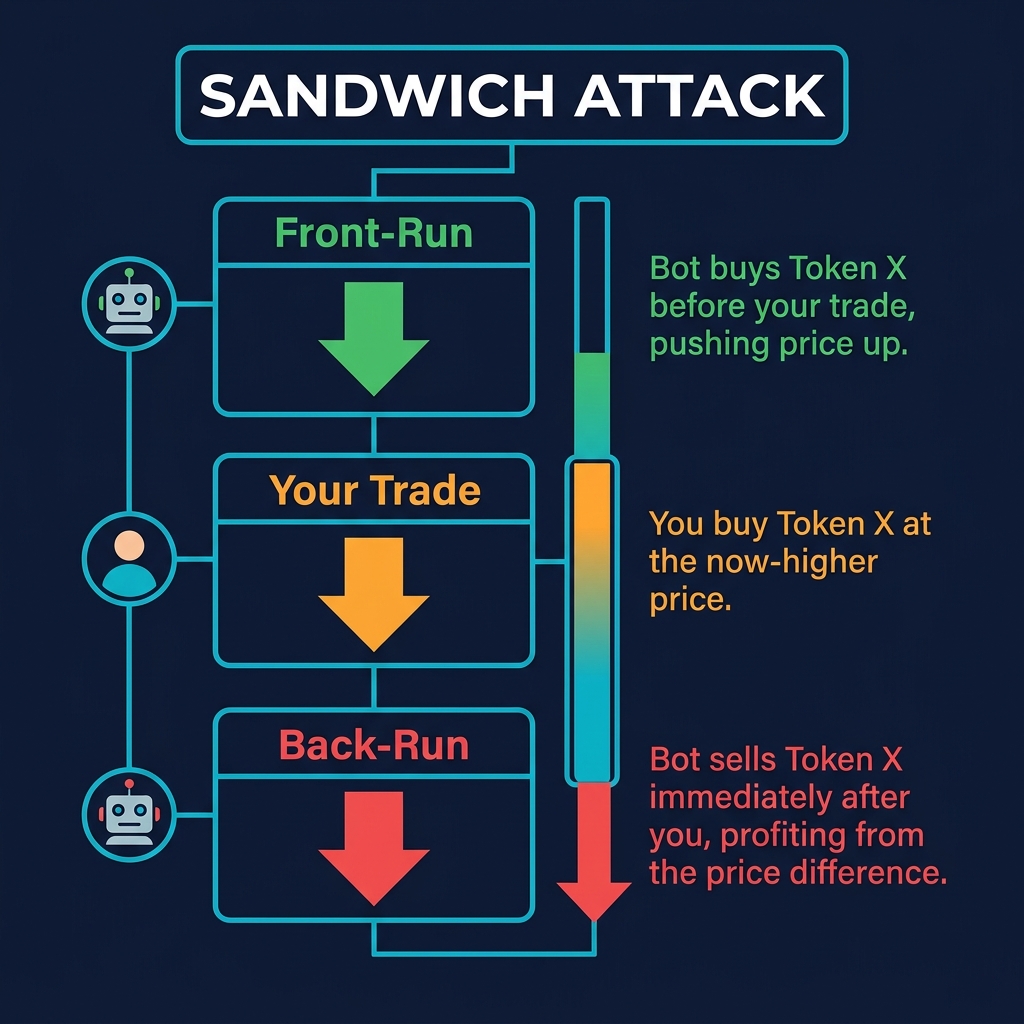
1. MEV Exploitation and Sandwich Attacks
When an agent submits a swap directly to the public mempool, MEV bots can front-run the trade. The bot buys the asset ahead of the agent and dumps it immediately after, forcing the agent to execute at the worst possible slippage.
- Mitigation: Transactions must be routed through private RPC endpoints, such as Flashbots Protect on Ethereum or Jito-Solana on Solana, to keep transactions hidden from searchers.
2. Narrative Hallucinations and Cascade Failures
An agent reading social sentiment might interpret a satirical post as a genuine market catalyst (e.g., a fake exploit report). If the agent dumps assets, it can trigger a cascade of stop-losses across other algorithmic platforms.
- Mitigation: Multi-source validation is mandatory. An agent must confirm social alerts with smart contract event logs or reputable news aggregators before executing size adjustments.
3. Model Drift and Regime Shifts
An agent trained during a trending market will perform poorly when price enters a tight range. The underlying LLM or reinforcement learning model can drift, leading to over-trading or inappropriate risk exposure.
- Mitigation: Continuous evaluation. If the system's real-time performance drops below a set threshold compared to historical backtests, the agent triggers a circuit breaker, shifting to a semi-autonomous mode that requires human verification.
⚠️ Limitation: AI agents cannot foresee black swan events originating outside digital networks, such as sudden physical infrastructure failures or unforeseen regulatory crackdowns. Always maintain manual emergency override switches to decouple agents from wallets instantly.
How to Use AI Trading Agents on CoinXSight
CoinXSight simplifies the integration of autonomous analytics with execution workflows:
- Access the Terminal: Log in to app.coinxsight.com and navigate to the Deep Alpha module.
- Review Confluence Scores: Check the multi-layered score for your target asset. The score combines momentum, volume, smart money concepts, and trend metrics.
- Configure Alert Webhooks: Set up webhook alerts using natural language prompts (e.g., "Alert when SOL Confluence Score crosses above 8/10 on the 4H chart").
- Deploy Smart Accounts: Connect your Web3 smart wallet to route automated signals using session keys, ensuring secure, MEV-protected execution.
FAQ
How do AI agents differ from regular trading bots? Traditional trading bots execute static, if-then rules based on mathematical formulas. AI agents process unstructured qualitative data (like news and social media sentiment) alongside quantitative indicators, adapting their trading strategies dynamically to changing market conditions.
Can an AI trading agent steal my funds? No, provided you use smart accounts governed by ERC-4337. By defining strict session keys and smart contract whitelists, the agent is restricted to trading specific assets on designated protocols and cannot transfer funds to unapproved external addresses.
Which blockchain is best suited for AI agents? Blockchains with low transaction fees and high throughput are ideal. In 2026, the majority of autonomous trading occurs on Solana and Ethereum Layer-2 networks (such as Base and Arbitrum) due to low execution latency and minimal gas costs.
What is the role of the Confluence Score in agentic trading? The Confluence Score is CoinXSight’s proprietary metric that aggregates trend, volume, momentum, and smart money layers. AI agents read this score to quickly evaluate market structure and adjust position sizes without processing multiple individual indicators.
Disclaimer: This article is for educational and informational purposes only and does not constitute financial, investment, or trading advice. Cryptocurrency markets are highly volatile and involve substantial risk of loss. Always conduct your own research (DYOR) and consult a licensed financial advisor before making any investment decisions. Past performance does not guarantee future results. CoinXSight provides analytical tools and data — not investment recommendations. All price projections are speculative and based on technical analysis patterns.