Spot or futures? It sounds like a simple choice, but getting this wrong costs more traders money than any bad indicator signal ever will.
Here is the uncomfortable truth: the difference between spot trading and futures trading is not just about leverage or shorting ability. They are fundamentally different games with different rules, different psychology, and different survival rates. A trader who is profitable on spot can blow up their account in futures within a week — not because they lack skill, but because they are applying the wrong rulebook to the wrong game.
In 2026, with BTC trading around $105,000 and institutional-grade derivatives markets now available on dozens of platforms, the futures landscape has never been more accessible. But accessibility is not the same as suitability. Roughly 70–80% of retail futures traders lose money, and a significant portion of those losses come from traders who jumped into futures before they had any business being there.
This guide will not just explain how each works — it will give you a concrete decision framework so you can pick the approach that matches your experience, capital, and goals. No hype, no "futures are evil" moralizing — just practical tradeoffs with real numbers.
How Spot Trading Works
Spot trading is the simplest way to participate in crypto markets. You buy an asset, you own it, and you sell it when you are ready.
A Real 2026 Spot Trade Example
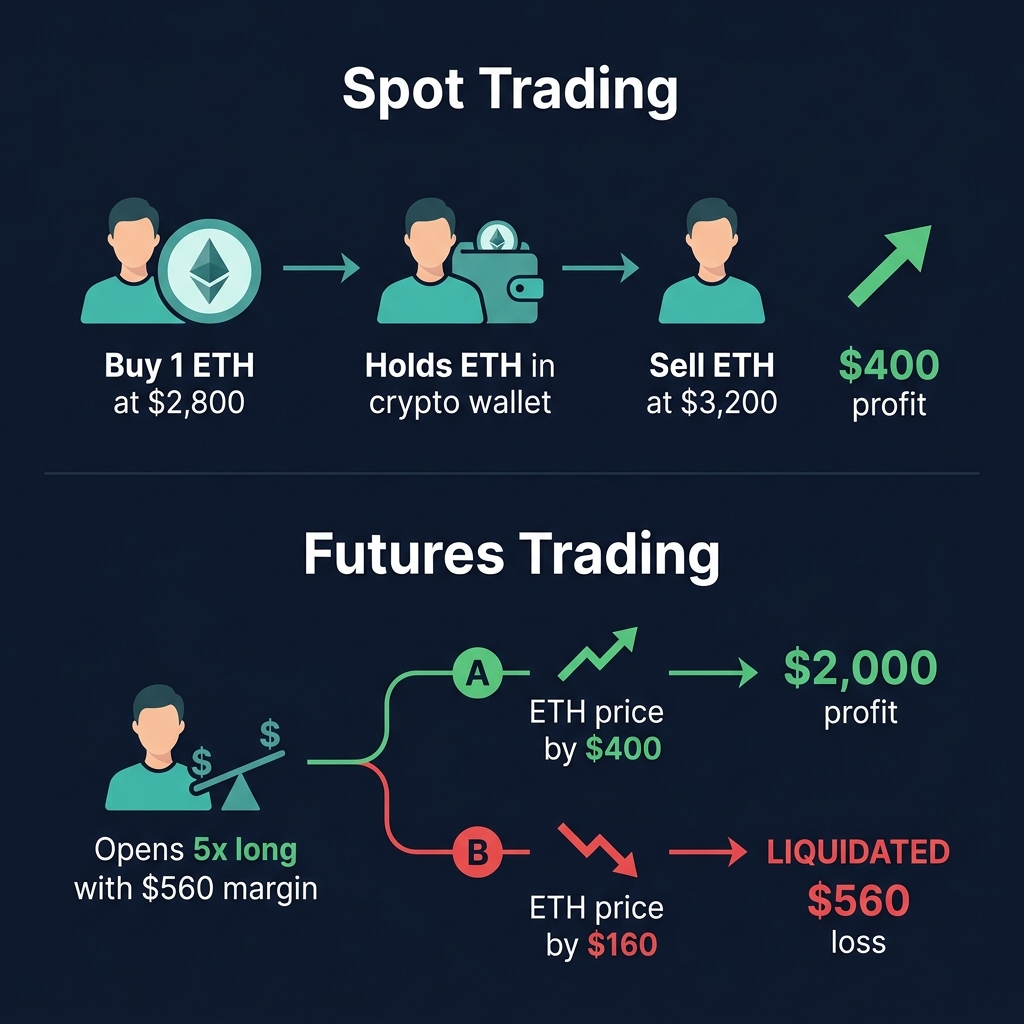
You decide ETH looks strong after reclaiming the $2,700 support zone. Here is what a spot trade looks like:
Entry: Buy 1 ETH at $2,800
Capital used: $2,800
Outcome A — ETH rises to $3,200: You sell for $3,200. Profit = $400 (14.3% return)
Outcome B — ETH drops to $2,500: You hold or sell for a $300 loss (10.7% drawdown). Your 1 ETH still exists. You can wait
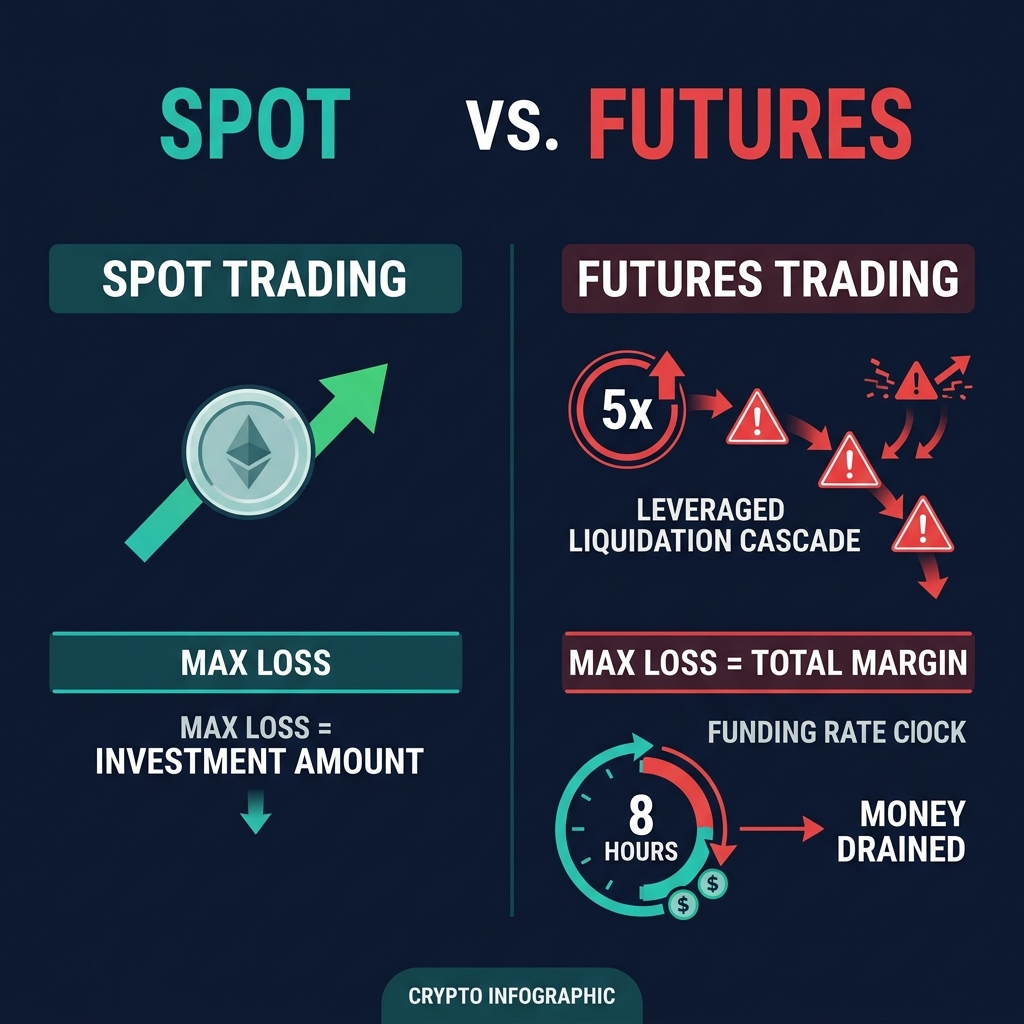
The key feature: you cannot lose more than you invested, and no one can force-close your position. Even if ETH drops 50%, you still own 1 ETH. You decide when to act.
This is why spot trading is the default for most crypto participants — from beginners accumulating BTC through DCA to fund managers building altcoin portfolios.
How Futures Trading Works
Futures trading lets you control a larger position than your capital would normally allow by using leverage. You do not own the underlying asset — you hold a contract that tracks its price.
A Real 2026 Futures Trade Example
Same setup — ETH looks strong at $2,800. But this time you use 5x leverage:
Position size: 1 ETH ($2,800 notional)
Margin required: $560 (your actual capital at risk)
Outcome A — ETH rises to $3,200: $400 gain on $560 margin = $2,000 profit (71.4% return on margin… but 14.3% on notional)
Outcome B — ETH drops to $2,640 (just -5.7%): Your $560 margin is wiped out. Position liquidated. You lose 100% of your margin on a move that would have been a minor drawdown in spot
That second scenario is not hypothetical. A 5.7% drop in ETH can happen in a single 4-hour candle — and regularly does.
For the complete mechanics of how leverage, margin, and liquidation work, see our leverage trading guide. This article focuses on helping you decide which game to play, not how the machinery works under the hood.
Head-to-Head Comparison: Spot vs Futures
Here is every dimension that matters, side by side:
Dimension
Spot Trading
Futures Trading
Asset ownership
Yes — you own the crypto
No — you hold a contract
Leverage
1x (no leverage)
1x to 125x (platform dependent)
Liquidation risk
None
High — position can be force-closed
Ongoing costs
None (beyond exchange fees)
Funding rates every 8 hours
Shorting ability
Very limited
Full short capability
Capital efficiency
Low — need full position value
High — only margin required
Maximum loss
100% of investment (asset goes to zero)
100% of margin (can happen from small moves)
Complexity
Low
High
Tax treatment
Capital gains (in most jurisdictions)
Varies — often treated as derivatives
Available pairs
Thousands of tokens
Typically 100–300 major pairs
Weekend/off-hours risk
Moderate — you hold through
Severe — gaps can trigger liquidation
Beginner suitability
✅ Excellent
❌ Not recommended
Profit from declining markets
❌ Not directly
✅ Yes, through short positions
Passive income potential
✅ Staking, lending, airdrops
❌ None
The pattern is clear: spot is simpler, safer, and more forgiving. Futures offer power tools — shorting, leverage, capital efficiency — but those tools can injure you just as easily as they help.
The Real Costs of Futures Trading
This is the section most "spot vs futures" articles skip. Futures trading has hidden ongoing costs that erode your edge even when you are making good trades.
Funding Rates: The Silent Account Drain
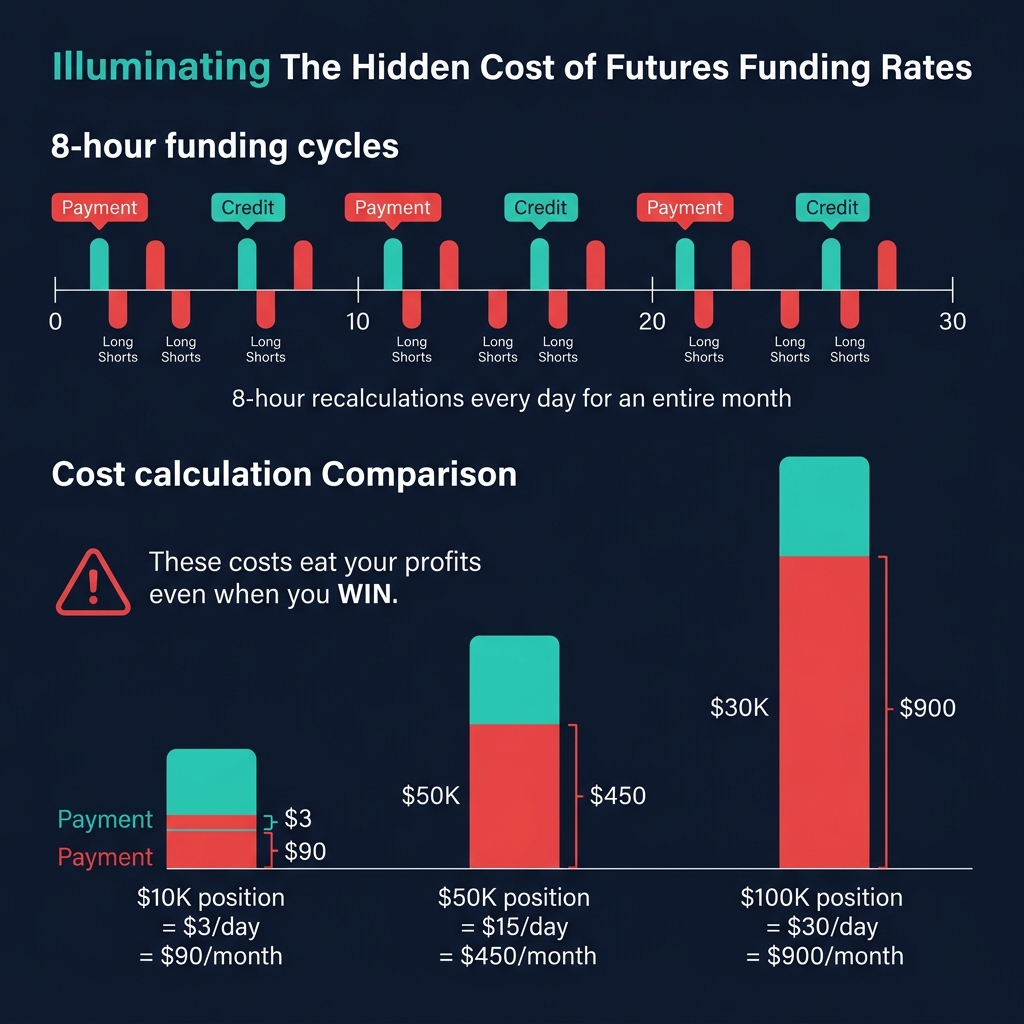
Perpetual futures contracts (the most popular type in crypto) use funding rates to keep the contract price anchored to spot price. These rates are exchanged between longs and shorts every 8 hours.
Here is what this actually costs:
Position Size
Funding Rate
Cost per 8 Hours
Daily Cost
Monthly Cost
$10,000
0.01% (neutral)
$1.00
$3.00
$90
$50,000
0.01%
$5.00
$15.00
$450
$100,000
0.01%
$10.00
$30.00
$900
$100,000
0.05% (bullish)
$50.00
$150.00
$4,500
At 0.01%, funding seems trivial. But during strong trends — when everyone is long and funding spikes to 0.03–0.10% — a $50,000 long position can bleed $75–$250 per day just in funding. That is $750–$2,500 over ten days, regardless of whether the price moves in your favor.
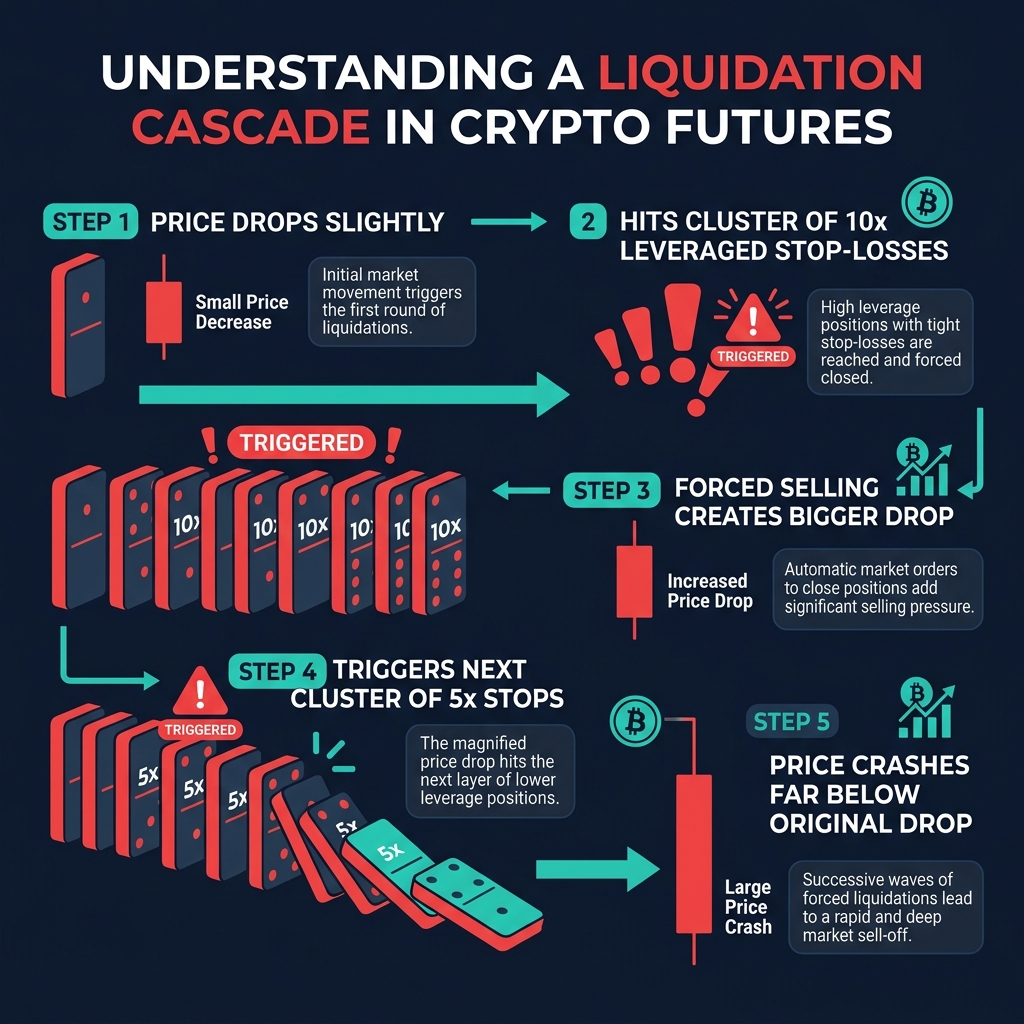
Liquidation Cascades: When "Safe" Leverage Becomes Deadly
You open a 3x long on BTC at $105,000. Your liquidation price is roughly $70,000 — that feels incredibly safe, right?
Here is what can actually happen:
BTC drops 8% in an hour (to ~$96,600) during a flash crash
Your unrealized PnL now shows a 24% loss on margin
Your margin ratio approaches the maintenance threshold
The exchange starts auto-deleveraging your position or adding margin requirements
If you have cross margin, other positions in your account become collateral — one bad trade can trigger a cascade
During extreme volatility, slippage means your actual liquidation price may be worse than calculated
The theoretical liquidation price assumes orderly markets. Crypto markets are not orderly during the moments that matter most.
The Statistics No One Wants to Talk About
Let us be direct:
70–80% of retail futures traders lose money — this is consistently reported across platforms that publish these figures
The average futures account survives less than 6 months before being depleted or abandoned
Most losses come from overleveraging (using 10x+ on volatile assets) and not using stop losses
Survivors tend to use low leverage (2–5x) and strict position sizing — essentially treating futures more like spot with a small efficiency boost
These are not scare tactics. They are the reality you need to factor into your decision.
When Spot Trading Wins
Spot is not just the "beginner" option. There are specific scenarios where spot is objectively the better tool, regardless of your experience level.
1. Long-Term Accumulation (DCA Strategies)
If your thesis is "BTC will be higher in 2–4 years," futures are the wrong vehicle entirely. You cannot DCA into a leveraged position without managing rolling contracts, funding costs, and liquidation levels.
Spot DCA example:
$500/month into BTC over 12 months
Total invested: $6,000
No liquidation risk, no funding costs, no management required
You can stake or lend the BTC for additional yield
2. Altcoin Portfolio Building
Most altcoins are only available on spot markets. Even for tokens that have futures, the liquidity in altcoin perpetuals is thin — meaning wider spreads, worse fills, and higher liquidation risk from wicks.
If you are building positions in mid-cap tokens based on sector rotation analysis or fundamental research, spot is your only practical choice.
3. Beginner Traders (First 6–12 Months)
This is non-negotiable. If you have not yet demonstrated consistent profitability on spot, futures will accelerate your losses, not your learning.
Spot gives you room to make mistakes without catastrophic consequences. A 15% drawdown on a $2,000 spot portfolio is a $300 learning experience. The same mistake on 10x futures is a $2,000 liquidation.
4. Tax Optimization and Simplicity
In most jurisdictions, spot trades are treated as straightforward capital gains. Futures introduce complexities: mark-to-market accounting, different tax categories for derivatives, and the headache of tracking hundreds of funding rate payments as taxable events.
If you are not already working with a crypto-savvy accountant, keep it simple with spot.
5. Earning Yield on Holdings
Spot positions can generate passive income through staking (ETH at ~3.5% APY), lending protocols, or eligibility for airdrops. Futures positions generate nothing — they only cost you funding.
When Futures Trading Wins
Futures are not inherently bad — they are powerful tools with specific use cases where they genuinely outperform spot.
1. Hedging Existing Spot Positions
This is arguably the most legitimate use of futures: protecting a portfolio you do not want to sell.
Example: You hold 2 BTC ($210,000) that you accumulated over years. You see bearish signals on the weekly market structure and expect a 15% correction, but you do not want to sell due to tax implications or long-term conviction.
Futures hedge:
Open a 1 BTC short on perpetual futures (50% hedge)
If BTC drops 15%: Spot portfolio loses ~$31,500, futures position gains ~$15,750
Net drawdown reduced from 15% to ~7.5%
Once the correction plays out, close the hedge
This is how institutions use futures — as insurance, not as a casino.
2. Short Selling During Bear Markets
Spot traders can only make money when prices go up. Futures traders can profit from declines. During the 2022 bear market, disciplined short sellers captured significant returns while spot-only traders watched portfolios bleed.
If your technical analysis identifies a bearish breakdown — say, BTC losing the $100,000 level with high volume — futures let you act on that conviction.
3. Capital-Efficient Trading for Experienced Traders
If you have a backtested, profitable strategy with a proven edge, low leverage (2–3x) lets you deploy capital more efficiently.
Example: A swing trader with a 55% win rate and 2:1 reward-to-risk ratio:
On spot: $10,000 capital, risking 2% ($200) per trade
On 2x futures: $5,000 capital achieves the same $10,000 exposure, freeing $5,000 for other allocations
The key word is backtested. If you cannot point to at least 100 historical trades proving your edge, you have no business using leverage to amplify it. See our backtesting methodology guide for how to validate a strategy properly.
4. Arbitrage and Market-Neutral Strategies
Advanced traders can exploit pricing differences between spot and futures markets:
Cash-and-carry arbitrage: Buy spot, short futures when futures trade at a premium. Collect the basis spread as risk-free yield
Funding rate arbitrage: Go long spot, short perpetual when funding is deeply positive. Collect funding payments while maintaining delta-neutral exposure
These strategies require significant capital and infrastructure, but they represent the cleanest use case for futures markets.
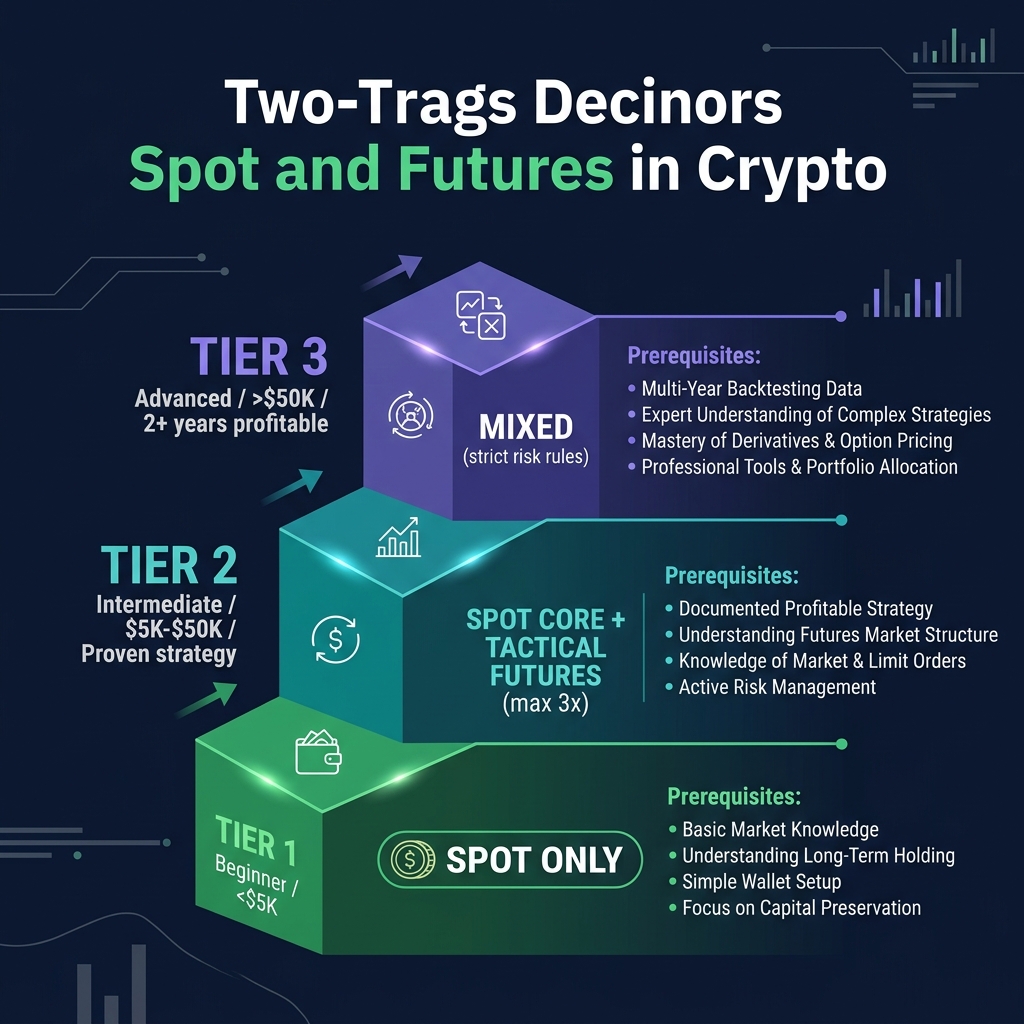
The Decision Framework: Which Should You Trade?
Stop asking "which is better?" and start asking "which is right for me, right now?" Use this framework:
Tier 1: Spot Only
You fit here if:
[ ] Less than 12 months of active trading experience
[ ] Portfolio under $5,000
[ ] No documented trading journal with at least 50 trades
[ ] Cannot explain funding rates, margin types, and liquidation mechanics without looking them up
Flexible allocation between spot, futures long, and futures short
Maximum 5x leverage, typically operating at 2–3x
Hedging strategies actively used
Funding rate monitoring with tools like CoinXSight's Deep Alpha module
Daily risk review and exposure assessment
Correlation analysis across positions to avoid concentration risk
Be brutally honest about which tier you are in. Moving up a tier prematurely is the single most expensive mistake in crypto trading. The market does not grade on a curve.
Risk Management: Different Rules for Different Games
Risk management is not one-size-fits-all. Spot and futures require fundamentally different risk frameworks.
Spot Risk Management Rules
Rule
Guideline
Example ($10,000 Portfolio)
Risk per trade
2–5% of portfolio
$200–$500 max loss per trade
Position sizing
Based on stop loss distance
If stop is 10% below entry: position = $2,000–$5,000
Max portfolio drawdown
20–30% before pausing
Stop trading at $7,000–$8,000 portfolio value
Diversification
5–15 positions
No single position > 20% of portfolio
Stop losses
Recommended but not mandatory
You can hold through drawdowns if thesis is intact
Spot risk calculation example:
Portfolio: $10,000
Risk per trade: 3% = $300
Entry: SOL at $170
Stop loss: $155 (8.8% below entry)
Position size: $300 ÷ 0.088 = $3,409 (roughly 20 SOL)
Futures Risk Management Rules
Rule
Guideline
Example ($10,000 Portfolio)
Risk per trade
0.5–1% of total portfolio
$50–$100 max loss per trade
Leverage
Max 3–5x, typically 2–3x
3x leverage on a $1,000 margin = $3,000 position
Stop losses
Mandatory, non-negotiable
Always set before entry, never moved further away
Max open exposure
2–3 positions simultaneously
Avoid correlated positions (e.g., long BTC + long ETH)
Max portfolio in futures margin
20–30% of total capital
$2,000–$3,000 in margin, $7,000–$8,000 in spot/cash
Daily loss limit
2–3% of portfolio
Stop all futures trading for the day after $200–$300 loss
Futures risk calculation example:
Portfolio: $10,000
Risk per trade: 1% = $100
Entry: BTC long at $105,000 with 3x leverage
Stop loss: $103,950 (1% below entry)
With 3x leverage, a 1% price move = 3% margin move
Notice the critical difference: on spot, you risk 2–5% per trade. On futures, you risk 0.5–1%. This is not because futures traders are more conservative by nature — it is because leverage amplifies mistakes just as much as it amplifies gains.
Over-diversifying into low-quality altcoins — Owning 30 tokens means you effectively own an index minus the due diligence
No exit plan — "I'll just hold" is not a strategy. Define profit targets and invalidation levels before entry
Ignoring opportunity cost — Capital locked in a sideways altcoin for 6 months could have been deployed elsewhere
FOMO buying at local tops — Without leverage pressure, spot traders often chase pumps because "I can just hold if it drops"
Futures Trading Mistakes
Using maximum available leverage — 50x or 100x exists for market makers, not retail traders. Using it is functionally gambling
Moving stop losses — "Just a little more room" is the most expensive sentence in futures trading
Trading without a daily loss limit — Revenge trading after a liquidation leads to account destruction in a single session
Ignoring funding rates — Holding a winning long position while paying 0.05% funding every 8 hours can erase days of gains
Cross-margin without understanding it — One liquidation cascading into your entire account is a lesson no one wants to learn the hard way
Using CoinXSight for Spot and Futures Decisions
Whether you trade spot or futures, CoinXSight's tools help you make better-informed decisions:
Alpha Hunter signals flag high-probability setups across both spot and derivatives markets, so you can apply your preferred execution method to quality opportunities
ASI Score consolidates technical, on-chain, and sentiment data into a single confidence metric, helping you decide whether a setup warrants the added risk of futures leverage or is better played as a simple spot position
Chart Pro supports multi-timeframe analysis so you can align your entry timing regardless of whether you are executing on spot or futures
Frequently Asked Questions
Can I lose more than I invest in crypto futures?
On most major exchanges in 2026, no — thanks to isolated margin and auto-liquidation mechanisms, your maximum loss on a futures position is limited to the margin you allocate to that trade. However, if you use cross margin, your entire account balance serves as collateral, meaning one bad trade can drain everything in your futures wallet. Always use isolated margin unless you fully understand cross-margin risks.
Are crypto futures more profitable than spot trading?
Not inherently. Futures amplify both gains and losses. A trader who makes 10% per month on spot would theoretically make 30% at 3x leverage — but they would also have 3x the drawdowns, funding costs, and liquidation risk. After accounting for these factors, many traders find their risk-adjusted returns are actually worse on futures than on spot. Profitability depends on your edge, not your leverage.
What leverage should a beginner use for crypto futures?
None. Beginners should trade spot only until they have at least 6–12 months of documented, profitable trading experience. When eventually transitioning, start with 2x leverage maximum and focus on liquid assets like BTC and ETH. Only increase to 3–5x after demonstrating consistent profitability at lower leverage levels. Anything above 5x is almost never justified for retail traders.
Do I need more capital for spot trading than futures?
Yes, spot trading requires the full position value. To buy 1 BTC at $105,000 on spot, you need $105,000. On 10x futures, you need $10,500. However, this capital efficiency is a trap for undercapitalized traders. If your strategy requires $100,000 of BTC exposure but you only have $10,000, the answer is not "use 10x leverage" — the answer is "trade with $10,000 of exposure on spot and adjust your profit expectations."
Can I use futures to hedge my spot portfolio?
Yes, and this is one of the most legitimate uses of futures. If you hold a long-term spot portfolio but expect short-term downside, you can open a short futures position to offset some of the decline. Common approaches include hedging 25–50% of your spot exposure during high-risk periods (major economic events, technical breakdowns, or historically volatile dates). The key is sizing the hedge appropriately and closing it once the risk event passes.
Should I trade crypto futures in 2026?
Only if you meet three criteria: (1) you have documented profitability on spot over at least 6–12 months, (2) you have risk capital you can afford to lose entirely without impacting your lifestyle, and (3) you have a specific, backtested strategy that benefits from leverage or short exposure. If you are trading futures because spot "feels too slow," you are trading for excitement, not profit — and the market will charge you dearly for that entertainment.
Summary
Spot and futures trading are not "beginner vs advanced" versions of the same thing — they are different instruments with different cost structures, risk profiles, and appropriate use cases.
Spot trading is the right choice for the vast majority of crypto participants. It is simpler, cheaper (no funding rates), eliminates liquidation risk, and gives you time to learn without catastrophic consequences. If you are building long-term positions, exploring altcoins, or still developing your trading skills, spot is where you belong.
Futures trading is a precision tool for specific situations: hedging existing portfolios, short selling during confirmed downtrends, and improving capital efficiency for traders with a proven, backtested edge. It is not a shortcut to bigger profits — it is a higher-stakes game that demands tighter risk management, smaller position sizes, and more discipline.
The honest framework is simple: start with spot, prove profitability, graduate to tactical futures use only when you have earned it through documented results. Skip the graduation ceremony and the market will send you back to the beginning — with a smaller account.
Master funding rate analysis, open interest tracking, and liquidation cascade prediction for crypto trading. Learn to read leveraged positioning, detect…
Master risk management for crypto trading. Learn position sizing formulas, stop-loss strategies, and how CoinXSight's Portfolio module tracks your risk…