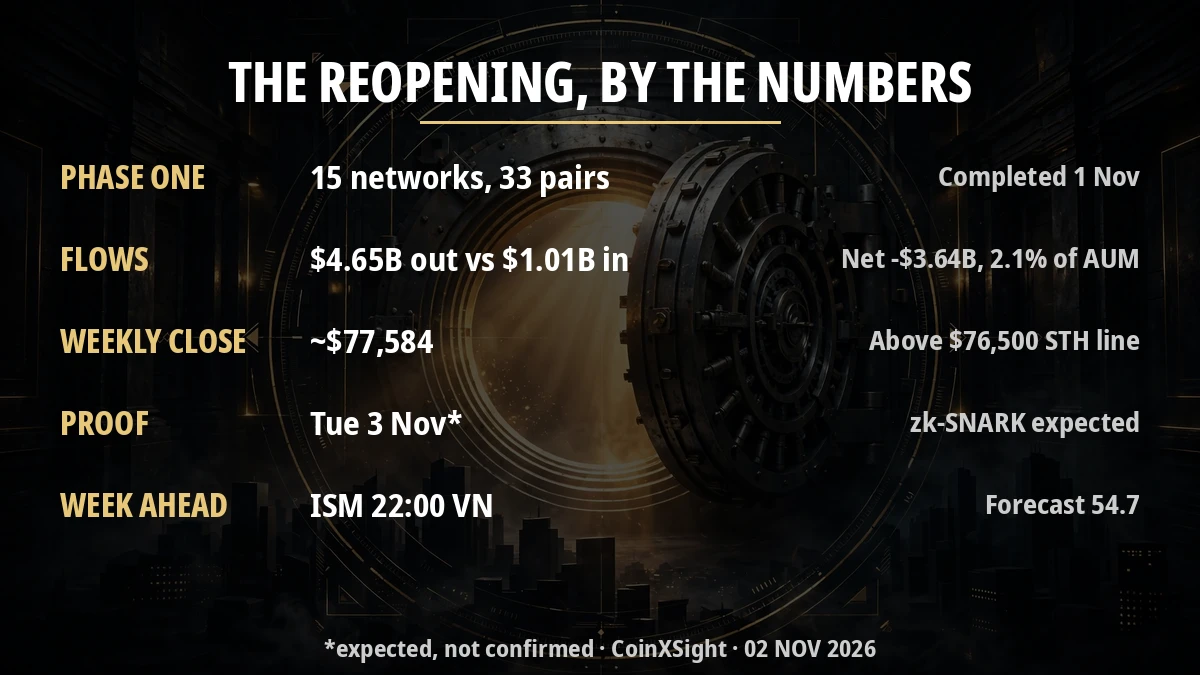
The Reopening Held: $4.65B Walked Out of Binance, Bitcoin Kept Its Line — Now the Data Takes Over
Monday analysis: Binance's reopening day moved $4.65B out with no cascade, Bitcoin closed the week above its $76.5K line, and the reserves proof that actually matters lands Tuesday. Tonight's ISM starts the week's real exam.
CX
CoinXSight Alpha DeskQuantitative Research Desk·Nov 2, 2026 · Updated Nov 2
The test was never whether Binance could reopen withdrawals. The test was what would happen in the hours after it did. On Sunday, the answer arrived in numbers: by mid-afternoon, the exchange had processed about $4.65 billion of withdrawals against $1.01 billion of deposits — a net outflow of roughly $3.64 billion, equal to about 2.1% of its $171 billion in assets under management. Large. Historic, even. And orderly.
No cascade. No halt. No second suspension. Phase one, covering 15 networks from Bitcoin to Sui, completed its rollout on schedule, and Bitcoin — the asset at the center of the worst week of the year — closed its weekly candle near $77,600, above every line that mattered. November starts with a market that took a $6.3 billion punch and stayed standing. What it has not yet done is prove it can climb.
The weekly close: the line held
Start with the chart, because Sunday night’s close was the verdict on last week’s fear. Bitcoin’s short-term holder cost basis sits near $76,500. The weekly pivot flagged by technical desks sits at $75,718. The week’s low, depending on the venue, printed between $76,326 and $76,360. The close: roughly $77,584, comfortably above both.
That is not a bullish signal by itself. It is a non-bearish one, which after last week counts as progress. The structure now is clean enough to state in two sentences. Below, $76,500 and the $76,264–76,478 shelf decide whether this correction gets a second leg. Above, the $79,500–80,500 reclaim zone decides whether the December-hike repricing was the whole story. Bitcoin opens Monday at about $78,050, almost exactly in the middle of that corridor — a market that survived its stress test and has not yet earned a promotion.
The breadth underneath is worse than the benchmark. Over the seven days to November 1, Bitcoin fell about 3.1%; only 13 of the top 50 coins finished higher, and by one count 83 of the top 100 were negative. Stablecoin supply — the market’s dry powder — quietly shrank from about $302.6 billion on October 25 to roughly $298.5 billion on November 1, a $4.1 billion drain. Capital is not rotating into risk. It is leaving the building slowly, through the side door, which is what late-stage corrections look like before they either resolve or accelerate.
Binance by the numbers: what Sunday actually proved
The reopening deserves a precise accounting, because precision is what was missing from the first 72 hours of this story.
Binance reopening metric
Figure
Source / note
Phase-1 networks restored
15 networks, 33 asset-network pairs
Recovery Update #4, 1 Nov; phase completed same day
Withdrawals processed (by ~15:30 UTC, 1 Nov)
~$4.65B out vs ~$1.01B in
Net outflow ~$3.64B ≈ 2.1% of ~$171B AUM
Incident coverage
~95% of ~$6.3B
Remainder ~5% in less-liquid tokens outside the top 10
Reserves snapshot (00:00 UTC, 31 Oct)
Top-10 user assets at 1:1 or better
Published on PoR portal; new wallet addresses in use
Independent verification
zk-SNARK proof expected Tue 3 Nov
Generation takes ~40–50 hours per Binance
Stolen funds located / frozen
~$3B
Analytics firms attribute the attack to TraderTraitor (high confidence)
Two readings of that table are available, and the honest analyst holds both. The generous reading: a 2.1% outflow on reopening day, after the largest theft in crypto history, is a vote of confidence — in 2022’s exchange failures, reopening days did not look like this, because there were no reopening days. The skeptical reading, and The Edge’s reserve analysis makes it well, is that the snapshot meets its 1:1 pledge “at the line rather than with room to spare”: the surpluses in Bitcoin and USDT have shrunk to a fraction of their October 1 size. Both readings agree on the operational fact — the doors opened and the exit was orderly. They disagree on how much cushion remains if a second shock arrives while the cushion is being rebuilt.
That disagreement is exactly what Tuesday is for. Monday’s snapshot is Binance’s statement, published on Binance’s portal, from Binance’s new addresses. The zk-SNARK proof expected Tuesday is the first artifact in this saga that outsiders can verify without trusting the exchange. Until it lands, the correct posture toward the reserves claim is the one this publication has kept since Thursday: noted, not endorsed.
Monday’s real exam is tonight, and it is not about Binance
For all the weekend’s drama, the week’s direction will be set elsewhere. Tonight at 22:00 Vietnam time, ISM manufacturing prints for October. The forecast is 54.7, a touch above September’s 54.5 — but the headline is the least important line in the release. September’s prices-paid component printed 77.9, deep in inflationary territory, and it is that sub-index, plus new orders and employment, that will feed the December rate debate now running at roughly 84.6% priced odds of a Fed hike.
Tomorrow compounds it: US midterm elections, with results landing Wednesday morning Vietnam time, and the September JOLTS report at 22:00, expected near 7.2 million openings against August’s 7.079 million. Then Wednesday’s XRPL amendment window and ISM services, Thursday’s Bank of England decision, and Friday’s payrolls report — consensus now near 55,000, a number low enough that a strong beat would be a genuine hawkish shock.
The pattern to notice: every one of these prints matters for the same reason. The market’s wound from last week was not the hack — the hack is healing on schedule. The wound was the discovery that December belongs to the hawks. Each data point this week either confirms that ownership or starts to contest it. Bitcoin at $78,050, mid-corridor, is priced for exactly that fight.
One smaller Sunday item deserves a line because it will be misread elsewhere: Ripple’s scheduled monthly escrow release of 1 billion XRP landed on November 1, into the thinnest liquidity of the week. Historically the bulk of each release is re-locked, and no confirmed unusual movement had been reported by Monday morning. It is a calendar item, not a supply shock — treat any headline claiming otherwise as noise until on-chain movement proves it.
The bottom line for Monday
Three postures, in order of confidence. The Binance chapter is closing operationally — withdrawals work, the outflow was survivable, and the remaining question is verification on Tuesday, not solvency on Monday. The market structure is unresolved — a weekly close above the line, breadth and stablecoin supply still deteriorating underneath. And the calendar is loaded — five days of prints, an election, and a payrolls report that will either validate the hawkish December or hand this market its first real reason to run.
Surviving the punch was the easy part to misread as the whole fight. The fight is this week.
Disclaimer: This article is for informational purposes only and does not constitute financial advice. Figures are cited from official releases and market data as reported at the time of writing and are subject to revision. Cryptocurrency markets are volatile; always do your own research before making investment decisions.
Follow the week: CoinXSight publishes the preview before every major print and the verdict the morning after — ISM tonight, JOLTS and the midterms tomorrow, payrolls on Friday. Follow the Analysis desk and none of them will reach you late.
CX
CoinXSight Alpha Desk
ALPHA // DESK
Quantitative Research Desk·Global Alpha Division
CoinXSight Institutional Research Desk produces quantitative crypto market intelligence, algorithmic models, and on-chain forensics.
QUANTITATIVE SUITE // DEEP ALPHA ENGINEACTIVE
BTC/USDT // LIVE SCANNER
CONFLUENCE 74
LIVE SPOT PRICE$82,807.47WEAK_BUY
TP2
$89,522.75
+9.07%
TP1
$85,056.42
+3.63%
ENTRY
$82,078.86
ZONE
SL
$80,590.09
-1.81%
Auto-detect Order Blocks, Fair Value Gaps and risk-adjusted DCA ladders in < 5s.