"Should I day trade or swing trade?" It's the first strategic question every crypto trader faces — and the wrong answer will cost you months of frustration, blown accounts, and unnecessary stress. The reality is that neither style is objectively "better." The best trading style is the one that fits your life, your psychology, and your capital. This guide gives you a concrete framework to make that choice with confidence.
We've already published in-depth guides for each style: the Day Trading Crypto Strategy and the Swing Trading Crypto Strategy. This article isn't a rehash — it's a head-to-head comparison designed to help you pick the right path (or combine both).
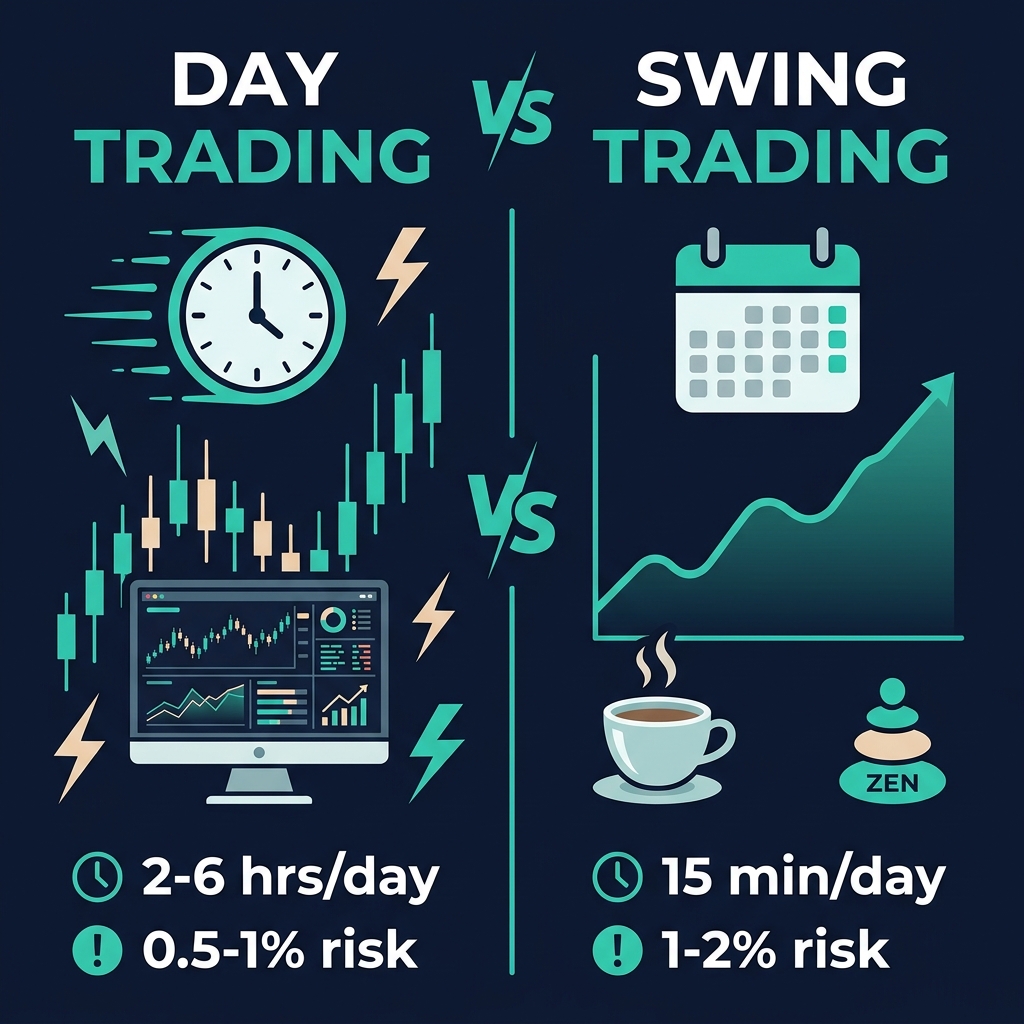
Head-to-Head Comparison: Day Trading vs Swing Trading
This table is the core reference. Bookmark it and revisit whenever you're questioning your approach.
Dimension
Day Trading
Swing Trading
Best For…
Time commitment
2–6 hours of active screen time daily
15–30 minutes daily (scan + manage)
Swing if you have a full-time job
Minimum capital
$5,000+ (tight position sizing below this)
$3,000+ (wider stops, fewer trades)
Swing for smaller accounts
Risk per trade
0.5–1% of account
1–2% of account
Day trading for tighter per-trade risk
Tools required
Order flow, 1H charts, real-time scanner
4H/1D charts, AI signals, on-chain data
Day trading needs more specialized tools
Realistic win rate
55–65% (more trades, lower per-trade edge)
60–70% (fewer trades, higher conviction)
Swing for higher hit rates
Stress level
High — rapid decisions under pressure
Moderate — planned entries, daily check-ins
Swing for lower anxiety
Skill floor
High — requires order flow reading, fast execution
Moderate — pattern recognition, patience
Swing for beginners
Monthly income potential
5–15% in strong months (highly variable)
5–12% in strong months (more consistent)
Day trading for higher ceiling
Tax efficiency
Lower — high trade count, short-term gains
Higher — fewer taxable events, simpler tracking
Swing for tax simplicity
Lifestyle compatibility
Requires scheduled sessions, limits flexibility
Trade from anywhere, check once or twice daily
Swing for freedom
Key takeaway: Swing trading wins on 7 out of 10 dimensions for most people. Day trading wins on income ceiling and per-trade risk control — but only if you have the time, tools, and temperament to execute it properly.
Day Trading Crypto: Pros, Cons, and Real-World Example
Day trading means opening and closing all positions within a single session — never holding overnight. In crypto, "overnight" is relative since markets run 24/7, but the principle is the same: you end each session flat, with no market exposure while you sleep.
For the full strategy breakdown — regime checks, Alpha Hunter filters, order flow entries — see the complete Day Trading guide.
Who Day Trading Is Best For
Full-time traders who can dedicate 3+ focused hours per session
Traders in high-volatility environments where BTC is moving 2–5% intraday
Small accounts seeking fast capital rotation — your $5K can be deployed and freed multiple times per day
People who thrive under pressure and make better decisions with adrenaline, not worse ones
Real 2026 Example: Day Trading BTC During a 1H Trend
Setup: June 3, 2026. BTC at $104,800. CoinXSight's AI Terminal shows a Strong Bullish 1H regime with 82% confidence. Alpha Hunter flags a 1H Bull Flag pattern with ASI 61. Order Flow Score reads 67 (BUY), with bullish delta and moderate volume intensity.
Execution on a $10,000 account (0.5% risk = $50 per trade):
Parameter
Value
Entry
$104,800 (limit at EMA 34 pullback)
Stop-loss
$104,300 (below Order Block, 0.48% risk)
Take-profit
$105,200 (previous 1H resistance)
Position size
$50 ÷ $500 × $104,800 ≈ $10,480 (~0.1 BTC)
Risk:Reward
1:0.8 (conservative TP1)
Result: BTC reached $105,200 in 3.5 hours. Profit: $40 on the first trade. A second trade during the same session using an S/R fade netted $160. Total session profit: $200 (2% return) in approximately 4 hours of active work.
The Hidden Costs of Day Trading
The $200 profit looks attractive until you factor in what it actually costs:
Screen time: 4 hours of focused, high-intensity monitoring — that's half a workday
Commissions and spread: On $20K+ of total volume across two trades, exchange fees typically run $10–20 (eating 5–10% of profit)
Emotional energy: The stress of watching 1-minute candles move against you depletes willpower. Most day traders report feeling mentally exhausted after sessions
Opportunity cost: Those 4 hours couldn't be spent on anything else — your job, family, learning
Inconsistency: That $200 day is not guaranteed. Sideways regimes produce $0 or negative sessions. You might average 2–3 profitable sessions out of 5
The Trading Psychology Guide covers how to manage the psychological toll of rapid-fire decision-making.
Swing Trading Crypto: Pros, Cons, and Real-World Example
Swing trading captures price movements over 2–14 days. You identify a setup, place your orders, and let the trade work while you go about your life. The operational overhead is dramatically lower than day trading.
For the full strategy breakdown — EMA crossover pullbacks, breakout retests, AI signal swings — see the complete Swing Trading guide.
Who Swing Trading Is Best For
Working professionals who can't stare at charts during market hours
Traders in trending macro environments where 4H and Daily trends are clean
Larger accounts that benefit from less frequent, higher-conviction trades
Beginners who need time to think before executing (no split-second decisions)
People who value work-life balance and want trading to complement their life, not consume it
Real 2026 Example: Swing Trading SOL Over 8 Days
Setup: May 22, 2026. SOL at $162. CoinXSight's Alpha Hunter flags a 4H Double Bottom with ASI 72 and neutral whale activity. Deep Alpha Confluence Score reads 74 with all layers above 40. The 1D trend is bullish (price above EMA 89 and EMA 200).
Execution on a $10,000 account (1.5% risk = $150 per trade):
Parameter
Value
Entry
$162.00 (limit order at pattern neckline support)
Stop-loss
$157.50 (below Double Bottom low, 2.8% risk)
Take-profit 1
$170.00 (previous swing high)
Take-profit 2
$174.50 (1.618 Fibonacci extension)
Position size
$150 ÷ $4.50 × $162 ≈ $5,400 (~33.3 SOL)
Risk:Reward
1:1.8 (TP1) / 1:2.8 (TP2)
Result: SOL hit TP1 ($170) on day 5 — closed 50% for $266 profit. Moved SL to breakeven on remaining position. SOL reached $173.50 on day 8 — closed remaining position for an additional $584 profit. Total: $850 profit (8.5% return) with approximately 15 minutes per day of management.
The Hidden Costs of Swing Trading
The $850 over 8 days looks incredible — but consider the other side:
Overnight risk: While you sleep, BTC could flash-crash 8%, dragging SOL down 15%. Your stop-loss will execute, but at potentially worse prices due to slippage during volatility spikes
Capital lockup: That $5,400 was tied up for 8 days. If a better opportunity appeared on day 3, you couldn't deploy that capital without closing the position early
Patience tax: Watching SOL bounce between $163 and $166 for three days before finally moving tests your conviction. Many traders close too early, capturing $100 instead of $850
Gap risk: Major news events (exchange hacks, regulatory announcements) can blow past your stop-loss before it triggers
Fewer at-bats: You might only take 4–6 swing trades per month. One bad streak (3 consecutive losses) can make an entire month negative
The Decision Framework: Choose Your Trading Style
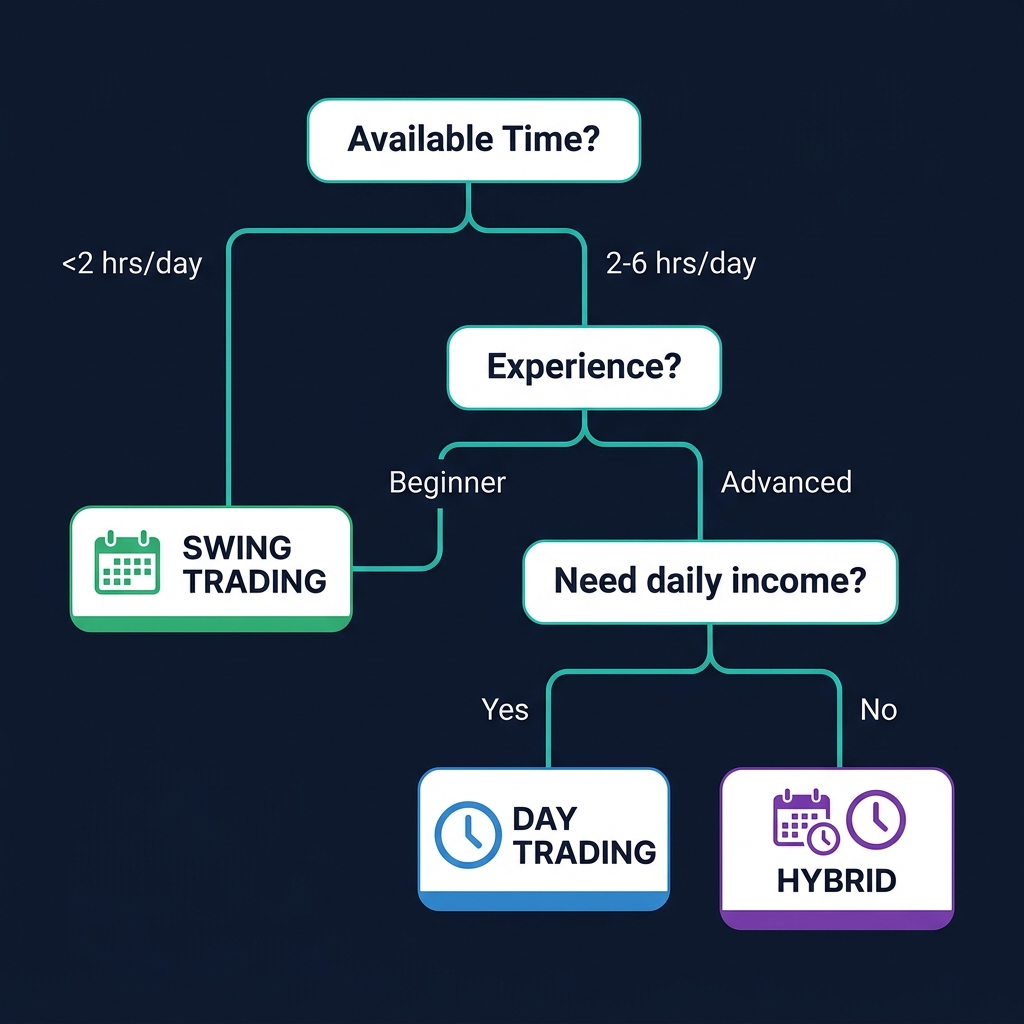
Use this flowchart to find your starting point. Answer honestly — your ego will want to pick day trading because it sounds more "serious." Ignore that impulse.
Step 1: Time Availability
I have less than 2 hours per day for trading → Swing Trading
I can dedicate 3–6 focused hours daily → Continue to Step 2
Step 2: Income Needs
I need consistent daily income from trading → Day Trading (but read the warning below)
I'm building long-term returns, not replacing a salary → Swing Trading
⚠️ Warning: "Consistent daily income" from day trading is a myth for most traders. Even professionals have 2–3 losing days per week. If you're depending on trading to pay rent, you're adding survival pressure that will destroy your decision-making. Build a 6-month financial cushion before attempting day trading for income.
Step 3: Experience Level
I'm a beginner (less than 6 months of active trading) → Swing Trading
I've been trading for 6+ months with a documented edge → Continue to Step 4
Step 4: Psychological Profile
I make better decisions when I have time to think → Swing Trading
I thrive under pressure and can execute pre-planned rules instantly → Day Trading
I get anxious when I have open positions overnight → Day Trading
I get anxious watching rapid price movements → Swing Trading
Step 5: Capital and Tools
I have less than $5,000 and basic charting tools → Swing Trading
I have $5,000+ and access to order flow, real-time scanning, and multi-timeframe analysis → Either style works — choose based on Steps 1–4
Quick-Reference Decision Table
If you are…
Start with…
Why
A full-time employee
Swing Trading
15 min/day fits any schedule
A student
Swing Trading
Focus on learning, not screen time
A freelancer with flexible hours
Either (lean Day Trading)
You can schedule sessions around work
A full-time trader
Day Trading (with swing core)
Maximize capital utilization
A complete beginner
Swing Trading
Lower stress, more time to learn
Someone with $2,000–$5,000
Swing Trading
Day trading position sizes are too small
Someone with $10,000+
Either
Capital supports both styles
The Hybrid Approach: How Professional Traders Combine Both Styles
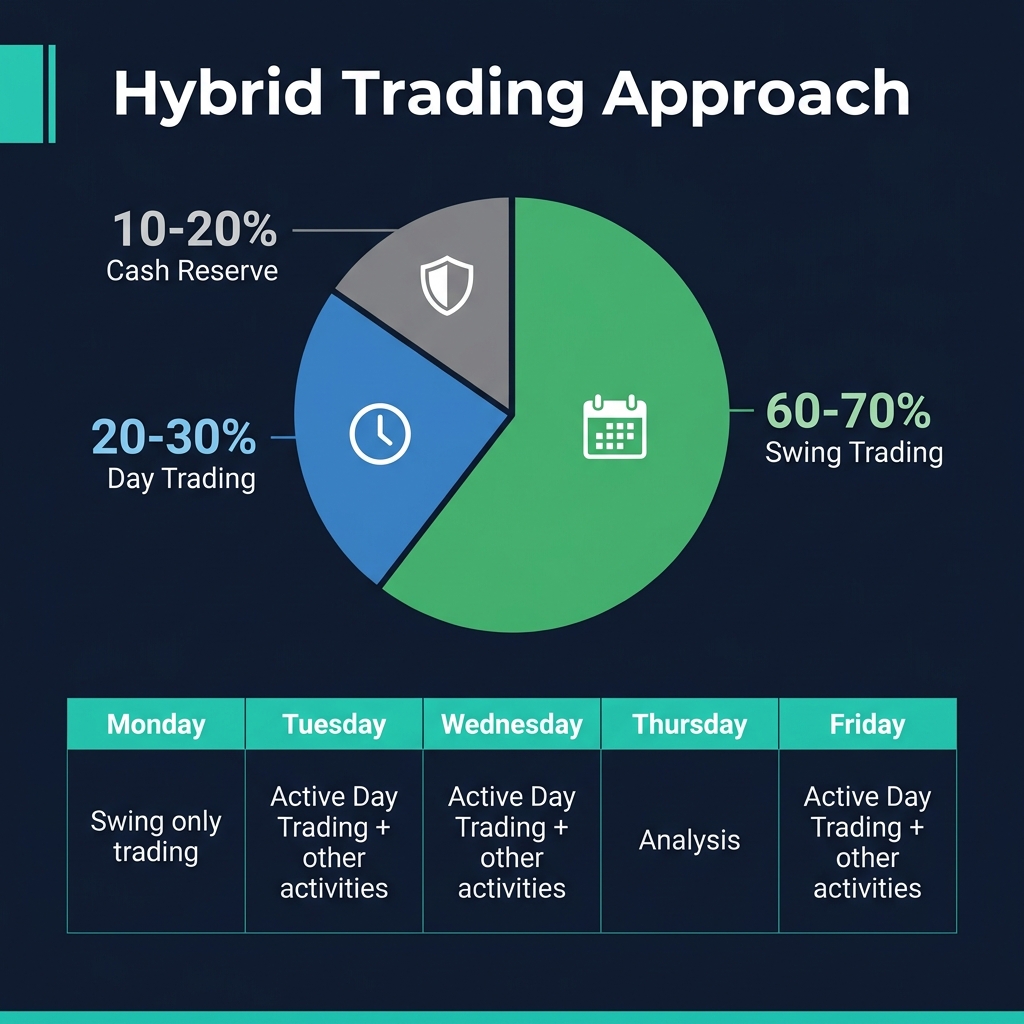
Here's what most trading guides won't tell you: the best traders don't choose one style — they use both. The key is maintaining separate capital allocations and clear rules for when each style applies.
The Core-Tactical Framework
Core Positions (60–70% of capital) — Swing Trading:
3–5 swing trades based on 4H and Daily setups
Hold time: 3–14 days
Use Alpha Hunter signals with ASI ≥65 and Deep Alpha Confluence ≥65
These are your bread-and-butter, consistent returns
Manage in 15 minutes per day
Tactical Positions (20–30% of capital) — Day Trading:
1–3 intraday trades during high-opportunity sessions
Hold time: 1–6 hours
Only trade when the 1H regime is Strong Trend (80%+ confidence)
These are opportunistic, capturing extra returns during volatile sessions
Requires 2–4 hours of active trading when deployed
Cash Reserve (10–20% of capital):
Always available for unexpected opportunities
Also serves as a psychological buffer — knowing you have cash reduces the urge to overtrade
Hybrid Rules That Prevent Conflicts
Never use swing capital for day trades — if your swing positions tie up 65% of capital, your day trading pool is capped at what remains minus the reserve
Day trading complements, not contradicts — if your swing positions are long SOL and ETH, your day trades should not short correlated assets
Regime dictates allocation: In strong trends, lean heavier into day trading (more intraday opportunities). In choppy markets, lean into swing only (fewer but higher-conviction setups)
Track P&L separately — review swing and day trading performance independently each month. If one style is consistently losing, reduce its allocation
A Typical Hybrid Week
Day
Swing Activity (15 min)
Day Trading Activity
Notes
Monday
Scan Alpha Hunter, enter 2 new swings
No session — regime uncertain
Patience pays
Tuesday
Check swings, adjust SL on 1 position
3-hour session — BTC trending 1H
2 intraday trades, +$180
Wednesday
SOL swing hits TP1, close half
No session — low volume
Market rest day
Thursday
Check swings, no action needed
2-hour session — momentum burst on ETH
1 trade, +$95
Friday
Close remaining SOL swing (TP2)
No session — end-of-week wind-down
Weekly review time
Total effort: ~75 minutes of swing management + ~5 hours of selective day trading = ~6 hours for the week.Total result: Swing profits + Day trading profits, diversified across timeframes and styles.
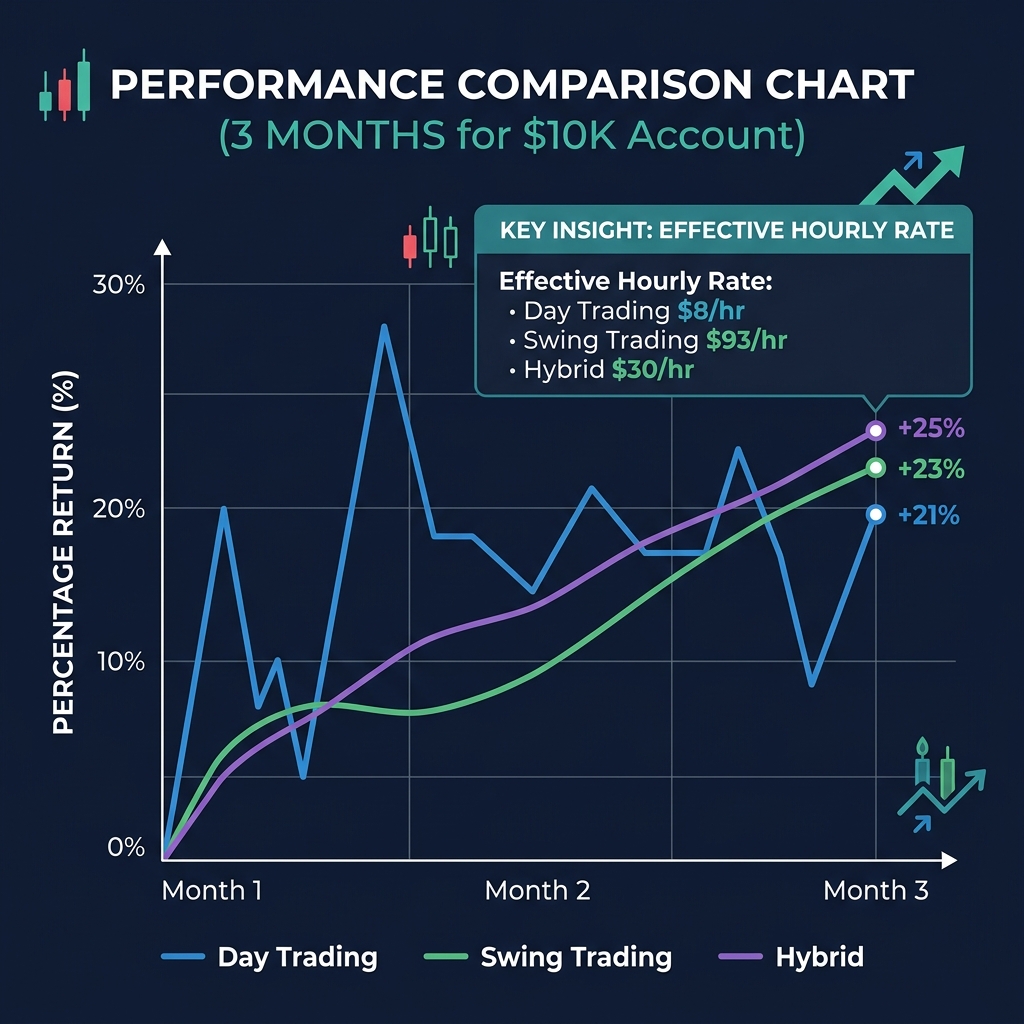
These scenarios use conservative, backtested assumptions — not cherry-picked best-case results. They're based on a $10,000 starting account in a moderately bullish market (similar to Q2 2026 conditions with BTC ranging $98K–$108K).
Scenario 1: Pure Day Trading
Month
Trading Days
Avg Trades/Day
Win Rate
Avg Win
Avg Loss
Monthly P&L
Month 1
22
3
58%
+$85
-$50
+$726
Month 2
20
3.5
61%
+$90
-$50
+$937
Month 3
21
3
56%
+$80
-$55
+$478
3-Month Total: +$2,141 (21.4% return)Time invested: ~264 hours (avg 4 hours/day × 66 trading days)Hourly rate: ~$8.11/hour (humbling, but realistic for a $10K account)
Key observations:
Month 3 was weaker because the market shifted to a sideways regime — fewer clean setups
Commission costs (~$400 over 3 months on ~200 trades) are already deducted
The variance is high — individual weeks ranged from -$200 to +$800
The uncomfortable truth: On a $10K account, swing trading produced better returns with 10x less time. Day trading only starts to outperform in raw dollars when capital exceeds $50K+ and the trader is genuinely skilled. For most people, swing trading is the rational choice — and the hybrid approach is the optimal long-term evolution.
Common Mistakes When Choosing a Trading Style
Mistake 1: Choosing Day Trading Because It Feels More "Productive"
Sitting at a screen for 4 hours doesn't mean you're making more money. Activity bias — the feeling that more trades equals more profit — is one of the most expensive cognitive errors in trading. If your swing trading system produces 23% in 25 hours, adding 239 extra hours of day trading for only 21% is objectively worse use of your time.
Mistake 2: Switching Styles After Every Losing Streak
You have three losing swing trades and decide "swing trading doesn't work, I'll switch to day trading." Then you have three losing day trades and switch back. This style-switching guarantees you never develop competence in either approach. Commit to one style for a minimum of 3 months before evaluating. Review your risk management system before blaming the style itself.
Mistake 3: Day Trading Without Proper Tools
Trying to day trade using only a basic candlestick chart and RSI is like bringing a knife to a gunfight. Day trading in 2026 requires real-time order flow data, AI-powered regime detection, and sub-minute execution capabilities. Tools like CoinXSight's Chart Pro with Order Flow Score and Alpha Hunter on the 1H timeframe exist specifically for this purpose. If you don't have access to these data layers, swing trading with 4H charts is a far better option.
Mistake 4: Swing Trading Without Patience
Swing trading's biggest requirement isn't technical skill — it's patience. If you can't watch a position sit flat for 3 days without the urge to close it, swing trading will underperform for you. The solution isn't to switch to day trading; it's to work on your trading psychology and set your orders so the exchange manages execution, not your emotions.
Frequently Asked Questions
Can I start with swing trading and transition to day trading later?
Yes — this is actually the recommended path. Swing trading teaches you the fundamentals of technical analysis, risk management, and emotional discipline at a manageable pace. After 3–6 months of consistent swing trading results, you'll have the chart-reading skills and psychological resilience to attempt day trading. Start with one day trading session per week alongside your swing positions to test the waters.
Is day trading or swing trading more profitable for crypto?
Neither is inherently more profitable. Over a 3-month simulation, swing trading returned 23.3% on $10K while day trading returned 21.4% — but with 10x more time invested. Day trading has a higher theoretical ceiling for skilled traders with large accounts ($50K+), but the median day trader actually underperforms the median swing trader because of overtrading, higher commissions, and emotional decision-making.
How much money do I need to start day trading crypto?
A minimum of $5,000 is recommended. With the 0.5% risk-per-trade rule, a $5K account risks $25 per trade — enough for meaningful position sizing on most tokens. Below $5K, your position sizes become so small that exchange fees eat a disproportionate share of profits. For swing trading, you can start with as little as $3,000 because fewer trades mean lower cumulative commission costs.
Can I day trade crypto part-time?
Technically yes, but it's less effective. Day trading works best with dedicated 3–4 hour sessions during high-volume periods (US market open or Asia/Europe overlap). If you can only trade 1 hour per day, swing trading will produce better results because you'll miss most intraday setups. The hybrid approach — swing trading as your core with occasional day trading sessions when you have free time — is the most practical part-time option.
What tools does CoinXSight offer for each trading style?
For day trading: Chart Pro with Order Flow Score (real-time delta, CVD, buy/sell ratio), Alpha Hunter on the 1H timeframe for intraday signal scanning, and the AI Terminal for quick regime checks. For swing trading: Alpha Hunter on 4H for signal generation, Deep Alpha for multi-layer confluence scoring (ASI ≥65 filter), and the Backtest module for strategy validation. Both styles benefit from the ASI Score system and on-chain whale tracking for additional confirmation.
Summary
Swing trading vs day trading crypto is not a question of which is "better" — it's a question of which fits your life. Swing trading wins on time efficiency, stress level, accessibility for beginners, and tax simplicity. Day trading wins on capital rotation speed and per-trade risk control for experienced traders with dedicated screen time.
For most traders reading this — especially those with full-time jobs, accounts under $25K, or less than a year of experience — swing trading is the smarter starting point. You'll learn faster, stress less, and likely earn comparable or better returns per hour invested.
If you have the time, tools, and temperament for day trading, the hybrid approach (60–70% swing core + 20–30% tactical day trades + cash reserve) delivers the best risk-adjusted returns of all three approaches while keeping your time investment manageable.
The worst decision is no decision. Pick a style, commit for 3 months, track your results honestly, and adjust from there.
Master crypto swing trading with AI-powered signal generation, EMA crossover strategies, and risk management. Step-by-step setups using CoinXSight with real…
Master risk management for crypto trading. Learn position sizing formulas, stop-loss strategies, and how CoinXSight's Portfolio module tracks your risk…