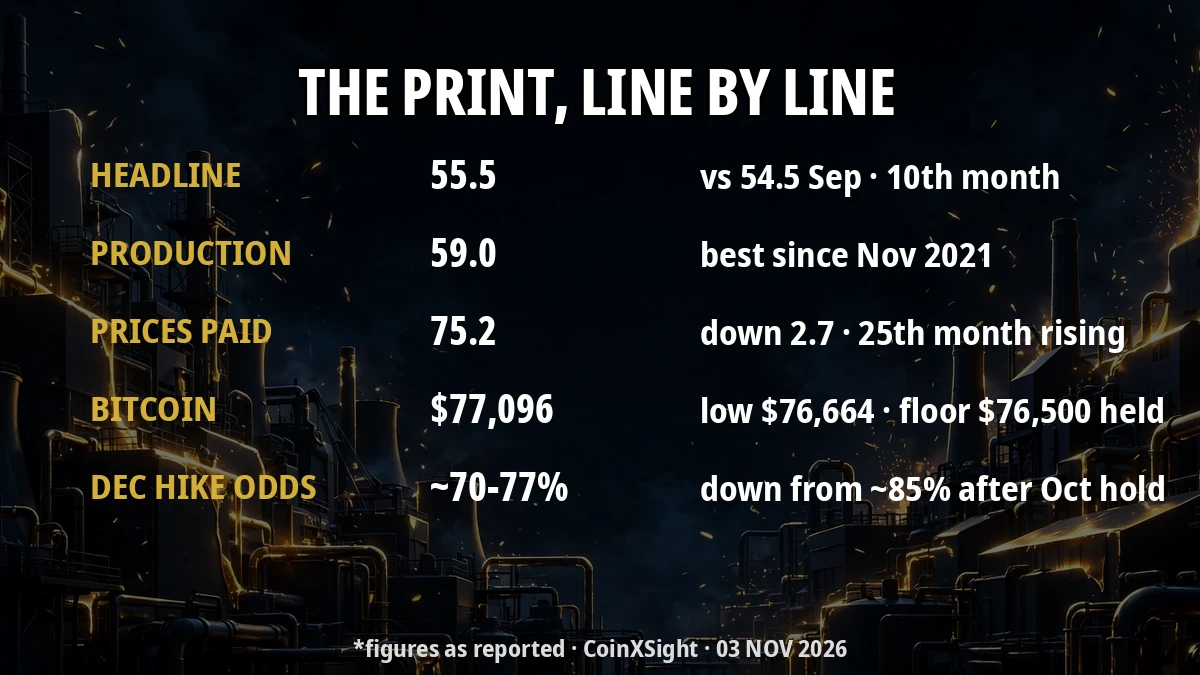
The print the doves were praying for arrived Monday night, and Bitcoin yawned. The Institute for Supply Management’s October manufacturing index rose to 55.5 from 54.5 in September — a beat against expectations of roughly 54.5 to 54.7, and the tenth straight month of expansion. Production jumped to 59.0, its best reading since November 2021. And the line that has owned this market for a month — prices paid — fell 2.7 points to 75.2, the biggest cooling in the inflation gauge since the hiking cycle began in earnest.
That is, on paper, the best combination available: growth accelerating, price pressure easing. It is the combination that is supposed to loosen the hawks’ grip on December. So why is Bitcoin trading at about $77,100 on Tuesday morning, down 1.3% from Monday’s open, its intraday low of $76,664 flirting with the $76,500 line that has defined this correction?
Because the print answered the easy question and left the hard one open. Growth is fine — nobody seriously doubted it after third-quarter GDP printed 3.4%. Inflation is the question, and 75.2 is not a clean answer. It is still the 25th consecutive month of rising input prices. More than half of purchasing managers — 53.1% — still reported paying more. The direction improved; the level did not. And in a market where December is priced as a hike until proven otherwise, direction alone does not move the needle. Proof does. Tuesday is the day proof starts arriving, from three directions at once.
The print, line by line
ISM Manufacturing, October 2026
October
September
Read
Headline PMI
55.5
54.5
Beat; 10th month of expansion
New orders
55.5
55.3
Demand steady, 10th month growing
Production
59.0
56.7
Highest since Nov 2021
Employment
52.4
52.7
Still growing, slightly slower
Prices paid
75.2
77.9
Cooling, but 25th month rising
Backlog of orders
54.6
56.4
Growing, slower
Supplier deliveries
59.1
59.0
Deliveries slowing, 11th month
Inventories
51.4
48.6
Back into expansion
Two details inside the release deserve more attention than the headline got. First, sentiment deteriorated for a third consecutive month even as activity accelerated — 66% of panelists’ comments were negative, with pricing volatility, longer lead times, tariffs, and the Middle East conflict doing the damage. Factories are busier and unhappier at the same time, which is what a tariff-and-war cost shock looks like from the inside. Second, the rival gauge disagrees: S&P Global’s final manufacturing PMI for October came in at 54.9, revised down from a 56.0 preliminary reading. Both surveys say expansion. They disagree on momentum, and the market will have to wait for services on Wednesday to break the tie.
The soft underbelly arrived in the same evening’s data dump. September construction spending fell 1.9% month-on-month, according to the Commerce Department — a reminder that the economy’s interest-rate-sensitive corners are not sharing in manufacturing’s resilience. A single soft construction print does not overturn a 55.5 headline. It does explain why traders treated the beat as a reason to hold positions, not add to them.
What it does to December
Start from where the debate actually stands, not where it stood last week. Immediately after the Fed’s October 28 hold — 3.75% to 4.00%, with Governor Cook and Cleveland’s Hammack dissenting in favor of a hike — futures priced a December increase at roughly 85%. By Monday, CME FedWatch pricing cited by Reuters and market newsletters had drifted to roughly 70% to 77%. The direction of travel favors the doves. The level still favors the hawks. That is the honest summary, and it is why Monday’s prices-paid cooling matters without settling anything: a 75.2 print keeps the drift alive but does not accelerate it. A print back above 77 would have.
The market’s next three chances to move that number arrive in a pile. Tonight at 22:00 Vietnam time, September JOLTS is expected near 7.2 million openings against August’s 7.079 million — a labor market that is cooling without collapsing, which is exactly the ambiguity the Fed’s hawks can live with. Friday’s payrolls report, the last employment data before the December 8–9 meeting, carries consensus in the mid-five figures after September’s soft 29,000, with unemployment at 4.2%. Between them sits the Bank of England on Thursday, expected to deliver its first hike since August 2023. The December question is not one print. It is a week of prints, and ISM was only the opening argument.
Bitcoin’s tape: the line is live again
Strip away the macro and the chart is blunt. Bitcoin closed last week near $77,584, above the $76,500 short-term holder cost basis that has acted as this correction’s floor. It opened Monday near $78,128. By Tuesday morning it was back near $77,100, having traded as low as $76,664 overnight. The floor is not broken. It is being tested, in the thin liquidity of an election week, while the market waits for data that could justify either direction.
The structure around that test is unchanged from the weekend and still unfriendly. U.S. spot Bitcoin ETFs recorded $643 million of net outflows on October 30, the first session after the hack and the largest single-day exit since June. Stablecoin supply shrank by about $4.1 billion over the previous week. XRP, the market’s other bellwether, sits near $1.25, pinned between $1.20 support and $1.30 resistance, below every major daily moving average. None of this is a crash setup. All of it is a market with no spare buying power — the kind that treats a good macro print as a reason not to sell, rather than a reason to buy.
The levels, restated because they now decide the week: a daily close below $76,500 opens the $75,718 weekly pivot and, beneath it, the $72,956 shelf. A reclaim of $79,500 to $80,500 is what turns the December repricing from the whole story into a footnote. Everything between is noise, and this week is unusually full of it.
The Binance chapter just changed tense
Buried under the macro, the week’s other scheduled event quietly resolved itself a day early. In Recovery Update #5 on Monday, Binance said the full zero-knowledge proof for its October 31 reserves snapshot is complete — users holding any of ten tokens (BTC, ETH, USDT, BNB, SOL, USDC, XRP, USD1, RLUSD, ZEC) can now verify their own balances are backed at least 1:1 using the exchange’s verifier tool, rather than taking the exchange’s word for it. The Block, crypto.news, and Bitcoin Insider all confirmed the update within hours. The proof had been expected Tuesday; it landed Monday.
That is a real milestone, and it deserves precise framing rather than celebration. The proof covers a snapshot — October 31, 00:00 UTC — not a live balance sheet. The snapshot’s own ratios leave almost no margin: Bitcoin at 100.04%, BNB at 101.30%, per Crypto Briefing’s analysis of the published figures. About 95% of the roughly $6.3 billion stolen has been replenished from corporate resources and insurance funds; the remaining 5% sits in less-liquid tokens still being sourced. A new snapshot covering more tokens lands Wednesday, November 4, with its own 40-to-50-hour proof to follow. And from today, Binance says it will progressively restore withdrawals on additional networks and assets — the next phase of the reopening — though the list and activation times are still undisclosed.
The honest posture, updated for Tuesday: the reserves claim for the ten covered tokens is now independently checkable, which is a genuine upgrade from last week’s trust-me snapshot. It is not an audit, it does not cover the outstanding 5%, and it does not make the exchange whole. Verification arrived. Completion did not — and the next snapshot on Wednesday will test whether the first proof was a one-off or a routine.
Today decides the frame
Tuesday is the week’s hinge, and not because of any single event. Americans vote in the midterm elections, with results landing Wednesday morning Vietnam time. A divided government — the gridlock outcome markets have priced as the base case — would leave crypto legislation, including the CLARITY Act’s Senate path, to grind on through negotiation; a sweep either way would rewrite the calendar. JOLTS lands at 22:00. The Binance proof, already live, gets its first full day of user verification. Any one of these is a footnote. Together they decide whether Monday’s ISM beat becomes the start of a repricing or just a good print in a bad month.
Three postures, in order of confidence. The growth story is intact — 55.5 with production at a five-year high is not a softening economy. The inflation story is cooling but unconvinced — 75.2 after 77.9 is progress, not victory, and December still leans hawkish until payrolls says otherwise. And Bitcoin’s story is unchanged — a market holding its line on fumes, waiting for a reason. Today hands it three. Watch which one it takes.
—
Disclaimer: This article is for informational purposes only and does not constitute financial advice. Figures are cited from official releases and market data as reported at the time of writing and are subject to revision. Cryptocurrency markets are volatile; always do your own research before making investment decisions.
Follow the week: CoinXSight publishes the preview before every major print and the verdict the morning after — JOLTS and the midterms tonight, ISM services Wednesday, the Bank of England Thursday, payrolls Friday. Follow the Analysis desk and none of them will reach you late.
CX
CoinXSight Alpha Desk
ALPHA // DESK
Quantitative Research Desk·Global Alpha Division
CoinXSight Institutional Research Desk produces quantitative crypto market intelligence, algorithmic models, and on-chain forensics.
QUANTITATIVE SUITE // DEEP ALPHA ENGINEACTIVE
BTC/USDT // LIVE SCANNER
CONFLUENCE 74
LIVE SPOT PRICE$82,807.47WEAK_BUY
TP2
$89,522.75
+9.07%
TP1
$85,056.42
+3.63%
ENTRY
$82,078.86
ZONE
SL
$80,590.09
-1.81%
Auto-detect Order Blocks, Fair Value Gaps and risk-adjusted DCA ladders in < 5s.