Leverage Trading Crypto: A Risk-First Guide to Margin and Futures
Understand how leverage works in crypto futures, the mechanics of margin, liquidation, funding rates, and why most leveraged traders lose money. A practical risk-first framework for using leverage responsibly.
MC
Marcus ChenSenior Quantitative Strategist·May 18, 2026 · 15 min read · Updated Oct 6
Before explaining how leverage works, you need to understand one statistic: 70-80% of retail futures traders lose money. This isn't crypto-specific — the same ratio applies in forex and traditional futures markets. Exchanges are required to disclose this in many jurisdictions.
Leverage doesn't change the probability of your trade being correct. It amplifies the outcome — making winners bigger and losers bigger. For traders without strict risk management, amplified losses arrive faster than amplified gains, and one bad trade can wipe out weeks of profits.
This guide takes a risk-first approach: understanding the dangers before exploring the opportunities.
How Leverage Actually Works
The Basic Mechanics
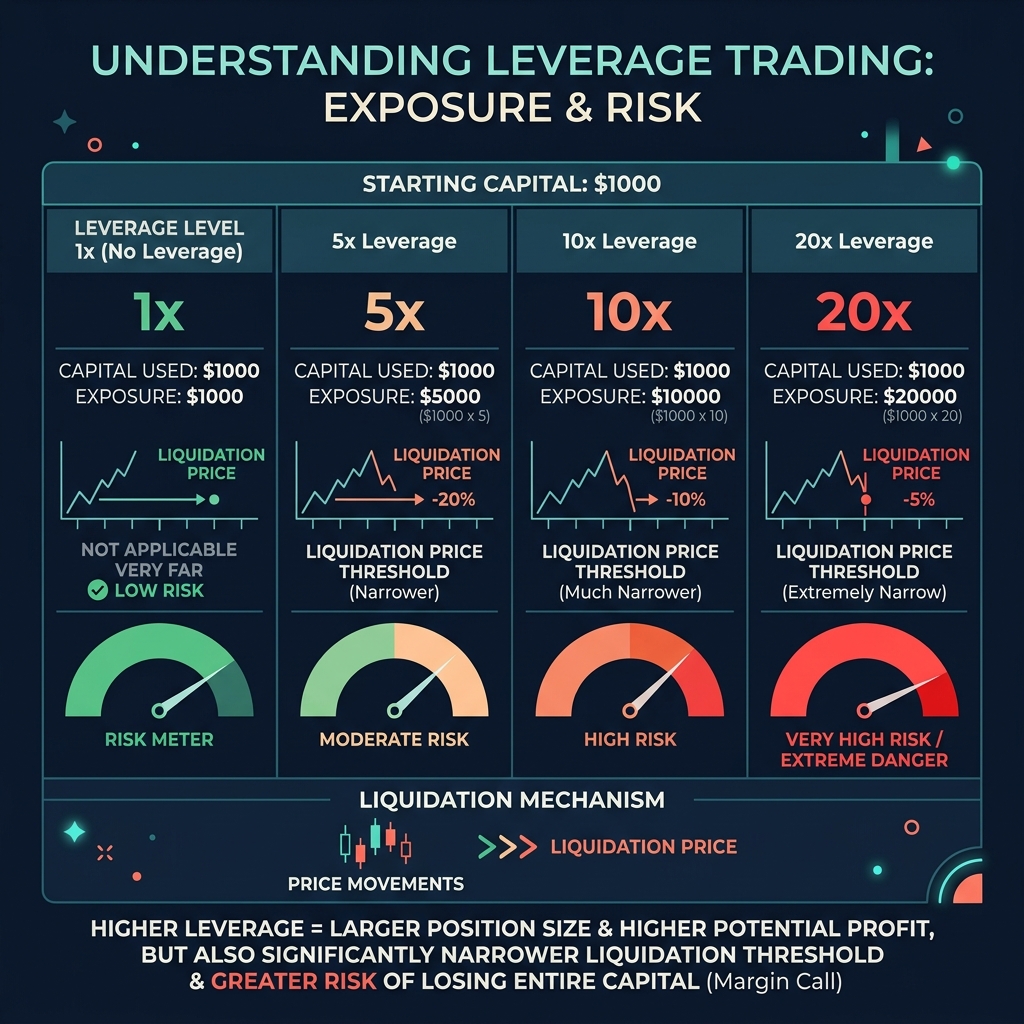
When you trade with leverage, you're borrowing capital from the exchange to increase your position size beyond your actual deposit (called margin).
Example — 10x leverage on a $1,000 account:
Component
Value
Your margin (deposit)
$1,000
Leverage multiplier
10x
Total position size
$10,000
Borrowed from exchange
$9,000
If BTC moves +5%, your $10,000 position gains $500 — a 50% return on your $1,000 margin. But if BTC moves -5%, your position loses $500 — also 50% of your margin. A -10% move would wipe out your entire $1,000.
Perpetual Futures vs. Margin Trading
Margin trading (spot leverage):
You borrow actual crypto or stablecoins
You pay hourly/daily interest on borrowed funds
No expiration date
Can be liquidated if margin ratio falls below threshold
Perpetual futures (most common in crypto):
You trade a contract that tracks the underlying asset's price
You never own the actual crypto
No expiration date (unlike traditional futures)
Funding rate mechanism keeps the contract price aligned with spot price
Can be liquidated based on margin ratio
Most crypto leverage trading happens through perpetual futures on exchanges like Binance, Bybit, and OKX.
Understanding Liquidation
Modern crypto analytics platforms integrate these signals with additional data layers — combining trading indicators, on-chain metrics, and AI analysis for higher-probability entries.
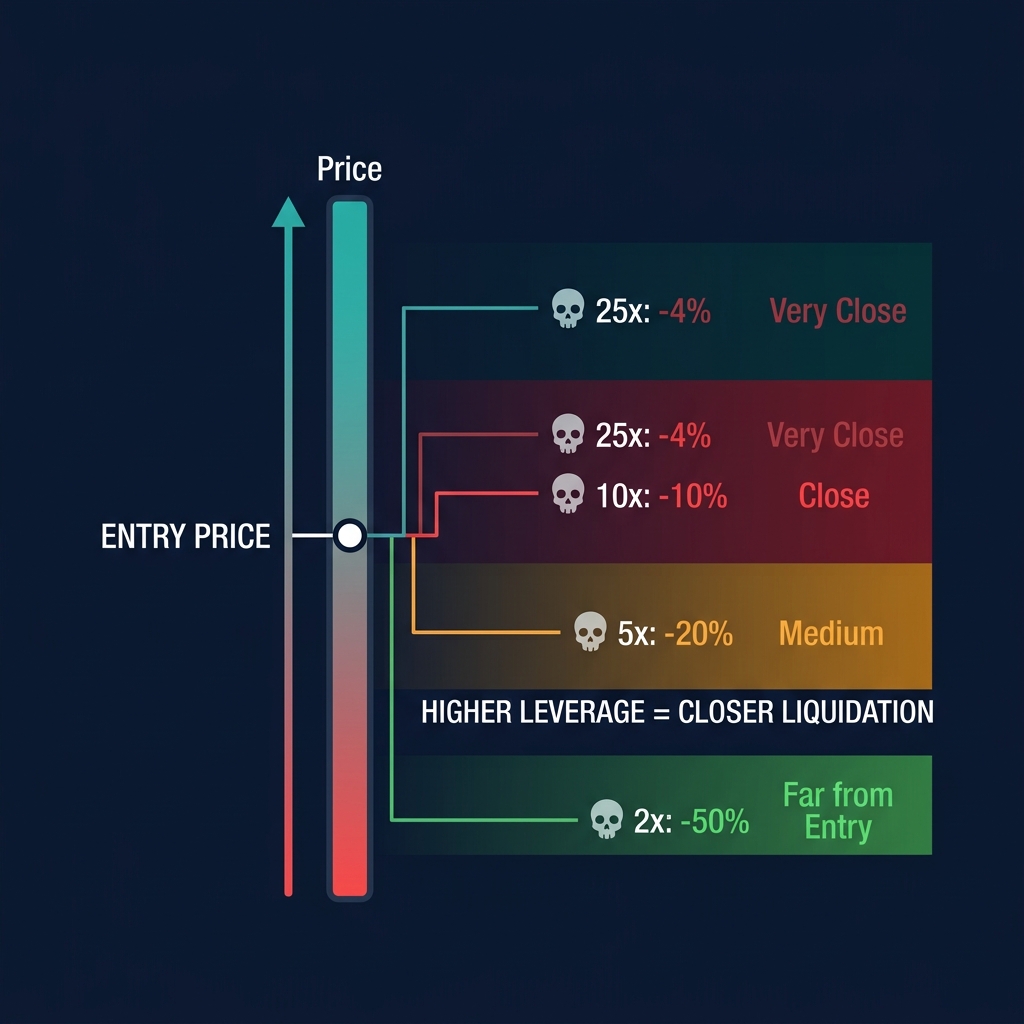
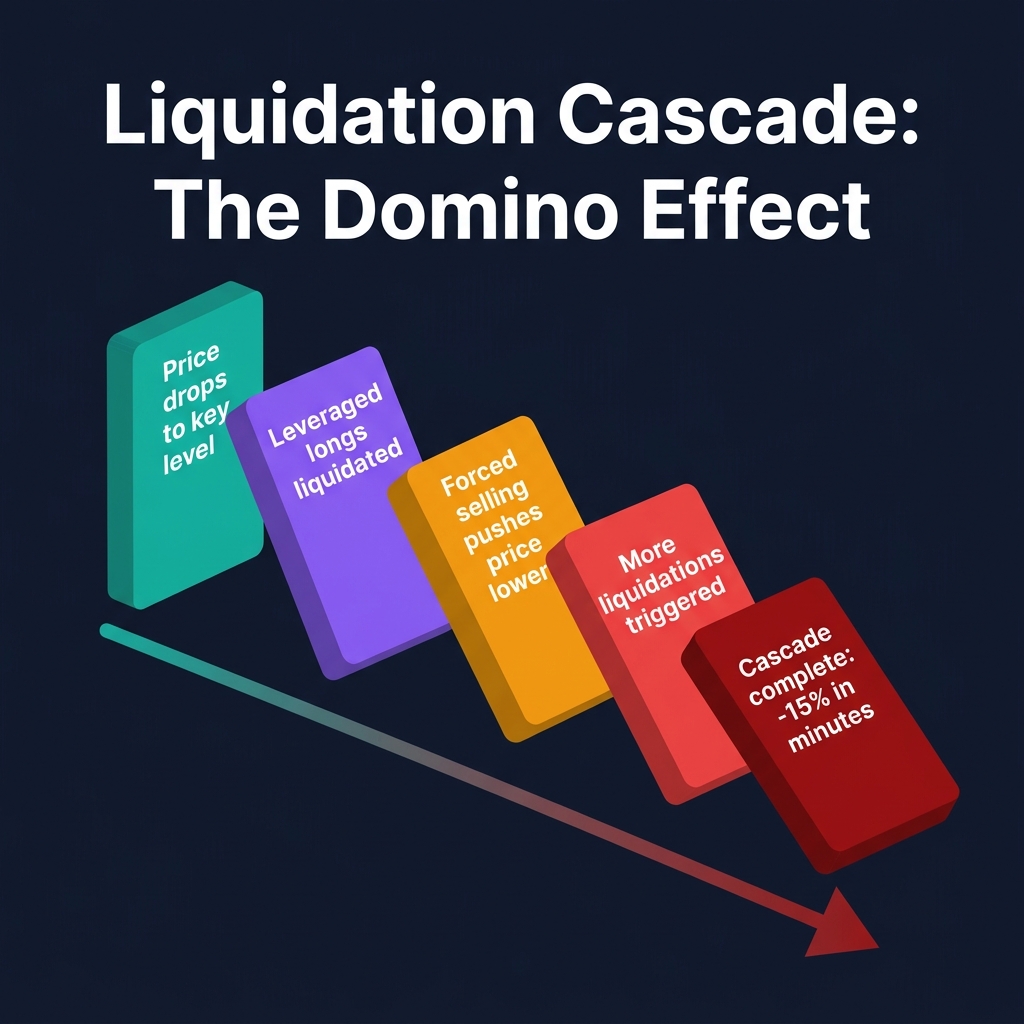
Liquidation is the mechanism that closes your position when losses approach your deposited margin. It's the single most important concept in leveraged trading.
How Liquidation Is Calculated
Your liquidation price depends on three factors:
Entry price — where you opened the position
Leverage used — higher leverage = closer liquidation price
At 100x leverage, a 1% adverse move liquidates your entire position. BTC regularly moves 1% within minutes.
Isolated vs. Cross Margin
Isolated margin: Only the margin allocated to a specific position can be lost. If you deposit $500 into an isolated 10x BTC long, you can only lose that $500. Your remaining account balance is protected.
Cross margin: Your entire account balance serves as margin for all open positions. This gives you a wider liquidation distance but means one bad trade can consume your entire account.
Recommendation: Always use isolated margin when learning. The defined maximum loss makes risk management straightforward.
Funding Rates: The Hidden Cost
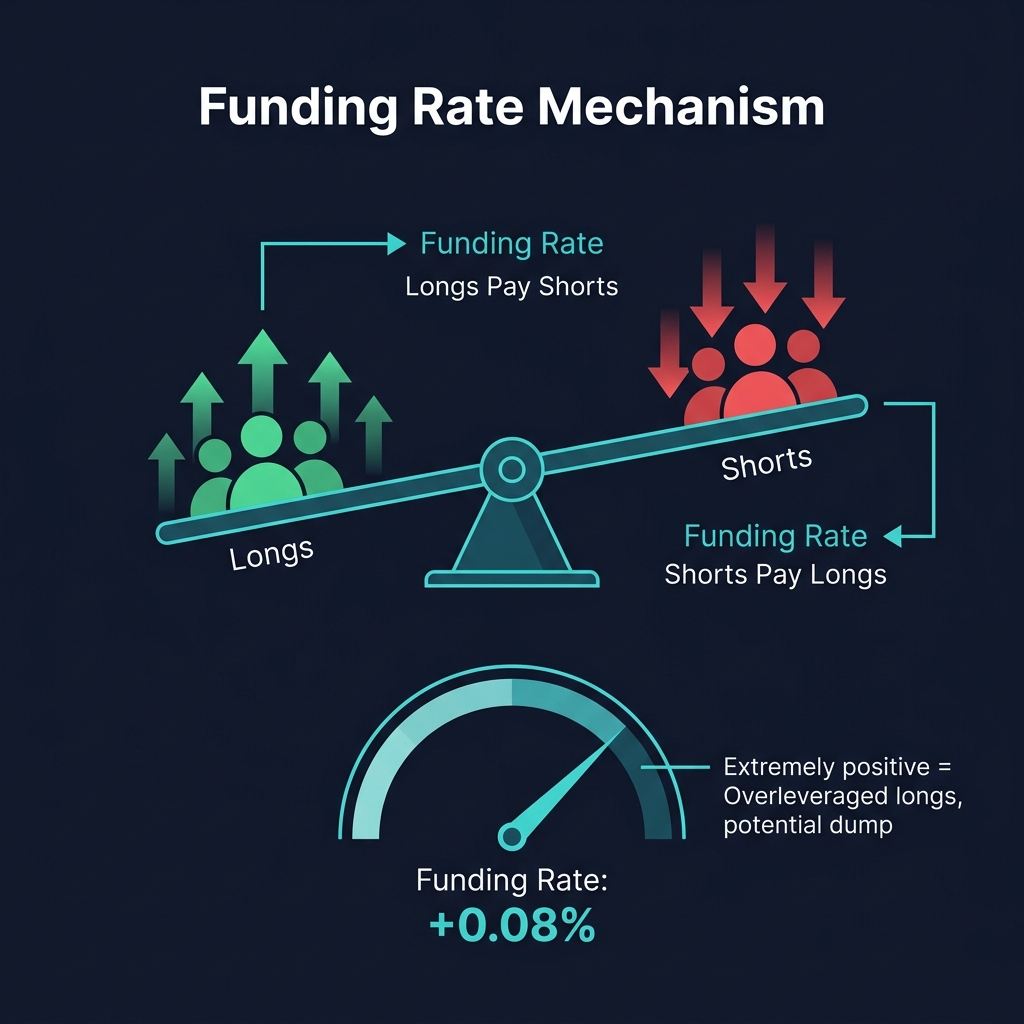
Perpetual futures use a funding rate mechanism to keep the contract price aligned with the spot price. Every 8 hours (on most exchanges), one side pays the other:
Positive funding rate: Longs pay shorts. This means more traders are bullish (long), so longs pay a premium.
Negative funding rate: Shorts pay longs. More traders are bearish, so shorts pay a premium.
Why Funding Rates Matter
1. Cumulative cost. A 0.01% funding rate per 8 hours seems trivial. But at 10x leverage, you're paying 0.1% on your position size every 8 hours — that's 0.3%/day or ~9%/month. On a $10,000 position, that's $900/month in fees, even if the price doesn't move.
Funding rate > 0.05%: Market is overleveraged long → higher probability of long squeeze
Funding rate < -0.05%: Market is overleveraged short → higher probability of short squeeze
3. Strategic opportunity. When funding rates are extreme, contrarian trades (going against the crowd) have positive expected value because:
You get paid funding instead of paying it
Overcrowded positions tend to unwind violently
CoinXSight's Deep Alpha module displays funding rate data alongside technical indicators, allowing you to gauge leverage sentiment before entering trades.
The Risk-First Framework for Leverage
Rule 1: Size Your Position by Risk, Not by Leverage
Most beginners think: "I have $1,000 and want to trade BTC with 10x leverage, so my position is $10,000."
Professional traders think differently: "I'm willing to risk $20 on this trade. My stop loss is 2% from entry. So my position size is $20 / 0.02 = $1,000. With $1,000 in margin, my leverage is 1x."
Identify your stop-loss distance based on technical levels
Calculate position size: Risk Amount ÷ Stop-Loss Distance
The leverage is a consequence of the calculation, not an input
Rule 2: Never Use More Than 5x Effective Leverage
"Effective leverage" is your total position size divided by your total account equity. Even if an exchange offers 100x, keeping effective leverage under 5x gives you enough margin buffer to survive normal market volatility.
Effective leverage
Margin buffer
Survives typical daily volatility?
1-2x
50-100%
Yes — handles 5-10% swings
3-5x
20-33%
Yes — handles 3-5% swings
10x
10%
Marginal — 3% swing risks liquidation
20x+
<5%
No — liquidated by normal intraday noise
Rule 3: Always Set Stop Losses Before Entry
On a leveraged position, a stop loss is not optional — it's the difference between a manageable loss and total liquidation. Place your stop loss at a technical invalidation level (below support for longs, above resistance for shorts), not at an arbitrary percentage.
If funding costs exceed 0.5% of your position per day, the trade needs to move significantly in your favor just to break even.
When Leverage Makes Sense
Despite the risks, there are legitimate use cases for moderate leverage:
1. Capital Efficiency for Confirmed Setups
When CoinXSight's Confluence Score shows 8+ with multi-timeframe alignment and favorable on-chain metrics, using 2-3x leverage on a well-defined setup can improve capital efficiency without excessive risk.
2. Hedging Existing Positions
If you hold 1 BTC in spot and want to protect against a short-term decline without selling, you can open a small short futures position. This is a legitimate risk reduction strategy used by professional traders.
3. Range Trading in Sideways Markets
When BTC is in a defined range (identified via Bollinger Bands or Support/Resistance), small leveraged positions at range boundaries with tight stop losses can be profitable.
4. Funding Rate Arbitrage
When funding rates are extremely positive (longs paying shorts), you can buy spot BTC and simultaneously open a short futures position. You earn the funding rate with zero directional risk. This is a professional strategy that requires understanding of basis risk.
Common Leverage Mistakes
Mistake 1: Averaging Down on a Losing Leveraged Position
Adding to a losing position ("averaging down") increases your total exposure and moves your effective liquidation price closer to current price. In spot trading, this can work. In leveraged trading, it accelerates liquidation.
Mistake 2: Moving Your Stop Loss
"I'll give it a little more room" is the most expensive sentence in leveraged trading. Moving a stop loss widens your risk beyond the original plan. If you wouldn't take the trade at the new stop level with the original position size, you shouldn't move the stop.
Mistake 3: Revenge Trading After Liquidation
After a liquidation, the emotional impulse is to "make it back quickly" by taking a larger position. This almost always leads to a second, larger loss. After any liquidation, take at least 24 hours away from trading. Review what went wrong using the framework in the Trading Psychology Guide.
Mistake 4: Using Leverage Without Understanding the Underlying Asset
Leverage amplifies your analysis quality. If your directional analysis is 55% accurate (slightly better than random), leverage can make that edge profitable. If your analysis is 50% accurate (coin flip), leverage will lose money faster due to fees, funding, and slippage. Master spot trading first.
A Practical Leverage Checklist
Before every leveraged trade, verify:
[ ] Confluence Score ≥ 7 on primary timeframe
[ ] Stop loss at technical invalidation level (not arbitrary)
[ ] Position size calculated from risk amount, not leverage multiplier
[ ] Effective leverage ≤ 5x
[ ] Isolated margin mode enabled
[ ] No major news/events within 4 hours
[ ] Funding rate is not extreme (< 0.03% against your direction)
[ ] Current drawdown from recent peak < 5% (not revenge trading)
If any item fails, either reduce leverage or skip the trade entirely.
Summary
Leverage is a precision tool that amplifies both skill and mistakes. Most retail traders lose money with leverage because they treat it as a way to make more money rather than as a risk management variable that should be derived from position sizing calculations.
The core principles:
Size by risk, not by leverage
Never exceed 5x effective leverage
Always use isolated margin and stop losses
Account for funding rate costs on longer holds
Master spot trading before touching futures
Leverage doesn't make bad traders profitable — it makes them broke faster. Used correctly within a disciplined framework, moderate leverage (2-3x) can improve capital efficiency on high-conviction setups without catastrophic downside risk.
Master risk management for crypto trading. Learn position sizing formulas, stop-loss strategies, and how CoinXSight's Portfolio module tracks your risk…