Election Day, Proof Day, Jobs Night: Three Verdicts in 24 Hours for a Market Holding Its Line
Election day in America, Binance's zk-SNARK proof already verifiable a day early, and September JOLTS at 22:00 VN u2014 three verdicts in 24 hours for a Bitcoin market still defending $76,500.
CX
CoinXSight Alpha DeskQuantitative Research Desk·Nov 3, 2026 · Updated Nov 3
America is voting, Binance’s proof is already checkable, and the labor market gets its say tonight. For a Bitcoin market that has spent a week defending one line in the sand, Tuesday is not a day of answers — it is a day of three verdicts arriving in sequence, each capable of moving the frame the others set.
Start with the price, because it is the least ambiguous thing on the screen. Bitcoin trades near $76,800 on Tuesday afternoon Vietnam time, down roughly 2% over 24 hours, after slipping below $77,000 in the morning session. Ethereum sits near $2,253, down about 1%. XRP is the quiet one at roughly $1.25, essentially flat on the day, pinned below every major daily moving average. The Crypto Fear & Greed Index reads 26, down from 37 — fear, deepening, on a day when the news flow is supposed to be the point.
That is the backdrop, not the story. The story is what Tuesday puts in front of this market, in order.
The vote: gridlock, sweep, or neither — and why the 60-vote rule matters more than the map
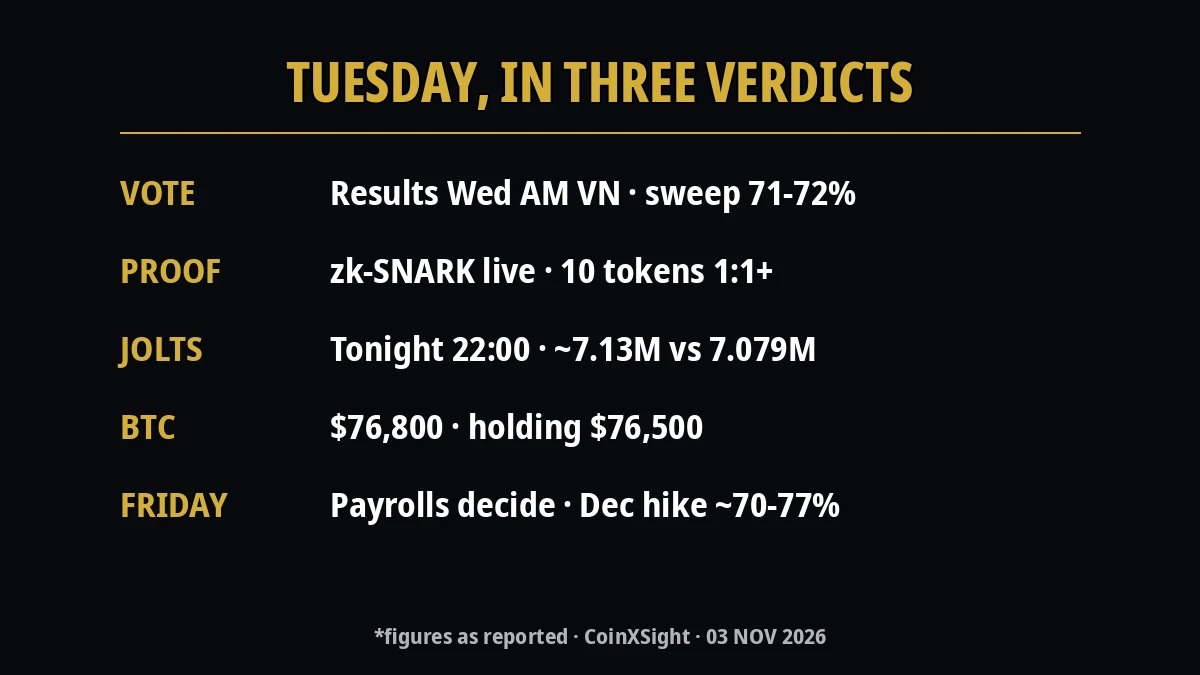
Americans are casting midterm ballots on Tuesday, with results landing Wednesday morning Vietnam time. The market’s base case, priced for weeks, has been divided government: a Democratic House, a Republican Senate, and the gridlock that follows. Prediction markets leaned the other way into the vote — Polymarket and Kalshi put a Democratic sweep of both chambers at 71 to 72% as of November 1 — which is itself a reason to be careful about what “priced in” means this week. If the sweep lands, it is not the outcome most trading desks modeled. If gridlock lands, it is the outcome the prediction markets discounted.
Here is the part that should discipline either reaction: for crypto law specifically, the election changes less than the headlines suggest. The Digital Asset Market Clarity Act stalled on September 15, when the Senate failed to invoke cloture on a 49-to-50 vote, short of the 60 needed. Analysts at 21Shares argue the bill is best treated as dead until the 120th Congress convenes in January 2027, with a motion to reconsider filed but going nowhere. A Democratic House would likely add stronger consumer-protection, conflict-of-interest, and DeFi disclosure provisions to any market-structure bill, delaying it further. A Republican sweep would remove that friction — but not the Senate’s 60-vote threshold, which neither party is likely to hold outright.
That is why the honest framing is not “gridlock kills CLARITY” or “sweep saves CLARITY.” It is that the near-term path for crypto rules runs through agency rulemaking, not legislation. After the Senate failed to advance the bill, officials at both the Commodity Futures Trading Commission and the Securities and Exchange Commission said they would use rulemaking to set clearer rules of the road, and the CFTC has since said it is advancing its first set of crypto market-structure rules. A divided Congress would solidify that as the main path. A sweep would speed legislation but still face the calendar: analysts at TD Cowen see market-structure law more likely clearing in 2027, with final rules possibly not taking effect until 2029.
Kevin O’Leary, warning of gridlock last week, added the caveat the market keeps skipping: even if the legislation passes, he is not convinced it automatically sends Bitcoin higher. The bill’s unresolved fights — stablecoin yield, ethics provisions around officials’ holdings — are the substance, not the sideshow. Traders who buy the election headline without reading the legislative mechanics are buying a narrative the Senate arithmetic does not support.
The proof: Binance’s zk-SNARK arrived a day early, and the fine print still matters
The week’s second verdict landed before the voting started. In Recovery Update #5 on Monday, Binance said the full zero-knowledge proof for its October 31 reserves snapshot is complete — a day ahead of the Tuesday estimate the exchange itself published in Recovery Update #3. Users holding any of ten tokens — BTC, ETH, USDT, BNB, SOL, USDC, XRP, USD1, RLUSD, and ZEC — can now verify their own balances are backed at least 1:1 using the exchange’s verifier tool, rather than taking the exchange’s word for it. The Block, CoinEdition, and crypto.news confirmed the update within hours of publication.
That is a genuine upgrade in kind, not just in tone. A Merkle tree lets each user confirm their account is included in the snapshot; the zk-SNARK shows reserves cover user balances at least 1:1 without revealing any individual’s balance. Verification replaces assertion, which is the entire point of a proof-of-reserves regime after a $6.3 billion breach.
The fine print deserves equal weight. The proof covers a snapshot — October 31, 00:00 UTC — not a live balance sheet. The snapshot’s own ratios leave almost no margin: Bitcoin at 100.04%, BNB at 101.30%, per Crypto Briefing’s analysis of the published figures. About 95% of the roughly $6.3 billion stolen has been replenished from corporate resources and insurance funds; the remaining 5% sits in less-liquid tokens still being sourced. A new snapshot covering more tokens lands Wednesday, November 4, with its own 40-to-50-hour proof to follow. And from today, Binance says it will progressively restore withdrawals on additional networks and assets — the next phase of the reopening — though the list and activation times are still undisclosed.
So the correct posture, updated for Tuesday afternoon: the reserves claim for the ten covered tokens is now independently checkable, which is a real milestone. It is not an audit, it does not cover the outstanding 5%, and it does not make the exchange whole. The first proof arriving early is encouraging. Whether the second proof, due late this week, arrives on the same schedule is the test of whether this is a routine or a one-off.
The jobs print: JOLTS tonight decides whether the doves keep their drift
The third verdict arrives at 22:00 Vietnam time, when the Bureau of Labor Statistics releases September’s Job Openings and Labor Turnover Survey. Consensus sits near 7.1 million openings — FxBlue lists 7.13 million — against August’s 7.079 million, with LinkUp’s independent forecast a touch softer at 7.05 million. The range matters more than any single number: a print near 7.1 million describes a labor market cooling without collapsing, which is exactly the ambiguity the Fed’s hawks can live with.
That ambiguity is the whole December debate. Monday morning’s ISM manufacturing report — headline 55.5, production at 59.0, prices paid cooling 2.7 points to 75.2 — was the best combination the doves could ask for, and it still did not settle anything: 75.2 is the 25th consecutive month of rising input prices, and more than half of purchasing managers still reported paying more. Futures pricing for a December hike drifted from roughly 85% immediately after the October 28 hold to roughly 70 to 77% by Monday. The direction favors the doves. The level still favors the hawks.
JOLTS can move that level in either direction. A print meaningfully above 7.2 million would argue labor demand is not cooling at all, hardening the hike case into Friday’s payrolls. A print below 7.0 million would argue the cooling is accelerating, giving the doves their second data point in two days. A print in the middle — the consensus zone — leaves the debate exactly where ISM left it: drifting dovish, still hawkish, waiting on payrolls. Friday’s report carries consensus in the mid-five figures after September’s soft 29,000, with unemployment at 4.2%, and it is the last employment data before the December 8–9 meeting. Tonight is the setup. Friday is the verdict.
The tape: the $76,500 line is doing all the work
Strip away the three verdicts and the chart is blunt. Bitcoin closed last week near $77,584, above the $76,500 short-term holder cost basis that has defined this correction. It opened Monday near $78,128. By Tuesday afternoon it was back near $76,800, having traded as low as $76,664 overnight. The floor is not broken. It is being tested for the third session in a row, in the thin liquidity of an election week, while the market waits for data that could justify either direction.
The structure around that test is unchanged from the weekend and still unfriendly. U.S. spot Bitcoin ETFs recorded $643 million of net outflows on October 30, the first session after the hack and the largest single-day exit since June. Stablecoin supply shrank by about $4.1 billion over the previous week. XRP sits near $1.25, pinned between $1.20 support and $1.30 resistance, below every major daily moving average, its daily RSI near 37 — weak momentum, not capitulation. None of this is a crash setup. All of it is a market with no spare buying power: the kind that treats good news as a reason not to sell, rather than a reason to buy.
The levels, restated because they now decide the week: a daily close below $76,500 opens the $75,718 weekly pivot and, beneath it, the $72,956 shelf. A reclaim of $79,500 to $80,500 is what turns the December repricing from the whole story into a footnote. Everything between is noise, and this week is unusually full of it.
Tuesday’s three verdicts, in order
Verdict
When (Vietnam time)
What to watch
Market read
Midterm results
Wednesday morning
House and Senate control; margin of any sweep
Gridlock priced as base case; sweep would reprice the CLARITY calendar, not remove the 60-vote hurdle
Binance zk-SNARK proof
Live since Monday
User verification uptake; next snapshot Wednesday, proof 40–50 hours later
Ten tokens independently checkable at 1:1+; snapshot, not audit; 5% still outstanding
September JOLTS
Tonight, 22:00
Openings vs ~7.13M consensus and 7.079M August
Above 7.2M hardens the hike case; below 7.0M feeds the dovish drift; consensus leaves payrolls to decide
ISM bridge (Monday)
Already in
Headline 55.5, prices paid 75.2
Growth intact, inflation cooling but unconvinced; December still leans hawkish
What today actually decides
It is tempting to treat Tuesday as a coin flip with three coins. It is better treated as a sequence. The election decides the legislative calendar — slowly, through a 60-vote Senate, whatever the map says Wednesday morning. The Binance proof decides whether trust in the market’s largest exchange is verifiable rather than asserted — and the next snapshot decides whether that verification is a habit. JOLTS decides whether the labor market gives the doves a second argument before payrolls.
Three postures, in order of confidence. The growth story is intact — 55.5 with production at a five-year high is not a softening economy. The verification story is genuinely better than it was on Friday — a completed zk-SNARK, a day early, is more than a press release. And Bitcoin’s story is unchanged — a market holding its line on fumes, waiting for a reason. Today hands it three. Watch which one it takes, and in what order.
Disclaimer: This article is for informational purposes only and does not constitute financial advice. Figures are cited from official releases and market data as reported at the time of writing and are subject to revision. Cryptocurrency markets are volatile; always do your own research before making investment decisions.
Follow the week: CoinXSight publishes the preview before every major print and the verdict the morning after — JOLTS and the midterms tonight, ISM services Wednesday, the Bank of England Thursday, payrolls Friday. Follow the Analysis desk and none of them will reach you late.
CX
CoinXSight Alpha Desk
ALPHA // DESK
Quantitative Research Desk·Global Alpha Division
CoinXSight Institutional Research Desk produces quantitative crypto market intelligence, algorithmic models, and on-chain forensics.
QUANTITATIVE SUITE // DEEP ALPHA ENGINEACTIVE
BTC/USDT // LIVE SCANNER
CONFLUENCE 74
LIVE SPOT PRICE$82,807.47WEAK_BUY
TP2
$89,522.75
+9.07%
TP1
$85,056.42
+3.63%
ENTRY
$82,078.86
ZONE
SL
$80,590.09
-1.81%
Auto-detect Order Blocks, Fair Value Gaps and risk-adjusted DCA ladders in < 5s.