ChatGPT for Crypto Trading: Beginner’s Guide (2026)
Learn how to use ChatGPT for crypto trading — 5 starter prompts, daily workflow, and real examples. Beginner-friendly 2026 guide. Perfect for any crypto trading platform setup.
KZ
Dr. Kevin ZhangPrincipal AI & Quantitative Researcher·May 23, 2026 · 8 min read · Updated Oct 6
AI-assisted crypto trading is using large language models — tools like ChatGPT (OpenAI), Google Gemini (Google), Claude (Anthropic) — as research, analysis, and decision-support tools alongside your trading platform. You ask questions, paste data, and get structured analysis back in seconds. For a broader overview of AI in crypto, see our AI in Crypto Trading guide.
This is NOT about connecting an AI to your exchange and letting it trade for you. That's algo trading — a different discipline with different risks. AI-assisted trading means you stay in control while using AI as a faster, smarter research assistant.
Think of it this way: before AI, you'd spend 2 hours reading 15 articles about whether ETH's supply-demand dynamics favor bulls or bears. Now, you paste the relevant data into ChatGPT and get a structured breakdown in 30 seconds. The trading decision is still yours.
💡 CoinXSight's Deep Alpha module is purpose-built for this workflow. It pre-computes the technical analysis (RSI, MACD, EMA, order blocks) and packages it into a Confluence Score — the same kind of structured analysis you'd ask ChatGPT to produce, but computed in real-time from live market data.
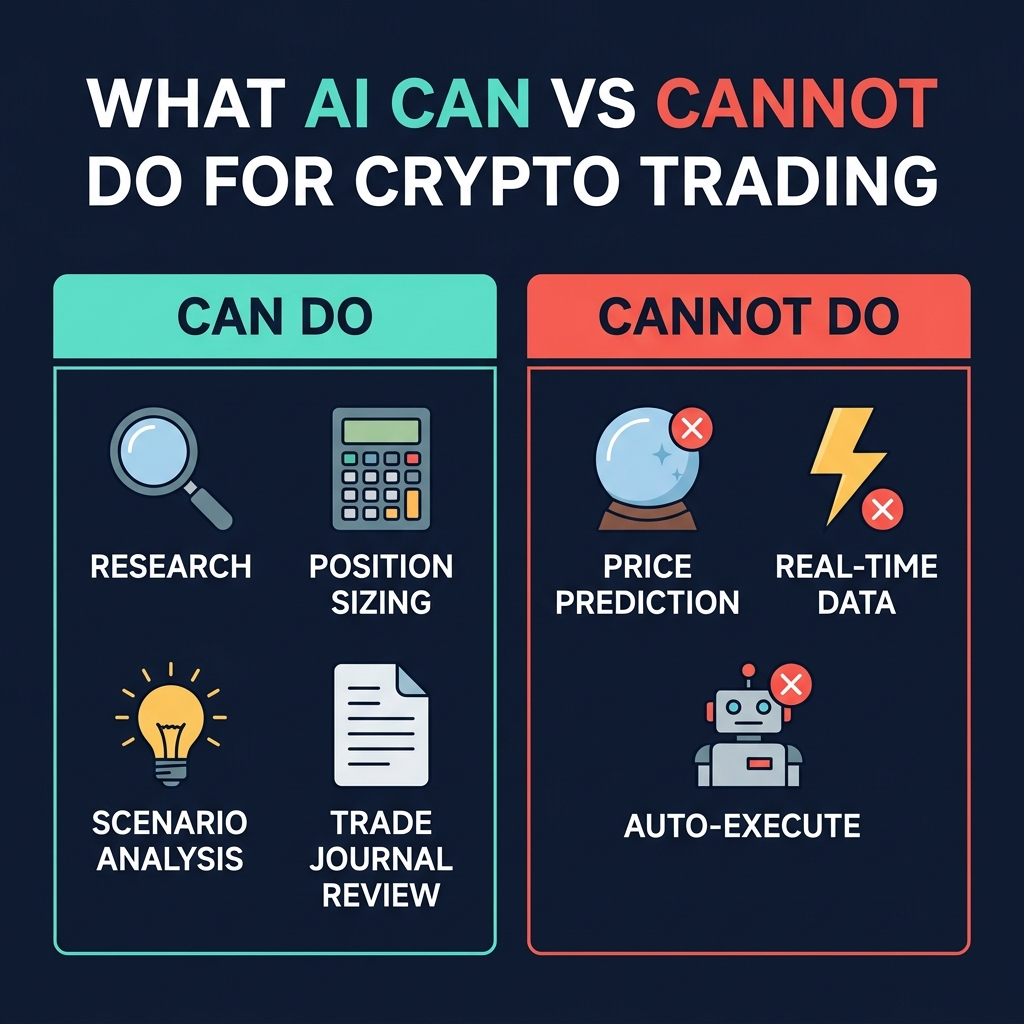
What AI Can and Cannot Do for Your Trading
Before exploring prompts and workflows, set realistic expectations. This is the most important section in this guide.
What AI Does Well
Capability
Example
Why It Works
Summarize complex topics
"Explain what a CME gap is and why it matters for BTC"
LLMs compress information from thousands of sources
Analyze structured data
Paste a table of 10 tokens with RSI, volume, and price — ask for the strongest setup
Pattern matching in tabular data via technical analysis concepts is a core LLM strength
Generate trading plans
"Create a swing trading plan for SOL with entry at $165, stop at $158, target $185"
Risk/reward math and plan structure are formulaic
Explain indicator readings
"RSI is 78, MACD histogram is declining, price is at resistance — what does this mean?"
Combining multiple signals into a narrative is what LLMs excel at
Brainstorm scenarios
"What are 3 bullish and 3 bearish scenarios for BTC if the Fed holds rates in June?"
Generating structured what-if analysis
What AI Cannot Do
Limitation
Why
What to Do Instead
Predict price
LLMs don't access real-time data and have no edge over random guessing on future prices
Use AI for analysis, not prediction. Make your own price calls.
Access live market data
ChatGPT's training data has a cutoff date; Gemini has limited real-time access
Use CoinXSight for live data → paste into ChatGPT for analysis
Execute trades
LLMs can't connect to exchanges (and you shouldn't want them to)
AI plans the trade; you execute it on your exchange
Replace risk management
AI will never tell you to close a losing position at 3 AM
Set stop losses. Always. AI doesn't babysit your trades.
Guarantee accuracy
LLMs hallucinate — they can invent statistics, misattribute patterns, or give confidently wrong analysis
Cross-check every claim against your platform data
⚠️ Critical limitation: ChatGPT and Gemini do not have real-time crypto prices. If you ask "What is the current BTC price?", the answer may be hours, days, or months old. Always verify prices on CoinXSight or your exchange before acting on AI analysis.
Real Example — BTC Analysis via ChatGPT (May 2026)
A trader pasted BTC's 4H data into ChatGPT: price $107,200, RSI(14) = 68,
MACD histogram declining, 50-EMA acting as dynamic support at $105,800.
ChatGPT identified the setup as "late-stage bullish momentum with early
exhaustion signals" and suggested monitoring RSI for a cross below 65.
Two days later, BTC pulled back to $104,600 — a 2.4% correction that
aligned with the AI's caution. CoinXSight's Confluence Score had read
5/10 at the time, confirming mixed signals.
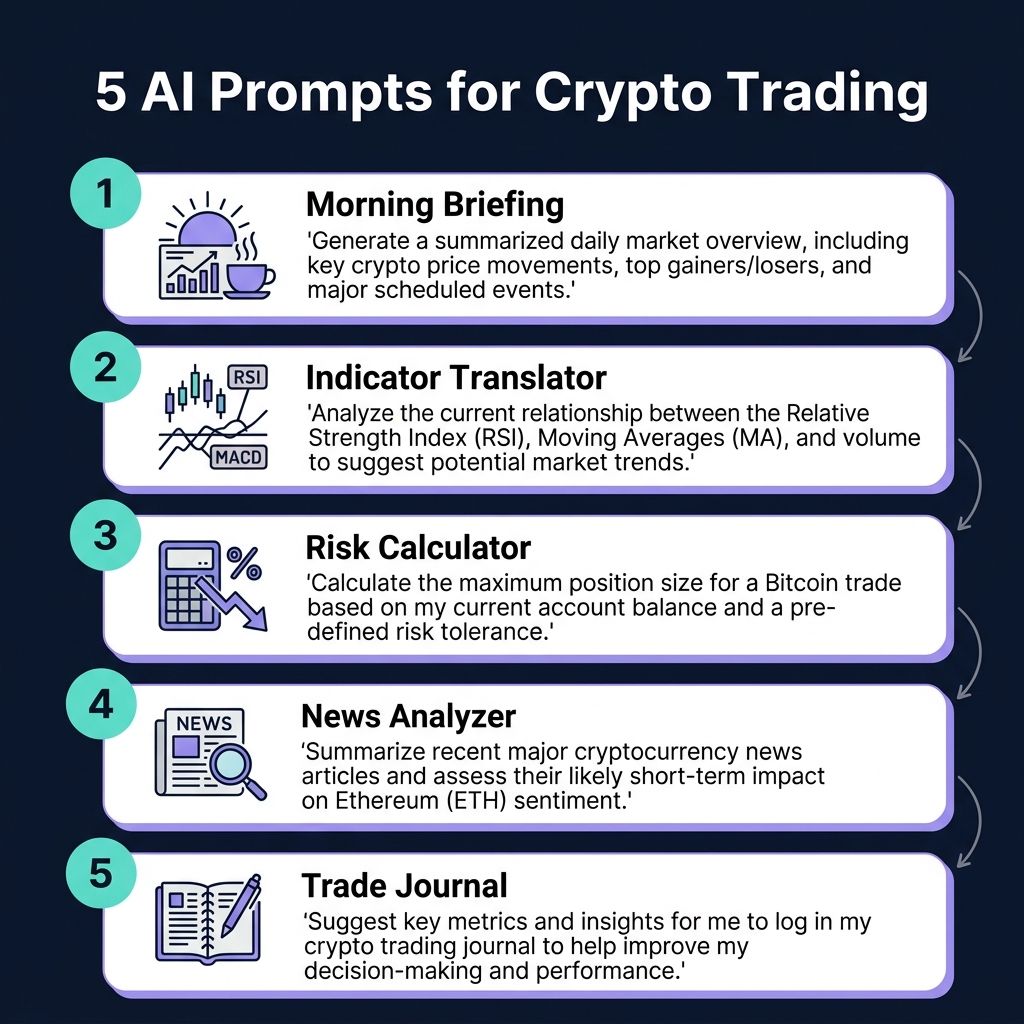
5 Starter Prompts That Actually Work
Understanding 5 Starter Prompts That Actually Work is a key part of crypto technical analysis. Most professional trading indicators on any crypto trading platform will help you apply these concepts in real time.
These prompts are battle-tested and produce useful output. Copy them, modify the token/data, and use them daily.
Prompt 1: The Morning Briefing
Act as a senior crypto analyst. I'm reviewing these tokens today: BTC, ETH, SOL.

Here are the current readings from my analytics platform:
- BTC: Price $107,200, RSI(14) = 62, MACD histogram positive but declining,
  above EMA 21 and 50, Confluence Score 7/10
- ETH: Price $2,580, RSI(14) = 55, MACD just crossed bullish,
  below EMA 50, Confluence Score 5/10
- SOL: Price $172, RSI(14) = 71, Supertrend bullish,
  near resistance at $175, Confluence Score 6/10

For each token, give me:
1. Current bias (bullish/bearish/neutral) with confidence level
2. Key level to watch today
3. One specific trade setup IF it triggers
4. Biggest risk factor right now
Why this works: You're giving AI structured data to analyze, not asking it to pull data it doesn't have. The output is actionable — specific levels, specific setups. To understand each indicator mentioned here, start with our RSI Indicator guide.
Prompt 2: The Indicator Translator
I'm looking at a 4H BTC chart and seeing these signals:
- RSI: 34 (near oversold)
- MACD: Histogram negative but bars getting smaller (potential convergence)
- Price: Just touched the lower Bollinger Band
- Volume: 30% above 20-period average on the last red candle
- Supertrend: Still bearish (red)

Explain what this combination of signals means in plain language.
Is this a potential reversal setup or a continuation of the downtrend?
What additional confirmation would I need before entering a long?
Why this works: Instead of reading 5 different guides for 5 different indicators, you get a unified interpretation. AI excels at synthesizing multiple data points into a narrative.
Prompt 3: The Risk Calculator
I want to enter a long position on ETH at $2,550.
My stop loss is at $2,480 (below the demand zone).
My account size is $5,000 and I risk 2% per trade.

Calculate:
1. Position size in ETH
2. Position size in USDT
3. Risk/reward if my target is $2,720
4. Risk/reward if my target is $2,650 (conservative)
5. What leverage would I need on a futures position to match this position size with $500 margin?
Why this works: Position sizing math is tedious and error-prone when done manually. AI does it instantly and correctly every time.
The core position sizing formula that AI helps you calculate:
Position Size = (Account Balance × Risk Per Trade%) / Stop Loss Distance%

Example: $10,000 × 2% / 3% = $6,667 position size
Prompt 4: The News Analyzer
Here's a crypto news headline and summary:

"Ethereum Foundation announces EIP-4844 Phase 2 upgrade targeting
Q3 2026. Expected to reduce L2 transaction costs by an additional
80% and increase data availability by 10x."

Analyze this for me:
1. Is this bullish, bearish, or neutral for ETH price? Why?
2. Which other tokens benefit most? (L2 tokens, competitors?)
3. What's the expected timeframe for price impact?
4. How should I adjust my ETH position or watchlist based on this?
5. Any historical parallels to similar upgrades?
Why this works: Fundamental analysis of news events is time-consuming. AI can contextualize news against historical patterns in seconds.
Prompt 5: The Trade Journal Reviewer
Here are my last 5 trades:

1. BTC long at $105,200 → closed at $107,800 (+2.5%) — held 3 days
2. ETH short at $2,620 → stopped out at $2,660 (-1.5%) — held 4 hours
3. SOL long at $168 → closed at $174 (+3.6%) — held 2 days
4. BTC long at $108,500 → stopped out at $107,200 (-1.2%) — held 6 hours
5. ETH long at $2,510 → closed at $2,580 (+2.8%) — held 1 day

Analyze my trading patterns:
1. Win rate and average R:R
2. Am I better at longs or shorts?
3. Do I hold winners long enough? Do I cut losers fast enough?
4. What's my biggest pattern weakness?
5. One specific thing I should change next week.
Why this works: Self-analysis is the hardest part of trading. AI provides an objective review of your journal without emotional bias. For more on risk discipline, see our Crypto Risk Management guide.
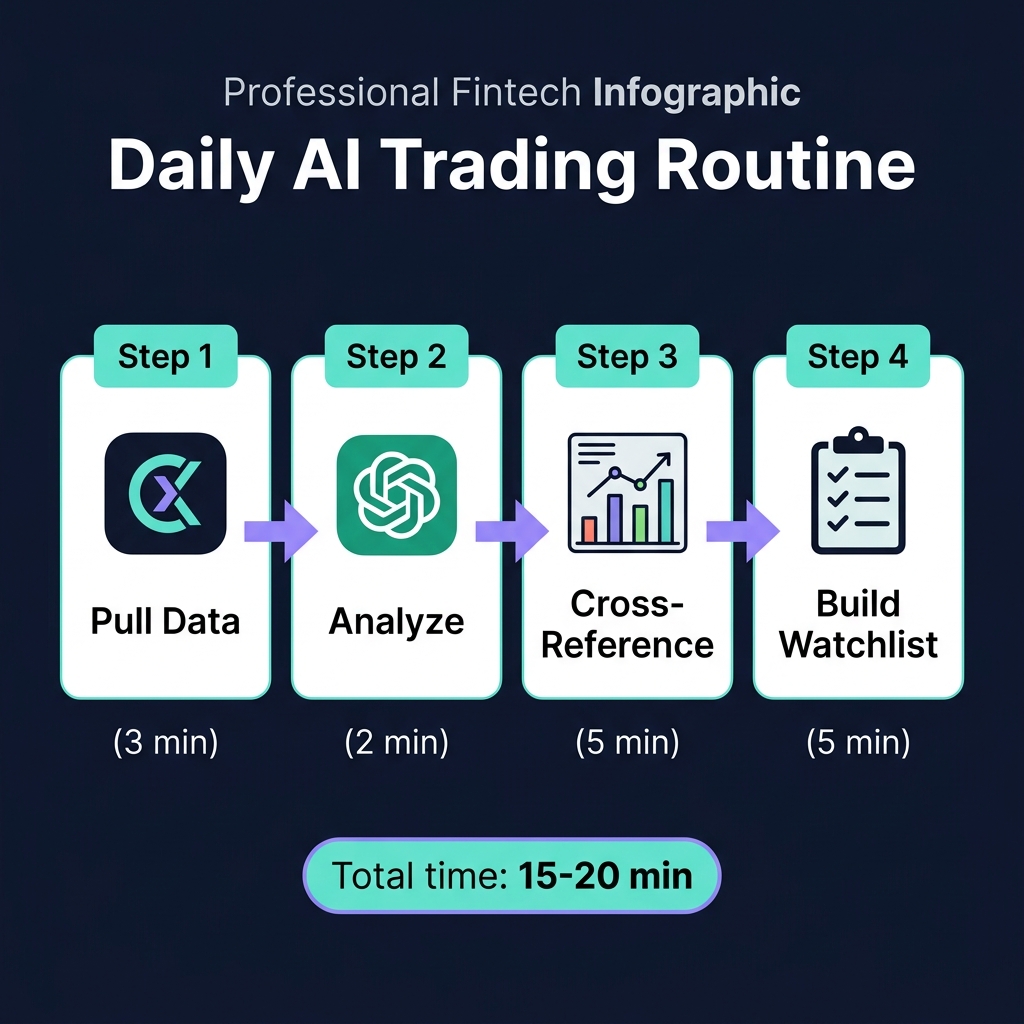
Daily AI-Powered Research Workflow
Here's a practical morning routine that combines CoinXSight with ChatGPT or Gemini. Total time: 15-20 minutes.
Note each token's Confluence Score, RSI, MACD direction, and trend status
Check Whale Tracker for any unusual movements in the last 24 hours
Screenshot or write down the key numbers
Step 2: Paste Into ChatGPT/Gemini (2 minutes)
Use Prompt 1 (Morning Briefing) with the real data you just pulled. Paste the actual numbers — don't rely on AI to look them up.
Step 3: Cross-Reference the Analysis (5 minutes)
AI gave you a bias and key levels. Now verify:
Open Chart Pro on CoinXSight — does the chart support the bias?
Check if the levels AI mentioned match actual support/resistance zones
Look at the Confluence Score breakdown — which layers agree/disagree?
Step 4: Build Your Watchlist (5 minutes)
Based on Step 3:
Add tokens with Confluence Score ≥ 7/10 and clear setups to your active watchlist
Set alerts at the key levels AI identified
Write down your plan: entry, stop, target for each setup
💡 CoinXSight's Alpha Hunter module automates parts of this workflow. It scans the entire market for tokens where Confluence Score is rising, momentum is shifting, and volume confirms — essentially doing the screening that you'd otherwise ask ChatGPT to help prioritize.
ChatGPT vs Gemini vs Claude: Which AI for Trading?
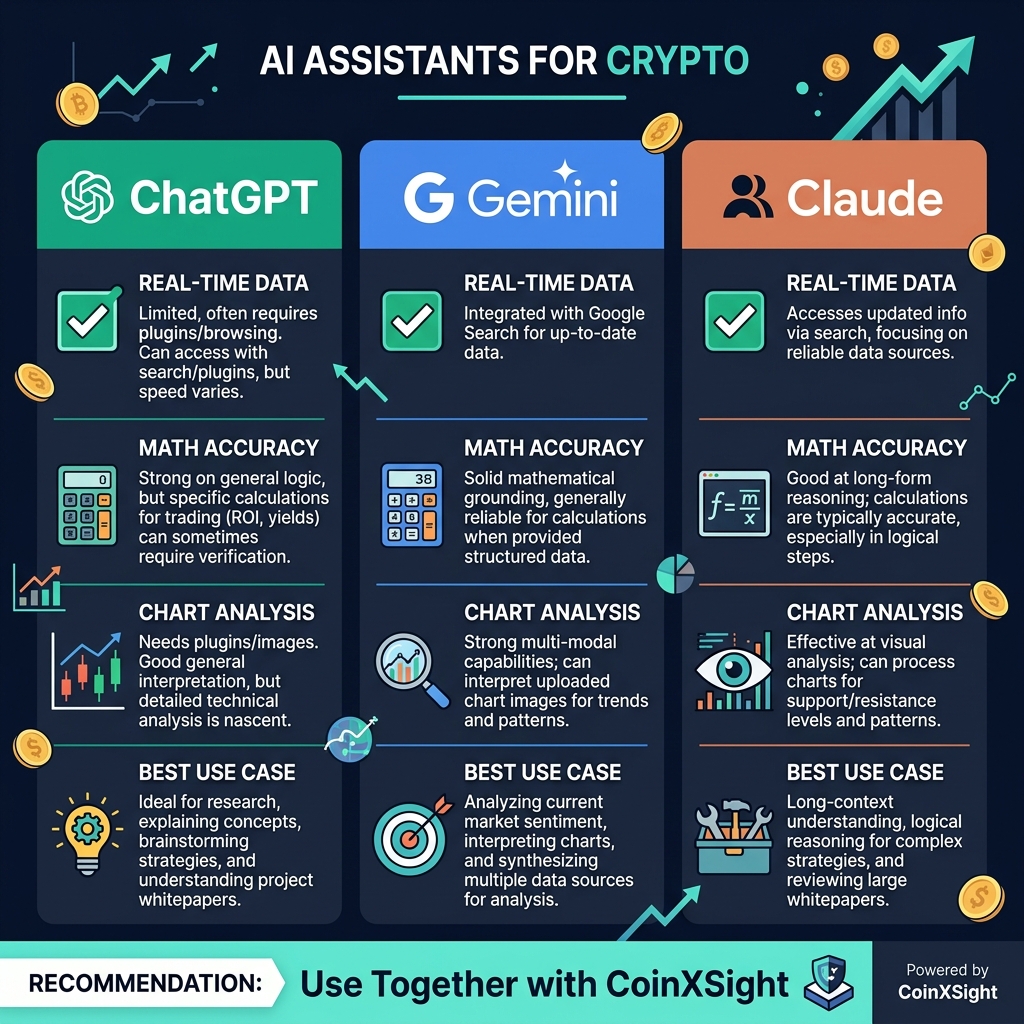
Each LLM has different strengths for crypto analysis. Here's an honest comparison based on real usage:
Feature
ChatGPT (GPT-4o)
Gemini 2.5
Claude 3.5
Real-time data
Limited (via browse)
Better (Google integration)
None (no web access)
Math/calculations
Excellent
Excellent
Excellent
Chart analysis
Can analyze uploaded screenshots
Can analyze uploaded screenshots
Can analyze uploaded screenshots
Structured output
Very good tables/lists
Good, sometimes verbose
Excellent, concise
Hallucination rate
Moderate
Moderate
Lower
Free tier
GPT-4o mini (limited)
Gemini 1.5 Flash (generous)
Free tier available
Best for trading
Prompt 1-5 above, journal review
News analysis, fundamental research
Detailed strategy analysis
Practical recommendation: Use Gemini for news/fundamental research (better real-time access), ChatGPT for technical analysis interpretation and trading plans, and CoinXSight for actual live data and signal generation. For a hands-on tutorial, see our AI Trading Copilot guide.
Real Example — ETH Sentiment Check via Gemini (June 2026)
Using Gemini's extended context window, a trader fed 7 days of ETH news
headlines plus on-chain data from CoinXSight's Whale Tracker: 23,400 ETH
moved from cold wallets to Binance over 48 hours. Gemini flagged this as
a potential distribution signal. ETH was trading at $2,580; within 72 hours
it dropped to $2,440 (−5.4%). The Whale Tracker had shown the exchange
inflow spike 6 hours before Gemini's analysis confirmed the bearish thesis.
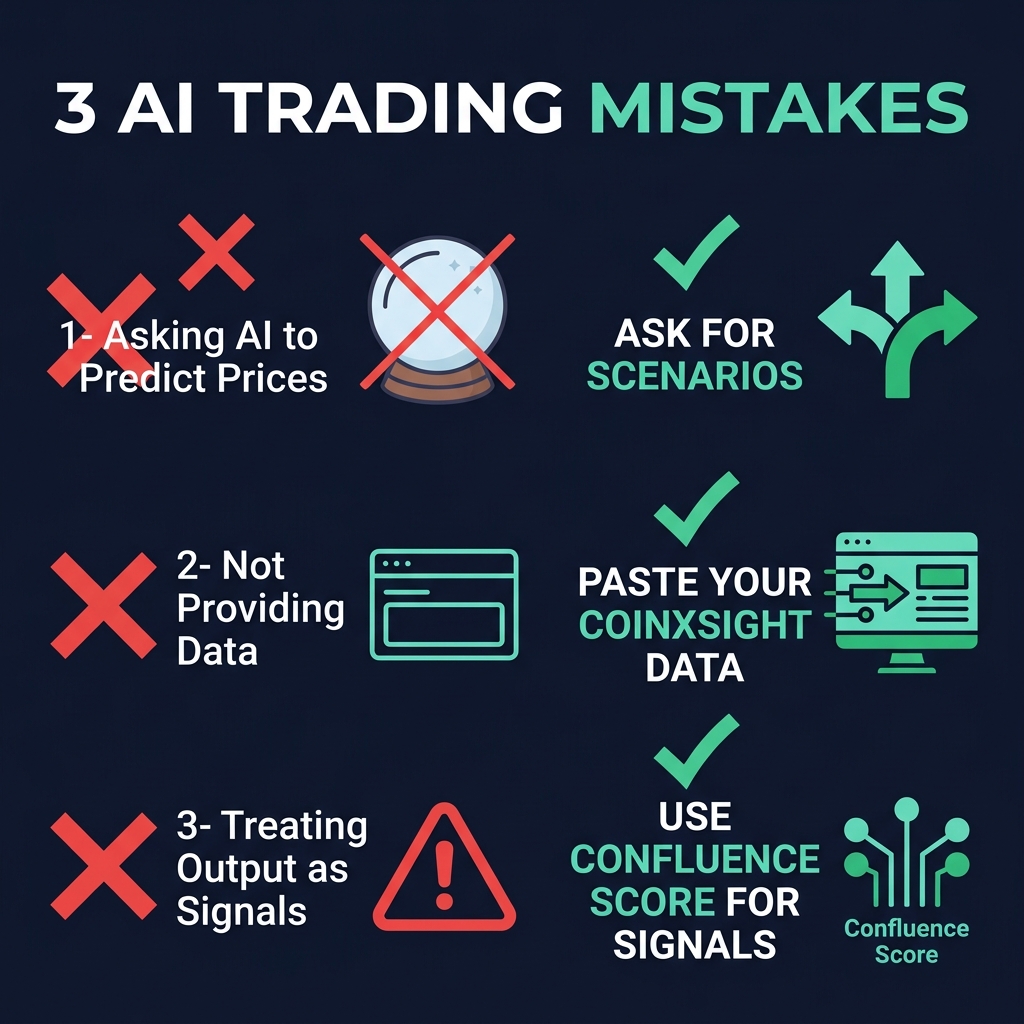
3 Common Mistakes When Using AI for Trading
Mistake 1: Asking AI to Predict Prices
"What will BTC price be next week?" — this is the most common and most useless prompt. No LLM has any predictive edge. If it says "$115,000," that's a guess, not analysis. Ask for scenarios and probabilities instead.
Mistake 2: Not Providing Data
"Is ETH a good buy right now?" — this produces generic output because you gave zero context. The AI doesn't know the current price, RSI, or trend. Always paste your data from CoinXSight or TradingView first.
Mistake 3: Treating AI Output as Trading Signals
AI analysis is a research input, not a signal. A signal has specific entry, stop, and target levels with backtested probability. AI text has none of that rigor. Use CoinXSight's Confluence Score for actual signals — it's computed from live data with consistent methodology.
⚠️ Limitation: LLMs update their training data periodically. ChatGPT's training cutoff means it may reference outdated market conditions, old token rankings, or deprecated protocols. Always verify current market data on CoinXSight before acting.
How to Use AI Research on CoinXSight
As a comprehensive crypto analytics platform, CoinXSight makes this analysis accessible through its integrated toolset:
Open Deep Alpha and select tokens from your AI-generated analysis
Compare AI's bias with the Confluence Score — they should align (7+/10 = bullish confirmation)
Use Chart Pro to verify the key levels AI identified
Check Whale Tracker to see if on-chain data supports the thesis
Only enter trades where both AI research AND Confluence Score agree
Set stop losses based on the risk calculator output — never skip this step
💡 CoinXSight's Deep Alpha module provides the same structured analysis that you'd get from a well-crafted ChatGPT prompt — but computed from real-time data with no hallucination risk. The Confluence Score (0-10) is a quantified version of the multi-factor analysis that AI describes in text. Use them together: AI for context and reasoning, CoinXSight for precision and live data.
FAQ
Is ChatGPT good for crypto trading?
ChatGPT is effective as a research and analysis assistant — it excels at interpreting indicator combinations, calculating position sizes, and reviewing trade journals. It cannot predict prices or access real-time market data. Use it alongside CoinXSight's live analytics for optimal results.
What are the best ChatGPT prompts for crypto?
The most useful prompts provide structured data and ask for specific outputs: morning briefings with your actual indicator readings, risk/reward calculations with exact entry/stop/target prices, and trade journal reviews with real results. Avoid vague prompts like "Should I buy BTC?"
Can Gemini access real-time crypto prices?
Gemini has limited real-time data access through Google's integration, but the data may lag or be incomplete for smaller tokens. For reliable, real-time multi-token analysis, use CoinXSight's Deep Alpha module — it streams live data with Confluence Scoring across 4 analytical layers.
Is AI better than manual analysis for crypto trading?
Neither is universally better. AI processes information faster and eliminates emotional bias in analysis. Manual analysis catches context that AI misses — market sentiment, regulatory nuance, and pattern recognition from experience. The strongest approach combines both: use AI for data processing and CoinXSight for signal generation, then apply your judgment.
How much does AI-assisted crypto trading cost?
ChatGPT Plus costs $20/month, Gemini Advanced $20/month, and Claude Pro $20/month. Free tiers exist for all three with usage limits. CoinXSight offers free access to basic features. Total cost for a full AI-assisted setup: $0-40/month plus your CoinXSight plan — far less than traditional analytics subscriptions.
Disclaimer: This article is for educational and informational purposes only and does not constitute financial, investment, or trading advice. Cryptocurrency markets are highly volatile and involve substantial risk of loss. Always conduct your own research (DYOR) and consult a licensed financial advisor before making any investment decisions. Past performance does not guarantee future results. CoinXSight provides analytical tools and data — not investment recommendations.
Which crypto trading platform is best for chatgpt for crypto trading analysis?
CoinXSight offers chatgpt for crypto trading alongside 12+ other trading indicators, AI-powered Confluence Scoring, and Smart Money Concepts u2014 making it a comprehensive crypto analytics platform for technical analysis.
KZ
Dr. Kevin Zhang
AI // QUANT LABS
Principal AI & Quantitative Researcher·Deep Alpha Engine Labs
Ph.D. in Computational Statistics. Leads machine learning architecture, regime-switching detection, and automated execution systems at CoinXSight Labs.
QUANTITATIVE SUITE // DEEP ALPHA ENGINEACTIVE
BTC/USDT // LIVE SCANNER
CONFLUENCE 35
LIVE SPOT PRICE$83,025.02NO_TRADE
TP2
$88,788.31
+6.95%
TP1
$85,327.13
+2.78%
ENTRY
$83,019.67
ZONE
SL
$81,865.94
-1.39%
Auto-detect Order Blocks, Fair Value Gaps and risk-adjusted DCA ladders in < 5s.