AI Crypto Research: Gemini, ChatGPT & On-Chain (2026)
Build an AI crypto research workflow with Gemini, ChatGPT, and on-chain data. Real token evaluation examples with CoinXSight. Essential crypto technical analysis for smarter trading.
KZ
Dr. Kevin ZhangPrincipal AI & Quantitative Researcher·May 23, 2026 · 10 min read · Updated Oct 6
AI-powered crypto research is a systematic workflow that combines large language models (ChatGPT, Gemini, Claude) with on-chain analytics to evaluate tokens before trading or investing. Instead of spending 4-6 hours reading whitepapers, checking tokenomics, and analyzing wallet data manually, you use AI to compress the research process into 30-60 minutes while maintaining the same depth.
The key distinction: this is fundamental analysis (why to trade a token) combined with on-chain analysis (what wallets are doing), not technical analysis (when to trade). For TA prompts, see our AI Prompt Engineering guide. For the beginner starting point, read our ChatGPT for Crypto Trading guide first.
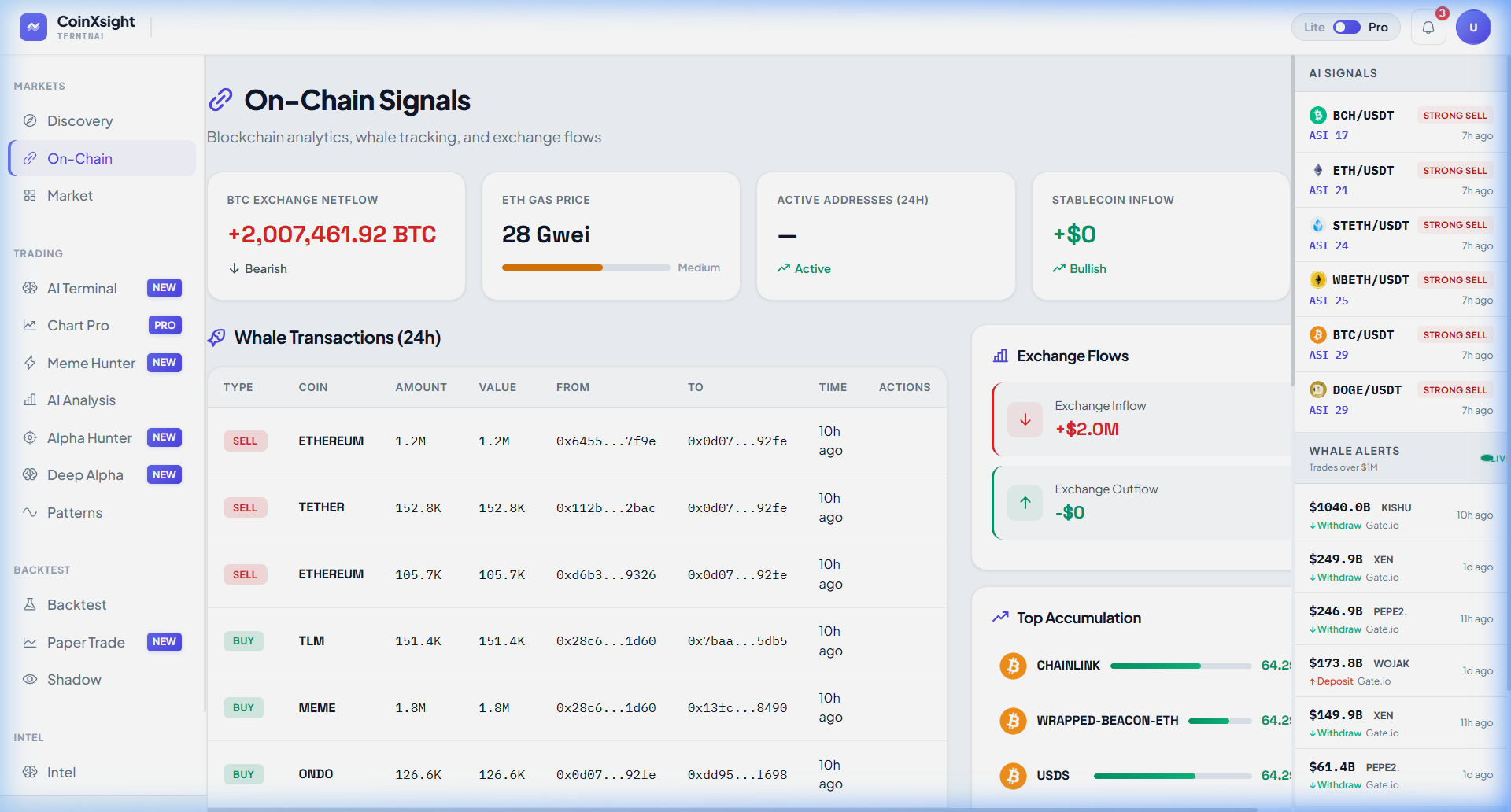
💡 CoinXSight's Whale Tracker module provides the on-chain data that feeds directly into your AI research prompts — exchange flows, large wallet movements, and accumulation/distribution patterns. Combined with Deep Alpha's technical data, you have both fundamental and technical inputs in one platform.
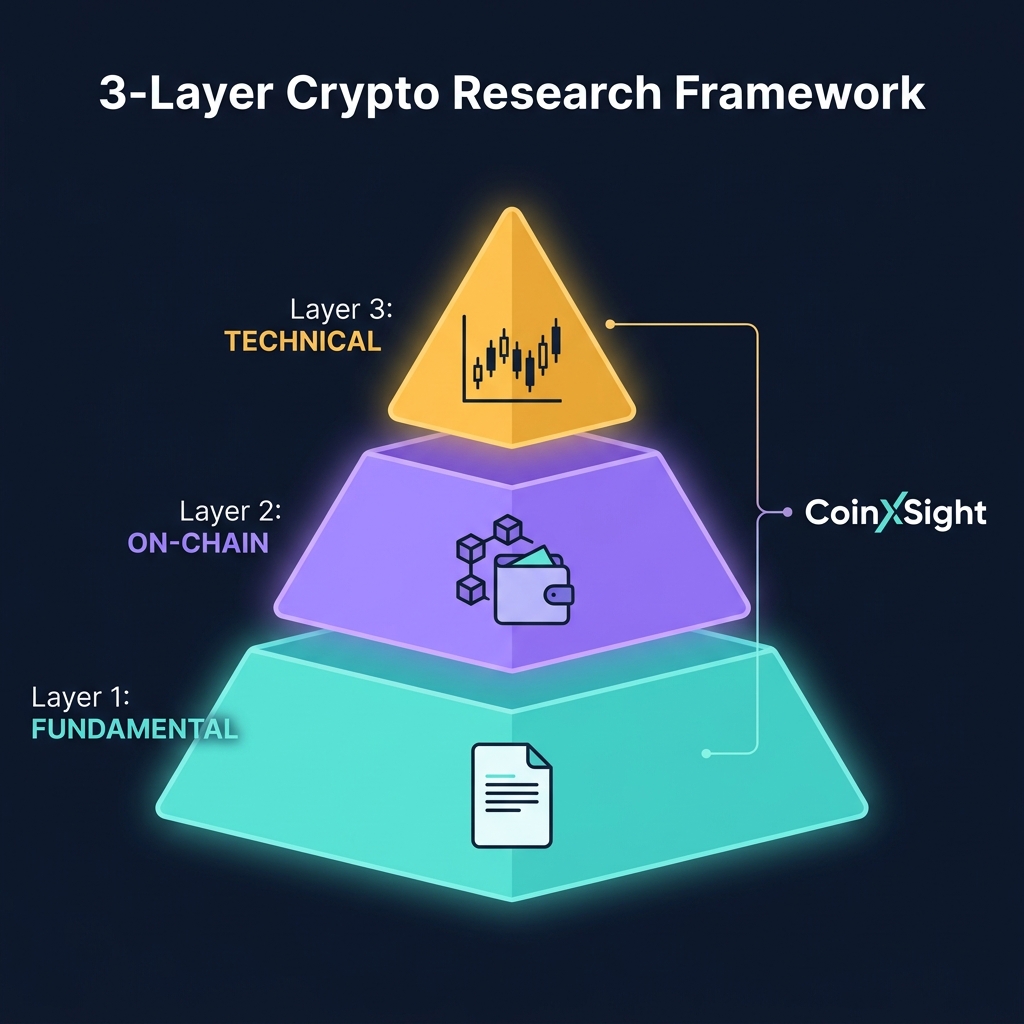
The 3-Layer Research Framework
Every thorough token evaluation covers three layers. Most traders only use Layer 3 (technical analysis). Adding Layers 1 and 2 gives you a significant edge because you understand why a token might move, not just when.
Layer
What It Covers
AI Tool
CoinXSight Module
Layer 1: Fundamental
Project purpose, team, tokenomics, competitive landscape, revenue model
RSI, MACD, Confluence Score, support/resistance, trend direction
ChatGPT (for interpretation)
Deep Alpha, Chart Pro
Layer 1: Fundamental Research with AI
Understanding Layer 1: Fundamental Research with AI is a key part of crypto technical analysis. Most professional trading indicators on any crypto trading platform will help you apply these concepts in real time.
The Whitepaper Speed-Read Prompt
Reading a 40-page whitepaper takes hours. Here's how to compress it:
Role: Crypto venture analyst performing due diligence.

I'm evaluating [TOKEN_NAME] ([TICKER]) for potential investment.

Here is the project's whitepaper summary / key documentation:
[Paste the executive summary or first 3-4 pages of the whitepaper,
or the project's homepage description]

Analyze the following:

1. PROBLEM & SOLUTION: What specific problem does this solve?
   Is the problem real and significant? Are there existing solutions?

2. TECHNOLOGY: What's the technical approach?
   Is it novel or a fork of existing tech?

3. TOKENOMICS: What is the token's utility?
   Is it necessary for the protocol to function,
   or is it a governance-only token?

4. COMPETITIVE LANDSCAPE: Name 3 direct competitors.
   What's this project's moat (if any)?

5. RED FLAGS: Based on what you can see,
   are there any concerning claims,
   unrealistic promises, or missing information?

6. VERDICT: Rate this project 1-10 on three axes:
   - Technology innovation
   - Market need
   - Token value capture

Output format: Structured table for each section.
Be skeptical — I want honest analysis, not optimism.
The Tokenomics Deep-Dive Prompt
Analyze these tokenomics for [TOKEN]:

Total supply: [X]
Circulating supply: [X]
Fully diluted valuation: $[X]
Current market cap: $[X]
Token distribution:
- Team: [X]% (vesting: [schedule])
- Investors: [X]% (vesting: [schedule])
- Community/ecosystem: [X]%
- Treasury: [X]%

Next token unlock: [date] — [amount] tokens ([X]% of circulating)

Questions:
1. What percentage of tokens are still locked?
   When is the biggest unlock event?
2. Calculate the potential sell pressure from the next unlock
   as a % of daily trading volume
3. Is the FDV/market cap ratio concerning?
   (Above 5x is a yellow flag)
4. Does the vesting schedule suggest the team is
   committed long-term?
5. What's the inflation rate over the next 12 months
   from scheduled unlocks?
The key tokenomics ratio AI helps you evaluate:
FDV/MC Ratio = Fully Diluted Valuation / Current Market Cap

Interpretation:
- FDV/MC < 2: Low dilution risk — most tokens already circulating
- FDV/MC 2-5: Moderate dilution — check unlock schedule
- FDV/MC > 5: High dilution risk — significant future sell pressure
You can verify current market cap and FDV figures on CoinGecko before plugging them into your AI prompt.
Example — AVAX Fundamental Check (May 2026)
We ran the whitepaper prompt on Avalanche's documentation with Gemini 2.5. Key finding: Gemini identified that AVAX's subnet architecture creates genuine technical differentiation from competitors, but flagged that the subnet adoption rate (28 active subnets vs. 200+ claimed) was lower than marketing implied. It rated AVAX 7/10 on technology, 8/10 on market need, 5/10 on token value capture. The lower value-capture score came from the observation that subnet validators can use custom gas tokens, partially decoupling AVAX token demand from ecosystem growth.
On-chain data reveals what large holders are actually doing — not what they're saying on X/Twitter. On-chain data platforms like Glassnode provide macro-level blockchain metrics, while CoinXSight's Whale Tracker gives you actionable whale-level signals essential for this workflow.
The Whale Activity Analysis Prompt
Role: On-chain analyst specializing in whale behavior.

Here's recent whale activity data for [TOKEN]
from CoinXSight Whale Tracker:

Exchange flows (last 7 days):
- Net exchange flow: [positive/negative] [amount] tokens
- Largest single inflow: [amount] tokens to [exchange] on [date]
- Largest single outflow: [amount] tokens from [exchange] on [date]

Top wallet activity:
- Top 10 holders control: [X]% of supply
- New whale wallets (>$1M) created this week: [X]
- Wallets increasing holdings: [X] wallets, total [amount]
- Wallets decreasing holdings: [X] wallets, total [amount]

Current price: $[X]
7-day price change: [X]%

Analyze:
1. Are whales accumulating or distributing?
   Quantify the bias.
2. Is the exchange flow data bullish or bearish?
   Large outflows typically indicate holding intent;
   inflows suggest upcoming selling.
3. Is the wallet concentration a risk?
   What if the top holder sells 10%?
4. Do whale movements align with or contradict
   the current price trend?
5. Based on on-chain data alone,
   is this a token I should add to my watchlist or avoid?
The Smart Money Tracker Prompt
I'm tracking smart money wallets for [TOKEN].
Here's what I'm seeing on CoinXSight:

Smart money wallet activity (last 30 days):
- [X] wallets previously profitable in [TOKEN]
  are currently accumulating
- Average entry price for these wallets: $[X]
- Current price: $[X]
- Total accumulated: [amount] tokens ($[X] value)

Historical context:
- Last time smart money accumulated at this rate: [date]
- Price at that time: $[X]
- Price 30 days later: $[X] ([+/- X]%)

Questions:
1. Is the smart money buying pattern significant
   enough to follow?
2. What's the risk if these wallets are wrong this time?
3. At what price level would smart money likely
   start taking profit?
4. Should I enter at current price or wait
   for a specific pullback level?
Example — ETH Exchange Flow Analysis (May 2026)
CoinXSight Whale Tracker showed net exchange outflow of 48,200 ETH over May 12-18, while price was falling from $2,640 to $2,520. We pasted this data into ChatGPT with the whale analysis prompt. Key insight from AI: "This is a textbook accumulation pattern — price is declining but coins are moving OFF exchanges. Smart money is buying the dip. The last time ETH saw a 40,000+ outflow week during a price decline was March 2026, which preceded a 22% rally over the next 3 weeks."
Layer 3: Combining AI Research with Technical Data
The final layer connects your fundamental and on-chain research with technical signals from CoinXSight Deep Alpha.
The Full-Stack Token Evaluation Prompt
Role: Senior crypto analyst performing a comprehensive
token evaluation.

I've completed three layers of research on [TOKEN].
Here's the summary:

FUNDAMENTAL (Layer 1):
- Project rating: [X/10] technology, [X/10] market need,
  [X/10] value capture
- Key strength: [one sentence]
- Key risk: [one sentence]
- Next major catalyst: [event/date]

ON-CHAIN (Layer 2):
- Whale bias: [accumulating/distributing/neutral]
- Exchange flow: [net inflow/outflow] — [amount] tokens this week
- Smart money status: [buying/selling/holding]

TECHNICAL (Layer 3 — from CoinXSight Deep Alpha):
- Confluence Score: [X/10]
- Trend: [bullish/bearish/ranging]
- RSI(14): [value]
- MACD: [status]
- Key support: $[X]
- Key resistance: $[X]

FINAL ANALYSIS:
1. Do all three layers agree on direction?
   Rate overall alignment 1-5.
2. What's the conviction level for a trade?
   (High/Medium/Low)
3. If high conviction: specific entry, stop,
   and 2 target levels
4. If low conviction: what signal would
   upgrade this to a trade?
5. Position size recommendation based on
   conviction level (small/medium/full)
6. Maximum risk per trade: 2% of portfolio
Decision Matrix
Fundamental
On-Chain
Technical
Action
Strong (7+/10)
Accumulating
Confluence ≥ 7/10
Full position — all layers align
Strong
Accumulating
Confluence 4-6/10
Wait — enter on technical confirmation
Strong
Distributing
Any
Avoid — smart money is selling
Weak (<5/10)
Accumulating
High confluence
Small position — on-chain overrides weak fundamentals short-term
Any
Neutral
Any
More research — insufficient on-chain signal
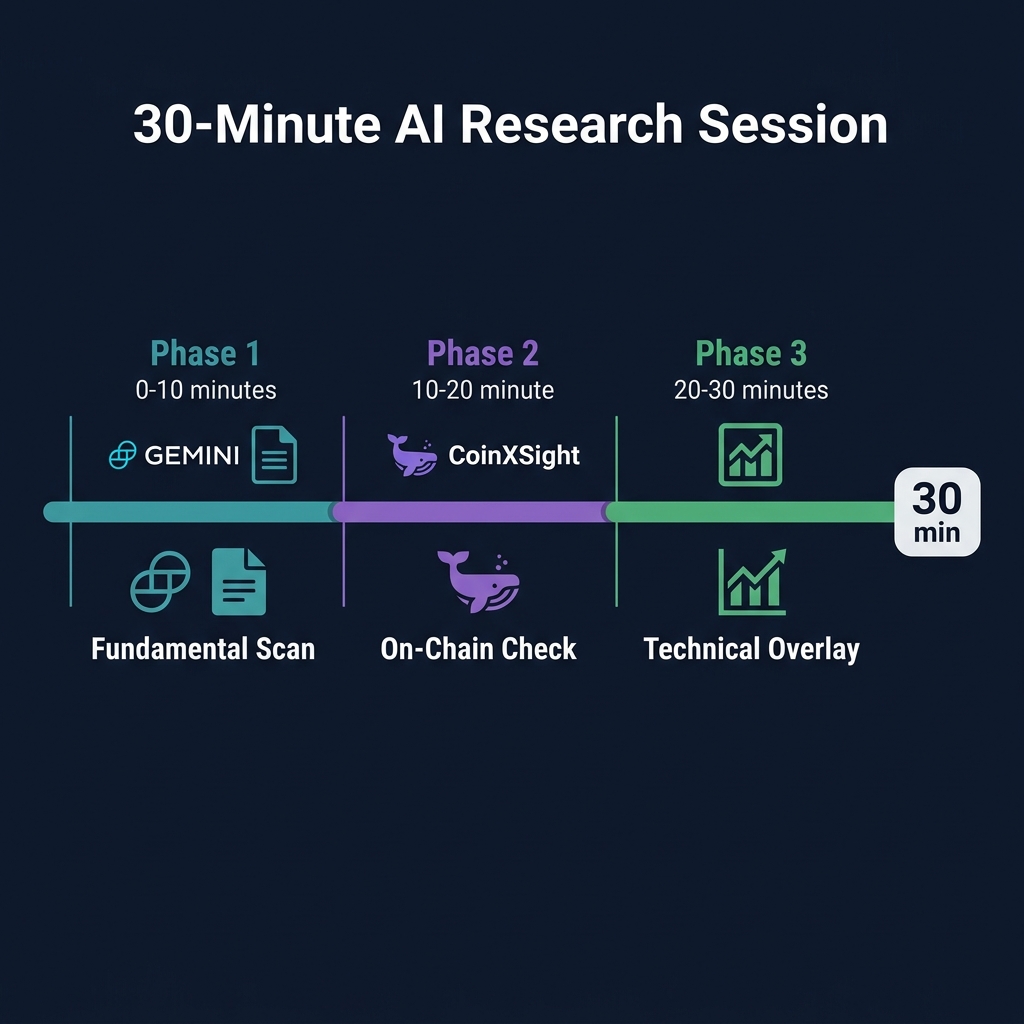
Practical Daily Workflow: The 30-Minute Research Session
Phase 1: Fundamental Scan (10 minutes)
Open Gemini → paste today's trending token from CoinXSight into the whitepaper prompt
Focus on tokens with rising Confluence Scores that you haven't researched yet
Save the AI's summary in your research notes
Phase 2: On-Chain Check (10 minutes)
Open CoinXSight Whale Tracker → check exchange flows for your watchlist
Note any tokens with unusual whale activity (>2x normal volume)
Paste the data into ChatGPT with the whale analysis prompt
Phase 3: Technical Overlay (10 minutes)
Open Deep Alpha → check Confluence Scores for researched tokens
Run the Full-Stack Evaluation prompt for any token where all 3 layers look promising
Add qualified tokens to your active trading watchlist
💡 CoinXSight's Alpha Hunter module automates the screening step. It identifies tokens where technical confluence is rising and whale accumulation is detected — feeding you the candidates that are most worth your 30-minute research session.
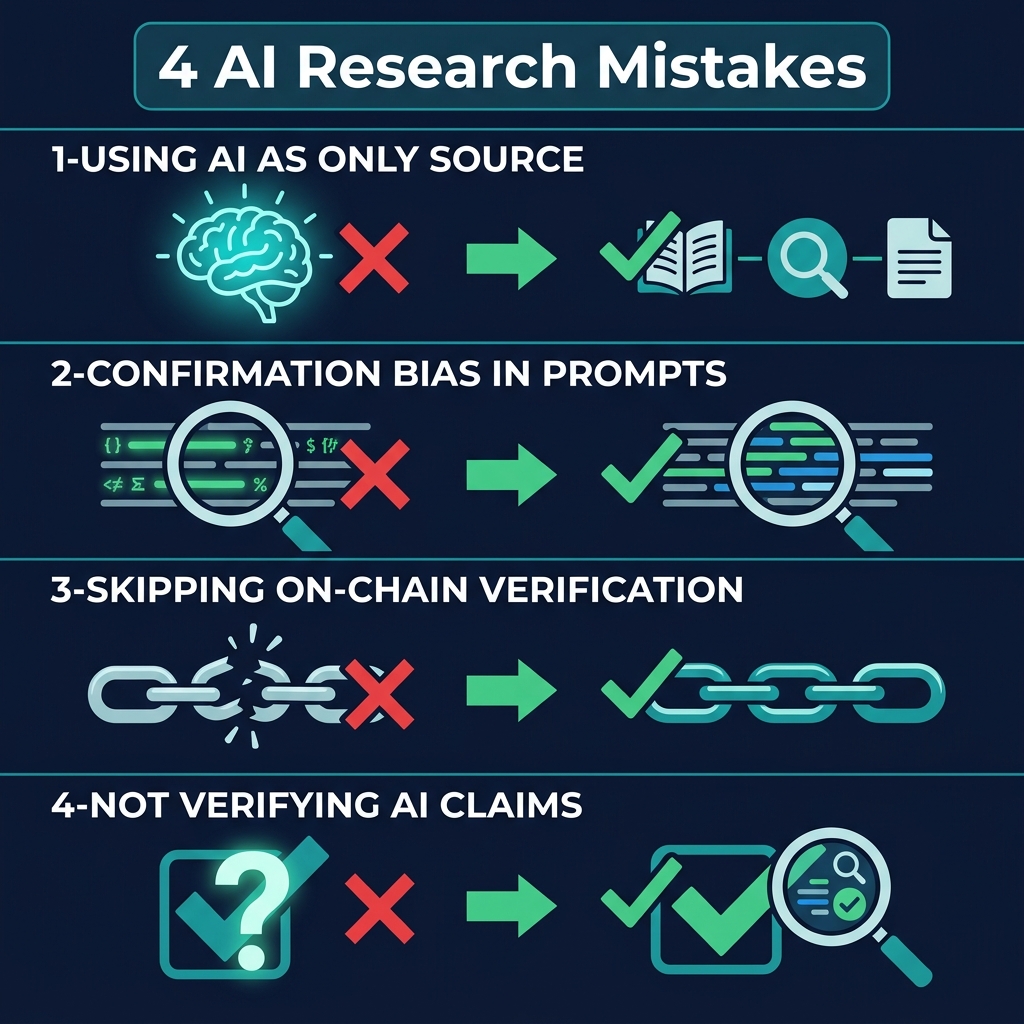
Common AI Research Mistakes
Mistake 1: Using AI as Your Only Source
AI summarizes existing information — it doesn't generate new alpha. If every trader is asking ChatGPT the same question about the same token, the AI-generated "insight" has zero edge. Combine AI research with your own on-chain analysis from CoinXSight for unique perspectives.
Mistake 2: Confirmation Bias in Prompts
"Tell me why SOL is a good investment" — you've already biased the output. Instead: "Evaluate SOL objectively. Give me the 3 strongest bull arguments and 3 strongest bear arguments." Always ask for both sides.
Mistake 3: Skipping On-Chain Verification
A project can have a great whitepaper but terrible on-chain metrics. If whales are distributing while the community is bullish, trust the wallets. CoinXSight Whale Tracker shows you what money is actually doing.
⚠️ Limitation: AI models have training data cutoffs and may reference outdated project information. Gemini has better access to current data through Google integration, but always verify critical facts (team changes, funding rounds, protocol updates) directly from the project's official channels. CoinXSight's on-chain data is real-time and cannot be hallucinated.
How to Use AI Research on CoinXSight
CoinXSight provides a crypto analytics platform where you can apply these concepts with real-time data. For broader DeFi ecosystem research, you can cross-reference TVL and protocol metrics on DefiLlama alongside your CoinXSight analysis:
AI accelerates research but doesn't replace it. LLMs compress hours of reading into minutes, but they can hallucinate project facts, miss recent developments, and reflect training data biases. Use AI for the first pass, then verify critical claims from primary sources and on-chain data from CoinXSight.
Which AI is best for crypto fundamental analysis?
Gemini 2.5 has the strongest access to current web data through Google integration, making it better for checking recent project updates and news. ChatGPT excels at structured analysis when you provide the data. For comprehensive research, use Gemini for information gathering and ChatGPT for structured evaluation.
How do I use on-chain data with AI prompts?
Pull on-chain metrics (exchange flows, whale activity, holder concentration) from CoinXSight's Whale Tracker module, then paste the specific numbers into ChatGPT with your analysis prompt. The AI interprets the data patterns while CoinXSight provides the raw, real-time data that AI cannot access independently.
What's the minimum research time before trading a new token?
Using the 3-layer framework with AI, 30-60 minutes produces a thorough evaluation: 10 minutes fundamental (AI-assisted whitepaper review), 10 minutes on-chain (CoinXSight Whale Tracker data), 10 minutes technical (Deep Alpha Confluence Score check), plus time for the full-stack prompt.
How reliable is AI for evaluating new crypto projects?
AI is reliable for structured analysis of known data — tokenomics math, competitive comparisons, risk identification. It's unreliable for predicting project success, evaluating team capability, or detecting scams that haven't been reported yet. Always combine AI analysis with CoinXSight's on-chain verification.
Disclaimer: This article is for educational and informational purposes only and does not constitute financial, investment, or trading advice. Cryptocurrency markets are highly volatile and involve substantial risk of loss. Always conduct your own research (DYOR) and consult a licensed financial advisor before making any investment decisions. Past performance does not guarantee future results. CoinXSight provides analytical tools and data — not investment recommendations.
Which crypto trading platform is best for ai crypto research analysis?
CoinXSight offers ai crypto research alongside 12+ other trading indicators, AI-powered Confluence Scoring, and Smart Money Concepts u2014 making it a comprehensive crypto analytics platform for technical analysis.
KZ
Dr. Kevin Zhang
AI // QUANT LABS
Principal AI & Quantitative Researcher·Deep Alpha Engine Labs
Ph.D. in Computational Statistics. Leads machine learning architecture, regime-switching detection, and automated execution systems at CoinXSight Labs.
QUANTITATIVE SUITE // DEEP ALPHA ENGINEACTIVE
BTC/USDT // LIVE SCANNER
CONFLUENCE 79
LIVE SPOT PRICE$83,613.06MODERATE_BUY
TP2
$89,046.84
+6.95%
TP1
$85,576.95
+2.78%
ENTRY
$83,263.68
ZONE
SL
$82,107.05
-1.39%
Auto-detect Order Blocks, Fair Value Gaps and risk-adjusted DCA ladders in < 5s.