Building an AI Trading Copilot: Automate Your Crypto Analysis in Real-Time
Step-by-step guide to building a personal AI trading copilot using LLMs, real-time APIs, and on-chain data. From market scanning to signal generation — automate your entire analysis workflow. Essential crypto technical analysis for smarter trading.
KZ
Dr. Kevin ZhangPrincipal AI & Quantitative Researcher·May 22, 2026 · 15 min read · Updated Oct 6
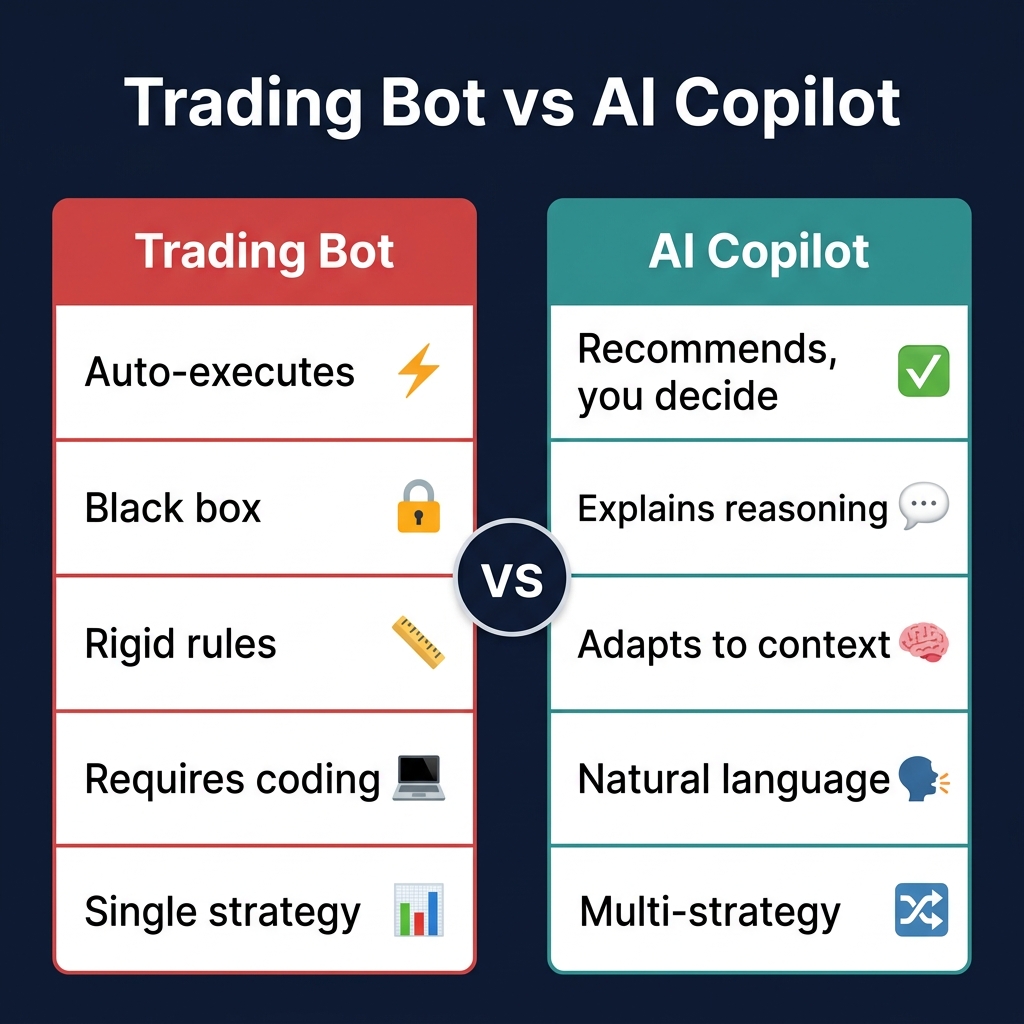
An AI trading copilot is NOT a trading bot. It doesn't execute trades automatically. Instead, it acts as your always-on research analyst — scanning thousands of data points, detecting patterns, and presenting actionable insights in plain language while you make the final call.
Think of it like this:
Trading Bot
AI Copilot
Executes trades automatically
Recommends trades, you decide
Black box — you don't know why
Explains reasoning in plain language
Rigid rules, breaks in new conditions
Adapts to any market context
Requires programming knowledge
Responds to natural language questions
Single strategy focus
Analyzes across multiple strategies simultaneously
The best traders in 2026 aren't choosing between human intuition and AI — they're combining both. The AI copilot handles the 95% of analysis that's repetitive and data-heavy, while the human handles the 5% that requires judgment and creativity.
The AI Copilot Architecture
The 4-Layer Stack
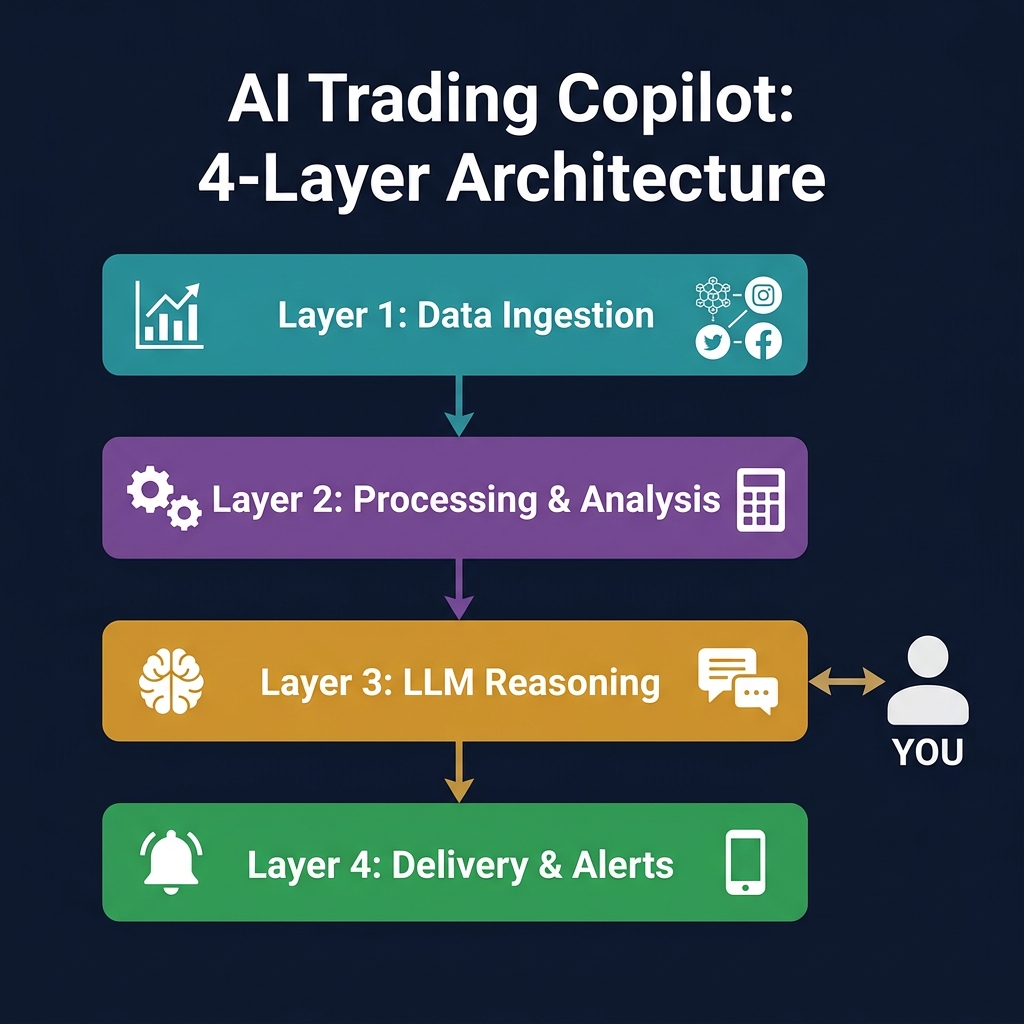
Every effective AI trading copilot consists of four layers:
Layer 1: Data Ingestion
Real-time market data, on-chain metrics, social sentiment, and news feeds flowing into a unified data pipeline.
Layer 2: Processing & Analysis
Technical indicator calculation, pattern recognition, anomaly detection, and statistical analysis running continuously on the incoming data.
Layer 3: LLM Reasoning
A large language model (GPT-4, Claude, Gemini) that synthesizes all processed data into natural language insights, answers your questions, and generates actionable recommendations.
Layer 4: Delivery & Alerts
Telegram, Discord, email, or dashboard notifications delivering insights at the right moment — not drowning you in noise.
Data Sources You Need
Source
What It Provides
Update Frequency
Binance/Bybit API
OHLCV, order book, funding rates, liquidations
Real-time (WebSocket)
CoinGecko/CoinMarketCap
Market cap, volume, dominance, global metrics
Every 1-5 min
Glassnode/CryptoQuant
On-chain: whale flows, exchange reserves, active addresses
ASI scores, Alpha Hunter signals, confluence ratings
Real-time
You don't need ALL of these to start. Begin with price data + one on-chain source + CoinXSight signals, then expand as your copilot matures.
Building Your Copilot: Step-by-Step
This is where crypto technical analysis becomes practical — a quality crypto analytics platform will display these signals in real time, helping you act on setups as they form.
Step 1: The Market Scanner Module
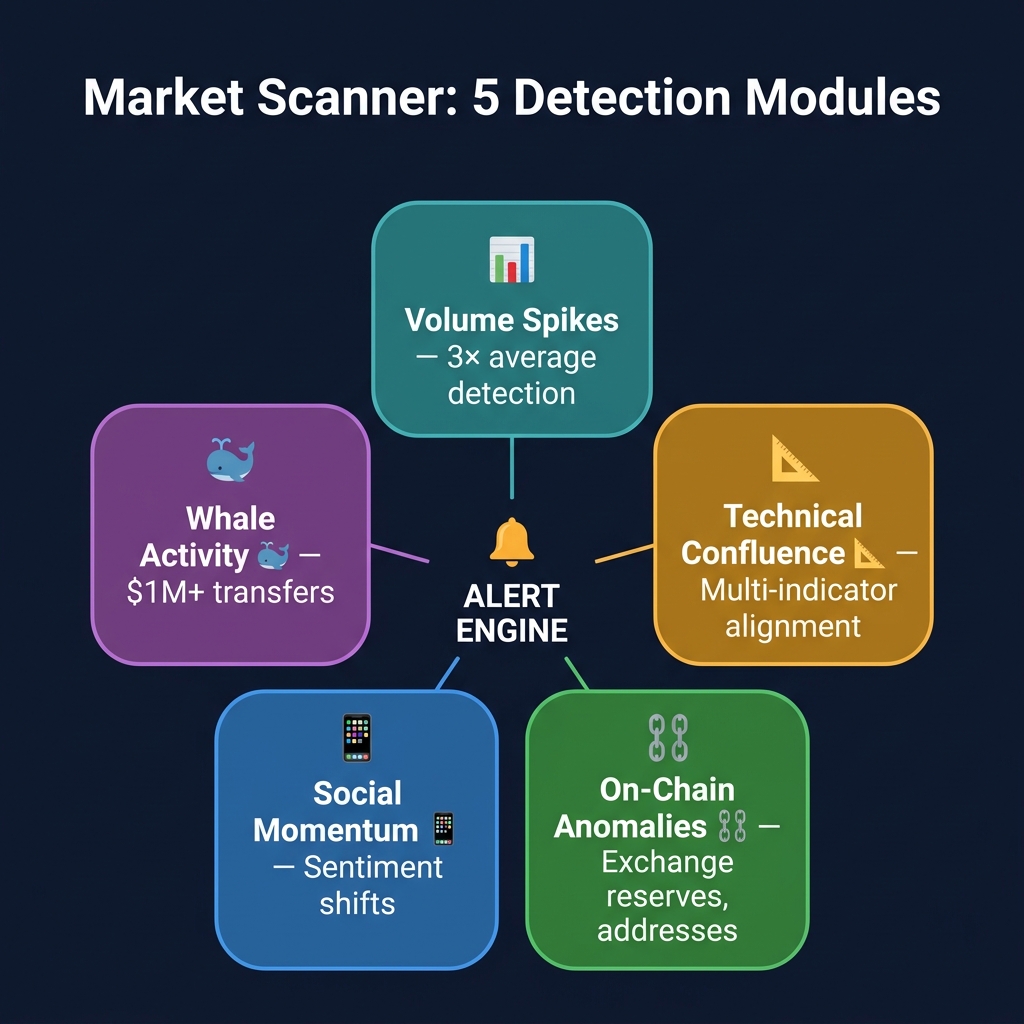
The scanner runs 24/7 and flags opportunities that match your criteria.
What to scan for:
1. Volume Spikes
   - If 1h volume > 3× 20-period average → FLAG
   - Cross-reference with price action (volume + no price move = accumulation)

2. Whale Activity
   - Large transfers to/from exchanges (> $1M for BTC, > $500K for altcoins)
   - New wallet accumulation patterns
   - Smart money wallet tracking (known profitable addresses)

3. Technical Confluences
   - Multiple indicators aligning on same timeframe
   - Key level tests (weekly/monthly support/resistance)
   - RSI divergences on 4h+ timeframes

4. On-Chain Anomalies
   - Sudden active address spike (> 2× average)
   - Exchange reserve drops (bullish — accumulation)
   - Funding rate extremes (contrarian signal)

5. Social Momentum
   - Social volume surge without price movement (early signal)
   - Sentiment shift from negative to positive (reversal indicator)
CoinXSight shortcut: The Alpha Hunter module already runs this exact scanner across 500+ tokens. Instead of building from scratch, you can use Alpha Hunter signals as your scanning layer and focus your copilot on the reasoning layer.
Step 2: The Analysis Engine
Once the scanner flags an opportunity, the analysis engine provides deeper context.
Multi-Timeframe Analysis Template:
For each flagged token, generate:

1. TREND ASSESSMENT
   - 1D: [Bullish/Bearish/Neutral] — based on 50/200 EMA position
   - 4H: [Bullish/Bearish/Neutral] — based on market structure
   - 1H: [Bullish/Bearish/Neutral] — based on momentum indicators

2. KEY LEVELS
   - Nearest support: $XX,XXX (method: Volume Profile POC)
   - Nearest resistance: $XX,XXX (method: Previous swing high)
   - Invalidation level: $XX,XXX (close below = thesis broken)

3. RISK METRICS
   - Current ATR (14): X.X% (vs. 30-day average: X.X%)
   - Suggested stop distance: X.X% (based on ATR × 1.5)
   - Risk/reward to nearest target: X.X:1

4. CONFLUENCE SCORE
   - Technical: X/10 (how many indicators agree)
   - On-chain: X/10 (whale activity, exchange flows)
   - Sentiment: X/10 (social momentum, fear/greed)
   - Overall: X/30 → [LOW / MEDIUM / HIGH]
Step 3: LLM Integration — The Brain
This is where the copilot becomes intelligent. Connect your processed data to an LLM with a carefully crafted system prompt.
System Prompt Template:
You are a professional crypto trading analyst copilot. Your role:

1. ANALYZE market data I provide and give actionable insights
2. IDENTIFY high-probability trade setups with clear entry, stop, and targets
3. ASSESS risk using position sizing formulas (half-Kelly, vol-adjusted)
4. EXPLAIN your reasoning — I need to understand WHY, not just WHAT
5. WARN me about risks I might be missing (correlation, leverage, liquidity)

Rules:
- Never be blindly bullish or bearish. Be objective.
- Always include risk management in every recommendation.
- Distinguish between HIGH CONFIDENCE and SPECULATIVE setups.
- If data is insufficient, say "insufficient data" rather than guessing.
- Include specific numbers: entry price, stop price, target price, position size.
- Reference historical precedents when relevant.

My risk profile:
- Account size: $XX,XXX
- Max risk per trade: 2%
- Max daily loss: 5%
- Max correlated exposure: 40%
- Preferred timeframes: 4H and Daily
Example conversation with your copilot:
You: "BTC just broke above $72K on high volume. Alpha Hunter shows HIGH confidence. What should I do?"
Copilot: "BTC breakout above $72K is confirmed with 2.3× average volume — strong. Here's my analysis:
Setup quality: 8/10
Weekly trend: Bullish (above 50W EMA since March)
Volume confirmation: ✅ (2.3× average, not a fake breakout)
On-chain: Exchange reserves at 2-year low (supply squeeze)
Risk: Funding rates at 0.04% — elevated but not extreme
Recommended trade:
Entry: $72,100-$72,400 (current range)
Stop: $70,800 (below breakout level + ATR buffer)
Target 1: $74,500 (previous ATH resistance)
Target 2: $78,000 (measured move from consolidation)
Risk/reward: 1:1.8 to T1, 1:4.2 to T2
Position sizing:
Your 2% risk = $XXX
Stop distance: 1.8%
Position size: $XXX / 0.018 = $XX,XXX
That's X.X% of your portfolio — within limits
Warning: You have an existing ETH long. BTC-ETH correlation is currently 0.78. Combined exposure after this trade: 35% (below your 40% limit). Proceed."
Step 4: The Alert System
Your copilot should proactively alert you — not wait for you to ask.
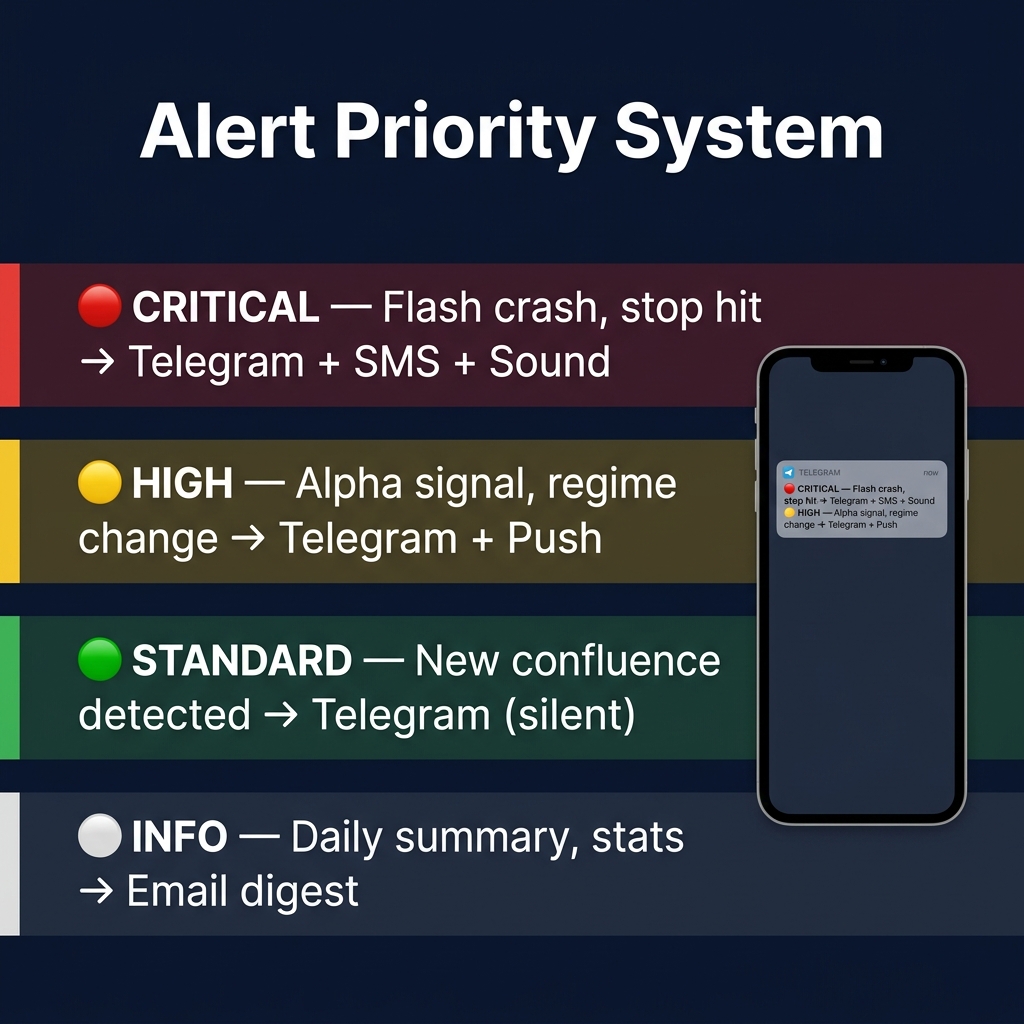
Alert priority levels:
Priority
Trigger
Delivery
🔴 Critical
Circuit breaker triggered, flash crash detected, position stop hit
Telegram + SMS + Sound
🟡 High
Alpha Hunter HIGH signal, regime change, whale mega-transaction
Telegram + Push notification
🟢 Standard
New confluence detected, weekly report ready, rebalance suggested
Telegram (silent)
⚪ Info
Market summary, portfolio stats, model performance update
Daily digest email
Alert format template:
🟡 ALPHA SIGNAL — SOL
━━━━━━━━━━━━━━━━━━━
Signal: LONG | Confidence: 82%
ASI Score: 78/100 | Confluence: 24/30

Entry zone: $168.50 - $170.20
Stop loss: $162.40 (-3.8%)
Target 1: $178.00 (+5.2%)
Target 2: $185.50 (+9.6%)

Position size (2% risk): $X,XXX

On-chain: Exchange outflows ↑ 340% (24h)
Social: Volume spike, sentiment shift positive
Technical: Breakout above descending wedge on 4H

⚠️ NOTE: Correlated with existing BTC position (ρ=0.71)
Combined exposure after trade: 38% (limit: 40%)
━━━━━━━━━━━━━━━━━━━
Reply YES to add to watchlist
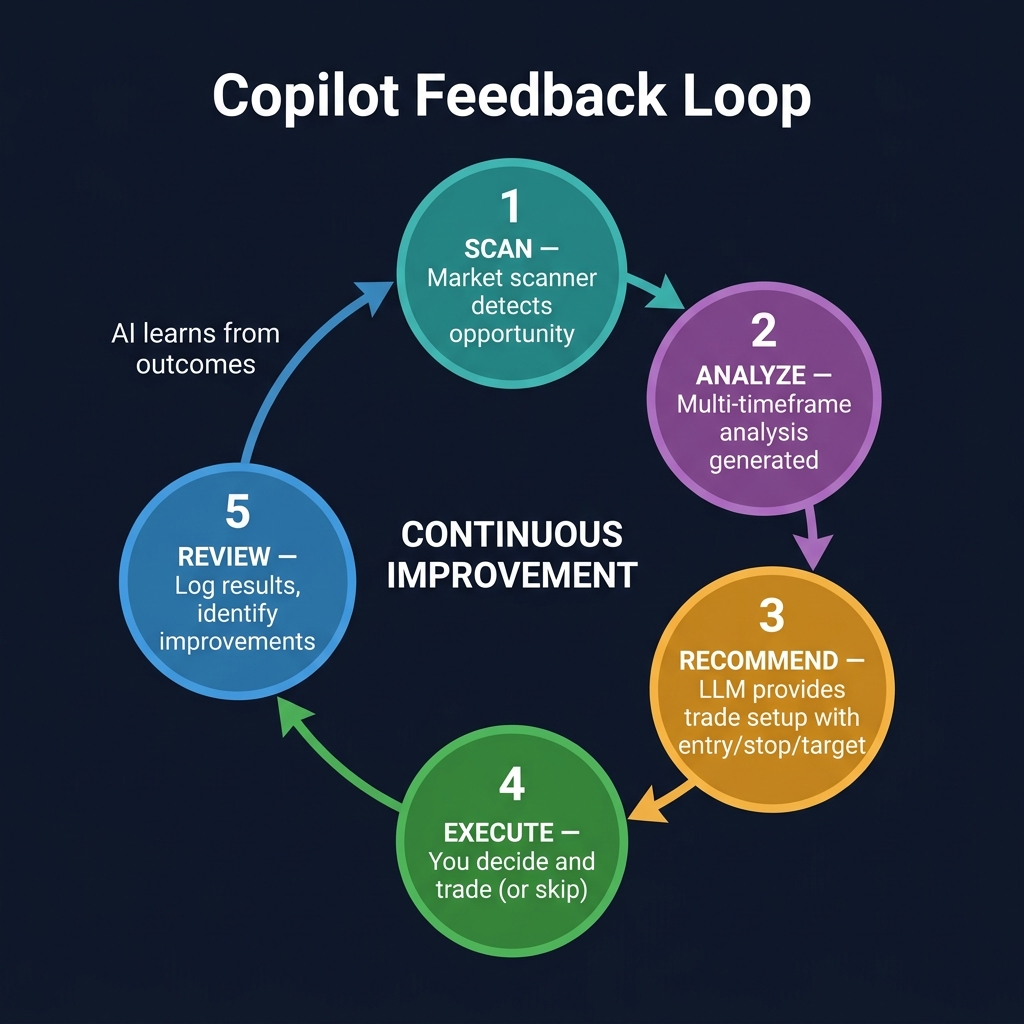
Step 5: The Feedback Loop
The copilot improves by learning from your decisions and outcomes.
After every trade, log:
Trade ID: #XXX
Asset: SOL/USDT
Direction: LONG
Entry: $169.80 | Exit: $177.40 | P&L: +4.5%

Copilot recommendation: LONG at $170.20 ✅
Signal source: Alpha Hunter HIGH + Copilot confirmation
Risk management: Stop placed at $162.40 (not hit)
Maximum Adverse Excursion: -1.2% (healthy)

What worked:
- On-chain signal (exchange outflows) was accurate
- Volume confirmation validated breakout

What to improve:
- Entry was slightly late (could have entered at $168.50)
- Target 2 not reached — consider partial exits earlier
Weekly review questions the copilot answers:
"Which signal sources had the highest accuracy this week?"
"Am I overtrading? How many signals did I skip vs. act on?"
"What was my average risk/reward on executed trades?"
"Are there any patterns in my losing trades?"
"How does my actual position sizing compare to the copilot's recommendations?"
Practical Tool Stack for 2026
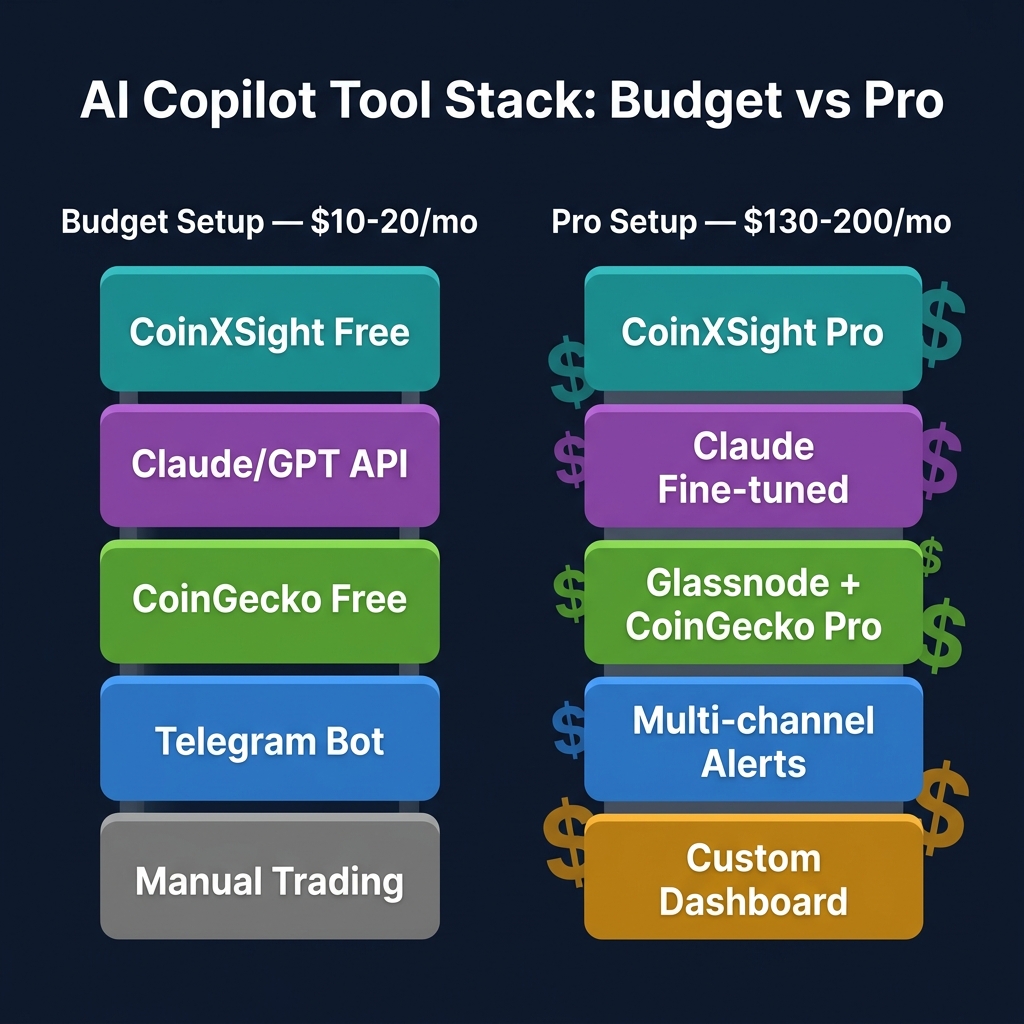
Budget-Friendly Setup ($0-50/month)
Component
Tool
Cost
Scanner
CoinXSight Alpha Hunter (free tier)
$0
LLM
Claude API / GPT-4 API
$10-20/mo
Data
CoinGecko free API + Binance WebSocket
$0
Alerts
Telegram Bot (self-hosted)
$0
Execution
Manual via exchange
$0
Total
$10-20/mo
Professional Setup ($100-300/month)
Component
Tool
Cost
Scanner
CoinXSight Pro (full Alpha Hunter + ASI)
$49/mo
LLM
Claude API with custom fine-tuning
$30-50/mo
Data
Glassnode + CoinGecko Pro + Binance
$50-80/mo
Alerts
Telegram + Discord webhook
$0
Dashboard
Custom Grafana or Streamlit
$0-20/mo
Total
$130-200/mo
No-Code Approach
Don't want to code? You can build a functional copilot using:
CoinXSight as your scanning + analysis layer
ChatGPT/Claude as your reasoning layer (paste data manually)
Telegram alerts from CoinXSight for notifications
Notion or Google Sheets for trade logging
This "manual copilot" approach takes 15-20 minutes per session but gives you 80% of the benefit with 0% coding.
Common Copilot Mistakes
1. Alert Fatigue
If your copilot sends 50 alerts per day, you'll ignore all of them. Filter aggressively.
Rule: Maximum 5-8 actionable alerts per day. If your scanner flags more, increase the quality threshold until only the best setups get through.
2. Over-Relying on LLM Confidence
LLMs sound confident even when they're wrong. Always cross-reference LLM analysis with:
Actual price chart (does the pattern match what the LLM describes?)
CoinXSight's quantitative ASI score (data-driven, not language-driven)
Your own experience and market feel
3. Not Defining Your Edge
A copilot amplifies your existing edge — it doesn't create one from nothing. Before building, answer:
"What type of trades am I best at?" (breakouts, mean reversion, momentum)
"What timeframe suits my lifestyle?" (scalping requires constant attention)
"What's my actual win rate on my best setups?" (be honest)
Configure the copilot to focus on YOUR edge, not to scan for everything.
4. Skipping the Paper Trading Phase
Minimum 4 weeks of paper trading before risking real capital on copilot recommendations. Track:
Signal accuracy (% of copilot suggestions that would have been profitable)
Timing quality (was the entry zone accurate?)
Risk management (did suggested stops hold?)
5. Building Before Using Existing Tools
Many traders spend months building a custom copilot when CoinXSight already provides 90% of the functionality:
Alpha Hunter = Scanner module
ASI Score = Analysis engine
AI Analysis = LLM-powered reasoning
Portfolio Dashboard = Risk monitoring
Alerts = Notification system
Start with existing tools. Build custom components only for the gaps.
How CoinXSight Functions as Your AI Copilot
CoinXSight is already built as an AI trading copilot platform:
Always-On Market Scanning
Alpha Hunter scans 500+ tokens 24/7 across multiple timeframes, generating signals with confidence levels and confluence scores — exactly like the scanner module described above.
AI-Powered Analysis
The AI Analysis module uses LLMs combined with quantitative models to provide plain-language market insights with specific entry, stop, and target levels.
Quantitative Scoring
Every token receives an ASI Score combining 12+ technical, on-chain, and sentiment indicators into a single actionable number.
Risk Integration
The Portfolio module monitors correlation, drawdown, and position sizing in real-time — alerting you before risk limits are breached.
Backtesting Validation
Before acting on any strategy, the Backtest module lets you validate against historical data — ensuring your copilot's logic holds up under pressure.
The best AI trading copilot isn't the most complex one — it's the one you actually use consistently. Start simple, track everything, and iterate. Your copilot should save you time, reduce emotional decisions, and surface opportunities you'd otherwise miss. If it's adding complexity without improving results, simplify.
Principal AI & Quantitative Researcher·Deep Alpha Engine Labs
Ph.D. in Computational Statistics. Leads machine learning architecture, regime-switching detection, and automated execution systems at CoinXSight Labs.
QUANTITATIVE SUITE // DEEP ALPHA ENGINEACTIVE
BTC/USDT // LIVE SCANNER
CONFLUENCE 93
LIVE SPOT PRICE$83,908.89STRONG_BUY
TP2
$89,725.68
+6.94%
TP1
$86,233.44
+2.77%
ENTRY
$83,905.28
ZONE
SL
$82,741.19
-1.39%
Auto-detect Order Blocks, Fair Value Gaps and risk-adjusted DCA ladders in < 5s.