As the U.S. Senate prepares for its landmark floor vote on the Digital Commodity Regulatory Clarity Act of 2026, institutional capital readies its deployment blueprints while decentralized finance confronts an existential compliance fork.
This morning, October 27, 2026, trading desks from Lower Manhattan to Singapore are closely tracking the legislative calendar of the United States Senate. The chamber is set to conduct a definitive roll-call vote on the Digital Commodity Regulatory Clarity Act (informally codified as the CLARITY Act)—a sweeping statutory overhaul intended to establish the first comprehensive federal jurisdictional boundary between the Securities and Exchange Commission (SEC) and the Commodity Futures Trading Commission (CFTC).
For nearly a decade, the primary headwind confronting institutional asset managers, multi-strategy hedge funds, and prime brokerage desks has not been technological scalability or market volatility; it has been regulatory ambiguity. The weaponization of enforcement-led regulation subjected digital asset protocols to capricious litigation cycles, forcing capital offshore and hamstringing domestic market infrastructure.
The CLARITY Act promises to replace this fragmented enforcement regime with codified, statutory definitions. Yet beneath the euphoric rally in major assets ($BTC, $ETH, $XRP), institutional risk officers and decentralized finance (DeFi) architects are unearthing critical structural caveats.
Understanding the operational boundary lines established by the CLARITY Act—distinguishing what traditional finance gains from the compliance burdens imposed on decentralized networks—is essential for navigating institutional digital asset flows over the next macro cycle.
1. The Core Statutory Divide: The SEC vs. CFTC Boundary Test
The CLARITY Act Jurisdictional Matrix: Statutory Division Between SEC and CFTC Perimeters (CoinXSight Telemetry)
At the heart of the CLARITY Act lies a mechanical, statutory framework designed to decisively terminate the decade-long jurisdictional turf war between the SEC and the CFTC. Rather than relying on the open-ended judicial interpretation of the 1946 Howey test, the legislation introduces a dual-pronged classification matrix based on Network Decentralization Thresholds and Economic Reliance Vectors:
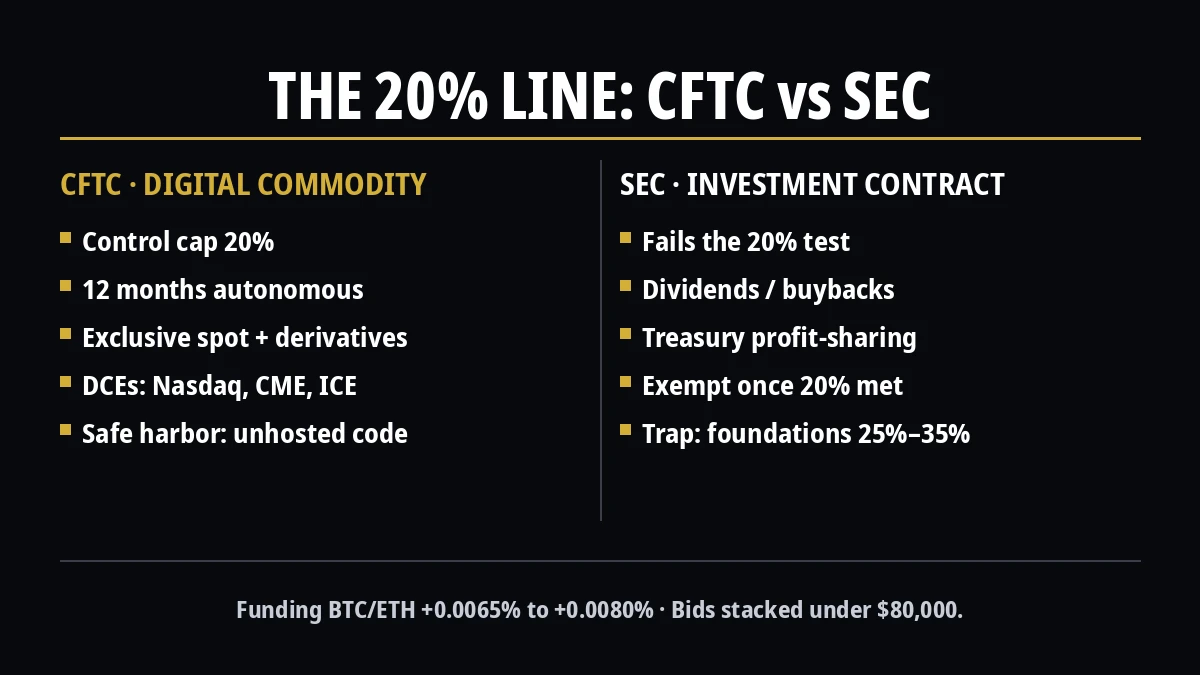
Digital Commodity Safe Harbor (CFTC Exclusive Jurisdiction): A digital asset is formally classified as a digital commodity subject to exclusive CFTC spot and derivatives market oversight if the underlying blockchain network demonstrates verifiable operational decentralization. Specifically:
No single person, entity, or affiliated group controls more than 20% of the voting power, consensus validator nodes, or governance voting tokens.
No entrepreneurial or managerial efforts by a promoter or development foundation are required for the network to maintain its ongoing utility, transaction validation, or consensus security.
The project code has operated autonomously on a public distributed ledger for a statutory minimum of twelve consecutive months.
Investment Contract Asset (SEC Restricted Jurisdiction): If an asset fails the decentralization safe harbor, or if initial distributions include contractual promises of programmatic dividends, direct share repurchases, or centralized treasury profit-sharing, it remains under SEC surveillance as an investment contract asset. Crucially, however, the Act provides a De-Listing and Transition Pathway: secondary market transactions of the asset are exempt from traditional broker-dealer securities registration once the network satisfies the 20% decentralization test.
Regulatory Dimension
Previous Enforcement Regime (2018–2025)
CLARITY Act Statutory Framework (2026)
Institutional Flow Impact
Jurisdictional Primacy
Discretionary litigation; SEC claimed omnibus oversight
CFTC holds exclusive authority over Digital Commodities
Eliminates litigation risk for compliant Tier-1 assets
Dual-registered Digital Commodity Exchanges (DCEs)
Unlocks direct spot clearing for Nasdaq, CME & NYSE
DeFi Developer Liability
Enforcement actions against open-source code deployers
Explicit developer safe harbor for unhosted protocol code
Shields core consensus contributors from intermediary status
Structural Comparison: Enforcement Litigation Era vs. CLARITY Act Statutory Architecture (CoinXSight Telemetry)
2. What Wall Street Gets: The Institutional Liquidity Pipeline
The immediate beneficiaries of the CLARITY Act are not retail speculators; they are Tier-1 custodial banks, registered broker-dealers, and institutional liquidity providers that were previously barred from digital asset settlement due to regulatory compliance ambiguity.
1. Dual-Registered Digital Commodity Exchanges (DCEs)
Under Title II of the Act, national securities exchanges and designated contract markets (DCMs)—including Nasdaq, the Chicago Mercantile Exchange (CME), and the Intercontinental Exchange (ICE)—can establish federally supervised Digital Commodity Exchanges. These venues are permitted to custody, clear, and settle spot digital commodities alongside equity options and commodity futures under a unified master clearing agreement.
2. Clearing the Runway for Tier-1 Bank Custody
The Act explicitly codifies that balance-sheet custody of digital assets by federally insured depository institutions does not trigger punitive punitive capital treatment (such as the legacy requirements under SEC Staff Accounting Bulletin No. 121). As witnessed by the recent OCC federal charter approval for the Ripple National Trust Bank and ongoing integration across stablecoins evolving into primary payment infrastructure, commercial banks can now hold, clear, and collateralize qualifying digital assets directly within their core institutional settlement rails.
3. Expansion from Bitcoin to Multi-Asset Institutional Portfolios
With Bitcoin, Ethereum, and now XRP achieving transparent regulatory clarity under commodity standards, multi-strategy asset managers are transitioning from simple directional buy-and-hold mandates to sophisticated portfolio allocations. Capital flow telemetry across institutional ETF creation/redemption pipelines confirms that institutional participation has matured into Delta-neutral basis arbitrage, collateralized lending, and automated risk allocation.
3. What DeFi Risks: The Two Unresolved Friction Points
While the legislation provides unprecedented clarity for centralized intermediaries, decentralized autonomous organizations (DAOs) and autonomous protocol liquidity pools face two formidable structural challenges:
1. The “Decentralization Trap” for Mid-Cap Altcoins
While mega-cap networks like Bitcoin, Ethereum, and Solana easily clear the 20% governance and validator decentralization threshold, dozens of mid-cap and infrastructure tokens remain trapped in a regulatory gray zone. Foundations holding 25%–35% of total token supply in development reserves or vesting contracts will find their tokens classified as investment contract assets, restricting secondary trading to registered ATS venues and drying up domestic liquidity. As analyzed in our recent study of altcoin rotation metrics and macro dominance trends, capital will bifurcate violently between compliant commodity assets and regulatory-stranded tokens.
2. Interface Gatekeeping and the Front-End Perimeter
Although the CLARITY Act provides explicit safe-harbor immunity for developers writing unhosted, open-source smart contract code, it draws a strict perimeter around user interfaces and commercial front-ends. Any website, mobile application, or API gateway that routes user orders to liquidity pools may be classified as a digital commodity broker unless it implements automated sanction-screening, KYC telemetry, and transaction reporting. This creates an architectural divergence: decentralized back-end contracts remain autonomous, but front-end access points will increasingly require institutional identity verification.
4. Market Microstructure Outlook: Reading the Post-Vote Capital Rotation
As the Senate concludes its deliberations, order book forensic telemetry across major trading venues reveals an intensifying repositioning dynamic:
Derivatives Premium and Funding Equilibrium: Perpetual funding rates on Bitcoin and Ethereum have held stable between +0.0065% and +0.0080%, demonstrating disciplined balance-sheet allocation rather than speculative retail frenzy. As mapped across our institutional liquidation heatmap analytics, market makers are defensively stacking bid walls beneath the $80,000 threshold to absorb potential “sell-the-news” algorithmic flushes.
Regulatory Flight to Quality: Capital is visibly rotating away from unvetted governance tokens and toward assets with clear federal pathways (BTC, ETH, SOL, XRP). The passage of the CLARITY Act signals the definitive closure of the “wild west” listing era, accelerating the institutionalization of crypto assets into mainstream global macro allocations.
5. Practical Checklist: How Market Participants Must Prepare
For funds, allocators, and active trading desks, the transition from enforcement ambiguity to codified statutory law requires an immediate operational audit:
Audit Portfolio Governance Dispersion: Screen all held tokens against the CLARITY Act’s 20% concentration rule. Identify tokens where foundation treasuries or insider vesting schedules exceed statutory limits and hedge secondary listing risks accordingly.
Shift Focus from SEC Enforcement to CFTC Rulemaking: The primary regulatory battlefield is shifting from litigation in the Southern District of New York to CFTC notice-and-comment rulemaking in Washington. Monitor upcoming CFTC rule proposals covering digital commodity market conduct, leverage limits, and reporting standards.
Institutionalize Due Diligence for Yield and Lending: Ensure that yield-generating activities across stablecoins and decentralized lending vaults adhere strictly to bankruptcy-remote custodial structures and verifiable on-chain collateral standards.
The Senate floor vote on the CLARITY Act marks the end of crypto’s first decade of existential regulatory combat and the beginning of its integration into the global financial architecture. The rules of the road are finally being drawn; those who adapt to their legal geometry will capture the next decade of institutional alpha.
Data sources: U.S. Senate Committee on Agriculture, Nutrition, and Forestry Official Legislative Draft (CLARITY Act of 2026); Congressional Research Service Legal Analysis; CoinGlass Derivatives Microstructure Feed; CoinXSight Institutional Order Book Telemetry. Figures current as of October 27, 2026.
Follow CoinXsight for continuous institutional-grade market microstructure and regulatory analytics.
Disclaimer: This article is for informational, educational, and analytical purposes only and does not constitute legal, regulatory, financial, investment, or trading advice. Proposed legislation, statutory interpretations, and regulatory agency jurisdictions are subject to ongoing congressional amendments, executive vetoes, and administrative rulemakings. Always perform comprehensive independent legal and financial due diligence before committing capital.
CX
CoinXSight Alpha Desk
ALPHA // DESK
Quantitative Research Desk·Global Alpha Division
CoinXSight Institutional Research Desk produces quantitative crypto market intelligence, algorithmic models, and on-chain forensics.
QUANTITATIVE SUITE // DEEP ALPHA ENGINEACTIVE
BTC/USDT // LIVE SCANNER
CONFLUENCE 74
LIVE SPOT PRICE$82,807.47WEAK_BUY
TP2
$89,522.75
+9.07%
TP1
$85,056.42
+3.63%
ENTRY
$82,078.86
ZONE
SL
$80,590.09
-1.81%
Auto-detect Order Blocks, Fair Value Gaps and risk-adjusted DCA ladders in < 5s.