Why the “not your keys, not your coins” mantra has evolved, how institutional MPC and account abstraction change self-custody ergonomics, and the exact threshold for migrating off centralized exchanges.
Over the past four years, the digital asset ecosystem has absorbed a succession of catastrophic counterparty failures, landmark regulatory rollouts, and sweeping technological upgrades. In late October 2026, as Bitcoin tests the $80,000 baseline and the United States Senate deliberates federal custody standards under the CLARITY Act, the foundational question for every crypto holder remains unchanged:
Where should your assets actually live?
For years, the ideological answer was binary: keep everything on a hardware wallet or risk total loss. Yet in 2026, the risk landscape has shifted dramatically. Centralized custodians operate under statutory bank charters with bankruptcy-remote segregations, while on-chain self-custody confronts an increasingly sophisticated adversary vector: automated smart contract drainers, supply-chain hardware compromises, and social-engineering phishing campaigns that target private keys directly.
Self-custody is no longer an all-or-nothing ideological purity test; it is an active balance-sheet engineering discipline. Understanding when to withdraw, how to structure multi-tier key architectures, and how to defend against modern attack vectors is the essential prerequisite for preserving capital across market cycles.
1. The Migration Threshold: When Should You Leave the Exchange?
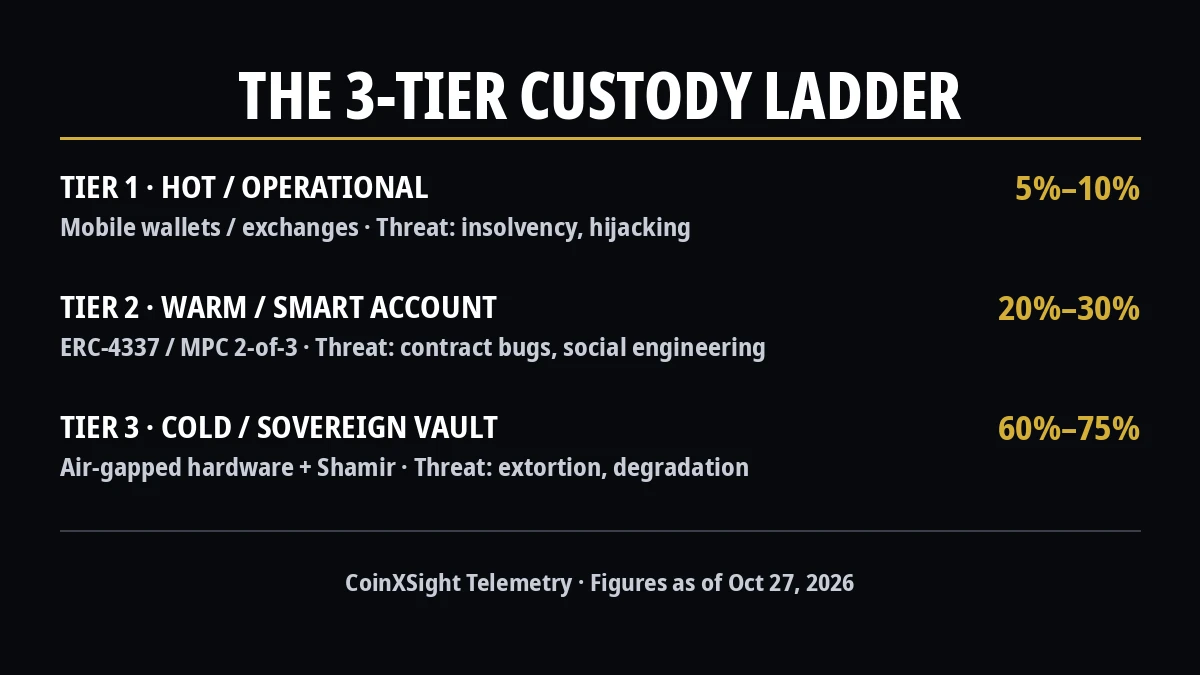
Modern Digital Asset Custody Architecture: Three-Tier Allocation & Threat Model (CoinXSight Telemetry)
Leaving capital on a centralized trading venue provides immediate liquidity and execution convenience. However, convenience incurs structural counterparty risk.
To determine when capital should migrate from centralized exchanges into sovereign self-custody, institutional risk desks use a three-factor decision matrix based on Portfolio Sizing, Trading Velocity, and Counterparty Duration:
1. The Capital Risk Ratio (> 10% of Liquid Net Worth)
If your digital asset balance represents more than 10% of your total liquid balance sheet, leaving it on a centralized exchange violates standard capital preservation doctrine. Regardless of proof-of-reserves attestations or brand reputation, centralized exchanges are commercial entities subject to regulatory freezing, insolvency proceedings, and withdrawal halts during extreme liquidity crises.
2. The Turnover Velocity Rule (The 30-Day Inactivity Test)
Capital allocated for active swing trading, limit-order execution, or collateral margin belongs on regulated venues with deep order book liquidity. Conversely, any capital that has not executed a trade or served as margin collateral within the preceding 30 days should be systematically swept into cold storage.
3. The Jurisdiction Risk Factor
As observed in our structural analysis of the CLARITY Act statutory divide and stablecoins evolving into regulated settlement rails, exchanges operating across disputed or offshore perimeters carry heightened seizure and de-banking vulnerabilities. Holding long-term reserves on unvetted offshore platforms introduces unhedged legal tail risk.
Custody Architecture Tier
Primary Storage Mechanism
Optimal Allocation %
Primary Threat Vector
Target Recovery Time (RTO)
Tier 1: Hot / Operational
Mobile Wallets / Regulated Exchanges
5% – 10%
Exchange insolvency; session hijacking
Immediate (Minutes)
Tier 2: Warm / Smart Account
ERC-4337 / MPC Multisig (2-of-3)
20% – 30%
Smart contract logic bugs; social engineering
Hours (Guardian recovery)
Tier 3: Cold / Sovereign Vault
Air-gapped Hardware + Shamir Backup
60% – 75%
Physical seed extortion; hardware degradation
Days (Multi-sig physical consensus)
Modern Digital Asset Custody Tiering & Balance-Sheet Allocation (CoinXSight Telemetry)
2. The 2026 Threat Model: How Self-Custody Loss Actually Occurs
In the early era of crypto, self-custody loss was almost entirely physical: losing a paper seed phrase, writing down incorrect mnemonic words, or discarding an unencrypted hard drive.
In 2026, physical loss accounts for less than 12% of total self-custody capital destruction. The modern threat model is overwhelmingly digital, systemic, and behavioral:
1. Blind Signing and Permissive Token Approvals
Modern DeFi protocols and NFT marketplaces rely on complex smart contract interactions. Attackers construct malicious web interfaces that prompt users to sign seemingly benign transaction payloads that actually grant unlimited token spending permissions (`approve` or `permit2` signatures) to an attacker-controlled contract address. The user keeps their private key safe, yet their entire ERC-20 balance is drained in a single transaction.
2. Supply-Chain and Firmware Infiltration
Sophisticated threat actors no longer attempt to crack cryptographic curves; they intercept hardware wallets in transit, flash malicious microcontroller firmware, or distribute trojanized desktop companion software. An air-gapped device running compromised firmware will generate deterministic seed phrases known in advance to the attacker.
3. Physical Coercion and Key Extortion
As cryptocurrency values climb into multi-trillion-dollar market capitalizations, physical extortion (the notorious “$5 wrench attack”) has become a documented risk for public holders. Single-seed hardware setups offer zero defense against in-person duress.
3. The 2026 Self-Custody Architecture: Multi-Tier Defense
To counter modern attack vectors, sovereign self-custody in 2026 has transitioned away from fragile single-mnemonic setups toward multi-layered, resilient architectures:
1. Account Abstraction (ERC-4337) and Social Recovery
Smart contract accounts eliminate the single-point-of-failure inherent in traditional Externally Owned Accounts (EOAs). By utilizing programmable verification logic, users configure Social Recovery Guardians—a trusted consortium of institutional signing services, hardware devices, and trusted family keys. If a primary key is lost or compromised, the guardian threshold can execute a scheduled key rotation without exposing the underlying assets.
2. Multi-Party Computation (MPC)
Institutional investors and sophisticated retail traders increasingly employ MPC wallets. Rather than generating a single private key that exists in memory during signing, MPC splits key generation into multiple cryptographic mathematical shares distributed across independent hardware environments (e.g., local secure enclave, cloud server, hardware token). A transaction is signed via secure multi-party computation without the full private key ever existing in a single physical location.
For high-value sovereign reserves, the institutional gold standard remains a multi-vendor multisig quorum (e.g., a 2-of-3 setup utilizing three hardware devices from completely different manufacturers—such as Ledger, Trezor, and Coldcard). This eliminates hardware supply-chain failure: even if one manufacturer’s firmware or hardware entropy is compromised, the attacker cannot sign a valid transaction without compromising an entirely separate hardware ecosystem.
4. Operational Runbook: The 5 Non-Negotiable Self-Custody Rules
Before executing a withdrawal from a centralized trading desk to personal cold storage, verify every step against this institutional runbook:
Verify Receiving Addresses on Air-Gapped Hardware: Never copy-paste an address from a clipboard without cross-verifying every character on the physical screen of your hardware device. Clipboard-hijacking malware dynamically replaces copied addresses with attacker addresses.
Execute Small-Scale Canary Transfers: Always send a minimal test transaction (e.g., $20) and verify on-chain confirmation before transmitting large-scale balance-sheet transfers.
Isolate DeFi Interaction from Cold Reserves: Maintain strict segregation between cold storage and interactive DeFi wallets. Never connect your primary sovereign cold vault to a browser extension or decentralized application interface. Funnel active capital through disposable, intermediate hot wallets.
Revoke Token Allowances Monthly: Utilize automated allowance audit tools to identify and revoke lingering open-ended token approvals on decentralized smart contracts.
Establish a Sovereign Inheritance Protocol: A self-custody setup that dies with the holder is a failure of risk management. Implement Shamir’s Secret Sharing (SLIP-0039) or time-locked dead-man switches with institutional legal trustees to ensure orderly generational transfer.
Self-custody is the foundational pillar of financial sovereignty in the digital age. It transforms personal capital from an unsecured liability on an exchange’s balance sheet into an unconfiscatable mathematical property right. Treat your security architecture with institutional discipline, eliminate single points of failure, and protect your sovereignty with layered defense.
Data sources: Chainalysis Crypto Crime & Key Compromise Report 2026; CertiK Web3 Security & Smart Contract Exploit Telemetry; CoinXSight Institutional Custody Architecture Guidelines. Figures current as of October 27, 2026.
Follow CoinXsight for continuous institutional-grade market microstructure and security analytics.
Disclaimer: This article is for informational, educational, and analytical purposes only and does not constitute technical, legal, security, financial, investment, or trading advice. Cryptographic key management, hardware wallets, and decentralized finance involve substantial technical risks, including irreversible loss of private keys, software bugs, and hardware failures. Always conduct comprehensive independent verification and follow rigorous security practices before managing private cryptographic keys.
CX
CoinXSight Alpha Desk
ALPHA // DESK
Quantitative Research Desk·Global Alpha Division
CoinXSight Institutional Research Desk produces quantitative crypto market intelligence, algorithmic models, and on-chain forensics.
QUANTITATIVE SUITE // DEEP ALPHA ENGINEACTIVE
BTC/USDT // LIVE SCANNER
CONFLUENCE 74
LIVE SPOT PRICE$82,807.47WEAK_BUY
TP2
$89,522.75
+9.07%
TP1
$85,056.42
+3.63%
ENTRY
$82,078.86
ZONE
SL
$80,590.09
-1.81%
Auto-detect Order Blocks, Fair Value Gaps and risk-adjusted DCA ladders in < 5s.