Payrolls Beat Every Forecast by 100,000 Jobs — and Bitcoin Still Couldn’t Retake $76,000
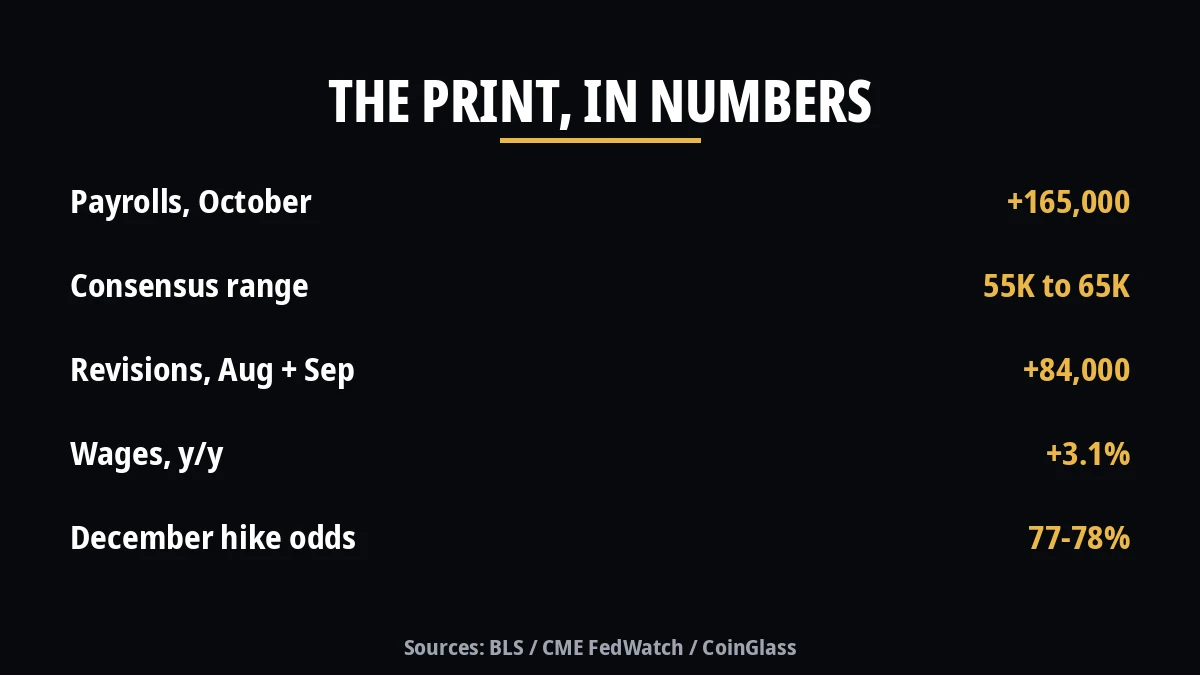
October payrolls beat every forecast u2014 165,000 jobs against 55,000u201365,000 expected, with 84,000 of upward revisions and wages running hot u2014 and the December hike is back to ~78%. But Bitcoin slipped under $75,000, recovered it, and still could not retake $76,000, while stocks managed only a narrow, chip-led bounce.
CX
CoinXSight Alpha DeskQuantitative Research Desk·Nov 7, 2026 · Updated Nov 7
Friday was supposed to be the day the American labor market finally showed a crack. The consensus said so, the recent trend said so, and the market had spent the week pricing a Federal Reserve that would have to think twice about raising rates again in December. Then the Bureau of Labor Statistics reported 165,000 new jobs in October, and the only crack in the story was the one in every forecast on Wall Street.
It was not a narrow beat. The Dow Jones survey expected 59,000. FactSet and CNBC had 55,000. Seeking Alpha’s number was 62,000, Bloomberg’s 65,000. The highest of the 79 forecasts in Bloomberg’s survey was 131,000. The actual print cleared that by 34,000 — and it cleared even Goldman Sachs’ above-consensus call of 75,000, and the top of the 100,000-to-150,000 band that leading-indicator models had pointed to as the upside case. And it arrived with the revisions pointing the same way: August was lifted to 186,000 from 133,000, September to 60,000 from 29,000, a combined 84,000 jobs that the earlier reports had missed. The three-month average of hiring, which had sagged to 51,000 a month ago, is now 137,000, the best since May. Against a 12-month average of just 48,000, October looks less like a blip and more like a different labor market than the one the autumn data described.
Bitcoin’s answer to all of this was to dip through $75,000, touch about $74,888 — its weakest since August 21 — and then claw its way back to near $75,900 by Saturday morning in Vietnam. It recovered the level, but it could not retake $76,000, and it is still sitting just below the short-term holder cost basis the market spent the week defending. That is the paradox this article has to hold in one frame: the best jobs report of the year, and a Bitcoin that could not use it. The relief bounce the market spent Friday hoping for is dead; the pressure from the beat is showing up as a sideways grind, not another leg down — $75,000 was pierced intraday and recovered, not lost cleanly.
The print, in full
The headline is the least interesting part once you read the release properly, so start with the parts that change the argument. Private payrolls rose 159,000, well above forecasts. The unemployment rate edged down to 4.1 percent from 4.2 percent, with 7.1 million people unemployed, and the labor force participation rate rose to 61.9 percent, its highest since February. The household survey, the noisier of the two measures in the release, added 463,000 jobs, its third straight large gain.
Wages were the hot edge of an already hot report. Average hourly earnings rose 0.4 percent on the month to $38.00, the strongest monthly gain since January and above the 0.3 percent forecast, and 3.1 percent over the year. The market had gone into the print expecting the annual wage rate to slip below 3 percent for the first time since May 2021. It went the other way. For a Federal Reserve that has spent the autumn arguing about whether wage growth is still too fast to let inflation settle, that is the line in the release that matters most.
The hiring was broad where it counted. Professional and business services added 70,000 jobs, its best month in a long while and a notable turn for a sector that had been shedding in the ADP data for three straight months. Health care added 42,000, and health care plus social assistance together added 55,000. Transportation and warehousing added about 25,000. Construction was flat, which reads as a non-event until you remember that housing starts just printed their weakest in years.
Two caveats keep the report honest, and both sit in the same release. The U-6 underemployment rate rose to 7.9 percent from 7.6 percent, and the number of people working part time for economic reasons jumped by 339,000 to 4.8 million. Some of the hiring, in other words, is people taking hours they did not want rather than jobs they did. And the survey’s own margin of error is roughly 100,000 jobs, which means a single month, however emphatic, is still a single month. But the revisions cut against dismissing it: when the past two months are revised up by 84,000 in the same release, the story is not one noisy print, it is three months of hiring stronger than first reported.
Friday night in one view
Print
What landed
What it changes
October payrolls, BLS, November 6
+165,000 vs 55,000–65,000 consensus; beat all 79 Bloomberg forecasts (highest 131,000)
The December hike is now the base case; the “hiring is stalling” story is dead for this month
Revisions, August and September
August 133,000 → 186,000 (+53,000); September 29,000 → 60,000 (+31,000); combined +84,000
Three-month hiring average jumps to 137,000 from 51,000 — best since May
Wages came in hot, not cool — the annual rate did not slip below 3% as expected
Michigan sentiment, November prelim
51.0 vs 48.0 forecast and October final; 1-year inflation expectations 4.3% (from 4.7%); 5–10 year 3.4% (from 3.5%)
Headline improved, but interviews ended November 2 — before Thursday’s rout
December hike odds
CME FedWatch ~77–78%, up from ~73% just before the print; Kalshi ~78%; Polymarket 77%
A quarter-point rise to 4.00–4.25% on December 8–9 is now priced as the likely outcome
Wall Street, Friday close
Nasdaq +1.09% to 24,579.42; S&P 500 +0.31% to 7,376.86; Dow −0.46% to 51,285.73
Narrow, chip-led bounce; weekly losses stand at Nasdaq −3.4%, S&P −2.7%
Bitcoin tape, Saturday morning Vietnam time
Near $75,900; Friday low ~$74,888, weakest since August 21; ETH near $2,240; Fear & Greed 25, Extreme Fear
$75,000 gave way intraday, then recovered; the bounce stalled below $76,000 and below short-term holder cost basis near $75,832
December is now a hike — probably
The repricing after the print was fast and, by the standards of this market, unusually clean. CME FedWatch put a 25-basis-point December rise at roughly 77 to 78 percent on Friday afternoon in Vietnam, up from about 73 percent just before the release. Kalshi showed about 78 percent, Polymarket 77 percent; one tracker had the odds spiking as high as 85 percent at one point during the day. The 10-year Treasury yield pushed toward 4.87 percent, and the two-year reached about 4.52 percent. A December hike to 4.00–4.25 percent, which on Thursday morning looked like a coin flip the market was drifting away from, is now the priced-in outcome.
The Fed’s own voices did nothing to slow that move. San Francisco Fed President Mary Daly called the report good news, said the labor market remains solid and wage growth is not accelerating excessively, and that it gives the Fed room to keep fighting inflation. That is a policymaker telling the market the strong print is not a problem for the tightening case. Cleveland Fed President Beth Hammack had said on Thursday that policy would need to become restrictive to bring inflation back to 2 percent. The October meeting held rates at 3.75–4.00 percent on a 10–2 vote, with two officials already wanting a rise; the December meeting on the 8th and 9th is where that dissent gets its second hearing.
None of this is settled, and the calendar says why. October consumer prices land on Tuesday, November 10, and the November jobs report arrives December 4, four days before the Fed meets. A hot CPI or another strong payrolls print would lock the hike in; a soft CPI, or a November payrolls number that takes back some of October’s strength, would reopen the debate fast. One month of hiring, even a month this strong, does not reverse a cycle by itself. But the burden of proof has flipped: the hold camp now needs the next two prints to cooperate, and the hike camp only needs them not to fall apart.
The sentiment number with an asterisk
The University of Michigan’s preliminary November reading did its part for the good-news story on the surface. Sentiment rose to 51.0 from 48.0, well above the 48.0 forecast, its highest since August. Current conditions rose to 51.0 from 46.7, expectations to 50.9 from 48.8. Year-ahead inflation expectations fell to 4.3 percent from 4.7 percent, the lowest since August, and long-run expectations eased to 3.4 percent from 3.5 percent. On its own terms, that is a consumer feeling a little less gloomy, expecting a little less inflation, and saying so in both halves of the survey.
Read the fine print before quoting it as a verdict on this week. The interviews ran from October 20 to November 2. They closed before the midterm results, before Thursday’s 5.5 percent Nasdaq rout, and before the payrolls report itself. The survey is a photograph of a consumer who had not yet seen any of the week’s news. Its most interesting line may be the one that has nothing to do with the headline: survey director Joanne Hsu said consumers’ comments “revealed growing anxiety over a possible AI bubble,” and sentiment fell 5 percent among respondents with the largest stock portfolios. The final November reading on November 20 will capture the week this one missed, and that is the number to watch.
Stocks bounced. Bitcoin didn’t.
Friday’s equity session is best read as relief, not recovery. The Nasdaq rose 1.09 percent to 24,579.42, with chip names leading — AMD up 11.04 percent, Micron up 5.12 percent, Nvidia up 2.78 percent, the semiconductor index up 3.62 percent. The S&P 500 added 0.31 percent to 7,376.86. The Dow fell 0.46 percent to 51,285.73, and the bounce faded from the morning highs into the close. For the week, the Nasdaq is still down 3.4 percent and the S&P 500 down 2.7 percent. Thursday took 5.52 percent off the Nasdaq in a day; Friday gave back about a fifth of it, and only in the names that had fallen hardest.
Bitcoin did not join the bounce, and that is the part of Friday that should worry a holder more than the payrolls number itself. The jobs report is, on paper, good news for risk assets: a strong economy, no recession signal, consumers still spending. But Bitcoin slipped through $75,000 while the Nasdaq was rising, then clawed back above it — and never got back to $76,000. It stayed below the short-term holder cost basis all day. The Deribit expiry that the market spent the week watching — about $2.65 billion of options, max pain at $79,000 — came and went at 15:00 Vietnam time with Bitcoin trading near $75,600, well below the level that would have flattered the bulls. The liquidation wave that started on Thursday kept rolling: CoinGlass counted about $1.05 billion in crypto liquidations over 24 hours, 88.2 percent of it longs, with Bitcoin accounting for $267.2 million and Ether about $167 million. The newest rolling reading, as of Saturday morning, tells the next chapter: about $613 million over 24 hours, with roughly $428 million of it shorts — the forced long selling has run its course, and the late shorts are now the ones being squeezed. The Crypto Fear & Greed Index ended the day at 25, Extreme Fear, down from 28. Spot Bitcoin ETFs, which saw $430.2 million of net outflows on Thursday, have now lost $869.8 million in the first four trading days of November.
There is a simple way to say what happened, and it is not flattering to the “Bitcoin as a hedge” story. When the market’s problem was a growth scare, Bitcoin fell with everything else. When the data said growth is fine, Bitcoin fell anyway, because fine growth means a December hike, and a December hike means higher yields and a stronger dollar, and that is the trade Bitcoin has been losing all autumn. The asset spent the week being repriced as risk, and Friday’s print gave the repricing a reason to continue rather than a reason to stop.
What the $75,000 test actually means
The level mattered before Friday tested it, and the test itself is the story. Bitcoin dipped to about $74,888 intraday — the weakest since August 21, 77 days earlier — then recovered to trade near $75,900 on Saturday morning, sitting just above the 50-week moving average near $75,552 and just below the short-term holder cost basis near $75,832, the line that marks where the average recent buyer starts losing money. It also sits below the election-night low of $75,736. The Fibonacci level traders were watching at $75,001 is now a level Bitcoin has traded through, not a floor it held — but the recovery back above it on the same day keeps the break from reading as a clean loss of the level.
The levels below are the ones the market talked about all week. Wintermute’s OTC desk pointed to $73,000 and then $68,000 as the next downside markers, with the 200-day moving average near $73,188 sitting between them. Above, the first job is simply getting back through $76,000, then $78,000 and $79,000, the old options max-pain line, and only then can anyone talk about $80,000 as anything but resistance. Ether, near $2,240 on Saturday morning, fell further than Bitcoin in percentage terms through the week and sits below its 20-, 50- and 200-day averages, with support near $2,205 and the next obvious liquidity pools near $2,174 below and $2,450 above. XRP held near $1.20, which in this tape counts as resilience.
None of this says Bitcoin has to keep falling. A Fear & Greed reading of 25 has marked better entries than worse ones through this cycle, funding rates on the perpetuals have flipped slightly negative, and the forced selling that defined Thursday and Friday eventually runs out of forced sellers. What it does say is that the next move up needs a catalyst the market does not currently have, while the next move down only needs the tape to stay heavy. The payrolls report removed the recession excuse for owning Bitcoin as protection, and left the tightening reality standing where the excuse used to be.
The week began with an election, a services miss, and a ledger patch, and it ends with a jobs report that beat every forecast and a Bitcoin that slipped under $75,000, recovered it, and still could not retake $76,000. The two facts belong in the same sentence because they are the same story: an economy too strong for the Fed to leave alone, and a risk market that spent the week learning what that costs. Chicago Fed President Austan Goolsbee speaks on Monday, the first Fed voice after the report, and Tuesday brings October consumer prices, the next print that can change the December argument, with the November jobs report following on December 4, four days before the Fed meets. Until then, the question is not whether the labor market is strong — Friday answered that — but whether Bitcoin can find a bid while the answer keeps pushing rates higher.
This article is for informational purposes only and does not constitute financial advice. Figures are cited from official releases and market data as reported at the time of writing and are subject to revision. Cryptocurrency markets are volatile; always do your own research before making investment decisions.
Disclaimer: This quantitative macroeconomic review and market telemetry analysis is published strictly for educational and informational purposes and does not constitute financial, investment, legal, or trading advice. Digital asset markets involve significant volatility and risk of capital loss. Always conduct independent due diligence (DYOR) before committing capital.
CX
CoinXSight Alpha Desk
ALPHA // DESK
Quantitative Research Desk·Global Alpha Division
CoinXSight Institutional Research Desk produces quantitative crypto market intelligence, algorithmic models, and on-chain forensics.
QUANTITATIVE SUITE // DEEP ALPHA ENGINEACTIVE
BTC/USDT // LIVE SCANNER
CONFLUENCE 74
LIVE SPOT PRICE$82,807.47WEAK_BUY
TP2
$89,522.75
+9.07%
TP1
$85,056.42
+3.63%
ENTRY
$82,078.86
ZONE
SL
$80,590.09
-1.81%
Auto-detect Order Blocks, Fair Value Gaps and risk-adjusted DCA ladders in < 5s.