From speculative trading collateral to regulated settlement rails: How the finalized U.S. GENIUS Act and South Korea’s December 3 payment integration are permanently reshaping digital dollar flows.
For nearly a decade, stablecoins lived almost exclusively within the fenced garden of crypto speculation. They were the dry powder parked between trades, the settlement token for perpetual swaps, and the temporary refuge during market crashes. In 2026, that narrow categorization is officially obsolete.
With the legislative completion of the U.S. GENIUS Act (Guaranteed Enforcement & National Interoperability for Underwritten Stablecoins) establishing strict federal reserve standards, and South Korea’s Financial Services Commission (FSC) formally recognizing fiat-backed stablecoin payment settlement effective December 3, 2026, digital dollars have crossed the Rubicon into global settlement infrastructure.
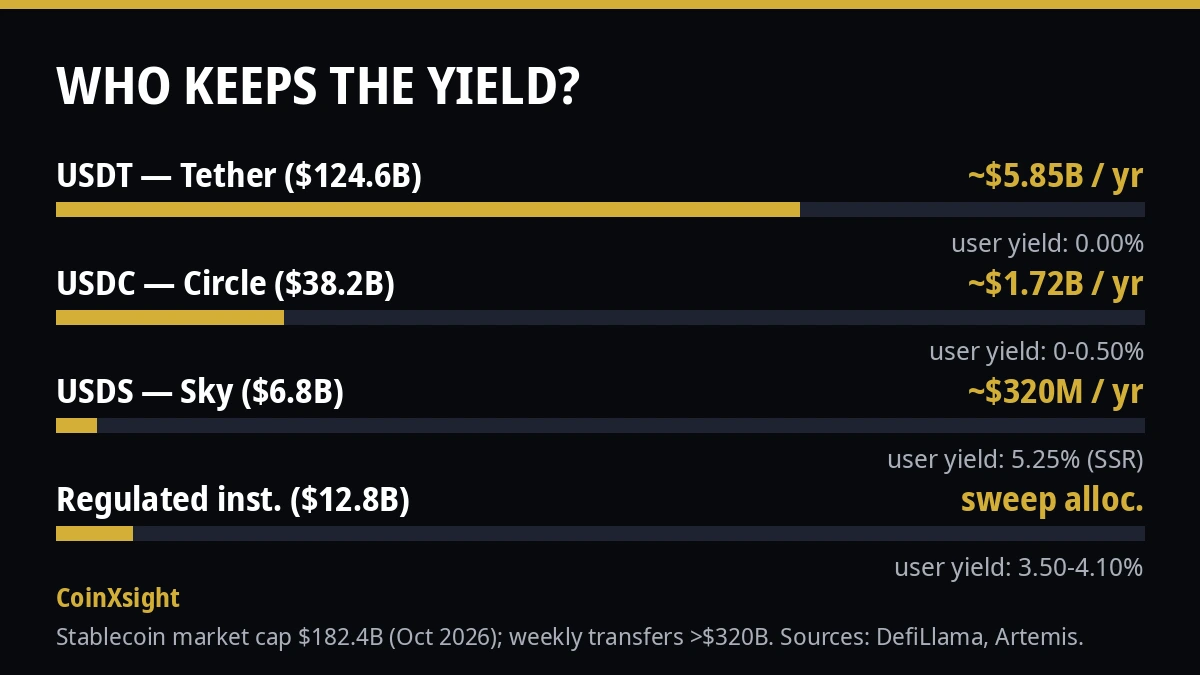
According to consolidated data from DefiLlama and Artemis, total stablecoin market capitalization reached $182.4 billion in October 2026, with adjusted weekly transfer volume consistently exceeding $320 billion across major Layer-1 and Layer-2 networks. Stablecoins now process more transaction volume than PayPal and are actively closing the gap with major card networks in cross-border corporate settlements.
Yet beneath the headline expansion lies a brutal structural realignment: Who captures the yield, who owns the rails, and which traditional intermediaries are about to get squeezed out?
1. The Two Regulatory Philosophies: U.S. Prudential Ringfencing vs. South Korea’s Direct Payment Rail
The current regulatory wave is fundamentally distinct from previous enforcement actions because it provides legal certainty rather than punitive litigation. However, Washington and Seoul have taken fundamentally different structural paths to reach the same destination.
The U.S. GENIUS Act: Prudential Reserve Lock-in
The finalized framework of the GENIUS Act establishes a dual-tier supervisory regime designed to integrate digital dollars directly into the shadow banking perimeter:
100% Cash & Short-Duration Treasuries: Non-bank issuers (such as Tether and Circle) must maintain reserves exclusively in segregated FDIC-insured cash deposits, reverse repo agreements with the Federal Reserve, or U.S. Treasury bills maturing in under 90 days.
Yield Pass-Through Restrictions: To protect commercial bank deposit franchises from massive retail capital flight, the act restricts consumer-facing stablecoin issuers from paying automated native interest directly on circulating tokens.
Interoperability Mandate: Federally approved stablecoins must maintain standardized programmatic redemption mechanisms, eliminating the secondary-market depegging discounts historically exploited by arbitrage desks.
South Korea’s December 3 Milestone: Institutional Merchant Adoption
In contrast, South Korea’s FSC framework focuses on domestic point-of-sale and enterprise settlement:
Commercial Merchant Acceptance: Beginning December 3, 2026, licensed domestic merchants and e-commerce platforms can legally accept qualified foreign and domestic fiat-pegged stablecoins with immediate zero-chargeback settlement.
Bank-Backed Custody & KYC Integration: Issuers must partner with domestic tier-1 banking institutions (such as Shinhan or Hana) to anchor local won (KRW) liquidation corridors, preventing illicit capital outflows while accelerating cross-border supplier invoices.
While Washington chose to protect its commercial banking core by restricting yield, Seoul chose to unlock frictionless consumer commerce.
2. Who Captures the Yield? The Trillion-Dollar Arbitrage
Stablecoin Reserve Backing & Yield Distribution Analysis (CoinXSight Telemetry)
The central economic paradox of the stablecoin boom is the massive interest rate spread between the issuer and the end-user.
With benchmark interest rates holding above 4.50% following ongoing Federal Reserve policy evaluations—as analyzed in our breakdown of the Federal Reserve’s October 27–28 meeting—the stablecoin business model has become one of the most profitable financial structures in history.
For traditional cross-border money transfer operators (such as Western Union and MoneyGram), average global transaction fees remain stubbornly anchored at 5.8% to 6.2%, with settlement cycles taking between 24 and 72 hours.
On modern Layer-1 networks like Solana—which recently overhauled its consensus latency as explored in Solana’s Alpenglow upgrade went live this week—a $50,000 corporate invoice settles in sub-second finality for less than $0.005 in network fees. The traditional 6% fee structure is completely indefensible against programmatic blockchain settlement.
3. The Structural Casualties: Who Gets Squeezed?
The institutionalization of stablecoins will not be painless. The transition from speculative token to regulated utility creates clear casualties across three distinct categories:
1. Unregulated Offshore Algorithmic Protocols
The GENIUS Act and the European Union’s MiCA framework have effectively criminalized unbacked or endogenous algorithmic stablecoins within regulated jurisdictions. Protocols attempting to maintain dollar parity through synthetic governance tokens or reflexive mint-and-burn mechanics have seen institutional liquidity evaporate to near-zero.
2. Regional Correspondent Banks
For decades, tier-2 and tier-3 banks in emerging markets survived on foreign exchange (FX) spreads and correspondent banking fees for international trade settlement. Stablecoins bypass the SWIFT messaging architecture entirely. As South Korean and Southeast Asian trade corridors pivot to direct on-chain dollar settlement, regional correspondent banks face an irreversible contraction in fee-based non-interest income.
3. Pure Consumer Wallets Without Ecosystem Lock-in
Stand-alone consumer crypto wallets that rely solely on in-app swap markups are being marginalized. The winners of the payment race are vertically integrated distribution powerhouses: merchant aggregators, institutional prime brokers, and neo-banks that can bundle FX conversion, tax reporting, and instant settlement into a unified API.
The formalization of payment frameworks arrives at a critical juncture for the broader digital asset complex.
Over the past 30 days, total digital asset market capitalization has contracted by more than $200 billion, triggered by intense spot ETF capital rotations and macroeconomic de-risking. As Bitcoin retests crucial structural floors—where $80,000 has served as support through all of October—stablecoins represent the singular sector where institutional capital is not fleeing the ecosystem, but merely rotating into cash-equivalent collateral.
Furthermore, altcoin liquidity pools are undergoing rapid bifurcation. Capital is rotating out of speculative high-beta assets and concentrating into proven settlement assets like Ethereum, Solana, and cross-border regulatory winners—an effect similarly mirrored in institutional exchange-traded flows such as XRP ETFs.
5. Strategic Outlook: The 2027 Playbook
As the market approaches the South Korean December 3 deadline and the phased implementation of the GENIUS Act through Q1 2027, smart capital is positioning around three concrete developments:
1. The Rise of “Yield-Bearing Tokenized Deposits”: While retail stablecoin yield remains heavily policed in the U.S., institutional wholesale settlement will increasingly rely on tokenized bank deposits and permissioned money market funds (such as BlackRock’s BUIDL) that legitimately distribute treasury returns.
2. Layer-2 Gas Token Dominance: Ethereum Layer-2 rollups and high-throughput Layer-1 networks are fiercely competing to become the primary settlement substrate for corporate enterprise treasuries. The network that captures stablecoin velocity captures systemic transaction fees.
3. The Unification of Merchant Checkout: The next phase of merchant adoption will not look like “paying with crypto.” Users will swipe standard virtual cards or scan QR codes; the backend will liquidate stablecoins over decentralized rails in milliseconds, completely invisible to the consumer.
The conclusion is unmistakable: Stablecoins have outgrown crypto. They are no longer an experiment running on top of decentralized finance; they are the new foundation of global digital payments.
Data sources: DefiLlama Stablecoin Telemetry; Artemis Dashboard; U.S. Congress Legislative Records (GENIUS Act Framework 2026); South Korea Financial Services Commission (FSC) Policy Briefing; Federal Reserve Board of Governors. All metrics current as of October 24, 2026.
Follow CoinXsight for continuous institutional-grade market microstructure and regulatory analytics.
Disclaimer
Disclaimer: This article is for informational, educational, and analytical purposes only and does not constitute financial, investment, legal, tax, or trading advice. Digital assets and stablecoin mechanisms involve inherent technical, operational, and regulatory risks, including potential counterparty insolvency and smart-contract vulnerabilities. Always conduct thorough independent due diligence and consult licensed financial professionals before making capital commitments.
CX
CoinXSight Alpha Desk
ALPHA // DESK
Quantitative Research Desk·Global Alpha Division
CoinXSight Institutional Research Desk produces quantitative crypto market intelligence, algorithmic models, and on-chain forensics.
QUANTITATIVE SUITE // DEEP ALPHA ENGINEACTIVE
BTC/USDT // LIVE SCANNER
CONFLUENCE 74
LIVE SPOT PRICE$82,807.47WEAK_BUY
TP2
$89,522.75
+9.07%
TP1
$85,056.42
+3.63%
ENTRY
$82,078.86
ZONE
SL
$80,590.09
-1.81%
Auto-detect Order Blocks, Fair Value Gaps and risk-adjusted DCA ladders in < 5s.