Why double-digit stablecoin yields are returning, how delta-neutral basis funding generates real cash-flow, and where hidden depegging and duration risks lurk in the pursuit of passive return.
Over the past two quarters, digital asset money markets have quietly witnessed a pronounced resurgence: stablecoin yields across decentralized lending pools, centralized institutional vaults, and tokenized Treasury protocols have climbed back into double-digit territory. Advertising banners and crypto yield aggregators once again flash headlines of 12% to 18% APY on USD-pegged balances.
To investors who weathered the structural collapses of 2022, these figures evoke immediate skepticism. Memories of algorithmic mint-and-burn mechanisms and circular Ponzi flywheels remain painfully vivid.
Yet treating all high-yield stablecoin products as fraudulent ponzis is just as financially costly as trusting them blindly. In late 2026, stablecoin yield generation has fragmented into fundamentally distinct risk buckets: genuine macroeconomic risk-free yield anchored to sovereign short-term debt, directional funding rate transfer extracted from perpetual futures traders, and synthetic collateral leverage stacked across rehypothecated liquidity protocols.
Dissecting the mechanical origin of every basis point—separating cash-flow reality from structural leverage traps—is the essential survival skill for navigating institutional decentralized finance.
1. The Anatomy of Real Yield: The Three Legitimate Sources of APY
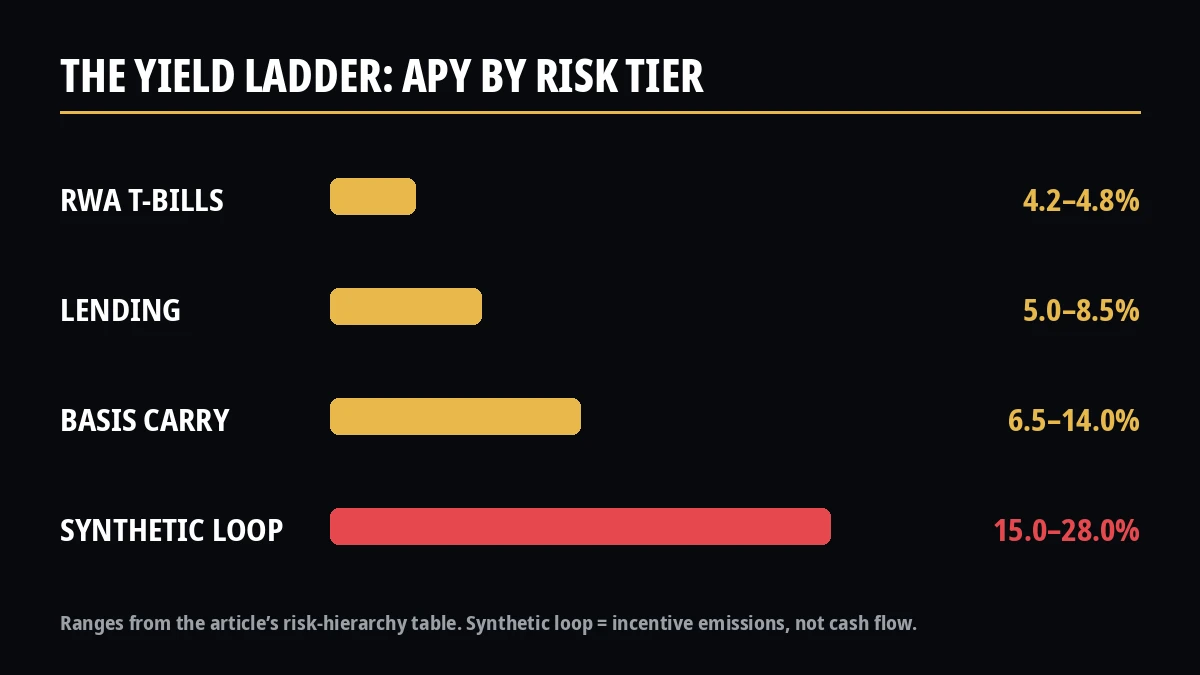
Stablecoin Yield Risk Hierarchy: From T-Bills to Recursive Looping (CoinXSight Telemetry)
In physical asset classes as well as digital markets, capital yield does not materialize out of thin air. Real yield requires an identifiable economic counterparty who is willing to pay a premium for capital utility, risk transfer, or time preference.
In current digital asset architecture, legitimate stablecoin yield derives strictly from three distinct economic mechanisms:
1. Tokenized Sovereign Debt (The Risk-Free Baseline: 4.2% – 4.8%)
The foundation of institutional stablecoin yields is anchored directly to short-duration sovereign obligations—primarily U.S. Treasury bills maturing in under 90 days and reverse repurchase agreements with central banks. Under regulated frameworks such as the U.S. GENIUS Act and the European Union’s MiCA perimeter, institutional issuers like Circle, Tether, and Ondo Finance maintain short-term government paper reserves. The yield generated here is the macroeconomic risk-free rate of the reserve currency, passed through to qualifying token holders via programmatic rebasing or accumulating share mechanics.
When speculative sentiment turns bullish across digital asset exchanges, derivative traders aggressively bid perpetual futures above spot prices. To maintain price parity between the perpetual contract and the underlying index, exchange risk engines mandate that long position holders pay an ongoing funding rate directly to short position holders every eight hours.
Quantitative hedge funds and yield vaults exploit this through a Delta-neutral cash-and-carry strategy: purchasing spot Bitcoin or Ethereum while simultaneously opening an equivalent short position on perpetual futures. The portfolio carries zero market directional risk, but systematically collects the funding payments paid by speculative longs.
In decentralized money markets (such as Aave, Compound, and Morpho), market participants deposit volatile crypto collateral (BTC, ETH, SOL) at conservative loan-to-value (LTV) ratios of 60%–75% to borrow circulating stablecoins for working capital, tax management, or leveraged spot exposure. The interest rate paid by borrowers reflects organic demand for balance-sheet liquidity, secured by automated smart contract liquidation mechanisms.
2. The Deceptive Mirage: How Synthetic Yield Masks Catastrophic Tail Risk
When an investor encounters a stablecoin protocol advertising 20%+ APY during a period when the Federal Reserve benchmark rate sits around 4.5%, the excess spread does not represent superior financial engineering. It represents unhedged tail risk.
Synthetic yields invariably conceal three structural failure points:
1. Recursive Looping and Leverage Stacking
Many high-yield protocols achieve elevated headline rates by automating “looping”: depositing liquid staking tokens (LSTs), borrowing stablecoins against them, swapping the borrowed stablecoins for more LSTs, and repeating the cycle three to five times. While this multiplies the staking yield during calm market regimes, it compresses the liquidation buffer to razor-thin margins. A minor depegging event in the secondary market triggers automated liquidation cascades that wipe out equity in seconds.
2. Governance Token Inflation (The Fake APY)
Protocols frequently inflate headline yields by distributing native governance tokens alongside organic interest. A pool advertising “18% APY” might consist of 3% real borrower demand and 15% protocol reward tokens. Because early liquidity providers systematically dump reward tokens onto public markets immediately upon receipt, the effective dollar return decays rapidly, leaving passive holders with depreciated governance tokens.
3. Illiquid Collateral Substitution
To sustain high borrowing demand, some aggressive lending protocols accept low-liquidity governance tokens or illiquid real-world debt certificates as allowable borrowing collateral. During market stress, liquidators cannot sell this illiquid collateral on open order books without suffering 30%+ slippage, resulting in protocol insolvencies where depositors are left with uncollectible bad debt.
3. The Institutional Due Diligence Framework: 4 Stress Tests Before Allocating
Before deploying institutional or treasury capital into yield-bearing stablecoins, sophisticated risk officers execute four non-negotiable diagnostic checks:
Test 1: The Counterparty Run Stress Test
Can the protocol survive a 50% capital withdrawal within a four-hour window without breaking its peg or halting redemptions?
If reserves are locked in long-duration private credit loans or illiquid staking queues, a sudden surge in redemption requests forces secondary market depegging, trapping depositors in illiquid pools.
Test 2: The Basis Inversion Audit
How does the yield vehicle perform when market funding rates turn negative?
During prolonged market drawdowns, perpetual funding rates frequently invert, forcing short basis positions to pay funding rather than receive it. Robust yield vaults must possess programmatic kill-switches that unwind futures exposure and rotate capital into risk-free Treasuries when basis spreads fall below the hurdle rate.
Test 3: Oracle Latency and Flash Loan Manipulation Resistance
Does the protocol rely on decentralized time-weighted average price (TWAP) oracles cross-referenced with off-chain telemetry, or can its collateral valuation be manipulated within a single block transaction?
Over 60% of historic DeFi exploits stem from oracle latency vulnerabilities where predatory actors manipulate thin automated market maker (AMM) pools to borrow prime stablecoins against artificially inflated synthetic assets.
Test 4: Regulatory Ring-Fencing and Bankruptcy Remoteness
Is the underlying collateral held in a legally segregated Special Purpose Vehicle (SPV) that is strictly bankruptcy-remote from the protocol operator?
As evidenced by our structural analysis of stablecoins evolving into global payment infrastructure, regulatory compliance under frameworks like the GENIUS Act guarantees direct legal claims on underlying reserves, eliminating the hidden custodian risk that doomed legacy shadow-banking vehicles.
4. Current Market Context: Late October 2026 Yield Landscape
The macro backdrop of late October 2026 presents a distinctive risk-reward dynamic across stablecoin deployments:
Funding Rate Compression: With Bitcoin consolidating near the $80,000 baseline, perpetual funding rates across major derivative exchanges have compressed to an annualized 6%–8%, normalizing from the hyper-leveraged peaks observed earlier in the cycle.
The RWA Hegemony: Over 68% of total circulating stablecoin market cap is now backed by tangible, yield-bearing sovereign short debt. The market has overwhelmingly rejected unbacked algorithmic experiments in favor of verifiable balance sheets.
Interoperability and Institutional Settlement: Cross-chain liquidity conduits and prime broker settlement APIs have drastically narrowed secondary market trading discounts. Capital now moves dynamically between macroeconomic ETF positioning, altcoin rotation metrics, and defensive cash-flow yields depending on active session volatility.
5. Tactical Rules: The Professional Stablecoin Yield Checklist
To maximize risk-adjusted stablecoin returns without exposing your balance sheet to catastrophic ruin, adhere to these four operational rules:
Cap Allocation by Strategy Tier: Allocate 60%–70% of treasury balances to regulatory-compliant, bankruptcy-remote RWA tokenized Treasuries (the capital preservation tier); limit basis carry strategies to 25%–30%; and restrict experimental or recursive DeFi yields to no more than 5% of total liquid assets.
Never Confuse High APY with Low Risk: In financial markets, yield is compensation for taking risk. If an asset pays double the sovereign risk-free rate, you are underwriting credit risk, liquidity risk, or smart contract execution risk—whether disclosed or not.
Monitor Secondary Liquidity Pools Daily: Track the automated market maker (AMM) curve balances of your chosen stablecoin on Curve and Uniswap. A persistent 3%–5% reserve imbalance is the earliest warning indicator of an impending run on the bank.
Demand Real-Time Proof of Reserves: Restrict capital deployment exclusively to protocols that offer cryptographically verifiable, real-time cryptographic proof-of-reserve (PoR) attestations verified by independent accounting firms.
Stablecoins have matured from speculative trading chips into the foundational settlement rails of the global digital economy. Treat your stablecoin yield not as a lottery ticket, but as a disciplined balance-sheet asset. Understand the plumbing, measure the credit risk, and never sacrifice your principal for transient basis points.
Data sources: DefiLlama Stablecoin Telemetry & Yield Analytics; CoinGlass Perpetual Funding Rate Matrix; Dune Analytics Institutional RWA Dashboards; CoinXSight Proprietary DeFi Risk Feed. Figures current as of October 26, 2026.
Follow CoinXsight for continuous institutional-grade market microstructure and regulatory analytics.
Disclaimer: This article is for informational, educational, and analytical purposes only and does not constitute financial, investment, legal, tax, or trading advice. Digital asset money markets, yield-bearing stablecoins, and decentralized finance protocols carry substantial financial risk, including smart contract vulnerabilities, counterparty insolvencies, and the permanent loss of invested principal. Historical yield performance is no guarantee of future returns. Always conduct thorough independent due diligence and consult accredited professional advisors before committing capital.
CX
CoinXSight Alpha Desk
ALPHA // DESK
Quantitative Research Desk·Global Alpha Division
CoinXSight Institutional Research Desk produces quantitative crypto market intelligence, algorithmic models, and on-chain forensics.
QUANTITATIVE SUITE // DEEP ALPHA ENGINEACTIVE
BTC/USDT // LIVE SCANNER
CONFLUENCE 74
LIVE SPOT PRICE$82,807.47WEAK_BUY
TP2
$89,522.75
+9.07%
TP1
$85,056.42
+3.63%
ENTRY
$82,078.86
ZONE
SL
$80,590.09
-1.81%
Auto-detect Order Blocks, Fair Value Gaps and risk-adjusted DCA ladders in < 5s.