Should you build your own crypto trading bot or buy one off the shelf? Open any crypto YouTube channel and you'll see the pitch: "My AI trading bot made $10,000 this month on autopilot." The idea is seductive — connect a bot to an exchange API and watch profits accumulate while you sleep.
The reality is more nuanced. Some ai trading bot crypto systems genuinely outperform manual traders. Others are expensive toys that lose money slowly (or quickly). And many products marketed as the best crypto trading bot are nothing more than simple rule-based scripts with an AI label slapped on for marketing.
This guide provides an honest, balanced analysis of the build vs. buy decision for automated crypto trading. No affiliate links, no product pushing — just a clear framework for deciding whether automation is right for your situation.
What "AI Trading Bot" Actually Means
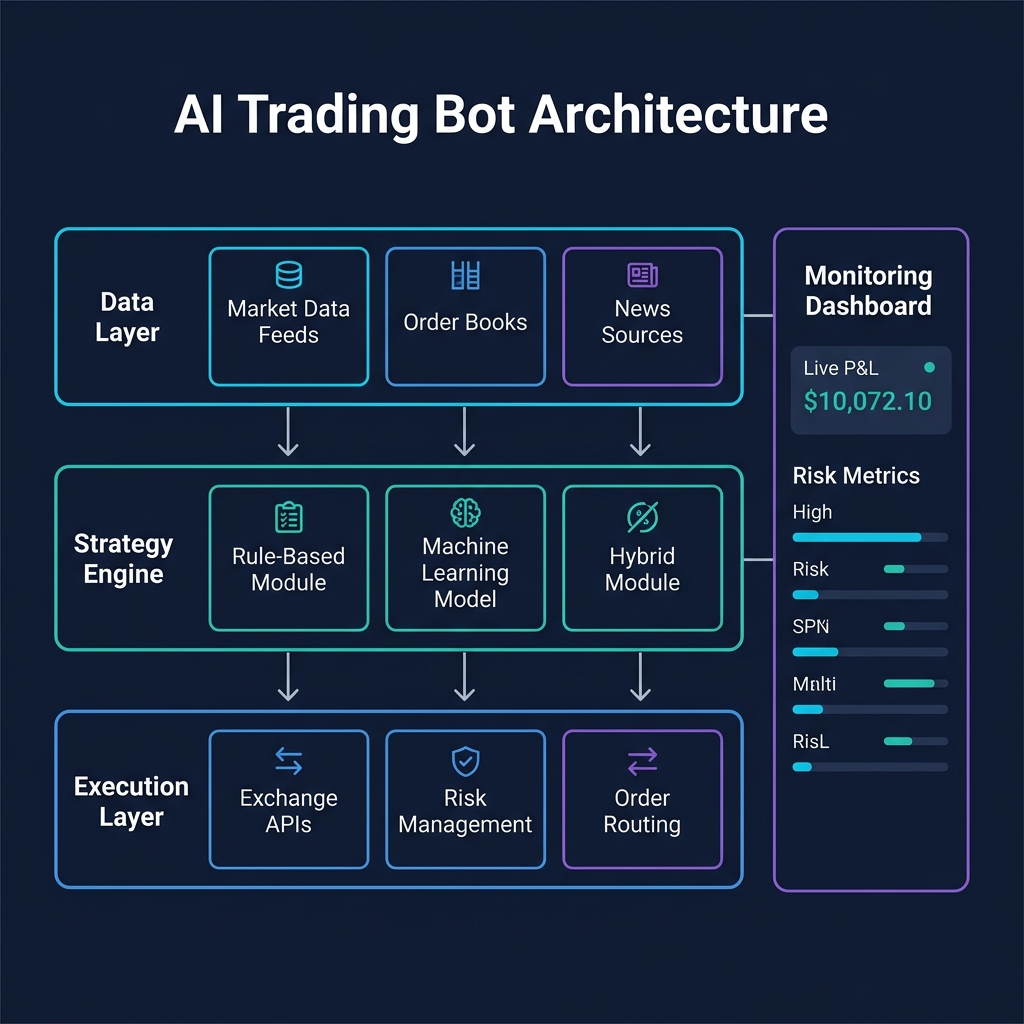
The term "AI trading bot" covers a spectrum from simple to genuinely sophisticated:
Level 1: Rule-Based Bots (Not Really AI)
What they do: Execute pre-programmed rules. "If RSI < 30 and price > EMA 200, buy. If price > entry + 5%, sell."
AI component: None. These are if/then statements automated through exchange APIs.
Performance: Can be profitable if the rules are well-designed and backtested. Fail catastrophically when market conditions change (a rule designed for bull markets will bleed in bear markets).
Cost to build: $500-2,000 (freelancer) or free if you can code basic Python/JavaScript.
Level 2: Machine Learning Bots
What they do: Train models on historical price data to predict future movements. Common approaches: LSTM neural networks, Random Forest classifiers, gradient boosting models.
AI component: Real but limited. The model learns patterns from past data but has no ability to adapt to fundamentally new market conditions (regime changes, black swans).
Performance: Typically 50-60% accuracy on directional prediction. After fees and slippage, many ML bots break even or lose money. The best implementations achieve 55-65% accuracy with strict risk management.
Cost to build: $5,000-20,000 in development time plus $500-2,000/month for compute and data feeds.
Level 3: Multi-Source AI Systems
What they do: Combine technical analysis, on-chain data, sentiment analysis, and order flow into a composite scoring system. This is what CoinXSight's ASI Score represents.
AI component: Substantial. Multiple AI engines processing different data streams with dynamic weighting based on market conditions. Learn more about how AI agents handle crypto trading decisions.
Performance: Higher accuracy (60-72% on directional calls for major assets). The multi-source approach reduces the failure mode of single-model systems.
Cost to build: $50,000-200,000+ in development costs. Requires a team: ML engineers, data engineers, infrastructure, and domain expertise.
Level 4: Fully Autonomous AI Agents
What they do: Make trading decisions autonomously, including position sizing, risk management, and strategy selection based on real-time conditions.
AI component: Comprehensive. The system adapts its strategy based on current market regime, adjusts risk parameters based on recent performance, and can handle novel market conditions.
Performance: The best institutional systems (Renaissance Technologies, Two Sigma) achieve Sharpe ratios of 2-5+. Retail versions are years behind institutional ones.
Cost to build: $500,000+ and requires a specialized team. Not realistic for individual traders.
The Honest Case for Building Your Own Bot
Mastering this concept is essential for crypto technical analysis. Our AI crypto trading guide breaks down how AI-powered platforms provide automated detection so you can focus on execution rather than manual chart scanning.
Advantages
1. Complete customization.
You control every parameter: which indicators, what timeframes, which coins, how much risk. No platform limitations.
2. No subscription fees.
After the initial development cost, you only pay for hosting ($20-100/month) and exchange API fees.
3. Proprietary edge.
If you discover a profitable strategy, you own it exclusively. Platform-based strategies are used by thousands of other traders, diluting the edge.
4. Learning experience.
Building a bot teaches you programming, data science, and systematic trading — skills that compound over your career.
Disadvantages (What Bot Promoters Don't Tell You)
1. Survivorship bias is extreme.
For every profitable bot, there are 50 that lost money and were abandoned. You only hear about the winners.
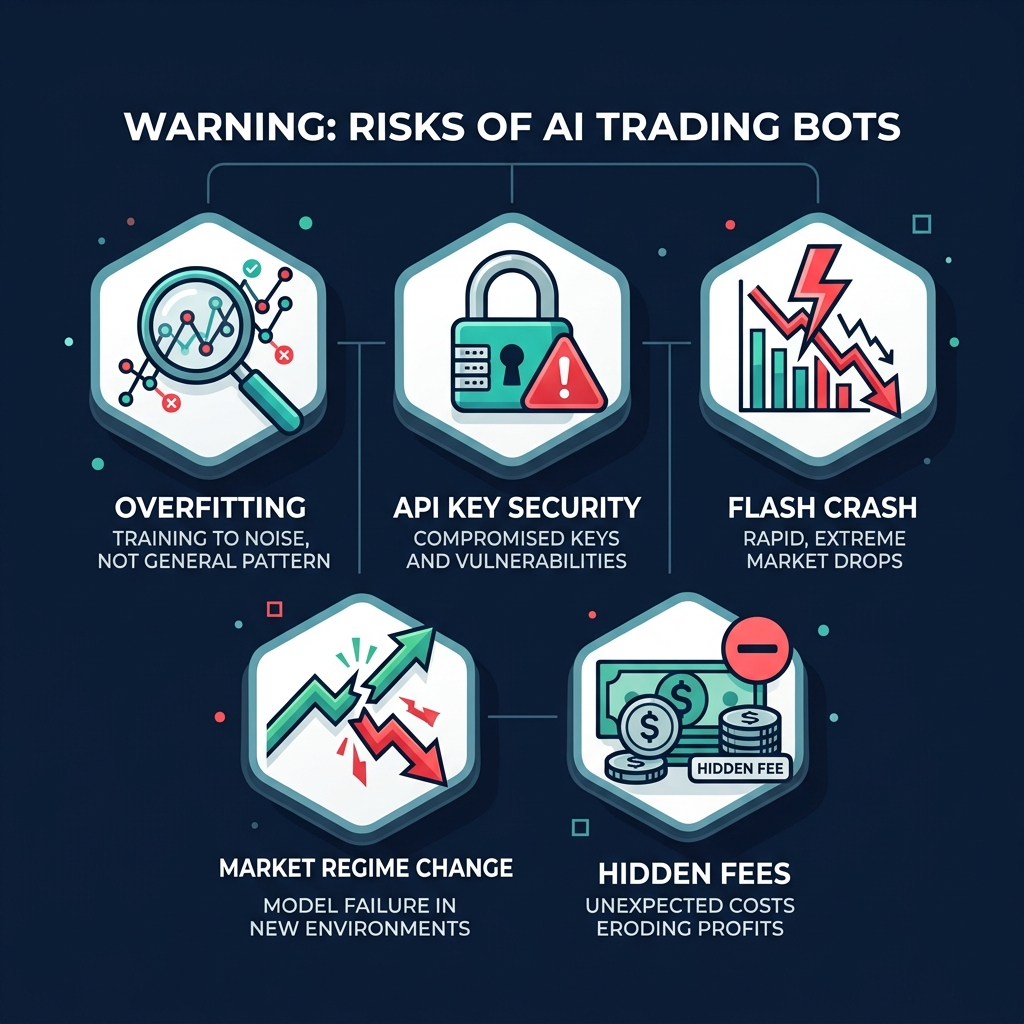
2. Overfitting is the #1 killer.
Most custom bots are overfitted to historical data. They perform beautifully in backtests (because they've memorized the past) and fail in live trading (because the future is different). This is the single most common failure mode.
How to detect overfitting:
Backtest win rate >80% → Almost certainly overfitted
Strategy requires >10 parameters → Too many degrees of freedom
Performance drops >50% on out-of-sample data → The model memorized, not learned
3. Infrastructure is expensive and fragile.
A bot that works on your laptop breaks when:
Your internet connection drops for 30 seconds during a volatile move
The exchange API rate-limits your requests
A software update changes the API response format
Your VPS runs out of memory during a market crash (when everyone is trading)
4. Maintenance is ongoing.
Markets evolve. A strategy that works in Q1 may fail in Q3. You need to continuously monitor, adjust, and re-validate your bot — which defeats the "passive income" promise.
5. Regulatory risk.
Automated trading is increasingly scrutinized by regulators. Market manipulation through bot activity (wash trading, spoofing) carries legal consequences. Your bot must comply with exchange ToS and local regulations.
The Case for Buying (Subscribing to) a Trading Platform
Advantages
1. Professional-grade AI without the dev cost.
Platforms like CoinXSight invest hundreds of thousands in AI development. You access the same technology for a monthly subscription.
2. Multi-source data already integrated.
Building your own on-chain + sentiment + technical analysis pipeline takes months. A platform provides it ready-made.
3. Continuous improvement.
The platform team updates the AI models, adds new data sources, and fixes bugs. You benefit from improvements without doing the work.
4. Community validation.
When thousands of traders use the same system, the signal quality is continuously validated. If the signals were consistently wrong, the platform would lose all users.
Disadvantages
1. No unique edge.
If 10,000 traders see the same Alpha Hunter signal at the same time, the edge is diluted. Early movers capture the best entries; latecomers get worse prices.
2. Subscription costs accumulate.
$30-200/month adds up. Over 3 years, you've spent $1,000-7,000. If you could build a profitable bot for $5,000, the math favors building after year 2-3.
3. Platform dependency.
If the platform shuts down, raises prices, or degrades in quality, you lose your tools. A custom bot is an asset you control.
4. Limited customization.
You can't modify the AI's scoring algorithm. If you disagree with how the platform weights sentiment vs. technicals, you can't change it.
The Third Option: AI-Assisted Manual Trading (The Practical Middle Ground)
Most successful retail crypto traders don't use fully automated bots. Instead, they use AI-assisted manual trading — leveraging AI for signal generation and analysis while maintaining human judgment for execution decisions.
AI handles:                          Human handles:
├─ Signal generation (Alpha Hunter)  ├─ Final trade decision (go/no-go)
├─ Scoring (ASI Score)               ├─ Position sizing
├─ Pattern detection                 ├─ Context awareness (news, events)
├─ On-chain analysis                 ├─ Risk management execution
├─ Multi-timeframe scanning          ├─ Emotional discipline
└─ Backtesting                       └─ Strategy adaptation
Why This Approach Outperforms Pure Automation
1. Humans handle context better than bots.
A bot doesn't know that the SEC just filed a major lawsuit against a crypto exchange. A human trader sees this news and pauses trading — avoiding losses that the bot would have incurred by blindly following technical signals.
2. Risk management is personal.
Your risk tolerance, financial situation, and time horizon are unique. A one-size-fits-all bot risk model doesn't account for whether you're trading with savings you can't afford to lose vs. discretionary capital.
3. Market regime awareness.
The AI Terminal's regime detection (covered in the Day Trading Guide) provides context that a human can act on immediately — reducing position sizes in sideways markets, pausing during uncertain regimes. A bot would need explicit programming for every regime transition scenario. The AI vs human traders comparison explores this dynamic in detail.
4. Emotional intelligence is a feature, not a bug.
The fear you feel when a position goes against you is actually useful information — it tells you the position is too large for your comfort level. Bots don't feel fear, which means they can't self-correct for sizing errors.
The Decision Framework: Which Approach Is Right for You?
Choose to BUILD a bot if:
Criterion
Threshold
Programming skill
Intermediate+ Python or JavaScript
Available capital for development
>$5,000
Time for maintenance
5+ hours/week ongoing
Risk tolerance for dev failures
High — expect the first 3 bots to fail
Trading experience
2+ years of profitable manual trading
Goal
Long-term systematic edge, learning
Choose to USE a platform if:
Criterion
Threshold
Programming skill
Not required
Available capital
$1,000+ for trading + $30-200/month for subscription
Time available
30-60 minutes/day for analysis
Trading experience
Beginner to intermediate
Goal
Immediate access to AI insights
Choose AI-ASSISTED MANUAL trading if:
Criterion
Threshold
Programming skill
Not required
Available capital
$5,000+ for trading
Time available
1-3 hours/day for active trading
Trading experience
Intermediate+
Goal
Best risk-adjusted returns with human oversight
What a Realistic AI Trading Setup Looks Like
For the 95% of traders who choose AI-assisted manual trading, here's the practical implementation using CoinXSight:
Execute → Place order with SL and TP set immediately
Weekly Review (30 minutes)
Backtest → Validate current strategy with recent data
Journal → Review win rate, average R:R, and mistakes made
Adjust → Modify strategy parameters if metrics deteriorate for 2+ weeks
This approach gives you 80% of the benefit of a sophisticated AI system while maintaining the human judgment that prevents catastrophic bot failures.
Frequently Asked Questions
Can I make a living from an AI trading bot?
Theoretically yes, practically very difficult. The most realistic path is AI-assisted manual trading with a $50,000+ account. Even then, expect monthly returns of 3-8% (not 50%+). Consistent 5% monthly returns on $50K = $2,500/month before taxes.
Are pre-built bots on exchanges worth using?
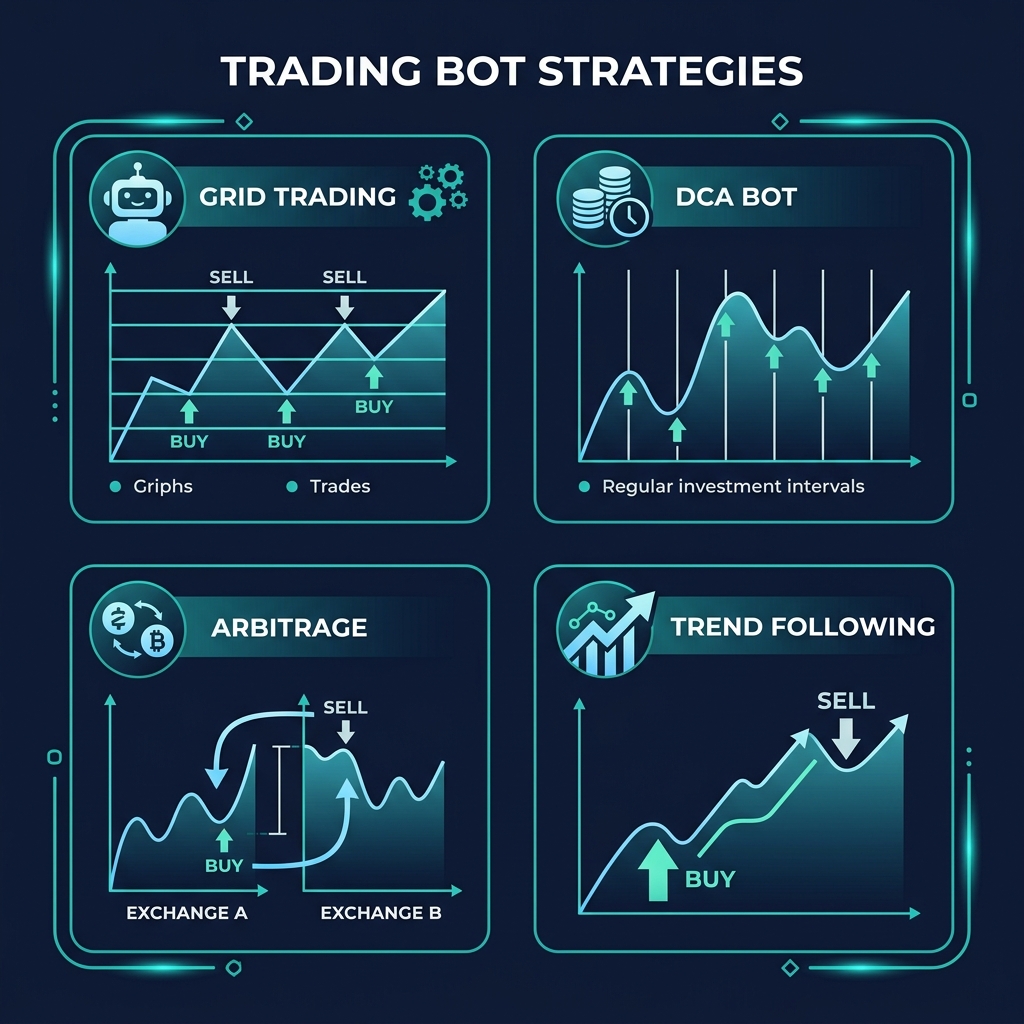
Exchange-native bots (grid bots, DCA bots) are legitimate tools for specific strategies. Grid bots work well in sideways markets. DCA bots reduce timing risk. But they are not "AI" — they're simple rule-based automation.
How do I know if a bot-selling service is a scam?
Red flags: guaranteed returns (no legitimate trader guarantees returns), no verifiable track record (screenshots can be faked), pressure to invest quickly, and the bot requires access to your exchange withdrawal permissions (only trade permissions should be needed).
What programming language is best for crypto bots?
Python (most libraries and tutorials), JavaScript/TypeScript (best for web-based bots and real-time WebSocket connections), and Rust (best performance for high-frequency strategies). Start with Python — it has the strongest ecosystem (ccxt, pandas, scikit-learn).
How does CoinXSight compare to a custom-built bot?
CoinXSight provides the AI analysis, signal generation, and scoring that would cost $50K+ to build independently. However, it doesn't execute trades automatically — it's designed for the AI-assisted manual trading approach. This is intentional: human oversight prevents the catastrophic failures that pure automation can cause.
Will AI eventually replace all human traders?
Institutional-grade AI already dominates some markets (high-frequency trading, arbitrage). But crypto's unique characteristics — regulatory uncertainty, narrative-driven price action, and extreme sentiment cycles — create conditions where human judgment combined with AI tools consistently outperforms pure AI automation.
Summary
The build vs. buy decision for AI trading bots comes down to your skills, capital, and goals. Building offers customization and learning but demands significant time and programming expertise. Buying offers immediate access but limits customization and creates platform dependency.
The practical middle ground — AI-assisted manual trading — combines the best of both: AI handles the computationally intensive analysis (scanning 500+ tokens, processing on-chain data, scoring confluence) while human judgment handles the nuanced decisions (context, risk sizing, execution timing).
The honest truth: Most retail traders who succeed in crypto use AI tools for analysis and execute trades manually. Fully automated bots that generate passive income reliably are the exception, not the rule. The successful ones are built by teams of ML engineers and quant researchers, not by following a YouTube tutorial.
Master risk management for crypto trading. Learn position sizing formulas, stop-loss strategies, and how CoinXSight's Portfolio module tracks your risk…