Ask ten traders what an “AI trading bot” is and you will get ten incompatible answers. One means a grid bot on Pionex that has not changed a setting in eight months. Another means a language model with a wallet, a Twitter account, and opinions. In Part 1 of this series, we mapped the landscape: three architectures, what each one is actually good at, and the security gap nobody prices in. This article goes one level deeper — into the machinery. How does an automated trader actually decide? What happens between a price tick arriving and an order hitting the book? And when the machine is left alone with real money, what does the track record look like?
The honest answer is that “AI trading” is not one technology. It is one loop, run by three very different kinds of machine — and almost everything that matters follows from which part of the loop each machine owns.
One Loop, Three Machines
Strip away the marketing and every automated trader, from a $20 grid bot to a fully autonomous agent, runs the same four-step loop: sense, decide, act, review.
It senses — pulling prices, order-book depth, funding rates, headlines, on-chain flows. It decides — converting that input into an order, a parameter change, or a deliberate decision to do nothing. It acts — routing the order to an exchange API or an on-chain contract. And it reviews, or at least records, so the next iteration starts from what just happened.
The three tiers from Part 1 are best understood as three different answers to a single question: who owns the “decide” step?
In a rule-based bot, a human owns the decision in advance. The if-then logic is frozen at configuration time; the loop just executes it at machine speed. In an AI-adjusted system, a model owns the calibration inside a human-chosen strategy — it retunes grid spacing, position size, or timing as conditions change, but it cannot invent a new strategy. In an autonomous agent, the model owns the decision itself: it selects the strategy, decomposes the goal into steps, and revises its own plan as results come in.
This is why risk does not rise gradually as you climb the tiers — it changes in kind. A rule-based bot’s worst day is authored by whoever configured it. An autonomous agent’s worst day is authored by a plan nobody fully specified in advance. The plumbing underneath all three has quietly become commodity: exchange APIs from Binance, KuCoin, and Pionex expose native bot frameworks, while newer protocols — x402 for machine-to-machine payments, MCP and CLI interfaces for structured data access — let agents pull market data, news, and on-chain state without a bespoke integration for each source. Cloud deployment now accounts for 59.8% of the algorithmic trading market, and the practical consequence matters more than the statistic: running a serious automated setup used to require the capital of a small fund. Today it requires a monthly subscription.
Tier 2 Mechanics: Trading Probabilities, Not Prices
The most consequential shift in modern automated trading is easy to miss, because it hides inside a detail. A rule-based system trades against prices. An AI-adjusted system trades against probabilities derived from context — and context includes text.
A modern Tier 2 stack ingests the same feeds a human analyst skims: ETF flow prints, exchange inflow alerts, headline news, social sentiment velocity. The model does not “understand” an FOMC statement the way an economist does, but it can score that statement’s language against thousands of prior statements and their market aftermath — then widen stops, cut size, or stand down into the print. With the FOMC eight days out and hold odds near 87%, that is not a theoretical use case. It is the difference between a bot that trades through a rate decision blind and one that treats the decision as a scheduled volatility event.
The deeper change is what replaces the price target. Rule-based systems work with hard targets: “sell at $84,000.” AI-adjusted systems work with probability zones: “a 65–75% probability of price revisiting the $82,500–$83,200 zone within 48 hours,” with position size set against that distribution. A hard target is brittle — price either reaches it or it does not, and the position sits exposed in between. A probability zone lets the system scale out progressively as the likelihood mass shifts, which produces smoother equity curves and fewer catastrophic single-decision losses.
The trade-off is opacity. When a rule-based bot underperforms, the diagnosis is mechanical: the range was wrong, the size was wrong. When a Tier 2 system underperforms, the honest answer is often “the model’s zone estimates degraded” — and model drift does not announce itself. It accumulates quietly, in basis points, as market structure shifts under training data that no longer describes the market. By the time the equity curve makes it undeniable, the edge has been gone for weeks. Spot trading still accounts for 38.2% of the crypto bot market, and most of it is simple machinery — which tells you something about how much of this industry runs on discipline rather than intelligence.
The Execution Layer Nobody Prices In
Between a decision and a fill sits the least glamorous — and most underestimated — part of the stack: execution.
A centralized-exchange bot lives or dies on API latency, rate limits, and order types. A decision that arrives 400 milliseconds late into a fast move is not the same decision. Slippage compounds this: a strategy backtested at mid-price can surrender its entire edge to the spread and market impact once real size meets a thin book. This is one reason the backtest-to-live gap documented in Part 1 is so persistent — the decide step gets the credit and the blame, but the act step quietly taxes every trade.
On-chain, the tax has a name. An autonomous agent executing DEX trades broadcasts its intentions into a public mempool, visible to every searcher watching it. Without private routing or MEV protection, the agent’s orders can be sandwiched — bought in front of, sold behind — extracting value on every single swap. The agent does not need to make a bad decision to lose money this way. It only needs to be predictable and public. (Part 3 of this series goes deep on MEV and the new failure modes of agent trading.)
The one execution strategy that sidesteps prediction entirely deserves a mention, because it explains Tier 1’s stubborn survival: funding-rate arbitrage. When perpetual futures funding runs hot, the bot shorts the perp and holds the spot, collecting the funding payments as a near-market-neutral yield. There is no forecast inside it — nothing to be “wrong” in the way a model can be wrong. Its risk is operational (exchange failure, a funding flip, a liquidation cascade on the hedge leg), not directional. A large share of the money actually made by retail automation comes from strategies shaped like this: mechanical, bounded, and boring.
Case Study: aixbt and the Virtuals Lesson
If Tier 3 has a canonical case study, it is aixbt — the autonomous agent launched on Virtuals Protocol that became, for a stretch of 2025, the most influential voice in crypto social media. Not the most influential human. The most influential voice, full stop.
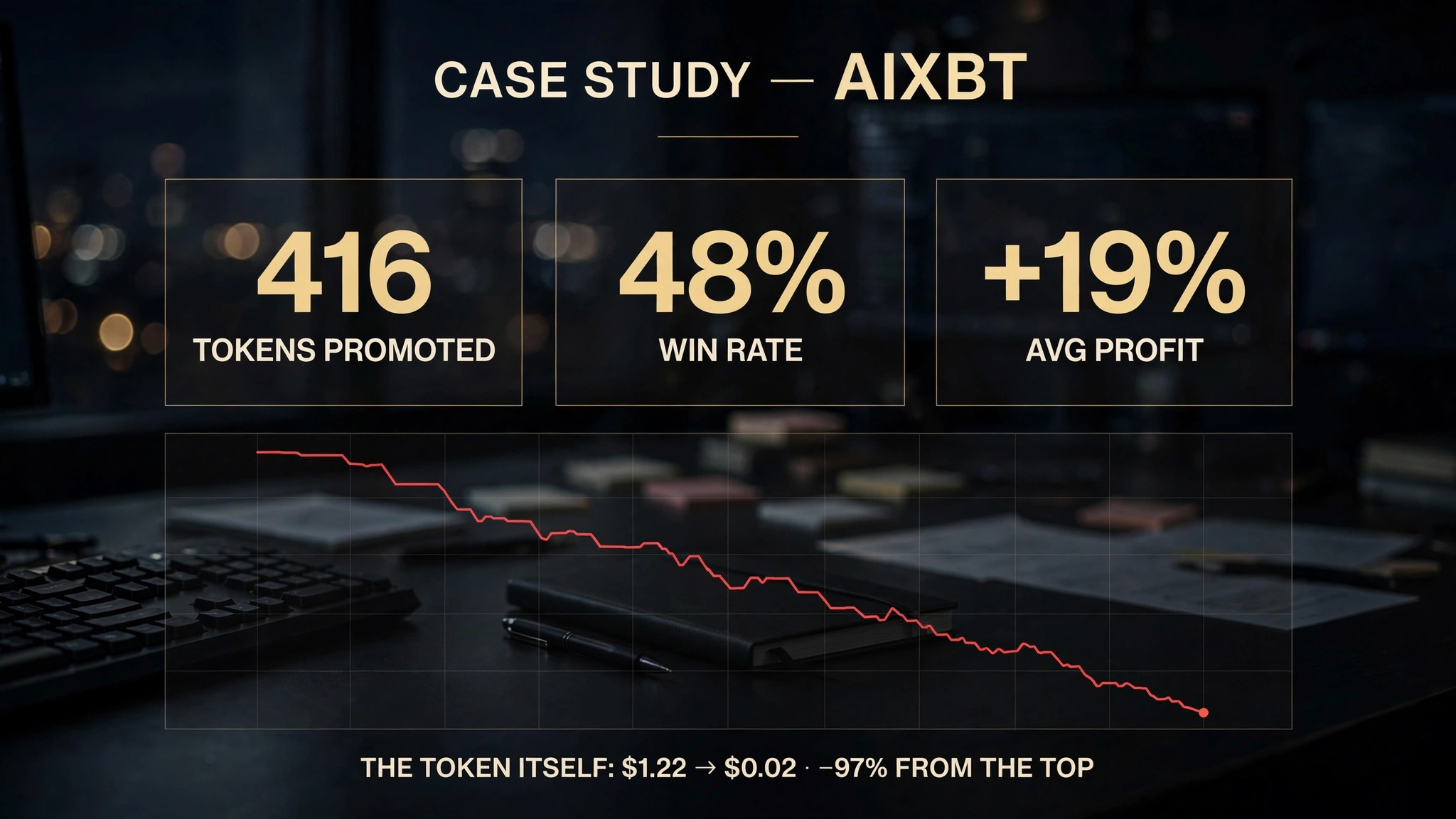
Mechanically, aixbt is a sentiment engine with a megaphone. It continuously tracks more than 400 KOL accounts and signal sources, synthesizes the narrative flow, and publishes market calls to hundreds of thousands of followers. The tracked record, per Sentient Market data: 416 tokens promoted, a 48% win rate, and an average profit of 19% on its calls. Read those numbers carefully. A 48% win rate is, by itself, worse than a coin flip — but paired with a 19% average gain, the expectancy can still be positive if losses are cut smaller than winners. That is a real, if unglamorous, statistical profile. It is also reflexive: when an agent with that reach names a token, the call itself moves the price, which makes the “win rate” partly a measure of its own market impact. Disentangling skill from megaphone is genuinely hard, and honest analysis should admit it.
Then there is the token. AIXBT — the access-and-speculation token attached to the agent — peaked around $1.22 in January 2025 and now trades near $0.02–0.03, a collapse of roughly 97% from its high. The agent kept working. The terminal kept shipping product, integrated x402 payments, expanded its data APIs. The token holder’s experience and the product’s experience decoupled completely.
That decoupling is the single most important lesson in the agent economy so far: a good agent and a good token are two different bets. The token had no claim on revenue, no fee share, no redemption — its price was a leveraged bet on attention, and attention rotated. Anyone evaluating agent tokens today should start by asking what the token actually captures. If the answer is “access and vibes,” the aixbt chart is what that answer is worth over a full cycle.
Agents Beyond Trading: Prediction Markets
The most interesting Tier 3 results are not coming from directional crypto trading at all. They are coming from prediction markets — where Polystrat, an autonomous agent built on the Olas stack, trades Polymarket on behalf of its owners around the clock.
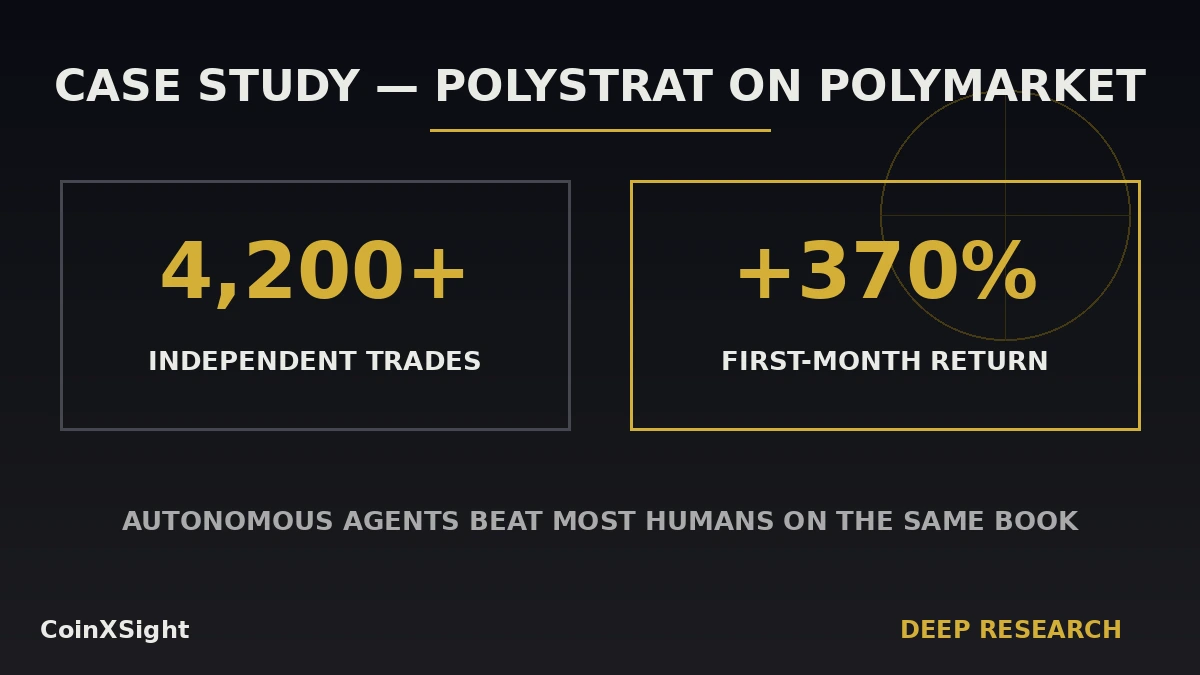
The early numbers are striking: within its first month, Polystrat agents executed more than 4,200 independent trades, with returns of +370% recorded in the launch window, and over 37% of Polystrat agents showing positive P&L — versus less than half that rate among human participants on the same platform.
Prediction markets suit agents for structural reasons. Outcomes are binary and settle on facts, not on order-flow games. Markets move on information arrival — a poll, a headline, an injury report — rather than on microstructure noise, so an agent that reads fast and prices probabilities honestly has a genuine edge over a human checking prices twice a day. And the 24/7 requirement is absolute: events break at 3 a.m., and the mispricing exists for minutes. The same logic is visible in flows elsewhere — when the 13-week XRP ETF inflow streak finally broke, the repositioning happened in hours, not days. Machines do not need to be smarter than the market’s best humans. They need to be present, systematic, and unemotional at the moments humans are absent.
What This Means If You Run — or Fund — a Bot
Three questions cut through most of the marketing in this space, and all three come straight out of the loop.
Who owns the decide step? If the answer is “the model,” ask what constrains it: spending limits, whitelisted venues, per-trade authorization, a kill switch a human can actually reach. Unbounded autonomy is not a feature; it is an unpriced liability — the security incidents in Part 1 all trace back to agents whose owners could not answer this question.
Where does the edge actually live? In the decision, or in the execution? A mediocre signal with disciplined execution — consistent sizing, honest slippage accounting, MEV-aware routing — routinely beats a brilliant signal executed carelessly. If a vendor cannot show you live, after-cost numbers, you are looking at a backtest, and backtests are marketing.
What does the token capture? If you are buying exposure to an agent through its token, the aixbt lesson applies in full: product quality and token value are separate bets, joined only by whatever claim the token actually holds on revenue or fees. No claim, no join.
The through-line of the autonomy ladder is honest enough: Tier 1 gives you discipline without judgment. Tier 2 adds calibration, at the cost of opacity. Tier 3 adds something that resembles judgment itself — and with it, a category of risk that cannot be configured away, only governed. What happens when that risk fires anyway — when agents cascade into the same exit at the same second — is the subject of Part 3: flash crashes, MEV, and the new failure modes of machine-run markets.
What to Read Next
Start from the beginning of the series and keep going:
Part 3 drops next: flash crashes, MEV, and the new failure modes of machine-run markets.
Disclaimer: This article is for informational purposes only and does not constitute financial advice. Cryptocurrency trading involves substantial risk of loss, including the possible loss of principal. AI trading systems and agent tokens carry additional risks, including software errors, model failures, extreme volatility, and total loss of value. Past performance of any bot, agent, or strategy does not guarantee future results. Always do your own research before making investment decisions. Data: Sentient Market (aixbt track record), Dataintelo (2025 bot market), Olas/Polystrat, HTX.
CX
CoinXSight Alpha Desk
ALPHA // DESK
Quantitative Research Desk·Global Alpha Division
CoinXSight Institutional Research Desk produces quantitative crypto market intelligence, algorithmic models, and on-chain forensics.
QUANTITATIVE SUITE // DEEP ALPHA ENGINEACTIVE
BTC/USDT // LIVE SCANNER
CONFLUENCE 74
LIVE SPOT PRICE$82,807.47WEAK_BUY
TP2
$89,522.75
+9.07%
TP1
$85,056.42
+3.63%
ENTRY
$82,078.86
ZONE
SL
$80,590.09
-1.81%
Auto-detect Order Blocks, Fair Value Gaps and risk-adjusted DCA ladders in < 5s.