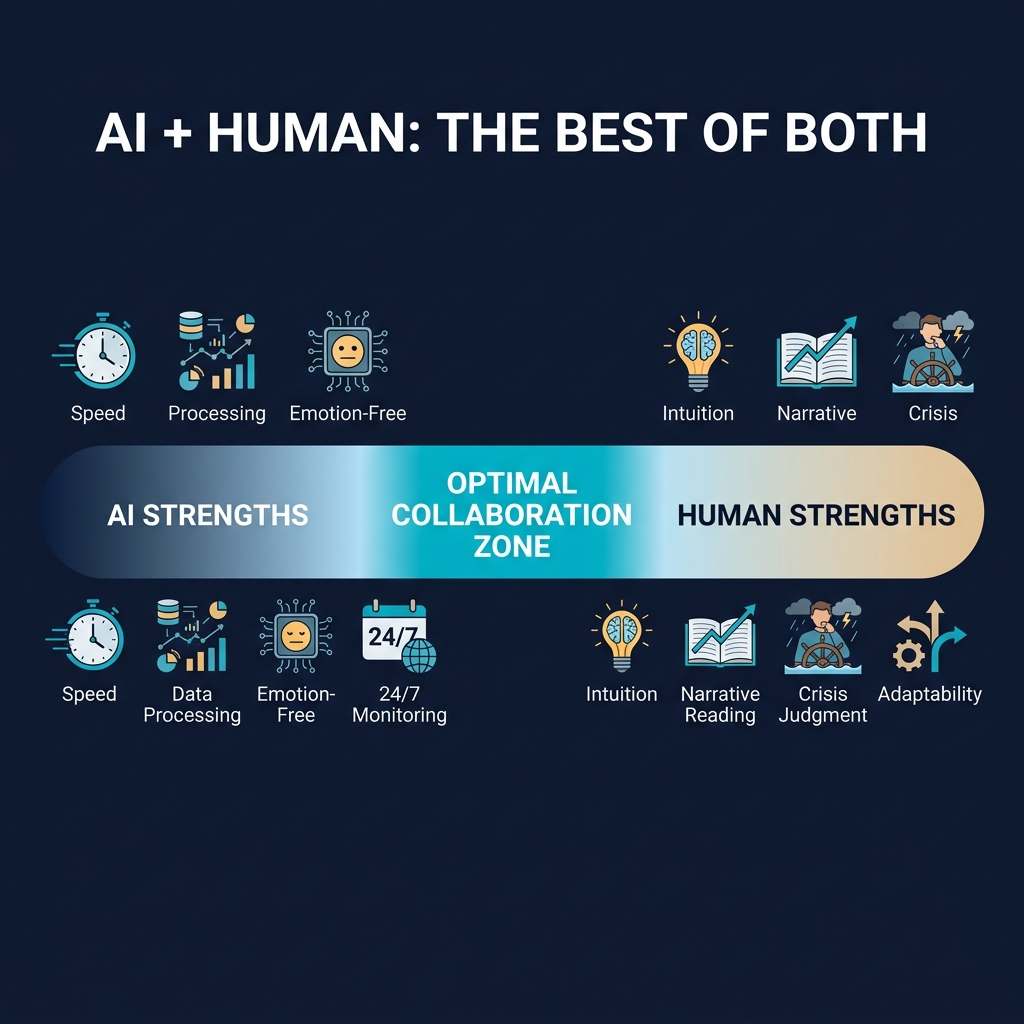
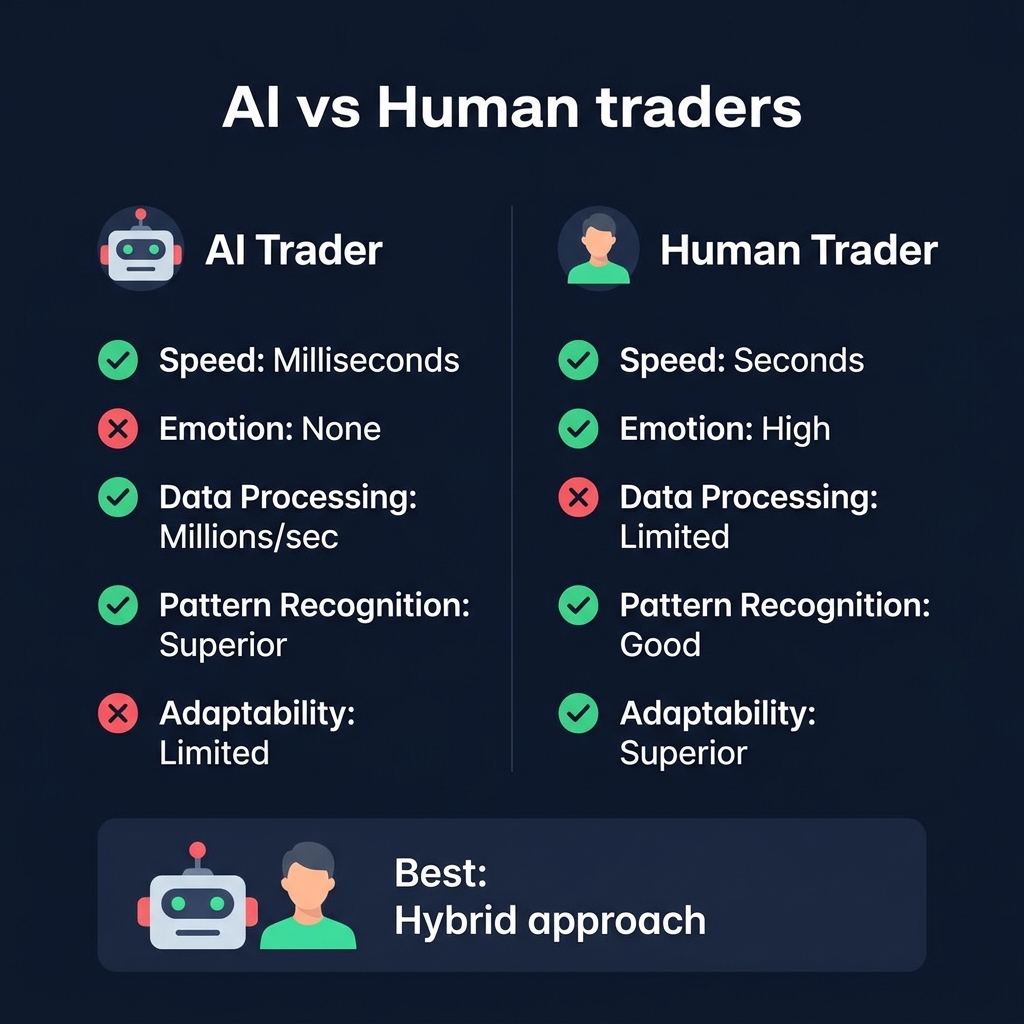
Every crypto trading community has the same debate: can AI replace human traders? The question itself is wrong. After analyzing thousands of trading signals and outcomes, the answer is clear — the best results come from AI and human working together, each handling what they do best.
AI doesn't panic sell during a 15% dip at 3 AM. Humans don't try to trade algorithmically through a regulatory black swan event. The magic happens when you combine AI's relentless data processing with human contextual judgment.
This isn't motivational fluff. We'll walk through specific scenarios, real trade examples, and a framework you can use starting today.
What AI Does Better Than You
1. Processing Scale
A human trader can realistically monitor 10-15 tokens, check 3-4 indicators per token, and scan maybe 20 news sources. An AI system like CoinXSight's backend processes:
4,000+ tokens simultaneously
12+ data layers per token (technical, on-chain, sentiment, volume)
Thousands of social posts, news articles, and on-chain transactions per hour
All of this recalculated every few minutes, 24/7, 365 days
You physically cannot compete with this. Accepting this fact is step one toward becoming a better trader.
2. Emotional Neutrality
The most destructive force in trading isn't bad analysis — it's emotion. AI doesn't experience:
FOMO when a token pumps 40% and everyone on Twitter is celebrating
Revenge trading after a loss, increasing position size to "make it back"
Anchoring bias — holding a losing position because "it was $150 last week, so $95 is a bargain"
Recency bias — assuming the last 3 trades predict the next one
AI evaluates every signal with the same mathematical consistency whether the previous trade was +50% or -20%.
3. Pattern Recognition at Scale
AI can identify chart patterns across every timeframe of every token simultaneously. A specific EMA crossover on SOL's 4H chart while RSI diverges on the daily and whale wallets accumulate — a human would take 30 minutes to check all this. AI catches it in seconds.
What Humans Do Better Than AI
This is where crypto technical analysis becomes practical — a quality crypto analytics platform will display these signals in real time, helping you act on setups as they form.
1. Contextual Understanding
In May 2025, the SEC announced a major regulatory shift on crypto ETFs. The immediate price reaction was negative (fear selling). Within hours, sophisticated traders realized the ruling was actually favorable for long-term adoption. They bought the dip aggressively.
AI systems that rely on NLP sentiment analysis saw the negative words ("regulation," "enforcement," "compliance") and rated sentiment as bearish. Human traders who actually read and understood the ruling saw the opportunity.
Key insight: AI reads words. Humans understand meaning. The gap between these two capabilities is where money is made.
2. Black Swan Judgment
When the unexpected happens — exchange hacks, regulatory bans, protocol exploits, macroeconomic shocks — AI models trained on historical data are navigating uncharted territory. Their training data doesn't include "this specific thing happening for the first time."
Humans can:
Assess the magnitude of a black swan (is this FTX-level or a minor exchange issue?)
Evaluate second-order effects (if Exchange X goes down, what happens to DEX volumes?)
Make survival-first decisions (preserve capital now, analyze later)
3. Narrative Recognition
Crypto markets are narrative-driven. "AI tokens," "RWA," "Liquid Staking" — these themes rotate and drive capital flows. AI can detect that certain tokens are trending, but it struggles to understand why the narrative matters, how long it might last, and when smart money will rotate out.
A human who understands that "AI narrative is cooling because a major AI company disappointed on earnings" can front-run the rotation before the data shows up in on-chain metrics.
The 10-Scenario Comparison
Scenario
AI Advantage
Human Advantage
Winner
Trending market (clear direction)
✅ Pattern recognition, scale
❌ Slow to react across 100 tokens
AI
Ranging/choppy market
✅ Identifies range boundaries accurately
❌ Gets chopped up emotionally
AI
Black swan event (exchange hack)
❌ No training data for novel events
✅ Crisis judgment, capital preservation
Human
Regulatory announcement
❌ NLP misreads nuance
✅ Reads and understands policy context
Human
Meme coin frenzy
⚡ Detects volume surge early
⚡ Understands social dynamics and timing
Both
Weekend low-liquidity dump
✅ No sleep, instant reaction
❌ Asleep, sees dump Monday morning
AI
Narrative rotation
❌ Detects lagging signals
✅ Understands why money is moving
Human
Multi-factor confluence
✅ Processes 12+ factors instantly
❌ Can check 3-4 at most
AI
Position sizing during fear
✅ Calculates optimal size mechanically
❌ Panic reduces or over-bets
AI
Major protocol upgrade
❌ Can't assess technical implications
✅ Understands what the upgrade enables
Human
Score: AI 5 — Human 3 — Tie 2
The takeaway: AI dominates in data-heavy, emotion-free scenarios. Humans dominate in context-heavy, novel scenarios.
The Collaboration Model: AI as Co-Pilot
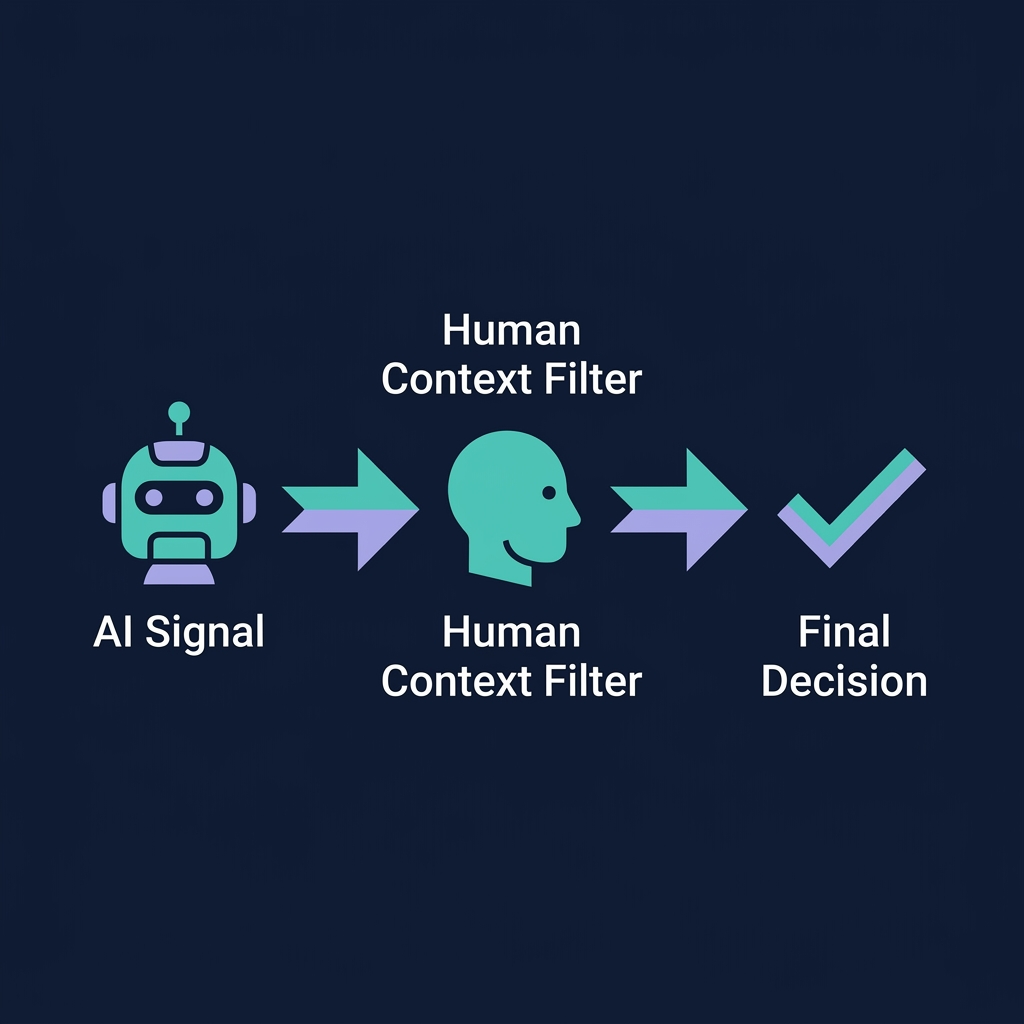
The most effective approach treats AI as a co-pilot, not an autopilot. Here's the framework:
Step 1: AI Provides the First Signal (Remove Initial Bias)
Before you form ANY opinion about a trade, check what the AI says first. This prevents anchoring bias.
Open CoinXSight's Alpha Hunter or ASI score. If the AI says "Strong Buy" on ETH with ASI 78, that's your starting point. If it says "Neutral" with ASI 52, that's also valuable information.
Why this order matters: If you decide "ETH looks bullish" first, you'll cherry-pick data to confirm your bias. If AI says "bullish" first, you then apply human judgment to stress-test the AI's conclusion.
Step 2: Apply the Human Context Filter
Now ask yourself these questions:
Is there any narrative or news the AI might not fully understand?
Are there macro events coming (CPI data, Fed meeting, crypto-specific events)?
Does this trade fit my current portfolio allocation?
Is the market in a regime that favors this signal? (AI signals work best in trending markets)
Am I feeling any emotional pressure to take or skip this trade?
Step 3: Score the Agreement
AI Signal
Human Assessment
Action
Bullish + high conviction
Agrees (context supports)
Full position size
Bullish + high conviction
Disagrees (context concerns)
Half position size or skip
Neutral
Agrees or disagrees
No trade — wait for clearer setup
Bullish + low conviction
Agrees
Quarter position size — speculative
Bearish
Human sees opportunity
Paper trade only — test your thesis
Case Studies: When AI Was Right and Humans Were Wrong
SOL Breakout — March 2026
In March 2026, SOL had been ranging between $140-$165 for three weeks. Most human traders were bored and had moved to other tokens. CoinXSight's ASI score gradually climbed from 58 to 74 during this consolidation. Alpha Hunter generated a "Strong Buy" signal on March 12th.
Many traders in Discord groups said "SOL is dead, it's just ranging." The AI saw:
SOL broke out above $165 on March 15th and reached $195 within 10 days. The AI didn't care about the narrative — it processed the data.
The FTX-Style Scenario — When Human Judgment Saved Capital
In late 2025, rumors circulated about a major exchange's solvency. AI models showed mixed signals — some on-chain metrics were concerning, but not enough to trigger a clear "sell" signal. The ASI score for tokens associated with that exchange dropped to 45, but that alone wasn't alarming.
Experienced traders recognized the pattern from FTX's collapse in 2022. The sequence of events — withdrawal delays, then reassuring tweets, then more delays — was eerily familiar. They pulled funds immediately, days before the exchange restricted withdrawals.
AI couldn't recognize "this feels like FTX" because pattern-matching across completely different entities with different data signatures isn't what quantitative models do. Human intuition, informed by experience, made the difference.
Building Your Personal Trust Calibration Process
Don't blindly trust AI on day one. Build trust gradually:
Month 1: Paper Trade Only
Follow every AI signal from Alpha Hunter on paper
Record the outcome of each signal
Note when your human instinct would have disagreed — and who was right
Month 2: Small Positions
Start with 25% of your normal position size
Only take AI signals where your human filter also agrees
Continue tracking accuracy
Month 3: Full Integration
If AI accuracy is above 55% (which is strong in crypto), trust the system
Use the collaboration framework for every trade
Maintain your trading journal to track AI vs human accuracy separately
Why CoinXSight Keeps the Human in the Loop
CoinXSight deliberately does not auto-execute trades. The platform provides intelligence — ASI scores, Alpha Hunter signals, whale alerts, sentiment data — but the final decision always rests with you.
This is intentional. We've seen that:
Fully automated systems fail during regime changes
Traders who understand why they're entering a trade manage it better
The learning process of evaluating AI signals makes you a better trader over time
The goal isn't to replace your judgment. It's to give you a powerful co-pilot that processes more data than any human can, so your judgment is better informed.
Frequently Asked Questions
Can AI trading bots consistently beat the market?
In specific conditions (trending markets, high-volume tokens, mean-reversion strategies), well-designed AI systems outperform average human traders. But no AI system consistently beats the market across all conditions. The edge comes from combining AI signals with human context filtering.
How do I know when to override the AI?
Override when you have specific, concrete contextual information the AI likely doesn't factor in — such as understanding a regulatory announcement, recognizing a black swan pattern, or knowing about an upcoming catalyst. Don't override based on "feelings" or "this time is different."
Is AI trading only for experienced traders?
No. In fact, AI tools benefit beginners the most. Experienced traders have developed intuition over years. Beginners don't have that intuition yet — AI fills the gap by providing data-driven signals while the beginner develops their own judgment.
What happens when the AI and my analysis disagree?
This is actually the most valuable scenario. It forces you to examine why you disagree. If you can articulate a specific contextual reason, give your human judgment more weight. If you're disagreeing based on a "gut feeling" without evidence, defer to the AI.
Will AI eventually replace human traders entirely?
For simple, rule-based strategies in liquid markets — possibly. For crypto specifically, with its narrative-driven cycles, regulatory uncertainty, and frequent structural changes — human judgment remains essential. The future is collaboration, not replacement.
Summary
AI excels at: data processing, emotional neutrality, pattern recognition at scale, 24/7 monitoring
The collaboration model: Let AI signal first → Apply human context filter → Score agreement → Size position accordingly
Build trust gradually: Paper trade → Small positions → Full integration
Keep learning: Track AI accuracy separately from your own to understand where each excels
The best traders in 2026 aren't fighting against AI or blindly following it. They're working with it — using AI to eliminate their weaknesses while applying their human strengths where AI falls short.