Stocks Rallied 1.3%. Bitcoin Gave Back $74,000 — the Decoupling Is the Story Now
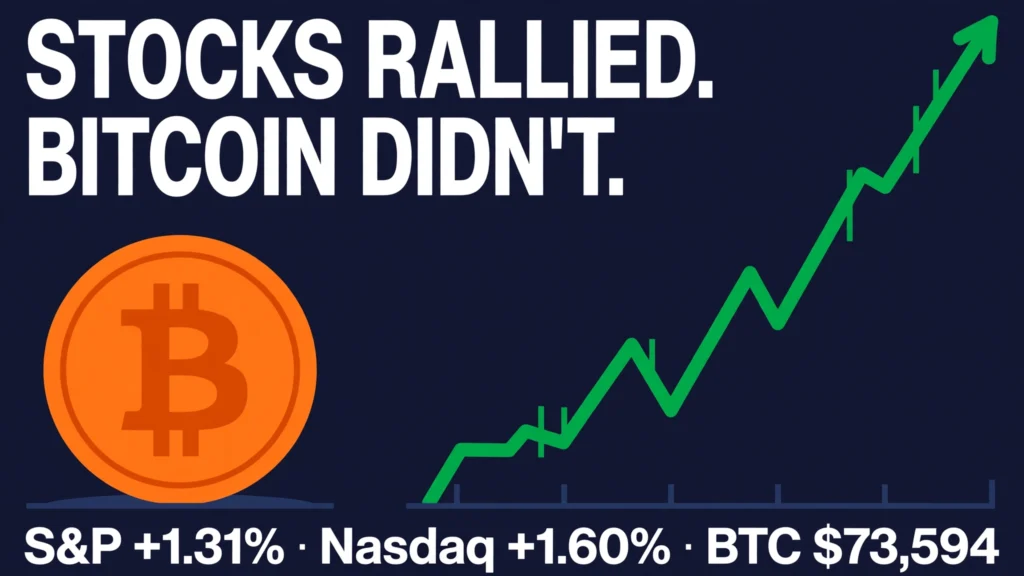
Stocks rallied 1.3% on Wednesday but bitcoin gave back $74,000 and sat at $73,594 by midday Thursday — the second decoupling of the week, with ETF outflows, a $75,717 holder cost basis overhead, and a fading 50bp tail into claims and PPI.
CX
CoinXSight Alpha DeskQuantitative Research Desk·Nov 12, 2026 · Updated Nov 17
Wednesday’s tape split in two, and the split is the story. American stocks had one of their best days in weeks: the S&P 500 rose 1.31%, the Nasdaq gained 1.60%, and the Nasdaq-100 jumped 2.3% on an AI-led rally. Bitcoin watched from the sidelines. By midday Thursday in Vietnam, it was trading at $73,594 — back below the $74,000 level it had briefly reclaimed the day before, after touching $74,811 in the morning session.
This is the second time this week that equities and crypto have walked in different directions. On Monday, stocks rose more than 2% while bitcoin barely moved. The pattern is no longer a one-day curiosity. It is the shape of the week, and it answers a question that has been hanging over the market since Tuesday’s hot CPI print: if the macro fear is easing, why isn’t bitcoin?
The short answer is that the two markets are no longer trading the same thing. Stocks are trading a relief rally in AI names and a Federal Reserve that the market now expects to hike by 25 basis points, not 50. Bitcoin is trading its own balance sheet: eight straight sessions of ETF outflows, a holder base sitting underwater, and a price pinned between a support line it has already broken once this week and a ceiling it cannot hold.
The tape, in one table
What
Reading
What it means
BTC (Binance, ~12:54 VN)
$73,594; day range $73,390–$74,811; Wed close $73,904
Back under $74,000 after touching it; still above $73,200 support
ETH (Binance, ~12:54 VN)
$2,047; day range $2,036–$2,104; −1.2% on the day
Weaker than BTC again; $2,000 is the line that matters
Liquidations, 24h
~$54M total (CoinClass, 01:57 UTC); ETH the largest slice
No flush — the drift down is orderly, not forced selling
US stocks, Wed
S&P +1.31%; Nasdaq +1.60%; Nasdaq-100 +2.3%
AI-led relief rally; crypto did not follow — second time this week
December Fed odds
25bp ~89%; 50bp ~10–12% (CME-based reads)
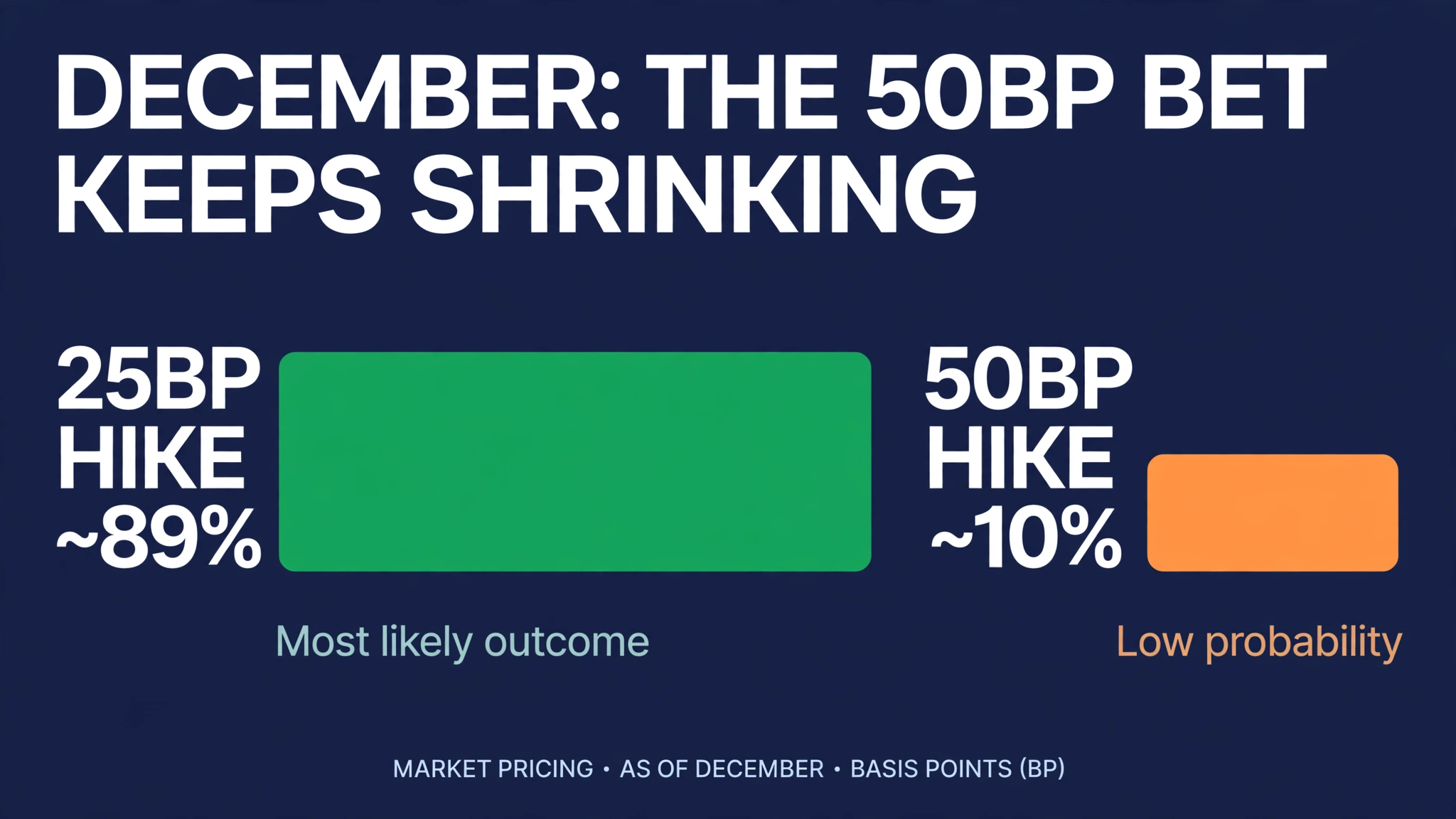
The 50bp tail keeps shrinking: 15.3% after CPI, ~10% now
Fear & Greed
28 (Fear), from 29
Sentiment flat; no panic, no greed
A quiet drift, not a flush
The most important number on the tape today is a small one. About $54 million in leveraged positions were liquidated across major venues in the past 24 hours, according to CoinClass — $26 million of longs and $28 million of shorts, almost evenly split. Ethereum accounted for the largest single-coin slice, roughly $46 million. That is a rounding error next to the $630–720 million that was wiped out in the 24 hours after Tuesday’s CPI print, and it is nowhere near the $1.02 billion wave that hit on Sunday night into Monday.
Do not read that as good news. A market that falls $1,300 from its morning high on almost no liquidations is not being flushed out — it is being sold, steadily, by people who are choosing to sell. Forced selling ends in exhaustion and often marks a bottom. Voluntary selling ends when the sellers run out of reasons, and right now they have not.
The flow data tells the same story. US spot bitcoin ETFs took in another $95 million of net outflows on Tuesday, and roughly $2.22 billion has now left the funds in eight sessions since October 30, according to Bitfinex. That is not a one-day wobble. It is a steady bleed, and it has a direct consequence for the price: the average short-term holder paid about $75,717 for their bitcoin, per Bitfinex’s cost-basis data. Every dollar below that level is a dollar of unrealised loss for the newest cohort of buyers, and every rally toward it meets supply from holders looking to get out whole.
Why stocks went and bitcoin stayed
The divergence has a simple mechanical explanation. Wednesday’s stock rally was led by AI hardware names — CoreWeave and Micron among them — on the back of the same risk appetite that had been crushed in last week’s rout. Stocks were rebounding from a sell-off. Bitcoin was not, because bitcoin’s sell-off never really stopped: it has now closed five straight weeks lower, the last of them down 4.5% from the weekly open, and it is trading 41% below its October all-time high near $126,000.
There is also a rates explanation, and it cuts against bitcoin. The 10-year Treasury yield closed at 4.98% on Tuesday’s curve — the highest in twelve days — and the cash bond market was closed on Wednesday for Veterans Day, so there has been no fresh cash read-through since. Futures on the 10-year nudged 2–4 basis points higher during the closure, which points to a possible retest of Tuesday’s 5.01% intraday peak when cash trading reopens tonight. A 5% ten-year yield is a gravity well for every risk asset, but it bites hardest on the ones with no cash flow. Stocks can point to earnings. Bitcoin cannot.
Gold, the other asset that usually benefits when real rates fall, fell 0.95% to about $3,992 on Wednesday. The dollar rose 0.69% to around 102.94. Nothing in the macro tape is currently rewarding the inflation-hedge story. That is the context in which bitcoin’s failure to follow a 1.6% Nasdaq rally has to be read — not as a crypto-specific accident, but as a market that has stopped believing its own hedge narrative for the moment.
The 50-basis-point bet keeps shrinking
The December question has narrowed while bitcoin slept. Immediately after Tuesday’s CPI print, CME FedWatch put the chance of a 50-basis-point hike at 15.3%, up from 1.1% before the data. By Wednesday, the latest CME-based reads had the 50-basis-point probability at 11.5%, according to PANews, and AiCoin’s timeline put it at 10.4% late on Wednesday evening. Polymarket’s December market sits in the same place: roughly 84–85% for a 25-basis-point hike, about 10–11% for 50 or more.
The direction is the story, not the decimal. The market has spent two days walking back the half-point scare that Tuesday’s CPI set off, and it has done so without any new data — just the slow realisation that a 0.3% core print, while exactly on the line Governor Christopher Waller drew, is not by itself a reason for the Fed to double its step. Waller’s own words still stand: if core prices rise 0.3% or more, a half-point move “should be considered.” Dallas Fed President Lorie Logan, a 2026 voter, has gone further, saying the FOMC needs “at least two more 25-basis-point rate increases” and that it may be able to move faster this winter than it has so far this fall.
The pushback is real, too. Robin Brooks, the former chief economist at the Institute of International Finance now at Goldman Sachs, argues the Fed will not hike 50 basis points in December even after a hot CPI. Deutsche Bank, which moved after the print, now expects 25-basis-point hikes in December, January and March 2027 — a slower, longer path rather than a bigger single step. The market has sided with the gradualists. That is why the 50-basis-point number keeps shrinking, and it is also why bitcoin has not rallied on the news: a market that prices a smaller hike is a market that prices a longer period of tight money, and tight money is the thing bitcoin has been falling on all month.
The yield test that has not happened yet
There is one more trap in today’s tape, and it is the yield. The 10-year at 4.98% is the Treasury curve from Tuesday, November 10. The cash market was closed on Wednesday. It reopens tonight, Vietnam time — after this article’s deadline, and after the market has had a full day to digest the claims data due at 20:30. Any sentence that says the 10-year “tested 5% today” is describing a futures tick, not a cash trade.
The honest way to write it is this: the last cash close was 4.98%, futures drifted a few basis points higher during the closure, and the real test — whether the market pushes the cash yield back through the 5.01% intraday peak from Tuesday — happens tonight. If it does, bitcoin’s $73,200 support gets tested from the rates side at the same time the claims data hits. If it does not, the bond market will have quietly confirmed that Tuesday’s spike was a CPI reaction, not a regime change. Either way, the answer arrives after the deadline, which is why this article is a preview of the test, not a report on it.
Tonight decides the week
Everything that matters next is scheduled after this article goes to print, which is the point of writing it now. The calendar for Thursday evening, Vietnam time, is the densest of the week:
Jobless claims, 20:30 VN: consensus 195,000, against 189,000 last week — the lowest initial-claims print since 1969. A number near consensus keeps the labour market in the “cooling but not cracking” frame the Fed wants. A big miss in either direction moves the December debate before the weekend.
Existing-home sales, 22:00 VN: consensus 3.87 million annualised, against 3.99 million in September. The release date is settled — the National Association of Realtors confirms Thursday, November 12 — after conflicting listings earlier in the week. Housing is the most rate-sensitive corner of the economy, and it is the one the Fed watches most closely for transmission.
Fedspeak: New York Fed President John Williams speaks at 18:30 VN — the first Fed voice since the jobs report. Chicago Fed President Austan Goolsbee follows at 23:15 VN, and San Francisco Fed President Mary Daly speaks at 01:10 VN on Friday. None of them will be quoted in this article, because none of them has spoken yet.
PPI, Friday 20:30 VN: the forecast is split, so it should be written as a range — headline +0.3% to +0.5% month over month, against +1.3% in September. It is the last big inflation print before the Fed meets on December 8–9, and the market will read it as the second half of the CPI verdict.
Levels that matter
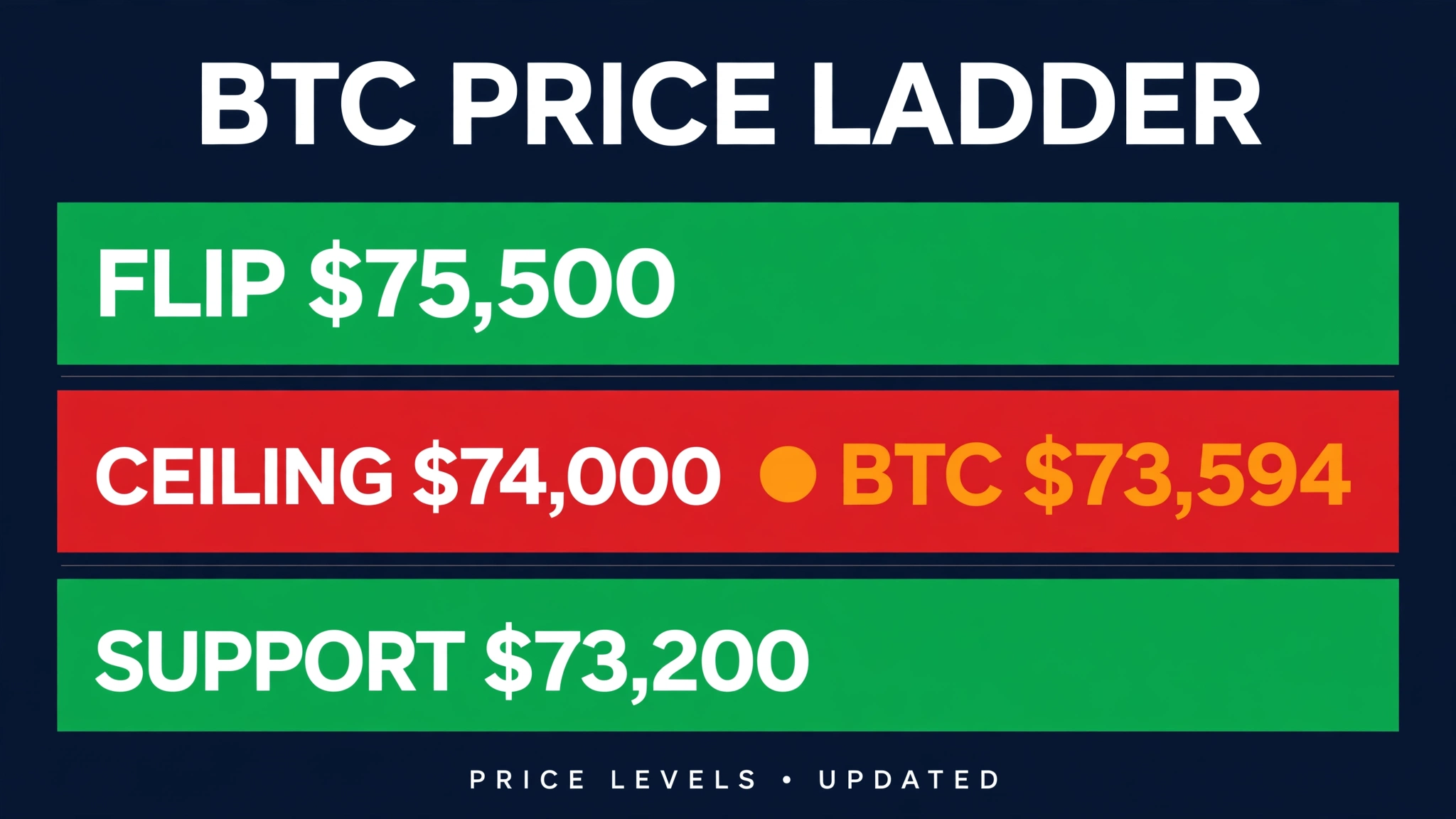
Strip away the narrative and the market is a price ladder with three rungs that matter. Support is $73,200 — the line bitcoin lost overnight on Tuesday, reclaimed on Wednesday, and has not tested again today, with the day’s low at $73,390. Below it, the next levels are $72,000 and then $70,000, the round number the options market has been watching all week. Resistance is $74,000 to $75,000, the band that has capped every bounce since Tuesday. Above that, the flip is $75,500, which sits almost exactly on the 50-week moving average at $75,556 and just under the short-term holder cost basis at $75,717. Three different measures of “where the pain starts” cluster within a few hundred dollars of each other. That is not a coincidence; it is why the band has held.
The trade, for now, is a range trade with a bias. Holding $73,200 keeps the range alive and keeps the claims and PPI prints as the catalysts that decide it. Losing $73,200 a second time in 48 hours, on a night when the 10-year is retesting 5% and the claims data is landing, would turn the range into a breakdown — and the quiet tape means there is no forced-selling cushion underneath to absorb it.
What to watch next
Bitcoin did not follow stocks on Wednesday, and the reason is not complicated: the buyers who would normally chase a relief rally are underwater, the ETFs are bleeding, and the bond market has not yet had its say. The decoupling is the signal. A market that ignores a 1.6% Nasdaq rally is a market telling you its problem is not risk appetite — it is positioning, flows, and a rate path that is getting longer rather than easier.
Tonight’s claims print is the first of two doors left this week, and Friday’s PPI is the second. Until one of them opens, the range is the trade, $73,200 is the line, and $74,000 is the ceiling that has now rejected bitcoin twice in two days. The reclaim happened on Wednesday. The trust did not come with it, and on Thursday it walked back out the door.
Disclaimer: This article is for informational purposes only and does not constitute financial advice. Figures are cited from official releases and market data as reported at the time of writing and are subject to revision. Cryptocurrency markets are volatile; always do your own research before making investment decisions.
CX
CoinXSight Alpha Desk
ALPHA // DESK
Quantitative Research Desk·Global Alpha Division
CoinXSight Institutional Research Desk produces quantitative crypto market intelligence, algorithmic models, and on-chain forensics.
QUANTITATIVE SUITE // DEEP ALPHA ENGINEACTIVE
BTC/USDT // LIVE SCANNER
CONFLUENCE 74
LIVE SPOT PRICE$82,807.47WEAK_BUY
TP2
$89,522.75
+9.07%
TP1
$85,056.42
+3.63%
ENTRY
$82,078.86
ZONE
SL
$80,590.09
-1.81%
Auto-detect Order Blocks, Fair Value Gaps and risk-adjusted DCA ladders in < 5s.