Hot CPI Hit Waller’s 50-Basis-Point Line — Bitcoin Broke $73,200 and the Fed Is Arguing About How Fast to Hike
October CPI came in hot on both lines — headline +0.4%, core +0.3% — landing exactly on the threshold Waller drew the night before. The December question is now 25 or 50 basis points, Logan wants at least two more hikes, and Bitcoin broke $73,200 overnight.
CX
CoinXSight Alpha DeskQuantitative Research Desk·Nov 11, 2026 · Updated Nov 11
October’s inflation report did not just beat forecasts. It landed exactly on the line a Federal Reserve governor had drawn the night before — and in doing so, it changed the December question from whether the Fed hikes to how big the hike will be. Core CPI rose 0.3% in October, the precise number Christopher Waller said would force the Fed to consider a half-point move. Bitcoin, which spent Tuesday sliding, broke its $73,200 support overnight and was trading at $73,671 by Wednesday morning in Vietnam.
That is the whole story in three sentences: the print was hot, the threshold was hit, and the market is now pricing something it was not pricing on Monday — a 50-basis-point hike in December, at odds that jumped from about 1% to 15% in a single morning.
The print: hot on both lines
The Bureau of Labor Statistics reported on Tuesday, November 10, that the consumer price index rose a seasonally adjusted 0.4% in October, after a 0.6% rise in September. Economists polled by Reuters had expected 0.3%. Core CPI, which strips out food and energy, rose 0.3% — against a 0.2% forecast, and for the third consecutive month at that pace. August was 0.3%. September was 0.3%. October is 0.3% again. The underlying trend is not drifting toward the Fed’s 2% target. It is stuck a full tenth above it, month after month, at an annualized run-rate above 3.6%.
Shelter did most of the damage, rising 0.3% and accounting for more than 30% of the monthly increase in the headline index. Food prices climbed 0.5% after no change in September, with groceries up 0.4%. Energy rose 0.7% after September’s 5.2% surge, gasoline up 1.0%. Inside the core index, recreation rose 0.8%, motor vehicle insurance 0.7%, and hospital services 0.8%. This was not one category misbehaving. It was broad.
One thing the report did not contain, and will not contain this cycle: a year-over-year rate. The BLS published no 12-month figures for October because it never collected October 2025 prices during last year’s government shutdown — there is no base month to compare against. The last published annual reading remains September’s 3.7%. Any wire quoting a “3.9% annual rate” for October is printing an economist’s forecast, not a BLS number. This article writes month-on-month only, because that is all the BLS published.
It is also the last CPI the Fed will see before its December 8–9 meeting. The November report lands on December 10, the day after the meeting ends. So Tuesday’s print is not one data point among many. It is the data point.
Waller drew the line — and CPI walked straight into it
The remarkable thing about Tuesday is that the market knew the threshold in advance, because Waller had stated it in public the day before.
Speaking in London on Monday afternoon Vietnam time, at the Bank of England Watchers Conference, the Fed governor said he would support a 25-basis-point increase in December even if October’s inflation came in cooler than September’s. Then he added the condition that turned Tuesday into a live test: “If core consumer prices rise 0.3% or more from September, [a half-point hike] should be considered.” And the reason he gave was not technical. It was about credibility: “If we only raise rates by 25 basis points, our credibility will be at risk, and I am not willing to take that risk.”
Core came in at exactly 0.3%. Not 0.29%. Not 0.31%. The number Waller named, to the tenth.
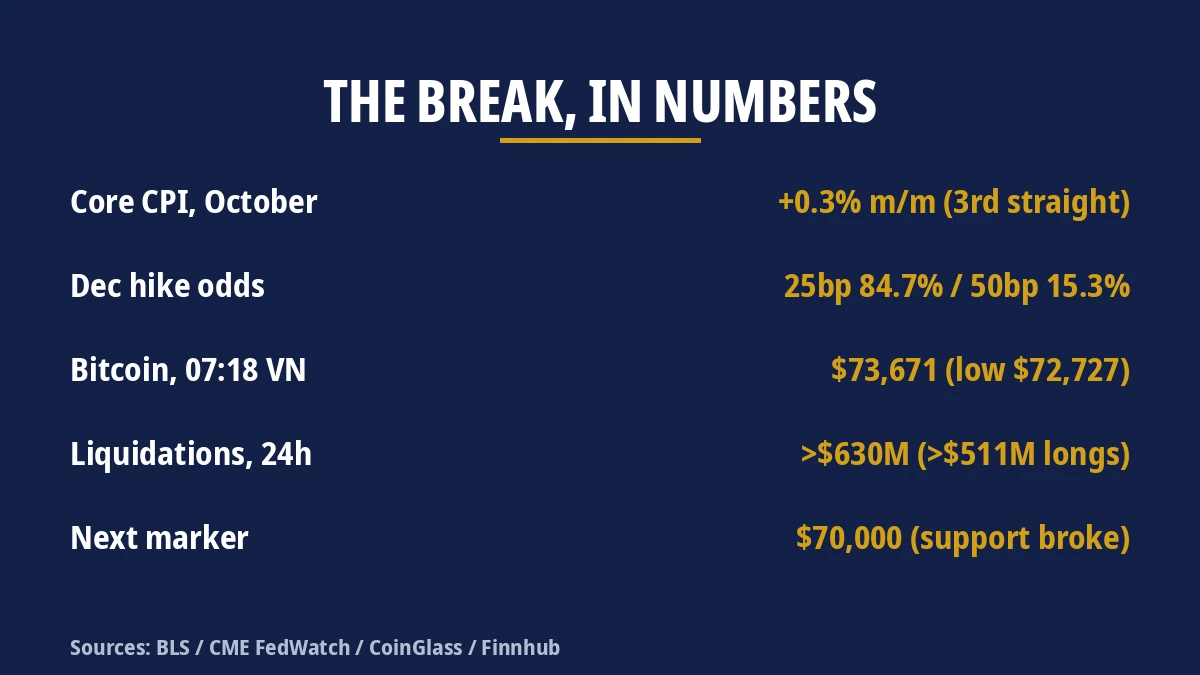
Waller’s shift matters because of who he was in October. He voted to hold rates at the October meeting — the Fed kept the target range at 3.75–4.00% on a 10–2 vote. A governor who voted to hold six weeks ago is now saying a half-point hike should be on the table. That is the sharpest hawkish turn from a sitting governor since the Fed’s tightening cycle resumed, and the market heard it that way: within hours of his speech on Monday, the odds of a December hike had already jumped from about 76% to 96% on CME FedWatch. After the CPI print, the question sharpened further — the odds of a 25-basis-point move settled at 84.7%, and the odds of 50 basis points jumped from 1.1% to 15.3%.
The bond market reacted the way it reacts when the Fed’s credibility is the question. The 10-year Treasury yield closed Tuesday at 4.983%, up 11.9 basis points on the day. The two-year, the most sensitive to Fed expectations, rose roughly 20 basis points. Gold fell 1.8%. None of that is a panic. It is a repricing — and the repricing runs in one direction.
Logan: at least two more hikes, and maybe faster
If Waller set the threshold, Dallas Fed President Lorie Logan supplied the pace. Speaking on Tuesday evening Vietnam time at an energy conference hosted by the Dallas and Kansas City Fed banks, hours after the CPI release, Logan said the Fed needs “at least two more 25-basis-point rate increases” — and that it may need to move faster than it has so far this fall.
“It remains clear to me, given the current outlook, that the FOMC needs to implement at least two more 25-basis-point rate increases,” Logan said in prepared remarks. “The exact pace of increases could depend on the near-term economic and financial environment. It may be possible to move more rapidly this winter than the FOMC has moved so far this fall.”
That is not a governor hedging. Logan is a voting member of the FOMC in 2026, and she is now on the record for two more hikes at minimum, with the door open to doing them faster. Read alongside Waller, the message from the Fed’s hawkish wing is now a coherent one: December is a hike, the size is a live debate, and the tightening does not stop there. By January, traders are already pricing a 48.8% chance of 50 basis points of cumulative hikes, overtaking the 43.9% chance of just 25 — and even a 7.4% chance of 75.
Logan also supported the October decision to hold, which makes her turn the same story as Waller’s: officials who were comfortable pausing six weeks ago are no longer comfortable. The three consecutive 0.3% core readings are doing the persuading.
Bowman: the brake pedal, and the AI warning
Not every Fed voice on Tuesday was pushing the same way. Vice Chair for Supervision Michelle Bowman, speaking at the Council on Foreign Relations in Washington in the early hours of Wednesday Vietnam time, added her voice to the inflation chorus — and then applied the brake.
“Today, I am seeing signs that inflation pressures are persisting, while labor market conditions appear to be firming,” Bowman said in prepared remarks. “This indicates that there is still work to do to bring inflation closer to 2%.” She estimated that core PCE inflation — the Fed’s preferred measure — likely rose 3.3% in October, driven by higher energy prices and AI-related demand, and warned that “bringing inflation down remains a priority” and that “CPI data suggests inflation pressures may persist.”
But Bowman stopped short of calling for hikes, and the reason she gave is worth more attention than the headline. “The benefit of additional policy tightening has to be carefully weighed against its costs for interest-rate-sensitive sectors,” she said — housing, smaller businesses, the parts of the economy that feel rate rises first. She pointed out that falling stock prices, rising bond yields, and a stronger dollar have already tightened financial conditions on their own, and that her forecast is for core PCE to move closer to 2% next year as the pressures from the AI buildout and the Middle East conflict wane or unwind.
She also issued a warning that had nothing to do with rates and everything to do with the AI trade the market has been riding all year. AI-related debt is on track to exceed $800 billion this year, Bowman said, and AI revenues, while rising quickly, do not yet cover the cost of maintaining existing models and building new ones. If revenue fails to keep up with sharply rising costs, she warned, the result could be a sharp correction in AI company share prices, higher financing costs, and reduced access to credit — with contractual obligations, leases, and guarantees worth more than three times the debt itself sitting behind it.
That is the one dovish-adjacent voice in a hawkish 24 hours, and it is a conditional one: inflation can cool without more hikes if the shocks fade. But Bowman herself said she would need to see AI and Middle East risks abate before she could be confident inflation comes down next year. On Tuesday’s evidence, neither has abated.
The Fed, in one table
Who
What they said (verbatim)
Signal for December
Waller, Fed Governor (voter)
“If core consumer prices rise 0.3% or more from September, [a half-point hike] should be considered” — “If we only raise rates by 25 basis points, our credibility will be at risk”
Most hawkish: +25bp certain, 50bp on the table — core printed exactly 0.3%
Logan, Dallas Fed (voter 2026)
“The FOMC needs to implement at least two more 25-basis-point rate increases” — “It may be possible to move more rapidly this winter”
Hawkish: two more hikes minimum, faster pace possible
Bowman, Fed Vice Chair for Supervision (voter)
“There is still work to do to bring inflation closer to 2%” — but “the benefit of additional policy tightening has to be carefully weighed against its costs”
Inflation is the priority, but no explicit call for hikes; watch AI-debt risks
Goolsbee, Chicago Fed (non-voter 2026)
“We’ve got to come to terms with inflation failure” (Monday)
Hawkish backdrop: inflation, not jobs, is the problem
Barkin, Richmond Fed (non-voter 2026)
“The appropriate direction of monetary policy is relatively straightforward” — but “it is wise to move policy with care” (Monday)
Hawkish direction, cautious pace; no base case for December
CME FedWatch (after CPI)
+25bp 84.7%, +50bp 15.3% (from 98.9% / 1.1% before the print); hold 0%
A hike is priced as certain; the size is now the debate
The tape: $73,200 gave way
For all the Fed talk, the tape is where the story becomes a loss. Bitcoin closed Tuesday at $74,212 on Binance, after a $74,116–$75,442 session — and then kept falling overnight. By 07:18 Vietnam time on Wednesday it was changing hands at $73,671, with an overnight low of $72,727. The $73,200 support — the level that doubles as the 200-day moving average near $73,170–$73,224, the line this market has defended all week — broke. The low on Bitstamp was $72,787, the weakest print since August 21.
Ethereum is in worse shape. It closed Tuesday at $2,088 and was trading at $2,052 by Wednesday morning, with an overnight low of $2,006 — a whisker above the $2,000 round number that now matters more than any moving average. ETH is down 3.6% in the session and has now fallen roughly 10% in a week. It closed Sunday below its 200-day moving average for the first time since August 18, and it has led every leg of this sell-off down: ETH accounted for about $240 million of the post-CPI liquidations, against roughly $169 million for bitcoin.
The liquidations came fast once the print landed. More than $630 million in positions were wiped out across the market in the 24 hours after the CPI release, according to CoinGlass, with over $511 million of it longs — and in one brutal hour, $186 million went, $177 million of it longs. That is a real flush, and it is a new one: it belongs to Tuesday’s CPI, not to the $1.15–$1.2 billion Sunday–Monday wave, and the two should never be added together or re-dated into each other.
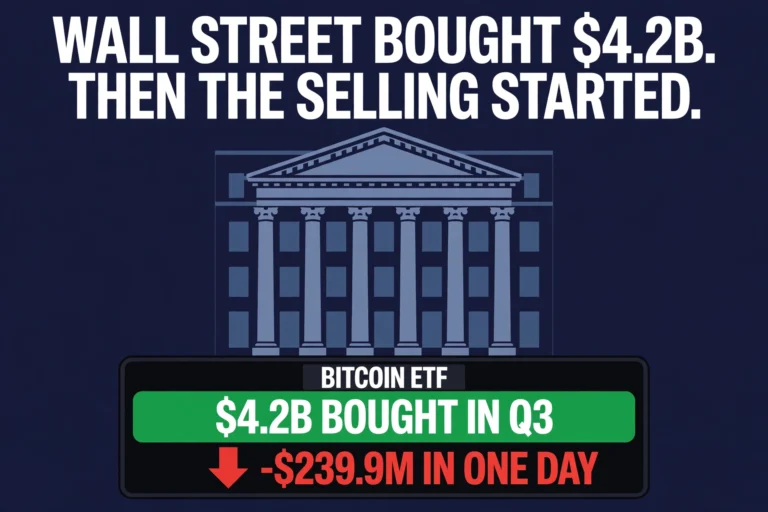
The institutional flow underneath is just as cold. US spot bitcoin ETFs recorded $201 million of net outflows on Monday, led by $213.2 million of redemptions from BlackRock’s IBIT — the seventh straight session of outflows, and the follow-on to a $1.28 billion weekly outflow last week, the worst since late June. Spot ether ETFs lost $184.6 million on Monday. There is no dip-buying from the ETF complex to catch this fall. There has not been for a week.
The Crypto Fear & Greed Index reads 32, in Fear — barely moved from Monday’s 29, which tells its own story: sentiment was already fearful before the print, and the print gave it a reason to stay there.
Stocks gave Monday back
Crypto did not fall alone. It fell with everything that had rallied on Monday, and the reversal was almost a mirror image.
The S&P 500 fell 0.38% to 7,520.93 on Tuesday, giving back a piece of Monday’s 2.35% surge — its best day since April. The Nasdaq Composite fell 0.74% to 25,065.88, the Dow slipped 0.30% to 52,231.89, and the Russell 2000 lost 0.68%. Technology was the worst of the eleven S&P sectors, down more than 1%. Nvidia, the stock at the center of both the AI boom and the board investigation into chief executive Jensen Huang, fell another 5.5% to $168.78 — a two-day drop of roughly 10% after Monday’s 4.27% slide.
The bond market did the real reacting, and here is the honest caveat for today: there will be no yield read-through in Wednesday’s session, because it is Veterans Day and the US bond market is closed. Stocks trade normally; bonds do not. So the last word on rates until Thursday is Tuesday’s close — the 10-year at 4.983%, up 11.9 basis points — and the next read on the Fed comes from equities alone. Gold fell 1.8% on Tuesday, the dollar strengthened, and the VIX eased slightly to 19.44 even as stocks fell, a sign that the move was a repricing rather than a panic.
That is the divergence in reverse. On Monday, stocks rallied and crypto barely participated. On Tuesday, stocks fell and crypto fell harder. The asset that was supposed to be the hedge against exactly this kind of macro repricing is, for now, the most exposed to it.
What December looks like now
So where does this leave the market, with four weeks to the December 8–9 meeting?
Monday’s two Fed voices — Goolsbee calling the inflation record a failure and Barkin calling the direction of policy straightforward — had already set the tone; Tuesday turned that tone into a timetable.
The hike itself is no longer the question. Traders price a December move as certain — 0% odds of a hold on CME FedWatch — and the debate has moved, in a single day, from “will they hike” to “25 or 50, and then what.” Waller’s threshold is the frame: core printed exactly 0.3%, so 50 basis points is a live option at 15.3%, and Logan’s “at least two more” means the tightening does not end in December either. By January, the market now gives 50 basis points of cumulative hikes a higher probability (48.8%) than 25 (43.9%).
For bitcoin, the levels have moved with the story. The $73,200 support — the 200-day average, the line that held through the Sunday flush and Monday’s slide — is now broken, and the next marker the market is watching is $70,000. The $75,500 flip and the 50-week moving average at $75,556, which capped every bounce last week, are now a distant reclaim rather than a live test. Ethereum’s line in the sand is simpler: $2,000, tested overnight at $2,006.
The calendar between now and the meeting is thin but not empty. Jobless claims land Thursday at 20:30 Vietnam time, alongside existing home sales at 22:00. Friday brings PPI at 20:30 — the second inflation print before December, forecast at +0.4% month-on-month after September’s +1.3% — and a hot PPI would do to the 50-basis-point odds what Tuesday’s CPI just did. The November CPI, the one that would restore the year-over-year comparison, does not arrive until December 10, the day after the meeting ends. The Fed will decide December’s hike without ever seeing it.
Tuesday’s print answered the question the market asked on Monday. It did not answer it gently. Inflation is running at 0.3% a month in the core, three months straight, with no year-over-year number to soften the reading. A governor drew a line at that exact number, and the data walked straight over it. The Fed is now arguing about the size of the hike, not whether there will be one — and bitcoin, which spent a week defending $73,200, no longer has that line to stand on.
Watch the PPI on Friday, and watch whether $70,000 holds if the selling continues. That is where the next decision gets made.
Track real-time institutional orderflow, liquidity heatmaps, and whale positioning across global crypto venues with the CoinXSight Intelligence Terminal.
Disclaimer: This article is for informational purposes only and does not constitute financial advice. Figures are cited from official releases and market data as reported at the time of writing and are subject to revision. Cryptocurrency markets are volatile; always do your own research before making investment decisions.
CX
CoinXSight Alpha Desk
ALPHA // DESK
Quantitative Research Desk·Global Alpha Division
CoinXSight Institutional Research Desk produces quantitative crypto market intelligence, algorithmic models, and on-chain forensics.
QUANTITATIVE SUITE // DEEP ALPHA ENGINEACTIVE
BTC/USDT // LIVE SCANNER
CONFLUENCE 74
LIVE SPOT PRICE$82,807.47WEAK_BUY
TP2
$89,522.75
+9.07%
TP1
$85,056.42
+3.63%
ENTRY
$82,078.86
ZONE
SL
$80,590.09
-1.81%
Auto-detect Order Blocks, Fair Value Gaps and risk-adjusted DCA ladders in < 5s.