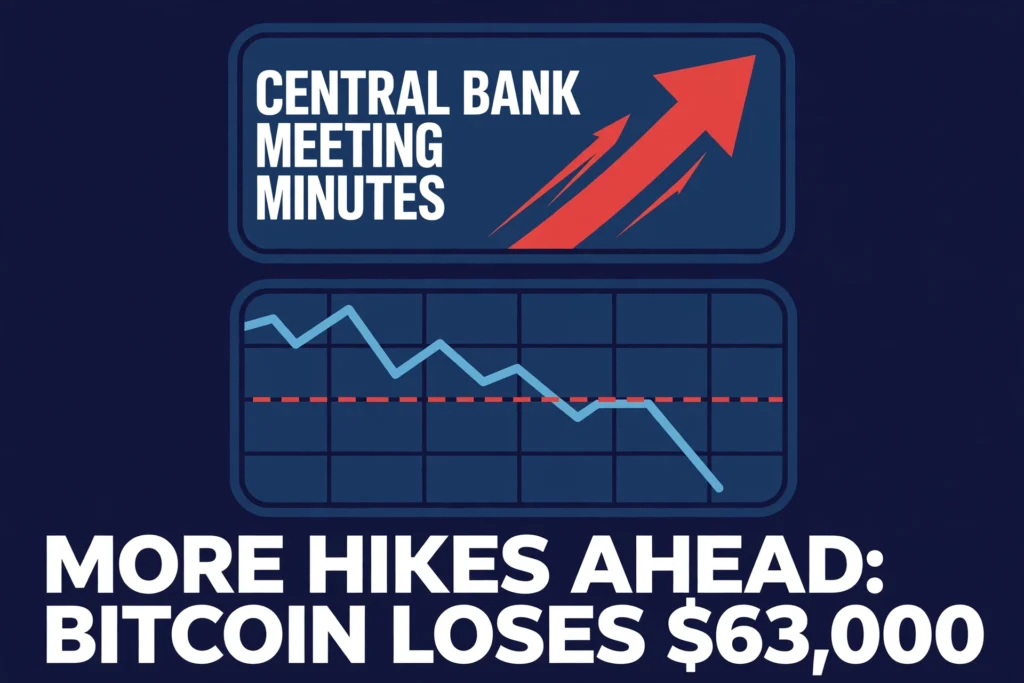
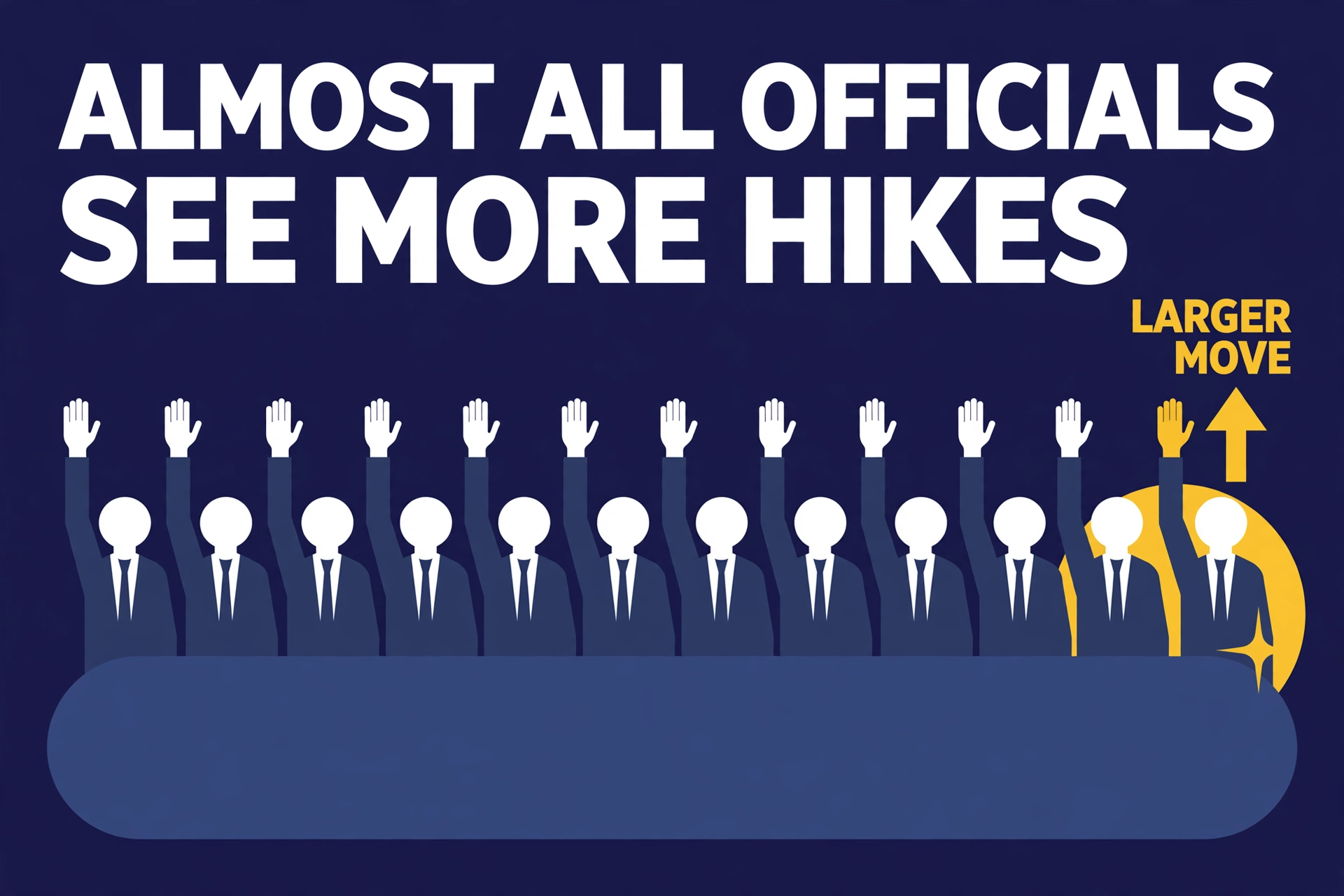
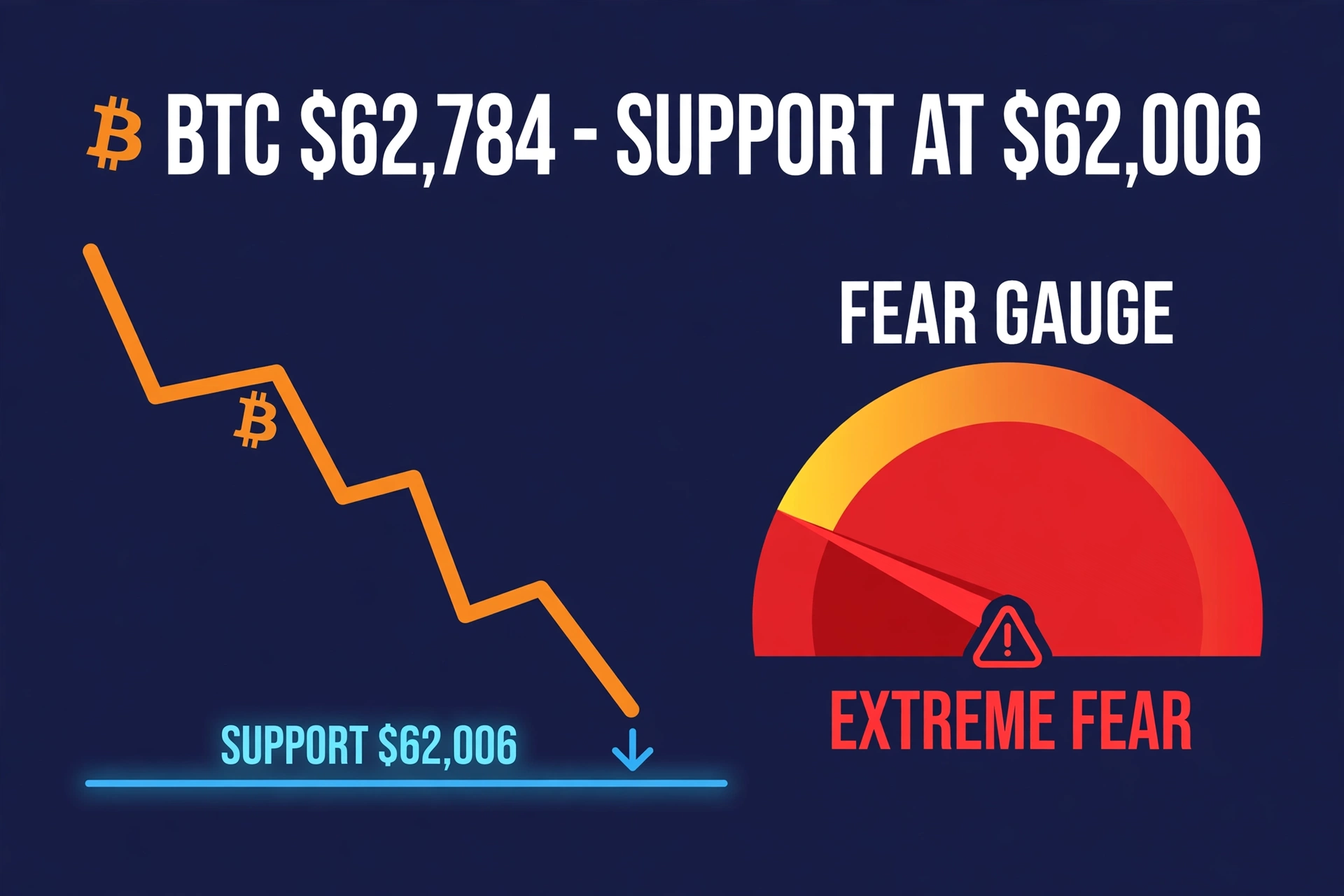
The Federal Reserve published the minutes of its October 27–28 meeting at 2:00 a.m. Vietnam time, and there is no dovish reading of them. Almost every official on the committee judged that further interest rate increases would likely be appropriate. A couple of them went further, saying a hike of more than 25 basis points could be considered in December if the inflation data came in unfavorable. Bitcoin read the document the way the bond market did: it broke below $63,000 overnight and traded at $62,784 early Thursday in Vietnam, down 3.1% in 24 hours, with an overnight low of $62,068 — sixty-two dollars above the support level that has held since the weekend.
This was the first of the week’s two big unknowns to resolve, and it resolved hawkish. The only question the minutes leave open is not whether the Fed tightens again, but by how much on December 8–9, and what happens to a crypto market that has now spent seven straight days in extreme fear.
What the minutes actually say
The October decision itself was already known: the Fed held the federal funds rate at 3.75%–4.00% by a 10–2 vote, with Governor Lisa Cook and Cleveland Fed President Beth Hammack dissenting in favor of a 25bp hike. What the minutes add is the breadth of the hawkish camp behind those two dissents — and it is much wider than the vote suggested.
Question
What the minutes record
How many officials
Rate path from here
Further increases likely appropriate to return inflation to 2% in a timely way
Almost all
December move size
More than 25 basis points worth considering if inflation data disappoint
A couple
October meeting itself
Favored raising rates 25 basis points at that meeting; policy “not sufficiently restrictive”
Some
The decision to hold
A close call
A few of the majority
AI buildout
A material source of inflation risk, and AI debt a financial-stability concern
Many
The staff projections behind the discussion explain the urgency. Fed staff estimated headline PCE inflation at 3.6% over the twelve months to September, with core PCE at 3.1% — both moving away from target, not toward it. Against that backdrop, even the officials who voted to hold described market expectations for hikes in December and into 2027 as broadly consistent with their own view. Nobody in the room was arguing for cuts. The argument was about pace.
The December debate is now about size, and the trigger data already printed
Federal Reserve October meeting minutes: almost all participants saw further hikes as appropriate, with multiple dissents advocating immediate tightening.
The most consequential line in the document is the conditional one: a move larger than 25 basis points in December if inflation data prove unfavorable. When officials wrote that sentence in late October, the October CPI report did not exist yet. It does now. Consumer prices rose 0.4% in October with core up 0.3% — the third straight 0.3% core reading — and Governor Christopher Waller, who has publicly set 0.3% core as the threshold at which the committee should consider a 50bp move, told CNBC on Wednesday that he still believes a half-point hike should be weighed in December.
Markets are not there yet. CME FedWatch prices roughly a 95% probability of a 25bp hike on December 9 and about 5% for a 50bp move — the larger step has roughly doubled from where it sat before the minutes, but it remains the tail scenario. The base case is a quarter point, followed by more: futures now sketch further hikes in January and April, and the New York Fed’s survey of market participants, cited in the minutes themselves, has a median expectation of hikes in December and March 2027.
One timing detail sharpens the December meeting. November CPI is not published until December 10 — the day after the FOMC concludes. The committee will therefore vote with October’s hot print as its most recent inflation data. The “unfavorable data” condition the hawks attached to a larger move will be judged on a report they have already seen, and it was not favorable.
Bitcoin is trading the path, not the meeting
None of this is a surprise in isolation, and that is precisely the problem for Bitcoin. The asset spent October pricing a Fed that was finished tightening. It is now repricing for a Fed whose own record shows near-unanimity that more hikes are coming, with the size of the next one openly debated. Bitcoin closed last week at $65,510 — its first weekly close below the 200-week moving average since October 2023 — and has now lost the $65,000 level, the $64,000 level, and, overnight, $63,000.
The tape offers no cushion. The 24-hour low of $62,068 sits almost exactly on the $62,006 intraday low from the weekend flush; below that, the chart opens toward $60,000 and then $57,742. The Crypto Fear & Greed Index fell to 10 on Thursday, its seventh consecutive day in Extreme Fear. Bitcoin is down roughly 50% from its all-time high. And the institutional bid that might ordinarily absorb this kind of macro repricing is still absent: Monday’s +$7.9 million net inflow into U.S. spot Bitcoin ETFs was followed on Tuesday by a final −$239.9 million, with BlackRock’s IBIT alone redeeming $209.5 million, and on-chain trackers estimate Wednesday’s session bled roughly another $269 million, a figure still preliminary at the time of writing. As yesterday’s 13F analysis showed, Wall Street spent the third quarter accumulating these products. The fourth quarter, so far, is being spent redeeming them.
The dovish data exists. The Fed is not looking at it
Bitcoin trades at $62,784 after breaching the $63,000 threshold, testing crucial support levels near $62,006.
If any part of the U.S. economy is arguing against further hikes, it is housing — and Wednesday’s data made that argument loudly, in both directions at once. Housing starts jumped 9.9% in October to a 1.309 million annual pace, beating the 1.25 million consensus, but the gain was carried by multifamily construction, up 25.5%. The forward-looking numbers were bleak: building permits fell 7.4% to 1.295 million, the slowest pace since May 2020, with single-family permits down 12.9% year over year. Pending home sales fell 4.7% in October to the weakest reading in the index’s 25-year history, even as the average 30-year mortgage rate eased from 7.54% to 7.27% during the month.
In a different inflation regime, a housing pipeline this weak would dominate the committee’s risk discussion. The minutes show it did not. With core PCE at 3.1% and rising energy costs pressing on households, the committee treated housing as a casualty of the policy it intends to continue, not as a reason to stop. The United Kingdom printed the same tension on Wednesday: inflation rose to 3.6% year over year in October, driven by a 33.2% jump in motor fuel costs, while core inflation held at 2.8% — energy-led, not broad, but rising for a fourth consecutive month, in an economy whose central bank has just raised rates to 4.00%.
There is no AI rescue coming either
Wednesday’s session closed the last door bulls had been pointing to. Nvidia, which reported a record $115.84 billion quarter on Tuesday, fell 2.9% to $150.96 — its fifth consecutive down session and its lowest close since June 2025 — as the earnings beat once again failed to lift either the stock or Bitcoin. The Dow fell 1.11% and the S&P 500 slipped 0.23%, while the Nasdaq managed a 0.42% gain. And in a detail that ties the two stories together, the minutes record that many Fed officials now see the AI buildout itself as a material source of inflation risk, with AI-related debt flagged as a financial-stability concern. The sector that was supposed to pull risk assets out of the macro hole is, in the Fed’s telling, one of the reasons the hole keeps getting deeper.
What would change the picture is not a better earnings print. It is a reason for the committee to doubt its own near-unanimity — a soft claims run, a weak Philly Fed reading, a disorderly break somewhere in credit. Thursday brings initial jobless claims and the Philadelphia Fed survey at 8:30 p.m. Vietnam time, plus the first trading session for Anthropic’s newly priced IPO. Until one of those cracks appears, the path the minutes describe is the path Bitcoin has to trade: more hikes ahead, the next one five weeks’ worth of fear away, and a support level at $62,006 that was tested to within sixty-two dollars before breakfast.
Disclaimer: This article is for informational purposes only and does not constitute financial advice. Figures are cited from official releases and market data as reported at the time of writing and are subject to revision. Cryptocurrency markets are volatile; always do your own research before making investment decisions.