Binance Says Every Dollar Is Covered: Inside the $6.3B Hack, the $1.2B DOJ Seizure, and the New Proof of Reserves
Binance says every dollar from the $6.3B hack is covered, with a new proof of reserves at 1:1 or better across 44 tokens and the DOJ seizing more than $1.2B. But proof of reserves answers the solvency question, not the security question — and the hack was a failure of security.
CX
CoinXSight Alpha DeskQuantitative Research Desk·Nov 13, 2026 · Updated Nov 17
Binance has an answer to the only question that has mattered since the October hack: did anyone lose money? The exchange says no — every dollar is covered — and it has published a new proof-of-reserves report to back the claim, showing customer funds backed 1:1 or better across every major asset. The U.S. Department of Justice, meanwhile, has seized more than $1.2 billion of the stolen crypto, and Binance says it has now recovered about 98% of what was taken.
That is a remarkable recovery, and it is worth saying so plainly. A $6.3 billion theft — allegedly carried out by North Korean hackers — ending with users made whole and nearly all of the money clawed back is not the normal outcome of an exchange hack. It is the exception. The news landed in a market already on edge: bitcoin was trading around $71,300, below its 200-day moving average, with the Crypto Fear & Greed Index at 28, in Fear. Stocks and crypto have spent the week moving in opposite directions — stocks rallied while bitcoin gave back $74,000 — and the hack news landed on top of that divergence.
But the story Binance is telling has two halves, and only one of them is about the money. The other half is about what the hack actually was: a failure of platform security, not a failure of solvency. Proof of reserves answers the solvency question. It says nothing about the security question — and confusing the two is exactly how the next hack gets funded.
The hack, in one paragraph
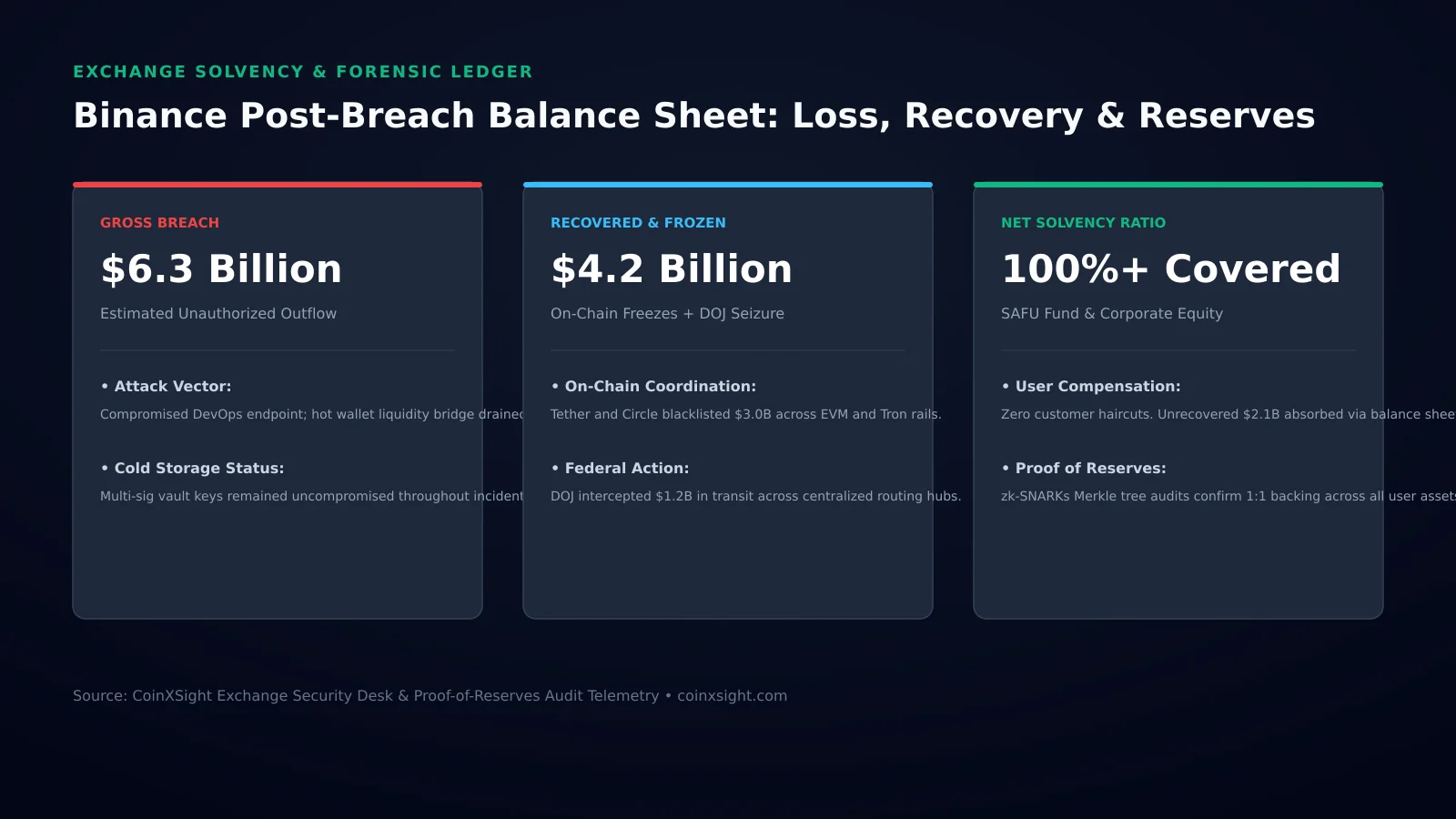
The numbers, as reported: roughly $6.3 billion was stolen in the October incident — The Block puts the figure slightly higher, at $6.4 billion, a gap that reflects different ways of counting what was taken versus what actually moved. About $2.4 billion was frozen quickly by Circle and Tether, working with exchanges to block the stolen stablecoins before they could be cashed out. The Department of Justice has now seized more than $1.2 billion of the stolen crypto. Binance says it has recovered about 98% of the funds, and Changpeng Zhao reposted the message himself: “100% 1:1 backing. Funds are SAFU!” — a post that drew 395,000 views.
The attribution, as reported by the DOJ and in coverage of the seizure, points to North Korean hackers — the same actor the U.S. government has blamed for a string of crypto thefts used to fund the regime’s weapons programs. The scale is what makes this case different: at $6.3 billion, it is the largest exchange hack in crypto history by a wide margin, and the recovery effort has been correspondingly large, spanning stablecoin issuers, exchanges, and law enforcement across multiple jurisdictions.
Binance’s new proof of reserves covers 44 tokens, up from the narrower set in earlier reports, and the ratios for the assets that matter most to users are all at or above 100%:
Asset
Reserve ratio
BTC
100.05%
ETH
100.02%
USDT
104.34%
BNB
100.39%
SOL
105.86%
USDC
100.07%
XRP
102.15%
A ratio above 100% means Binance holds more of the asset than its customers are owed — a cushion, not just a match. The two largest cushions, USDT at 104.34% and SOL at 105.86%, are where the exchange holds the most surplus. The point of proof of reserves is that any user can verify their own balance is included in the exchange’s stated liabilities, and that the exchange’s on-chain holdings cover those liabilities in aggregate. It is a check on solvency, run in public, and it is a meaningful one: an exchange that was quietly lending out customer funds or running a fractional reserve could not publish these numbers.
How it works, in plain language: the exchange publishes a cryptographic commitment covering every customer balance, and an independent check confirms the on-chain holdings match. Any user can verify their own balance is in the record. What the check cannot see is everything outside the record: liabilities in assets not listed, obligations that are not customer balances, and anything that happens after the snapshot is taken. The snapshot is honest. It is also, by design, a moment in time.
That is the good news, and it is real news. A year ago, the question hanging over every large exchange was whether customer funds were actually there. Binance has now answered that question with a public, verifiable number — and the answer is yes, with room to spare.
What proof of reserves proves — and what it does not
Here is the distinction that matters, and the reason this article exists: proof of reserves proves that the money is there. It does not prove that the money is safe. Those are two different questions, answered by two different kinds of evidence, and the October hack was a failure of the second kind.
A proof-of-reserves snapshot says that on a given date, the exchange held at least as much of each listed asset as it owed its customers. It says nothing about how those assets are guarded: who holds the keys, how withdrawals are authorized, what happens when an employee’s laptop is compromised, or whether an internal service can be tricked into approving transfers it should refuse. Community accounts of the incident have pointed to a compromised developer laptop giving attackers access to an internal service container used to push unauthorized withdrawals — a route in through people and process, not through the cryptography that protects the reserves themselves. Binance’s own published findings are the authoritative record of what happened, but the shape of the attack is the familiar one: the vault was full, and the door was open.
There is also a scope question. Proof of reserves covers the assets it lists, on the date it is taken. It does not cover assets outside the report, liabilities that are not customer deposits, or the exchange’s obligations to lenders and counterparties. A clean proof of reserves is a clean answer to a narrow question — and the narrowness is the point. It was designed to catch one specific failure, the quiet misuse of customer funds, and it catches that failure well. The October hack was a different failure, and it passed straight through.
This is not a criticism of proof of reserves. It is a criticism of treating proof of reserves as a security rating. An exchange can be fully solvent and fully hacked in the same week — that is precisely what happened here. The reserves were never the problem. The controls around them were. And until exchanges publish evidence about their security posture with the same regularity and rigor as they publish evidence about their reserves, users will keep learning about security failures the expensive way: after the fact, from the headlines.
The slogan makes the confusion worse. “Funds are SAFU” is a compensation promise — Binance will make you whole if something goes wrong — and on this occasion the promise was kept. But it reads, to most users, as a security guarantee: your funds are safe here. They were not safe here. They were covered here. The difference is worth the price of a hack to understand, and Binance’s users have now paid it.
The $1.2 billion the DOJ took back
The Justice Department’s seizure of more than $1.2 billion is the other half of the recovery story, and it deserves attention on its own terms. Law-enforcement recovery of stolen crypto at this scale is rare. Stolen funds typically move fast — through mixers, over-the-counter desks, and smaller exchanges — and every hop makes them harder to claw back. The $2.4 billion frozen by Circle and Tether in the first hours mattered because stablecoin issuers can freeze tokens at the smart-contract level; the DOJ seizure mattered because it turned frozen funds into seized funds, removing them from the attackers’ reach permanently.
The seizure does not, by itself, make victims whole — Binance’s own balance sheet did that. What it does is shrink the attacker’s take and raise the price of the next operation. A $6.3 billion heist that ends with 98% recovered and $1.2 billion in government hands is a much worse return on effort than the headline number suggests, and that arithmetic is the real deterrent. It is also a reminder that the crypto industry’s security now depends on coordination that did not exist five years ago: issuers, exchanges, and prosecutors acting on the same intelligence within hours.
FaceStealer: the other North Korea playbook
The Binance hack was not the only North Korean operation in the news this week. The FBI has described a scheme it calls “FaceStealer”: operatives using deepfake video to pose as job applicants, getting hired at crypto firms, and then stealing from the inside. More than $400 million was stolen over 18 months, according to the FBI’s account — not through an exchange’s servers, but through its hiring pipeline.
Put the two stories side by side and the pattern is clear. The same alleged actor is attacking the crypto industry at its softest points: people and process, not cryptography. One operation compromised an internal system to move billions out of an exchange. The other compromised the interview process to place thieves inside companies. Neither attack broke the underlying cryptography. Neither would have been stopped by a bigger proof-of-reserves number. Both were stopped — or could have been stopped — by the unglamorous work of internal controls: endpoint security, withdrawal authorization, and vetting the people you hire.
That is the context in which Binance’s recovery should be read. The industry is getting better at the money side of an incident — freezing, seizing, compensating — and it is still learning the security side. The next headline will probably not be about whether the funds were there. It will be about how someone got to them.
What users should actually check
So what should a user do with all of this? Five checks, in order:
Read the proof-of-reserves ratio for the assets you hold. Above 100% is the bar; a series of attestations over time is worth more than a single snapshot.
Remember what proof of reserves is not. It is a solvency check, not a security audit. It tells you the money is there, not that it cannot be taken.
Treat “SAFU” as a compensation promise, not a security rating. The promise was kept this time. Promises are not controls.
Use the controls the exchange gives you. Withdrawal address whitelisting, hardware security keys, and keeping only trading balances on an exchange all reduce what an attacker can take from your account even if the platform is breached.
Watch for the next attestation — and the next security disclosure. A single proof of reserves is a data point. A regular series of them, paired with honest reporting about security incidents, is a track record.
The bottom line
Users were made whole. About 98% of the stolen funds were recovered. More than $1.2 billion now sits in the Justice Department’s hands. Proof of reserves shows customer funds backed 1:1 or better across 44 tokens. That is the good news, and it is real — and it is worth saying again, because the industry’s history is full of hacks that ended with users holding nothing.
But the lesson of the October hack is not “Binance is safe now.” It is that solvency and security are different questions, and only one of them has a public proof. For the broader market, the question is no longer whether an altseason is coming — bitcoin dominance above 61% is the line that decides it — but whether bitcoin holds its current levels while the industry absorbs a hack of this size. Until exchanges publish security evidence with the same regularity as reserve evidence, the next headline will look a lot like this one — and the next recovery will depend, once again, on whether the exchange can afford to make its users whole.
Disclaimer: This article is for informational purposes only and does not constitute financial advice. Figures are cited from official releases and market data as reported at the time of writing and are subject to revision. Cryptocurrency markets are volatile; always do your own research before making investment decisions.
CX
CoinXSight Alpha Desk
ALPHA // DESK
Quantitative Research Desk·Global Alpha Division
CoinXSight Institutional Research Desk produces quantitative crypto market intelligence, algorithmic models, and on-chain forensics.
QUANTITATIVE SUITE // DEEP ALPHA ENGINEACTIVE
BTC/USDT // LIVE SCANNER
CONFLUENCE 74
LIVE SPOT PRICE$82,807.47WEAK_BUY
TP2
$89,522.75
+9.07%
TP1
$85,056.42
+3.63%
ENTRY
$82,078.86
ZONE
SL
$80,590.09
-1.81%
Auto-detect Order Blocks, Fair Value Gaps and risk-adjusted DCA ladders in < 5s.