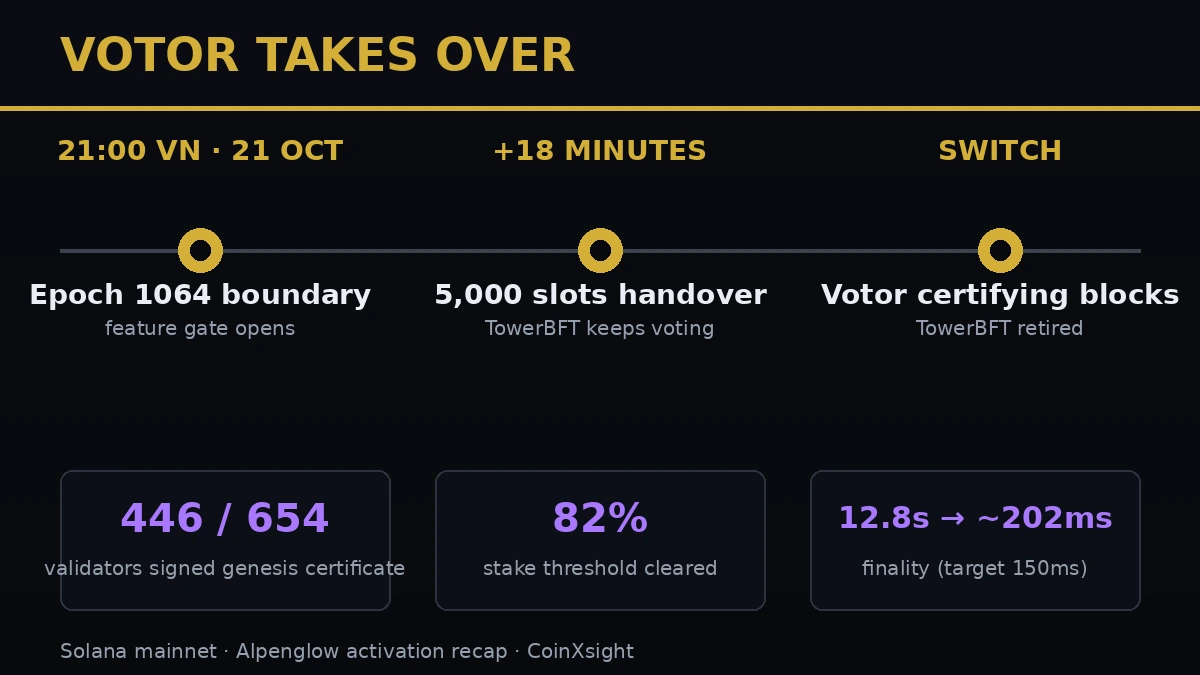
Last night, at slot 459,653,000, Solana did the thing. Eighteen minutes after epoch 1064 began — roughly 21:00 Vietnam time on October 21 — the feature gate held open, TowerBFT signed its last vote, and Votor took sole control of consensus. The genesis certificate carried the signatures of 446 of the network’s 654 validators, comfortably past the 82% stake threshold the migration required. No fork. No halt. No drama.
That is the good news. The rest of the story — what the first 20 hours actually proved, what they didn’t, and why SOL is trading at $104 anyway — is more complicated than the victory lap suggests.
The handover: 18 minutes that took 18 months
The choreography played out almost exactly as Anza drew it. The epoch boundary flipped the feature gate. TowerBFT kept governing for the first 5,000 slots — about 18 minutes — while validators confirmed the new code paths. Then the switch: Votor began certifying blocks, TowerBFT retired, and six and a half years of on-chain voting came to an end.
This is the part that genuinely had no precedent. No major live blockchain has ever replaced its consensus engine in production, in a single slot, without a fork or a freeze. The testnet went through six wipes and restarts to get here, plus one failed network-wide migration that had to be rolled back before the retry succeeded. Yesterday, the production version of that same procedure ran clean on the first try.
The 82% stake threshold deserves emphasis. This was the migration’s circuit breaker: the genesis certificate needed 82% of stake to sign before Alpenglow would start, otherwise validators would have kept running TowerBFT. It cleared. That single fact answers the loudest pre-activation worry — whether enough validators were ready — more decisively than any readiness survey could.
The first measurement: ~202ms observed, 150ms still the target
Here is where the recap gets its first dose of honesty. The Solana Foundation’s Alpenglow dashboard has shown a latest observed finality of around 202 milliseconds in the first day. That is a real number from the live network — and it is already an order of magnitude faster than the 12.8 seconds TowerBFT delivered.
But it is a single reading, not a sustained average, and it is not 150 milliseconds. The 150ms figure remains an engineering target derived from simulation and stake-distribution modeling, the same caveat we flagged before the activation. Testnet recorded a 54-millisecond median, which is encouraging, but testnet is a controlled environment and mainnet is not.
The honest framing: the target is 150ms, the first reading is ~202ms, and the sustained mainnet number will take weeks of measurement under varying load, MEV conditions, and validator churn to establish. Anyone telling you Alpenglow “achieved” 150ms yesterday is ahead of the evidence. Anyone telling you 202ms is a miss is missing the point — it’s the first data point, not the verdict.
The TPS mirage is already fooling people
Right on schedule, Solana’s headline throughput charts collapsed. Transaction counts fell sharply overnight — not because the network slowed down, but because validator votes stopped being transactions.
This is the statistical artifact we previewed: under TowerBFT, votes consumed roughly three-quarters of the ledger’s entries. Votor moves all of that off-chain into BLS-aggregated certificates, so the reported number plummets while actual user activity doesn’t move at all. As Raiku CEO Robin Nordnes told CoinDesk ahead of the switch: “Transaction counts will look much lower this week, and people will ask whether something is wrong. Nothing is wrong.”
The confusion is already circulating on social media, with charts showing the drop framed as network trouble. Pre- and post-activation TPS figures are simply not comparable — they measure two different things. Expect this misunderstanding to recur for weeks every time someone pulls a long-dated chart without reading the footnotes.
Metric
Before (TowerBFT)
After (Alpenglow, day one)
Finality
~12.8 seconds
~202ms observed (single reading); 150ms target
Block time
~400ms slots
~200ms slots (separate upgrade, done in October)
Vote cost per validator
~2 SOL/day in vote fees
0.8 SOL/epoch admission ticket
Reported TPS
Inflated by vote traffic
Drops ~60% (accounting change, not real activity)
Genesis participation
—
446 of 654 validators; 82% stake threshold met
Note the table’s second row. Finality and block time are separate upgrades and separate numbers — the 200ms slots landed through an independent change completed earlier in October. Conflating the two is the most common factual error in yesterday’s coverage.
The validator reset nobody priced
Beyond the consensus swap, activation quietly rewrote validator economics. The ~2 SOL per day that validators burned on vote transactions is gone, replaced by a flat 0.8 SOL per epoch admission ticket — roughly a 60% cost reduction. That’s margin back in every validator’s pocket, every epoch, forever.
The flip side is the new compliance surface. Validators had to be on an Agave-based client (4.3.0+, with 4.3.2 recommended), register a BLS key on-chain, and keep 0.8 SOL above rent-exempt in the vote account. Firedancer-family clients — about 15.8% of the top 500 validators as of mid-October — weren’t supported for this transition and had to switch clients before the boundary.
That they did, and the 82% threshold cleared, is the strongest signal about validator readiness available: revealed preference over survey data. The number to watch now is not whether the handover happened but how the validator set evolves — whether validators that cut it close on the migration catch up in the coming epochs, and whether the active set tightens or loosens under the new admission-ticket economics.
SOL at $104: the biggest upgrade ever, priced like a rumor
And then there’s the price. SOL changed hands around $103.55–104.29 on activation day, down about 2.3% over 24 hours, with an intraday range up to $109.20. It held above $100 — the psychological line that’s survived every test this month — but rejected another push toward the $108.39–110.56 resistance cluster, the same ceiling that capped the October 21 high of $108.25.
Step back and the picture is stark: the biggest consensus upgrade in Solana’s six-year history — arguably the most ambitious live upgrade any blockchain has attempted — and the token traded down. Over 30 days, SOL is off more than 10%, sitting roughly where it was a month ago despite the network becoming, on the first measurement, an order of magnitude faster at finality.
The setup before the switch already diagnosed this: macro is doing the pricing. With the Fed blackout week underway and an 89%-priced December hike looming, risk assets aren’t rewarding idiosyncratic catalysts. Solana’s own ETF complex posted eleven straight sessions of outflows, over $60 million out in October — institutions haven’t bought the story yet, a dynamic we traced when the pressure first built.
There’s a second layer to it. Consensus upgrades don’t move prices; usage moves prices. What a clean activation buys is the removal of the single biggest technical objection to building settlement infrastructure on Solana — payments, institutional flows, agents executing multi-step strategies against deterministic finality. That thesis doesn’t pay out on activation night. It pays out over quarters.
What actually matters next
Rotor is the next phase — replacing Turbine for block data distribution — and it hasn’t shipped. The next weeks are about three measurable things:
Sustained finality. Does the network converge toward the 150ms target under real load, or settle somewhere above it? The difference between 202ms and 150ms matters far less than the difference between a stable number and a volatile one.
Validator set dynamics. How the active set evolves under the new admission ticket, and whether any stragglers from the client switch normalize in the coming epochs.
Real usage, not reported TPS. With vote traffic out of the blocks, Solana’s throughput numbers finally measure something real. The interesting question isn’t whether the headline number dropped — it did, mechanically — but whether the freed blockspace attracts the applications Alpenglow was built for.
Yesterday was the first consensus-engine swap on a live major network, and it worked. The real test isn’t the switch — it’s what the next year builds on top of it.
Disclaimer: This article is for informational purposes only and does not constitute financial advice. Cryptocurrency markets are volatile and carry substantial risk of loss, including risks related to network upgrades, validator behavior, and client software changes. Technical targets cited (such as finality times) are engineering goals based on simulation, not guarantees of sustained mainnet performance. Single observed measurements do not establish sustained network behavior. Past performance does not guarantee future results. Always do your own research before making investment decisions. Data: Solana Foundation, Anza, Finnhub.
CX
CoinXSight Alpha Desk
ALPHA // DESK
Quantitative Research Desk·Global Alpha Division
CoinXSight Institutional Research Desk produces quantitative crypto market intelligence, algorithmic models, and on-chain forensics.
QUANTITATIVE SUITE // DEEP ALPHA ENGINEACTIVE
BTC/USDT // LIVE SCANNER
CONFLUENCE 74
LIVE SPOT PRICE$82,807.47WEAK_BUY
TP2
$89,522.75
+9.07%
TP1
$85,056.42
+3.63%
ENTRY
$82,078.86
ZONE
SL
$80,590.09
-1.81%
Auto-detect Order Blocks, Fair Value Gaps and risk-adjusted DCA ladders in < 5s.