Tonight, Solana attempts something no major blockchain has ever done: replace its consensus engine — the machinery that decides which transactions are real — on a live network, in a single slot.
The upgrade is called Alpenglow. Anza, the development firm behind the Agave validator client, has spent 18 months building it. At the start of epoch 1064 — this evening, Vietnam time — a feature gate flips and the migration begins. Roughly 18 minutes later, at slot 459,653,000, TowerBFT, the consensus protocol Solana has run since genesis, retires. Votor takes over.
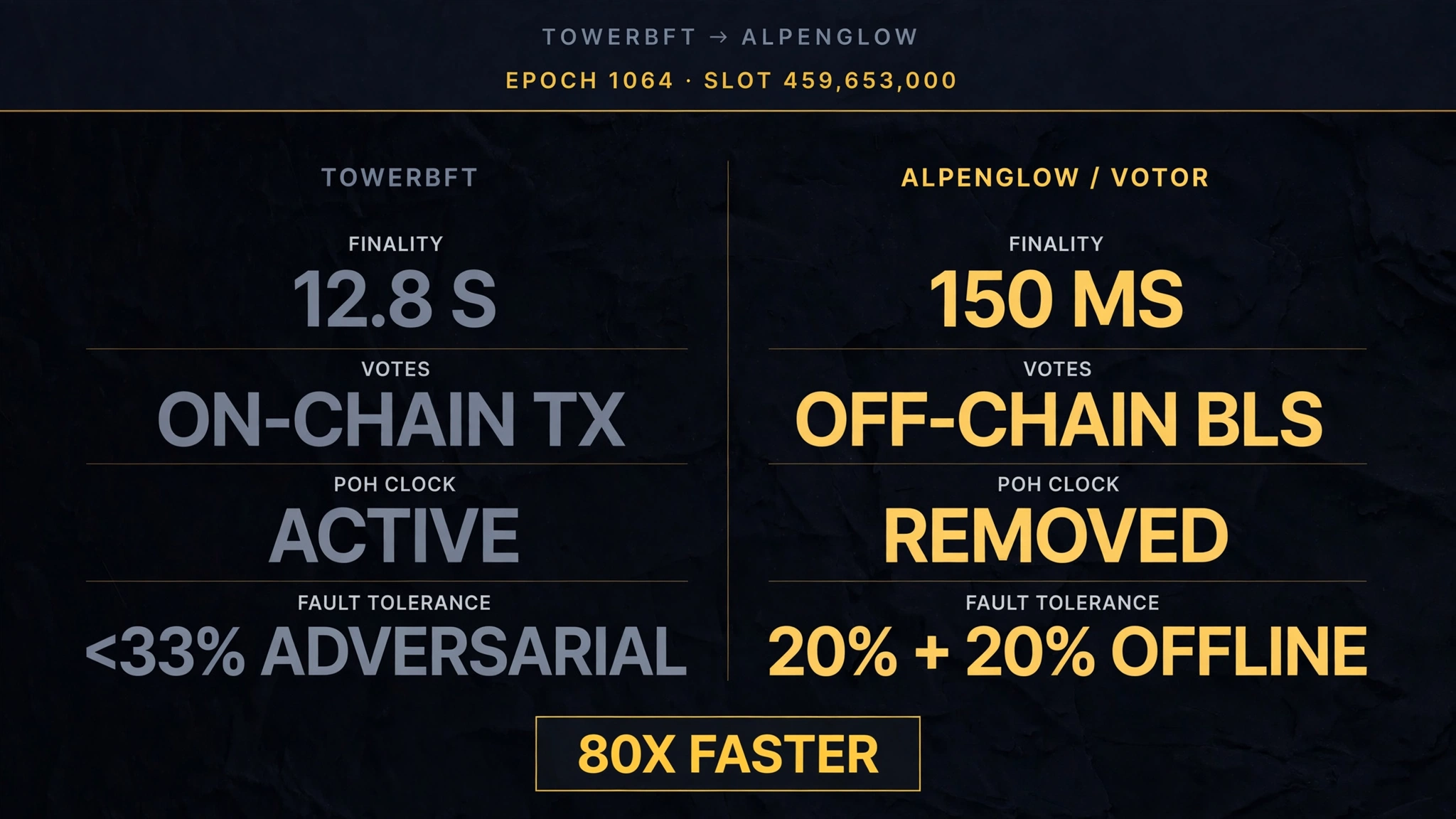
The headline number: finality drops from about 12.8 seconds to a target of roughly 150 milliseconds. About 80 times faster. If it works, Solana becomes the first major chain with near-instant irreversible settlement.
The migration: 18 months of work, one slot
The choreography is precise. Anza’s October 13 announcement put the epoch-1064 boundary at approximately 14:50 UTC on October 21 — though the firm noted on October 19 that the epoch was tracking earlier than that estimate. Epoch start times drift; validators are told to track the epoch number, not the clock.
The sequence: the feature gate activates at the epoch boundary. TowerBFT keeps governing for the first 5,000 slots — about 18 minutes — while validators confirm the new code paths. Then, at slot 459,653,000, Alpenglow formally takes effect and TowerBFT is retired.
This is the first phase of Alpenglow — Votor, the new voting protocol. Testnet switched on September 24, devnet on September 25. Tonight is the first time Votor faces production mainnet conditions: real stake, real MEV, real adversaries.
For users, nothing changes. The SVM is untouched. Fees are untouched. Wallets work exactly as yesterday. This is plumbing, not product — which is precisely why it matters.
TowerBFT vs Alpenglow: what actually changes
Under TowerBFT, every validator vote is an on-chain transaction. Votes are not a side channel; they are the chain’s heaviest workload. A large share of Solana’s famously high transaction counts is not users doing things — it is validators voting on what users did. Finality takes about 12.8 seconds because votes must be gossiped, included in blocks, and confirmed across rounds.
Alpenglow’s Votor moves all of that off-chain. Validators exchange votes directly as BLS-signed messages and aggregate them into certificates. If 80% of stake backs a block in the first round, it finalizes immediately. At 60%, a second round closes it. Proof of History — Solana’s famous cryptographic clock — is gone entirely. As Anza puts it: liveness now belongs to the validator network, not whoever holds the slot.
TowerBFT (current)
Alpenglow / Votor (new)
Finality
~12.8 seconds
~150ms target
Vote mechanism
On-chain vote transactions
Off-chain BLS-signed messages, aggregated into certificates
Finalization rounds
Multi-round gossip + block inclusion
One round at 80% stake, two rounds at 60%
Fault tolerance
<33% adversarial stake
20% adversarial + 20% offline simultaneously
Proof of History
Core clock mechanism
Removed
Blockspace
Shared with vote transactions
Solely for users
Headline TPS
Inflated by vote traffic
Drops sharply (statistical, not real)
The fault-tolerance row deserves attention. TowerBFT handled under 33% adversarial stake. Alpenglow tolerates 20% adversarial plus 20% offline stake simultaneously — up to 40% of stake misbehaving or missing. That is a different security model, not just a faster one.
Why 150 milliseconds is the whole game
Twelve-point-eight seconds does not sound like much until you try to build on it. Today’s Solana already offers roughly 400-millisecond pre-confirmation — a probabilistic “probably final” signal. But probabilistic is not final, and the gap between the two is where use cases go to die.
Payments are the obvious one. No merchant waits 12.8 seconds for settlement certainty. At 150 milliseconds, finality enters tap-to-pay territory — irreversible before the customer puts the phone down. That is the difference between crypto payments as a demo and crypto payments as infrastructure.
DeFi feels it differently. Every block of latency between intent and finality is extractable value leaking to whoever is fastest. Compress finality by 80x and the MEV landscape reshapes: strategies that were unprofitable under 12.8-second finality become viable, and strategies built on the old latency profile break.
Then there is the competitive frame. Solana’s pitch has always been speed, but finality was the asterisk — fast to see, slow to trust. Ethereum’s L2 ecosystem, Sui, Aptos all market settlement speed as the frontier. Alpenglow removes the asterisk.
One caveat, stated plainly: 150 milliseconds is an engineering target, not a guarantee. The Solana Foundation says real-world finality will depend on validator participation and live-network conditions. Testnet has recorded a median finality of 54 milliseconds — encouraging, but testnet is not mainnet, and tonight is the first production measurement.
What could go wrong on activation night
A consensus-engine swap on a live network has no precedent, which means the risk inventory is partly theoretical. But several concrete failure points are visible.
The Firedancer problem. Validators must run an Agave-based client at version 4.3.0 or later — 4.3.2 is the recommended build as of October 16. Firedancer clients are not supported for this transition. As of October 13, roughly 15.8% of the top 500 validators ran Firedancer-family clients. Every one of them had to switch before the epoch boundary. If a meaningful fraction did not, stake participation at the handoff drops, and the 80%/60% thresholds get harder to hit.
The admission ticket. Alpenglow introduces a Validator Admission Ticket: every vote account must hold 0.8 SOL above its rent-exempt balance each epoch. Fall short and the validator cannot vote or produce blocks in the following epoch. A small amount per validator, but a new operational requirement landing on the same night as a consensus swap.
The metrics shock. Once votes leave blocks, Solana’s headline transaction counts fall off a cliff — reported TPS could drop around 60%. That is a statistical artifact, not a real activity decline, but markets do not always read footnotes. Expect confused headlines tomorrow about Solana’s “collapsing” throughput.
The infrastructure wobble. Providers like Quicknode warn the handoff may briefly pause new transactions entering blocks and disrupt data streams or subscriptions. Unstaked RPC nodes may see later finality signals than staked validators. For most users this will be invisible. For trading infrastructure, it is the kind of evening you staff up for.
What to watch tonight
Validator participation at the boundary. Did the Firedancer 15.8% complete the switch? Watch stake-weighted client versions around epoch 1064. Anything under ~90% of stake on supported Agave builds at the handoff is a yellow flag.
Skipped slots in the first hour. The 5,000-slot TowerBFT overlap is the designed safety margin. Skipped slots spiking after slot 459,653,000 — when Votor takes sole control — would signal validators struggling with the new voting path.
Measured finality versus the target. Testnet’s 54-millisecond median is the optimistic benchmark; 150 milliseconds is the official target. Watch what mainnet prints in the first hours.
The admission-ticket fallout. Validators that missed the 0.8 SOL funding drop out of voting next epoch. A visible dip in active validator count tomorrow is expected mechanics — but the size of the dip tells you how prepared the set was.
SOL’s price reaction. Which brings us to the market.
The tech/price gap: SOL at $104
Here is the tension the market has to resolve. Alpenglow is, by Anza’s description, the biggest upgrade in Solana’s history — a genuine first in blockchain engineering. And SOL trades around $104–105, down more than 6% over the past 30 days. The chain is about to get 80 times faster at finality, and the market is yawning.
Part of that is macro. With the October FOMC eight days out and an 89%-priced December hike looming, risk assets are not rewarding idiosyncratic catalysts. We covered Solana’s recent pressure — China overhang, support levels, the works — and the price action since has not argued with that framing.
But part of it is structural. Consensus changes do not move prices; usage moves prices. What a clean activation does is remove the single biggest technical objection to building settlement infrastructure on Solana — payments, institutional flows, and the autonomous trading agents that need deterministic finality to execute multi-step strategies without settlement risk.
The asymmetry is stark. A messy activation tonight would validate every “Solana breaks” meme at the exact moment the network claimed to have outgrown them. A clean activation changes nothing tomorrow morning — and everything over the next year. Infrastructure upgrades compound quietly.
Tonight, Solana swaps its engine mid-flight. By tomorrow, we will know whether the most ambitious live upgrade in crypto history was a non-event. In infrastructure, that is the best possible outcome.
—
What to Read Next
Solana is moving fast this week — do not read this upgrade in isolation:
Follow CoinXsight for daily institutional-grade crypto analysis.
Disclaimer: This article is for informational purposes only and does not constitute financial advice. Cryptocurrency markets are volatile and carry substantial risk of loss, including risks related to network upgrades, validator behavior, and client software changes. Technical targets cited (such as finality times) are engineering goals, not guarantees of mainnet performance. Past performance does not guarantee future results. Always do your own research before making investment decisions. Data: Anza, Solana Foundation, CoinDesk, CoinOTAG.
CX
CoinXSight Alpha Desk
ALPHA // DESK
Quantitative Research Desk·Global Alpha Division
CoinXSight Institutional Research Desk produces quantitative crypto market intelligence, algorithmic models, and on-chain forensics.
QUANTITATIVE SUITE // DEEP ALPHA ENGINEACTIVE
BTC/USDT // LIVE SCANNER
CONFLUENCE 74
LIVE SPOT PRICE$82,807.47WEAK_BUY
TP2
$89,522.75
+9.07%
TP1
$85,056.42
+3.63%
ENTRY
$82,078.86
ZONE
SL
$80,590.09
-1.81%
Auto-detect Order Blocks, Fair Value Gaps and risk-adjusted DCA ladders in < 5s.