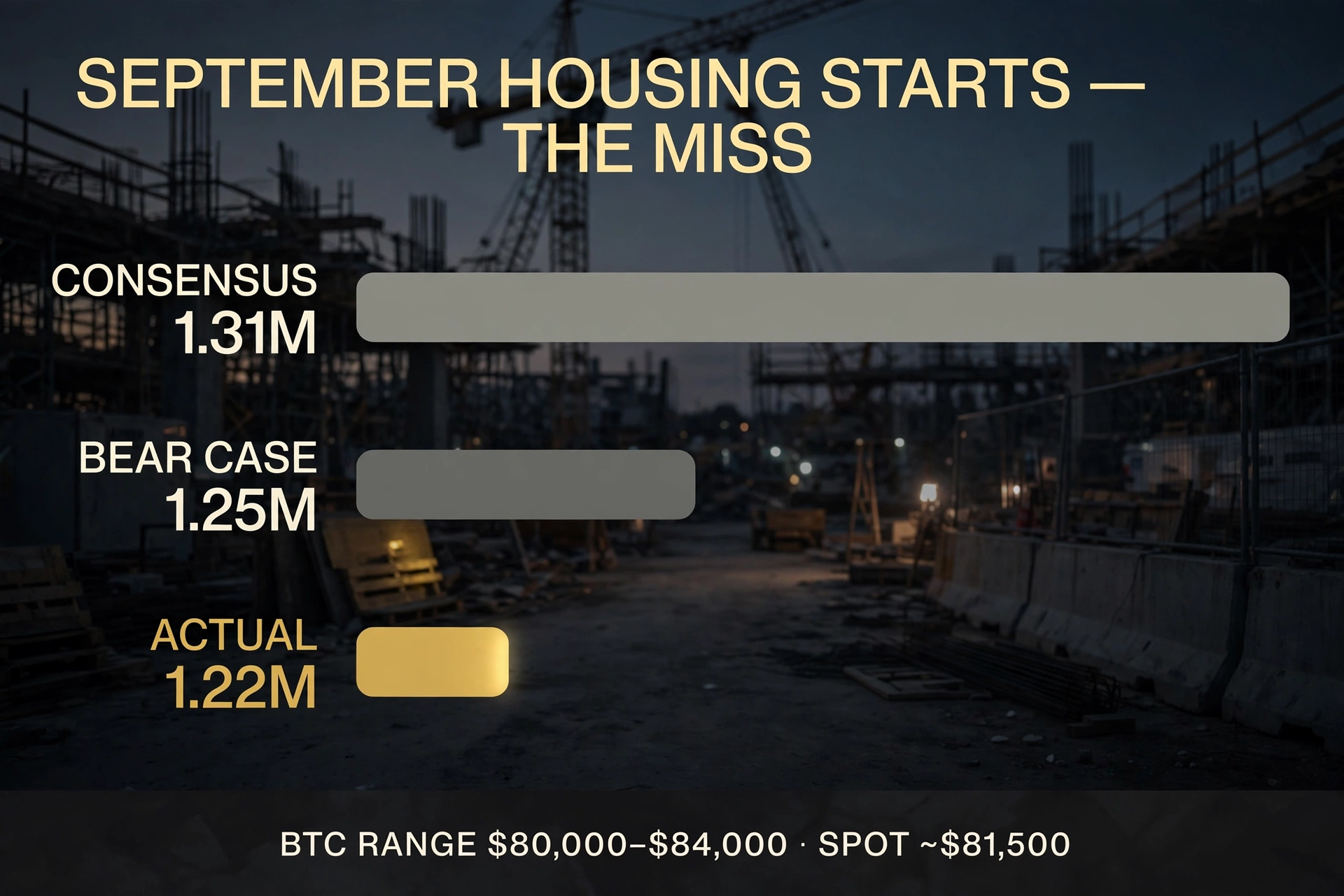
The Census Bureau has told us how many homes American builders broke ground on in September: 1.22 million — a miss, and not a small one. It is not CPI. It is not the jobs report. Most crypto traders did not even have the release on their calendar — and that is exactly why it matters, with Bitcoin pinned inside an $80,000–$84,000 range and eight days to the FOMC.
Housing is where this cycle’s central argument gets tested in the real economy. The argument, since PPI printed 6.3%, is that the U.S. is running a growth shock: inflation is hot because demand is strong, not because the economy is breaking. Bitcoin has traded that narrative well — yields fell on the hot PPI print, gold made all-time highs, and BTC held $80K. Housing starts are the consumer-side check on that story. Builders do not start homes they cannot sell. If they are still starting them with mortgage rates above 7%, the growth shock is real. If they have quietly stopped, the first crack in the consumer economy is showing — and it is showing in the most rate-sensitive sector there is.
What the Street expects: a bounce off a weak base
Consensus, per the Wall Street Journal survey, sits at 1.31 million starts (seasonally adjusted annual rate), up 2.7% from August’s 1.275 million. Building permits — the forward-looking half of the release — are expected at 1.40 million, up 0.4% from 1.394 million. A fresher cut of the same survey nudged both numbers a touch lower (1.30M starts, 1.39M permits), which tells you where the late money leans: soft.
Context matters more than the headline. August starts fell 2.6%, and starts have declined in four of the past five months in Wells Fargo’s telling. The bank is the street’s bear on this print: it expects starts to fall 2.0% to 1.25 million, citing mortgage rates that pushed above 7% into late September, deteriorating builder expectations for future sales, and price cuts becoming standard practice. The NAHB’s own survey work points the same direction — builders are not acting like men and women who see a strong consumer.
So the setup into the 19:30 Vietnam time print was asymmetric. A print at consensus would have been a non-event. A print at Wells Fargo’s number was a story — and the number that actually landed came in below even that.
Indicator (Sep)
Previous
Consensus
Bear case (Wells Fargo)
Why it matters
Housing Starts
1.275M (-2.6%)
1.31M (+2.7%)
1.25M (-2.0%)
Real-economy demand check
Building Permits
1.394M (-2.7%)
1.40M (+0.4%)
Falling trend
Leads starts by 1-2 months
30Y mortgage rate
>7% late Sep
—
—
The affordability choke
BTC at the print
$81,500-82,000
Range $80K-84K
Support $80,000
Positioning is long and nervous
Why housing leads, and why crypto should care
Housing starts sit near the front of the economic transmission chain. A start is a construction job, a lumber order, an appliance purchase, a mortgage origination — months of downstream activity committed on the basis of one decision: someone will buy this home. Permits lead starts. Starts lead employment in construction. Construction employment leads the consumer. When housing rolls over, it rarely rolls alone.
For Bitcoin, the transmission runs through the Fed reaction function and through risk appetite. This market has spent October pricing a very specific world: growth strong enough to keep inflation sticky (CPI 3.7%, core 2.6%, PPI 6.3%), a Fed that holds on October 28 — 87% odds on FedWatch — and then likely hikes in December. In that world, as we laid out in this morning’s FOMC countdown, Bitcoin’s range makes sense: bad news for rate cuts, good news for risk assets, net effect a grind between $80K and $84K.
Housing was one of the few remaining data points that could break that world before the Fed does. It just swung at it.
Scenario one: a hot print extends the growth shock
It did not happen — but it is worth spelling out what a hot print would have meant, because it defines what the market just lost. Had starts come in at 1.33 million or better, with permits confirming, the read would have been straightforward: American builders, facing 7%-plus mortgage rates, are still building — because buyers are still there. The consumer is not cracking. The growth-shock narrative that carried Bitcoin through a 6.3% PPI print (see our breakdown of that report) gets another leg.
For BTC, that is the comfortable scenario, with a twist. Strong data keeps December hike odds elevated and caps the upside — nobody bids Bitcoin aggressively into a hiking Fed. But it also validates the bid underneath: every flush toward $80,000 this month has been absorbed, and the on-chain structure underneath the range — long-term holders at record levels, exchange balances thin — says sellers are not pressing. A hot housing print would likely have meant more of the same: range intact, dips bought, volatility sold. Boring, and bullish in the way that matters. That is not the tape we got.
Scenario two: a cold print shows the first crack
Wells Fargo was right — and then some. Starts printed 1.22 million, below the bank’s 1.25 million bear case, with permits slipping 0.2% on the month and starts down 5.2% from August, near post-COVID lows. That is not a recession signal by itself — one month of housing data never is — but it is the first hard evidence that the rate shock has reached the real economy’s most rate-sensitive organ. The narrative flips from “growth shock” to “growth cracking,” and that is a different trade entirely.
The first move on a print like this is usually good for Bitcoin: yields down, December hike odds down, the Fed’s path suddenly looking kinder. Do not trust it past the first candle. If the market decides the consumer is genuinely rolling over, the conversation moves from “when does the Fed cut” to “how bad is the landing” — and in every modern episode, Bitcoin has traded that transition as a risk asset first and a hedge later. A cold print plus a break of $80,000 on volume would be the combination to respect: positioning is crowded long (roughly $184 million of liquidations in the last 24 hours, about 90% of them longs), and crowded longs do not exit politely.
Bitcoin’s setup after the print
Technically, there is not much to say, and that is the point. BTC trades around $81,500–$82,000, down roughly 1.2% on the day, having failed again at the top of the range. Spot ETF flows looked like the soft underbelly: U.S. Bitcoin ETFs bled about $228.6 million last week, a second consecutive red week. But Monday’s session flipped the signal — +$526.6 million poured back in, the largest single-day inflow in nearly a month. The bid that absorbed September’s supply has not vanished; it is being selective, buying the dip in size while ignoring the range top. Support sits at $81,144, then the psychological line at $80,000; resistance is $82,587, then $83,457 — above that, the range top near $84,000.
A second-tier data release does not normally move a $1.6 trillion asset. But ranges break on accumulated evidence, not single prints, and this print lands in a market that is (a) positioned long, (b) eight days from an FOMC it has fully priced, and (c) running out of fresh reasons to hold the top of the range. Housing will not decide Bitcoin’s October. It might decide whether the next test is of $84,000 or of $80,000.
The bottom line
The print answered the question. Housing starts landed at 1.22 million — below the 1.30 million consensus and below even Wells Fargo’s 1.25 million bear case, a 5.2% monthly drop that leaves starts near post-COVID lows, with single-family starts the weakest in a year. Permits slipped 0.2% on the month. That is the cold-print scenario, printed in full: the first real-economy crack has appeared, and it arrived days before the FOMC. The growth shock narrative now has a counterweight, and the market has to decide, quickly, whether cracking growth is a reason to buy Bitcoin or to sell everything. History says it sells first. Monday’s +$526.6 million ETF inflow says at least one deep-pocketed bid disagrees. Watch the $80,000 line: if it holds on this print, the range survives into the FOMC; if it goes, the crack in housing becomes a crack in the tape.
—
Disclaimer: This article is for informational purposes only and does not constitute financial advice. Cryptocurrency markets are volatile and carry substantial risk of loss. Economic data releases can differ materially from consensus forecasts and are subject to revision. Past performance does not guarantee future results. Always do your own research before making investment decisions. Data: U.S. Census Bureau, Wall Street Journal survey via Morningstar/Dow Jones, Wells Fargo, CME FedWatch, CoinGlass.
CX
CoinXSight Alpha Desk
ALPHA // DESK
Quantitative Research Desk·Global Alpha Division
CoinXSight Institutional Research Desk produces quantitative crypto market intelligence, algorithmic models, and on-chain forensics.
QUANTITATIVE SUITE // DEEP ALPHA ENGINEACTIVE
BTC/USDT // LIVE SCANNER
CONFLUENCE 100
LIVE SPOT PRICE$82,617.68STRONG_BUY
TP2
$90,817.78
+10.15%
TP1
$85,796.52
+4.06%
ENTRY
$82,449.02
ZONE
SL
$80,775.27
-2.03%
Auto-detect Order Blocks, Fair Value Gaps and risk-adjusted DCA ladders in < 5s.