Overnight, two of the largest AI bets in the market reported within hours of each other — and Bitcoin woke up 2 to 3% higher, trading toward $84,000 with the Fear & Greed Index at 68. This is not a coincidence. Meta and Tesla’s third-quarter results read like two chapters of the same story: AI is no longer a research project or a capital-expenditure line item. It is a product line — with attach rates, subscription counts, and revenue.
For crypto, that matters. Bitcoin has spent most of October as a macro instrument, bouncing between rate-cut odds and inflation prints. The overnight earnings injected something the macro calendar hasn’t delivered in weeks: genuine risk-on sentiment driven by AI monetization. Super Micro Computer rose 9.6%. Meta climbed ~4% after hours. Tesla added to a 3.4% gain in the regular session. And spot Bitcoin ETFs pulled in $527 million Monday and $23 million Tuesday, while $160 million in shorts were squeezed in the liquidation cascade.
The deeper story, though, is not the tape. It’s what these two quarters reveal about how AI spending actually works — and the one question neither company answered.
Meta: the margin collapse that wasn’t
The headline number looks ugly. Operating income of $13.0 billion, down 37% year over year, a huge miss against the ~$20.9 billion consensus. Operating margin halved to 20% from 40% a year ago. Read cold, it looks like the AI buildout is finally eating Meta’s profits alive.
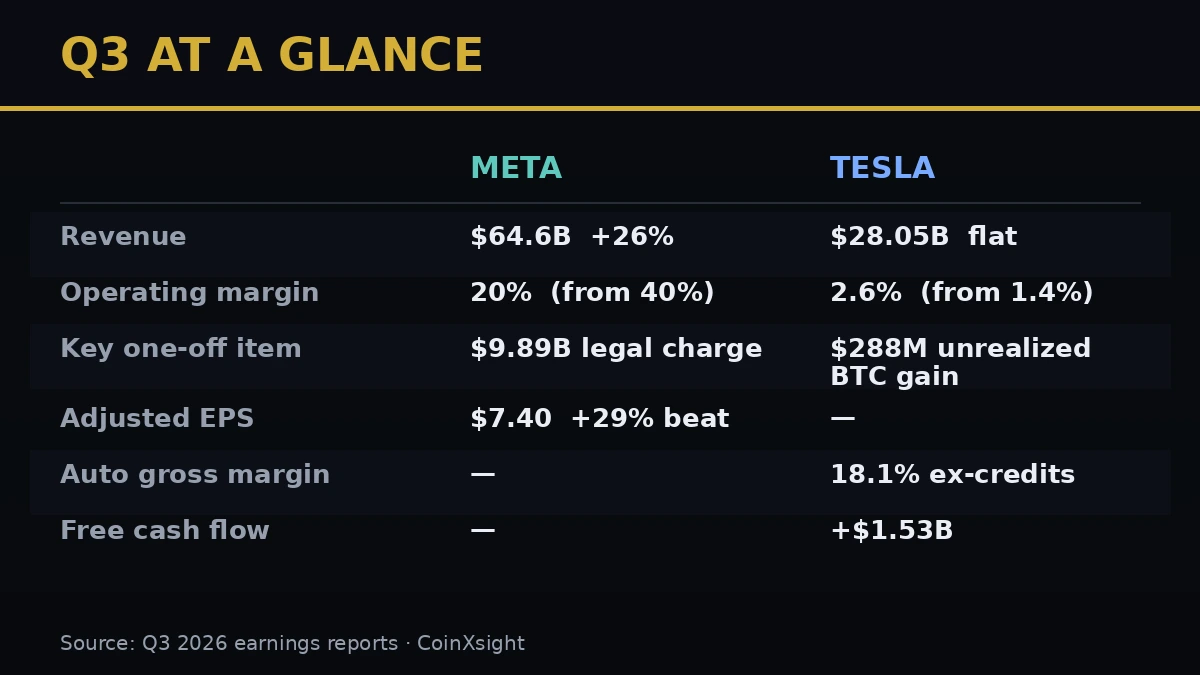
It isn’t. The entire margin shock is one line item: a $9.89 billion legal charge — the August settlement with 52 state attorneys general over youth mental health and social media claims. Strip that charge out, and the quarter was a beat almost everywhere that matters: revenue of $64.6 billion, up 26% year over year, ahead of the ~$63.3 billion consensus. Ad revenue alone hit $63.1 billion. Adjusted EPS was $7.40 against a $5.74 estimate — a 29% beat. The advertising engine isn’t slowing. It’s accelerating.
This distinction is load-bearing, and most of the first-pass commentary got it wrong. The margin contraction is a legal event, not an AI capex event. The capex story is separate — and it deserves its own scrutiny.
Tesla: margins rebuilt, AI attached
Tesla’s quarter was the mirror image. Revenue of $28.05 billion was essentially flat year over year and slightly below consensus, but everything downstream improved. Total gross margin recovered to 19.6% from 16.8% in Q2; auto gross margin ex-credits rose to 18.1%. Operating margin doubled from 1.4% to 2.6%. Non-GAAP EPS of $0.48 beat the $0.44–0.45 estimate.
Deliveries of 486,532 vehicles were down 2% — the market already knew that number — but the composition is changing. More than 75% of new vehicles sold in North America now ship with Full Self-Driving attached. Active FSD subscriptions hit 1.74 million, up 67% year over year. The Cybercab robotaxi fleet has been running in Austin since September 3, logging ~2 million unsupervised miles — 8x quarter over quarter. The Semi is entering mass production in Nevada; Optimus began production at Fremont.
And the balance sheet tells its own AI story: R&D surged 69% to $2.76 billion (Super Intelligence, Optimus, Cybercab), free cash flow swung back positive to +$1.53 billion from negative $1.09 billion last quarter, and the quarter included a $288 million unrealized Bitcoin gain. Oh, and both Tesla and SpaceX boards have formed committees to discuss a merger — a combined entity sitting on over 30,000 BTC, worth roughly $2.5 billion.
Two models of AI spending
Put the two quarters side by side and the contrast is striking — not in results, but in how each company spends on AI.
Metric (Q3 2026)
Meta
Tesla
Revenue
$64.6B (+26% YoY)
$28.05B (~flat YoY)
Operating margin
20% GAAP (charge-distorted)
2.6% (up from 1.4%)
AI spend channel
Data-center capex ($34.9B Q3)
R&D +69% to $2.76B
Free cash flow
-$2.12B
+$1.53B
2026 capex guide
$135-145B (low end raised)
Not guided separately
AI product metric
Muse: 10M+ users in 6 weeks
FSD: 75%+ attach rate
BTC exposure
None
$288M unrealized Q3 gain
Meta spends like an infrastructure company: $34.91 billion of capex in a single quarter, full-year 2026 guidance raised at the low end to $135–145 billion, and free cash flow pushed negative to −$2.12 billion. The bet is that AI infrastructure monetizes through the advertising flywheel.
Tesla spends like a product company: the AI money flows through R&D and shows up as per-unit economics — FSD subscriptions, robotaxi miles, Optimus production lines. Free cash flow is positive. Cash sits at $45.45 billion.
One model borrows from the future; the other charges the customer. Both are working — this quarter. The question is which one keeps working if the economy turns.
AI is monetizing — in ads and cars
Zoom out from the two balance sheets and the macro signal is loud. This is the part that connects directly to the AI Agent series we’ve been building: AI is no longer a capability looking for a business model. It is a business model looking for scale.
Consider the two flagship products launched this quarter. Meta’s Muse personal AI agent reached more than 10 million users in the US and Canada in roughly six weeks, with about a quarter of them using it daily. Zuckerberg called it the company’s first “frontier model” — and it’s already a consumer product with a growth curve. Tesla’s FSD has a 75% attach rate on new vehicles — three out of four buyers pay for autonomy.
As we explored in How AI Agents Trade Crypto, agents are moving from rule-based bots toward autonomous decision-makers. What’s changed is the venue: the action isn’t just on-chain anymore. It’s in 10-million-user consumer products and in two million unsupervised robotaxi miles. The agent economy has a macro footprint now, and that footprint is risk-on.
The crypto read-through: risk-on returns
So what does a frontier model with 10 million users have to do with Bitcoin at $84,000? Everything, through the risk-appetite channel.
The overnight bid in crypto has AI fingerprints all over it. The rally wasn’t driven by rate expectations — remember, the Fed is in its October 17–29 blackout and the December hike sits at ~89% odds, as we detailed in our FOMC countdown. It wasn’t driven by inflation either — September CPI printed 3.7% and the market shrugged. It was driven by earnings: proof that the AI trade still has a pulse.
Bitcoin’s setup absorbed it cleanly. The 24-hour liquidation data shows $213.6 million in total liquidations, $160.2 million of it shorts — a genuine squeeze, not a leverage build. The ETF bid is healthy again after the Housing Starts article flagged its wobble. The range that held at $80–82K through October’s macro chop is now testing the top.
The read-through is simple: when Big Tech’s AI bets cash checks, risk appetite returns, and Bitcoin — the most liquid risk asset on the planet — is where that appetite expresses first.
The question nobody is asking
Here’s what neither earnings call resolved. Meta’s $135–145 billion capex program was forgiven this quarter because advertising grew 26%. The market’s logic: as long as ads print money, the data-center build is an investment, not a cost. But capex is a choice that compounds; ad growth is a cycle that doesn’t always cooperate.
What happens in 2027 if ad growth decelerates — not collapses, just normalizes — while the capex guide stays at $140 billion? Free cash flow stays negative. The multiple compresses. And Bitcoin, which has just re-rated upward on AI optimism, discovers that its newest macro driver has a cyclical edge.
This isn’t a bear call. It’s a calendar call. The legal charge is one-time; the capex is forever. The AI-monetization story is real — 10 million Muse users and 2 million robotaxi miles are not narratives, they’re numbers. But the forgiveness Meta received last night was conditional: contingent on ads staying strong enough to fund the build. Watch Q4 guidance execution, watch the $73–76B revenue guide, and watch whether 2027 capex comes with the same ad growth attached.
The bottom line
Two quarters, one verdict: AI is monetizing across ads and cars, and markets are rewarding it. Meta’s margin panic is a misread of a legal charge; Tesla’s margin recovery is real and AI-attached. The risk-on bid that lifted Bitcoin toward $84,000 overnight is earned, not speculative.
But the bid has a condition attached, same as Meta’s. It’s contingent on the AI capex cycle staying funded — by ad revenue at Meta, by per-unit economics at Tesla. As long as those hold, crypto gets the tailwind. The moment either wobbles, Bitcoin will be the first to know.
Disclaimer: This article is for informational purposes only and does not constitute financial advice. Cryptocurrency markets are volatile and carry substantial risk of loss. Earnings figures cited are from company reports and may be subject to revision. Past performance does not guarantee future results. Always do your own research before making investment decisions. Data: Meta Q3 2026, Tesla Q3 2026, CME FedWatch, CoinGecko.
CX
CoinXSight Alpha Desk
ALPHA // DESK
Quantitative Research Desk·Global Alpha Division
CoinXSight Institutional Research Desk produces quantitative crypto market intelligence, algorithmic models, and on-chain forensics.
QUANTITATIVE SUITE // DEEP ALPHA ENGINEACTIVE
BTC/USDT // LIVE SCANNER
CONFLUENCE 74
LIVE SPOT PRICE$82,807.47WEAK_BUY
TP2
$89,522.75
+9.07%
TP1
$85,056.42
+3.63%
ENTRY
$82,078.86
ZONE
SL
$80,590.09
-1.81%
Auto-detect Order Blocks, Fair Value Gaps and risk-adjusted DCA ladders in < 5s.