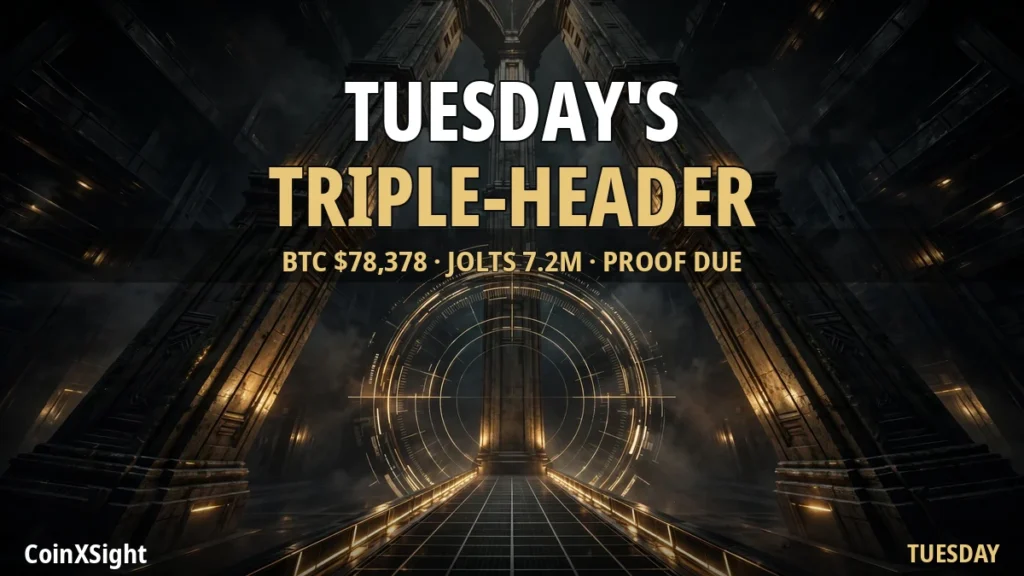
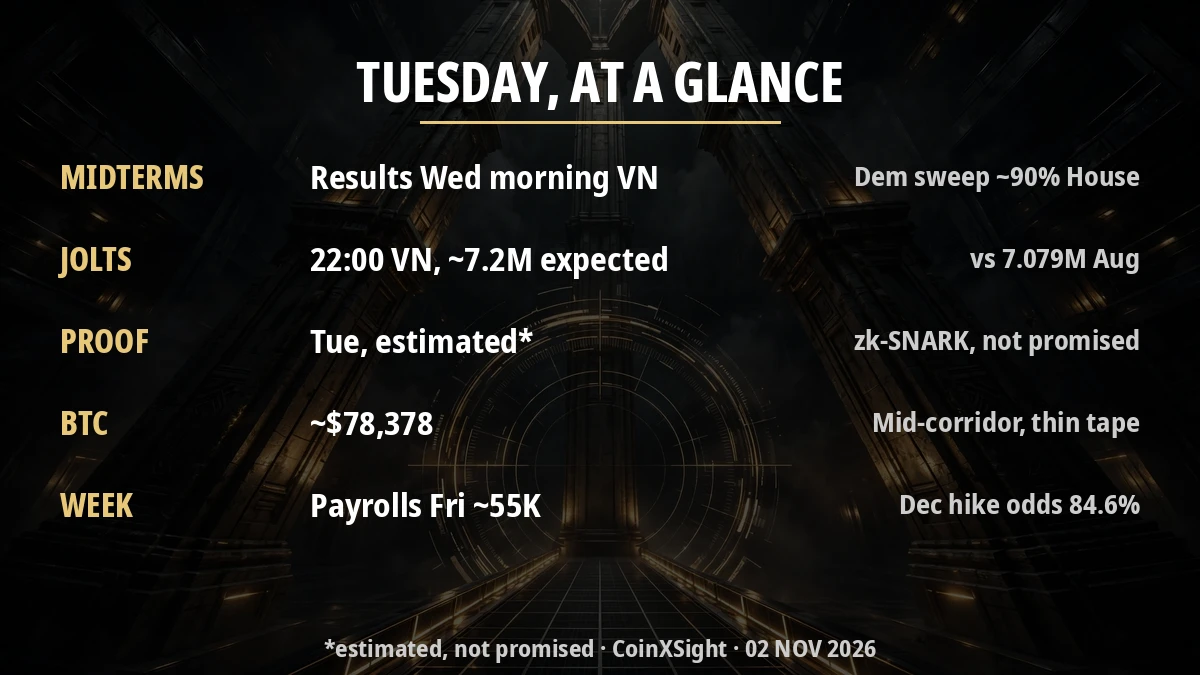
Tuesday is not one event. It is three, stacked on top of each other, and Bitcoin walks into all of them with almost no cushion. Americans vote in the midterm elections, with results landing Wednesday morning Vietnam time. The September JOLTS report prints at 22:00 Vietnam time, the latest delayed datapoint in a week that will decide whether December belongs to the hawks. And Binance’s full zero-knowledge proof of reserves — the one artifact in the $6.3 billion hack saga that outsiders can actually verify — is due the same day, on the exchange’s own estimated timetable.
Any one of those would move a market this fragile. Together, on a Monday tape this thin, they are a volatility machine. Bitcoin trades near $78,378 at Monday midday Vietnam time, up about 0.6% on the day, almost exactly in the middle of the corridor that has defined November so far: the $76,500 shelf below, the $79,500–80,500 reclaim zone above. XRP sits near $1.255, flat, after the calmest week of any major coin. Nothing about this tape screams direction. Everything about the calendar screams that direction is coming, fast, and probably all at once.
Monday’s tape: a market holding its breath
Start with what the tape actually says, because the weekend’s narratives have run ahead of it. Bitcoin’s weekly close near $77,600 held every line that mattered — above the $76,500 short-term holder cost basis, above the $75,718 weekly pivot, above a week’s low near $76,330. That is a non-bearish outcome after the worst week of the year, and it deserves to be stated plainly. It is not, by itself, a bullish one.
Underneath, the deterioration has not reversed. Only 13 of the top 50 coins finished the week higher; by one count, 83 of the top 100 were negative. Stablecoin supply — the market’s dry powder, the money that actually buys dips — shrank from about $302.6 billion on October 25 to roughly $298.5 billion on November 1, a $4.1 billion drain in seven days. Capital is not rotating into risk. It is leaving slowly, through the side door. That is what late-stage corrections look like before they resolve or accelerate, and it is the single most important microstructure fact heading into Tuesday: there is less standing liquidity to absorb a surprise than there was a week ago.
Monday’s own session fits the pattern. Bitcoin drifted between roughly $77,620 and $78,878, a range so narrow it reads as a market waiting for permission. XRP barely moved at all. The options expiry is behind us, the forced selling from the hack week has cleared, and what remains is a market of participants who have decided to let Tuesday decide for them. When that many traders stand aside at once, the first real headline does not just move price — it moves it through empty space.
The calendar: what lands, and when
Event (Vietnam time)
What to watch
Why it moves crypto
Mon 22:00 — ISM manufacturing (Oct)
Forecast 54.7 vs Sep 54.5; prices-paid was 77.9
Sets the tone for the December hike debate before Tuesday
Tue — US midterm elections
Results arrive Wed morning VN
Decides the CLARITY Act’s fate for two years
Tue 22:00 — JOLTS, September
Expected ~7.2M vs 7.079M in August
Feeds the hike odds now priced near 84.6% for December
Tue — Binance zk-SNARK PoR proof
Full proof expected (Binance: ‘estimated’)
First independently verifiable reserves evidence since the hack
Wed — XRPL amendment window; ISM services
Activation decision; services prices
XRP-specific catalyst plus a second inflation read
Fri — US payrolls
Consensus near 55K
A strong beat would be a genuine hawkish shock
The midterms: three Congresses, three crypto regimes
The election is the longest fuse on the calendar and the one with the most durable consequences. The policy note that has framed the industry’s thinking, from TD Cowen’s Jaret Seiberg in late October, lays out three scenarios, and each one writes a different two years for digital assets.
The most probable outcome, by prediction-market odds, is a Democratic sweep: roughly a 90% chance of taking the House and around 62–69% for the Senate, depending on the market. Under it, Senator Elizabeth Warren would chair the Senate Banking Committee, bringing the CLARITY Act’s most persistent critic to the gavel and subjecting federal regulators to aggressive oversight. Seiberg calls this the most negative scenario for crypto — but with a crucial qualifier that markets keep forgetting. A Democratic Congress cannot easily force a hostile bill past a president who remains favorable to the industry and willing to veto anything that curbs his regulators’ authority, and Democrats lack the votes to override. The realistic result of a sweep is therefore not a crackdown but a stalemate: the CLARITY Act stalls, legislation is renegotiated on Democratic terms around ethics provisions and investor protection, and policy advances instead through regulators — on tokenization, perpetual futures, and stablecoins.
The second scenario, a Democratic House with a Republican Senate, keeps Senator Tim Scott’s gavel at Banking and forces the two chambers to reconcile competing versions of market-structure legislation. That is a slower, messier path to the same destination: compromise language, delayed timelines, and a bill that survives only if both sides accept ethics provisions the White House has resisted.
The third scenario, a Republican sweep, is the least likely — about 10% for the House and 35% for the Senate on Kalshi — and the best for the industry’s legislative hopes. A wider Senate majority would improve the odds of advancing the CLARITY Act in 2027 or 2028, and could even open a lame-duck revival attempt. A narrow majority, though, leaves the bill exactly where it died in September, when a cloture vote failed 49–50 over the ethics provisions barring senior officials from profiting from crypto ventures and the unresolved question of stablecoin yield.
The history matters because it disciplines expectations. The House passed its version in July 2025 by 294–134. The Senate Banking Committee approved its own in May 2026 by 15–9, with two Democrats joining Republicans. Then the floor vote failed, and Bitcoin-linked stocks fell on the news. The bill has already proven it can pass everywhere except the one room that counts. Tuesday decides who occupies that room — and the industry has spent $176 million across more than 100 races trying to choose them.
For traders, the honest framing is this: no outcome on Tuesday night produces a signed CLARITY Act by Christmas. The realistic bull case is a Congress that can pass one in 2027; the realistic bear case is two years of regulatory trench warfare with legislation frozen. Markets that price the election as a binary legislation event will misprice both directions. The trade is the slope of the next two years, not the headline on Wednesday morning.
JOLTS and the December hike: the number inside the number
If the election is the long fuse, JOLTS is the short one. The September report, delayed by the data calendar pile-up, is expected near 7.2 million job openings against August’s 7.079 million. The headline will get the alerts. The internals will get the trade.
The context is a market that has already priced the hawkish case: roughly 84.6% odds of a December rate hike, a number that would have read as absurd a month ago and now reads as consensus. That pricing is the wound last week left behind — not the hack, which is healing on schedule, but the discovery that December belongs to the hawks. Every print this week either confirms that ownership or starts to contest it. A JOLTS print meaningfully above 7.2 million, especially alongside a hot ISM prices-paid reading tonight, hardens the hike case and pressures the $76,500 shelf from the macro side. A soft print — openings slipping toward or below August’s level — gives the market its first real reason to question 84.6%, and in a thin tape, questioning a consensus that crowded is itself a catalyst.
Tonight’s ISM manufacturing report is the warm-up act with real teeth. The forecast is 54.7, a touch above September’s 54.5, but the headline is the least important line in the release. September’s prices-paid component printed 77.9, deep in inflationary territory, and it is that sub-index, plus new orders and employment, that feeds the December debate. Then Friday’s payrolls report — consensus near 55,000, a number low enough that a strong beat would be a genuine hawkish shock — closes the week. The sequence is designed, accidentally, to test the same thesis four times in five days.
Binance’s Tuesday proof: estimated, not promised
The third item on Tuesday’s docket deserves the most careful language in this article, because the distinction between an estimate and a commitment is the whole story. In its Recovery Update #3 on October 31, Binance said its full zk-SNARK proof of reserves is expected to be generated by Tuesday, November 3. That is Binance’s own timetable, reported by the exchange itself — and the operative word in its statement is “estimated.” It is not a hard commitment, and as of Monday afternoon Vietnam time, the full proof had not been published. The snapshot that is public, timestamped 00:00 UTC on October 31, covers the top ten user assets at 1:1 or better — Bitcoin at 100.04%, BNB at 101.30% — from new wallet addresses, with a downloadable address list that lets anyone check on-chain balances against the claim.
What Tuesday’s proof would add is the piece no snapshot can supply: cryptographic verification that individual user balances are included in the reserves, without exposing personal financial information. That is the difference between a statement and evidence, and it is why this publication has held the reserves claim at “noted, not endorsed” since Thursday. The snapshot meets its 1:1 pledge, as The Edge’s analysis put it, “at the line rather than with room to spare” — Bitcoin’s surplus has shrunk to a fraction of its October 1 size. A proof that lands on time and checks out would close the solvency question for good. A proof that slips, or arrives with ratios thinner than the snapshot, would reopen it at the worst possible moment: mid-week, mid-election-count, with payrolls two days out.
On the operational side, phase one of the reopening is complete and no new phase had been announced by Monday afternoon: 15 networks, 33 asset-network pairs, withdrawals of about $4.65 billion against $1.01 billion of deposits by mid-afternoon Sunday — a net outflow of roughly $3.64 billion, about 2.1% of $171 billion in assets under management — with later press tallies putting the first-day total nearer $5.8 billion. Large, historic, and orderly. The remaining roughly 5% of the $6.3 billion impact sits in less-liquid tokens outside the top ten, and further networks reopen only as security checks complete, on no fixed timetable. The doors opened and the exit was orderly. Tuesday decides whether the receipts behind the doors check out.
The microstructure argument: why Tuesday moves more than it should
Put the three events together with the tape, and the trade setup clarifies. Thin Monday liquidity, a $4.1 billion weekly drain in stablecoin supply, breadth still negative underneath a flat benchmark, and positioning that has gone quiet after expiry — this is a market with fewer standing bids and offers than normal, facing three binary-ish headlines in 24 hours. In that structure, the direction of the first headline matters less than its size: a soft JOLTS print and a Democratic sweep arriving within hours of each other do not cancel out; they compound, because the same thin book has to absorb both.
The levels are clean enough to trade around. Below, $76,500 and the $76,264–76,478 shelf decide whether this correction gets a second leg. Above, the $79,500–80,500 reclaim zone decides whether the December-hike repricing was the whole story. Bitcoin at $78,378 sits almost exactly in the middle, which is another way of saying it is priced for a fight it has not yet had. XRP, flat near $1.255 after its calmest week of any major coin, is the tell for risk appetite in the other direction: if the week’s headlines turn risk-on, XRP’s $1.32 level from October 28 is the first reclaim to watch; if they turn risk-off, its calm week offers no protection, only a longer way to fall.
One smaller item deserves a line because it will be misread elsewhere: Ripple’s scheduled monthly escrow release of 1 billion XRP landed on November 1, into the thinnest liquidity of the week. Historically the bulk of each release is re-locked, and no confirmed unusual movement had been reported by Monday afternoon. It is a calendar item, not a supply shock — treat any headline claiming otherwise as noise until on-chain movement proves it.
The bottom line for Tuesday
Three postures, in order of confidence. The Binance chapter is closing operationally — withdrawals work, the outflow was survivable — and its remaining question is verification on Tuesday, not solvency on Monday. The macro chapter is wide open — a hike priced at 84.6% facing four separate tests in five days, starting tonight. And the political chapter is the longest trade of all — not whether a bill passes this week, but which Congress writes the rules for the next two years.
Surviving the punch was the easy part to misread as the whole fight. The fight is Tuesday, and it starts the moment the first headline hits an empty book.
—
Disclaimer: This article is for informational purposes only and does not constitute financial advice. Figures are cited from official releases and market data as reported at the time of writing and are subject to revision. Cryptocurrency markets are volatile; always do your own research before making investment decisions.
Follow the week: CoinXSight publishes the preview before every major print and the verdict the morning after — ISM tonight, JOLTS and the midterms tomorrow, payrolls on Friday. Follow the Analysis desk and none of them will reach you late.
CX
CoinXSight Alpha Desk
ALPHA // DESK
Quantitative Research Desk·Global Alpha Division
CoinXSight Institutional Research Desk produces quantitative crypto market intelligence, algorithmic models, and on-chain forensics.
QUANTITATIVE SUITE // DEEP ALPHA ENGINEACTIVE
BTC/USDT // LIVE SCANNER
CONFLUENCE 74
LIVE SPOT PRICE$82,807.47WEAK_BUY
TP2
$89,522.75
+9.07%
TP1
$85,056.42
+3.63%
ENTRY
$82,078.86
ZONE
SL
$80,590.09
-1.81%
Auto-detect Order Blocks, Fair Value Gaps and risk-adjusted DCA ladders in < 5s.