Five On-Chain Signals After the Fall: What $4.9B of Exchange Outflows Actually Mean
Topic Bank #8: five on-chain and structural signals after the wildest week of the year u2014 exchange flows, short-term holder cost basis, liquidations, sentiment, and the post-expiry tape u2014 and the three decisions they point to.
CX
CoinXSight Alpha DeskQuantitative Research Desk·Nov 1, 2026 · Updated Nov 1
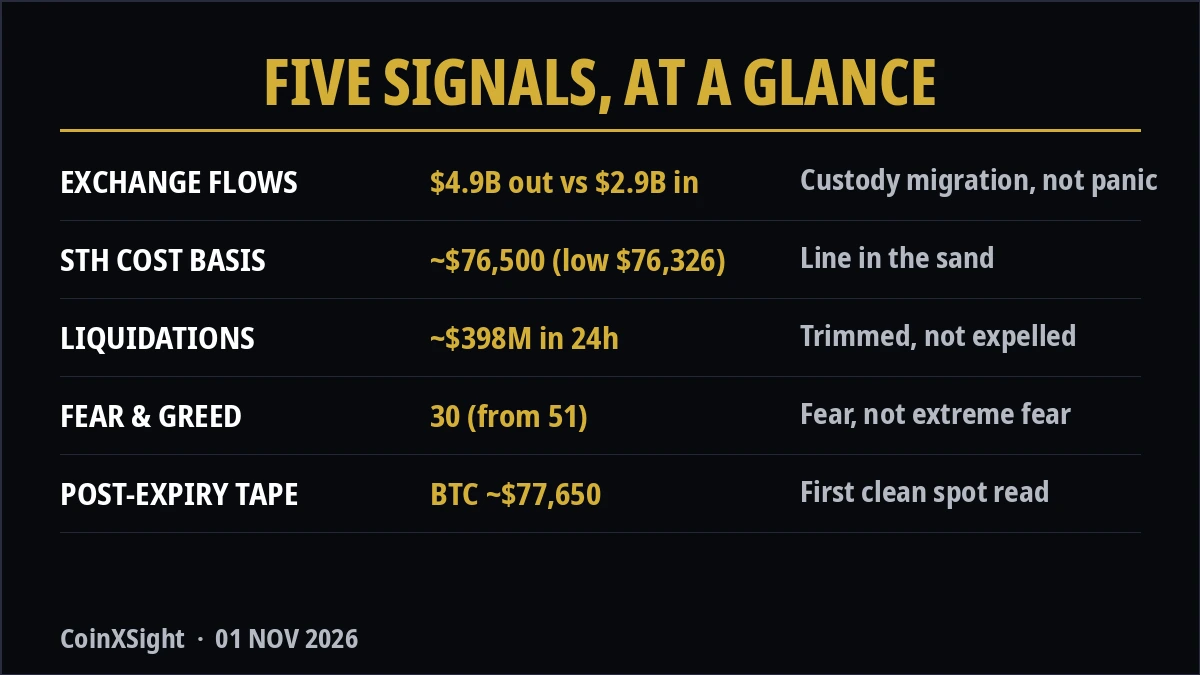
The most important number in crypto this weekend is not a price. It is a direction: on the worst day of the week, exchanges recorded roughly $4.9 billion of withdrawals against $2.9 billion of deposits. Coins were leaving platforms at a pace not seen in months — and they were leaving because holders, not traders, decided to move them.
That flow is the first of five on-chain and structural signals that define this market on Sunday morning, November 1. Each one, read properly, says something price alone does not. Together they say the correction that took Bitcoin from $80,048 on Monday to about $77,650 today is, so far, a repricing — not a capitulation. Here is the dashboard, indicator by indicator, with the numbers that are actually verified and the traps each one sets.
1. Exchange netflows: the holders moved first
Thursday’s $4.9 billion of exchange withdrawals, set against $2.9 billion of deposits, is the single most informative print of the week. Context decides its meaning. Outflows after an exchange security incident can mean panic selling, but coins that leave an exchange are not sold — they are relocated. The deposit side, still $2.9 billion, is where the actual selling pressure showed up, and it was smaller than the migration by a wide margin.
Read it as a sentiment gauge with a split personality: trust in centralized custody took a hit, while conviction in the asset did not show the same damage. That distinction is exactly why self-custody flows deserve more attention than headline panic this week. The trap is treating “outflows” as automatically bullish or bearish. Outflows to cold storage are a supply-side tightening. Outflows to another exchange are just moving the risk. The direction of travel matters, and the custody migration reading is the one the rest of the week’s data supports.
2. Short-term holder cost basis: $76,500 is the line in the sand
Short-term holders — coins last moved within roughly the past five months — carry an aggregate cost basis near $76,500. That level is where the marginal buyer of this cycle starts losing money, and markets treat it accordingly: above it, recent buyers are in profit and tend to hold; below it, they become the sellers, because every bounce back to breakeven is an exit opportunity.
Bitcoin’s Saturday low near $76,326 dipped just under that line and recovered. Beneath it sits a second shelf, $76,264–76,478, where September’s low meets the 200-day moving average. A market that defends a cost basis prints resilience; a market that closes the week below it prints a regime change. This is the indicator to watch on the weekly close tonight, not the intraday wick.
3. Liquidations: $398 million, and the leverage is not gone
Roughly $398 million in liquidations hit in the 24 hours to Saturday, on top of Thursday’s flush. The figure is large, but the more important observation is what did not happen: perpetual open interest did not collapse, and funding did not reset to deeply negative panic levels. Leverage was trimmed, not expelled.
That is a mixed signal, and honest reading demands saying so. Partial deleveraging leaves a market that can still cascade if the next macro print surprises — Friday’s payrolls report is the obvious candidate — while also leaving a market that has already absorbed a $6.3 billion exchange breach without a disorderly unwind. The trap here is the reflex to call every liquidation spike a bottom. Liquidations mark pain, not value. The value question is answered by indicators one and two, not this one.
4. Sentiment: fear at 30, and what fear is actually good for
The Crypto Fear & Greed Index printed 30 on October 31, down from a neutral 51 at the start of the week. Contrarian instinct says fear is a buy signal. The data says something more careful: 30 is fear, not extreme fear. Markets have bottomed at readings like this, but they have also ground lower from them for weeks. Fear at 30 is a permission slip to start scaling in with discipline. It is not a green light to go all in.
What fear does reliably signal is positioning. When retail sentiment is bearish while on-chain flows show holders migrating to custody rather than selling, the two gauges disagree — and in crypto’s history, the on-chain gauge has usually been the one telling the truth. Watch whether fear deepens toward the 20s this week. If it does while the cost-basis line holds, the contrarian case gets materially stronger.
5. The derivatives anchor: what expiry left behind
Friday’s Deribit expiry — roughly $10.48 billion of Bitcoin options notional with a max pain of $78,000 — pinned price through settlement and then released it. The post-expiry tape matters because it is the first clean read of spot demand without the gravitational pull of a giant expiry: Saturday’s session traded green on thin books, with Bitcoin holding near $77,650 and XRP near $1.255.
The next structural question is whether the $79,500–80,500 reclaim zone gets tested before Friday’s payrolls report. A move into that zone on spot volume, not derivatives squeezes, would be the first evidence that the week’s repricing has found its floor. A rejection from below it, with the cost-basis line failing on the weekly close, would confirm the opposite: that the correction has a second leg, and that the December hike pricing — near 84.6% after Thursday’s data — is doing the driving.
Indicator
Reading (as of 1 Nov morning VN)
Signal
Exchange flows (Thu)
~$4.9B out vs ~$2.9B in
Custody migration > panic selling
STH cost basis
~$76,500 (Sat low ~$76,326, recovered)
Line in the sand; weekly close decides
Liquidations (24h Sat)
~$398M
Leverage trimmed, not expelled
Fear & Greed
30 (from 51)
Fear, not extreme fear — scale, don’t chase
Post-expiry tape
BTC ~$77,650, XRP ~$1.255; reclaim zone $79,500–80,500
First clean spot read; reclaim or second leg
How to use this dashboard this week
Three decisions, in order. First, the weekly close: does Bitcoin hold $76,500? Second, the Binance sequence: do withdrawals actually restart in today’s targeted window, and does Monday’s proof of reserves close the confidence loop or leave it open until the verifiable proof expected Tuesday? Third, Friday’s payrolls at 20:30 Vietnam time — the print that either validates the December hike pricing or gives this market its first real reason to reprice the other way.
Price tells you what happened. On-chain tells you who did it, and whether they are coming back. This week, the people who moved first were the holders — and they moved their coins somewhere safer, not to an exit.
Disclaimer: This article is for informational purposes only and does not constitute financial advice. Figures are cited from official releases and market data as reported at the time of writing and are subject to revision. Cryptocurrency markets are volatile; always do your own research before making investment decisions.
Follow the dashboard: CoinXSight updates the on-chain picture with every major print — follow the Onchain desk so the weekly close, the Binance sequence, and Friday’s payrolls are in your feed before they move price.
CX
CoinXSight Alpha Desk
ALPHA // DESK
Quantitative Research Desk·Global Alpha Division
CoinXSight Institutional Research Desk produces quantitative crypto market intelligence, algorithmic models, and on-chain forensics.
QUANTITATIVE SUITE // DEEP ALPHA ENGINEACTIVE
BTC/USDT // LIVE SCANNER
CONFLUENCE 74
LIVE SPOT PRICE$82,807.47WEAK_BUY
TP2
$89,522.75
+9.07%
TP1
$85,056.42
+3.63%
ENTRY
$82,078.86
ZONE
SL
$80,590.09
-1.81%
Auto-detect Order Blocks, Fair Value Gaps and risk-adjusted DCA ladders in < 5s.