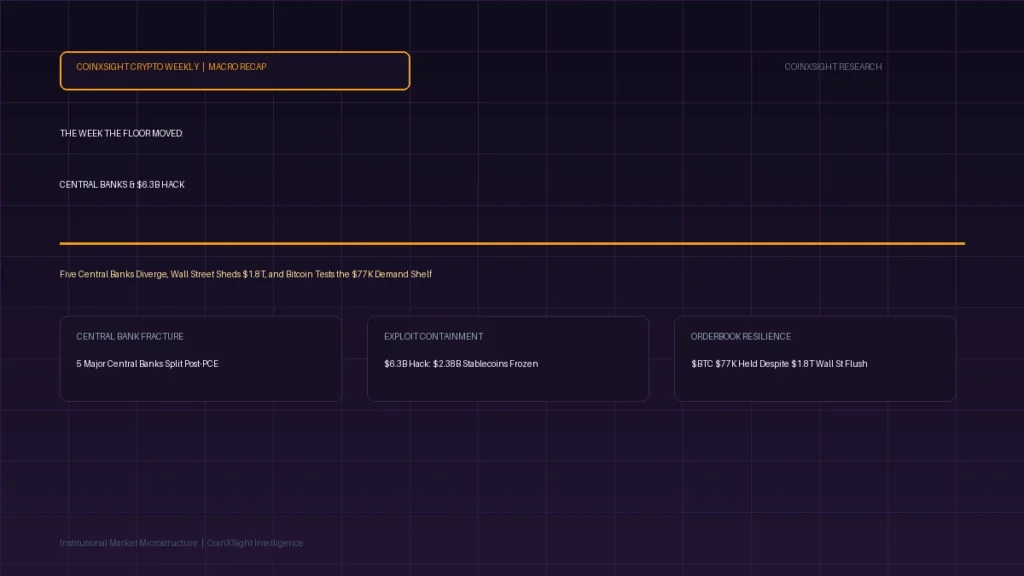
The Week the Floor Moved: Five Central Banks, a $6.3B Hack, and Bitcoin Below $80K
Crypto Weekly: five central banks refused to ease, in-line data still broke Bitcoin below $80K, and Binance confirmed a $6.3B breach. The week taken apart u2014 plus the post-DST calendar that decides November, starting with Friday's payrolls.
CX
CoinXSight Alpha DeskQuantitative Research Desk·Nov 1, 2026
Bitcoin opened last Monday at $80,048. It goes into November changing hands near $77,650, and the distance between those two numbers is the least interesting part of the week. What changed underneath the price is the question the next month will be priced on: in five days, five central banks told the market that the easing era is not coming back on schedule, the strongest US growth print of the year landed next to inflation that refuses to cool, and the largest exchange in the world confirmed a security breach with an estimated $6.3 billion price tag. Any one of those is a headline. Together, they moved the floor.
This is the week, taken apart piece by piece — and then the week ahead, which is not a cooldown. It is a second exam.
The tape: a slow leak, then a trapdoor
The week’s shape matters more than its net move. Bitcoin spent Monday through Wednesday grinding in the low $80,000s, with XRP riding the Ripple Swell conference up to the $1.33 area and sentiment, measured by the Fear & Greed Index, sitting at a neutral 51. Nothing about that tape said collapse. It said balance — a market waiting for the Federal Reserve.
Thursday removed the floor. Bitcoin closed October 29 at $77,777, down 4.2% in a day; XRP closed the same session at $1.23, down 6.8%, surrendering the entire Swell premium in one move. The median top-50 coin fell 6.8%. Liquidations kept running through the weekend — roughly $398 million in the 24 hours to Saturday alone — and sentiment printed 30, deep in fear, on October 31. XRP ended October down 15.7% for the month, a statistic worth holding onto whenever the seasonal November averages get quoted this week: the average November in XRP’s history is spectacular, the median November is negative, and the token just demonstrated which of those two numbers tends to show up.
There was no single villain. There were three, arriving in sequence — and separating them is the only way to read what comes next.
Five central banks, one direction
Start with the policy block, because it repriced everything else. Between Tuesday and Friday, five major central banks met. Not one of them cut. Two of them tightened or threatened to, and the global calendar now converges on a second decision window in December that this market is not positioned for.
Central bank
Decision
Vote / detail
The signal
Federal Reserve
Hold, 3.75–4.00%
10–2; Cook and Hammack dissented for a hike
Growth upgraded to a “strong pace”; December described as live
Bank of Canada
Hike +25bp, to 2.50%
First hike in roughly a year
2027 inflation forecast raised to 3.1%
Reserve Bank of NZ
Surprise hold, 2.75%
4–3; market had priced 95–100% for a hike
All seven members agreed further tightening may be needed
European Central Bank
Hold, 2.50%
Unanimous; a hike was discussed
Lagarde signaled December direction is “quite clear” — and announced she will step down, effective 7 Feb 2027
Bank of Japan
Hold, 1.25%
8–1; Takata dissented for 1.50%
Underlying CPI called “consistent with the 2% target” for the first time since 2013; December hike priced near 80%
Read that table as one sentence: the world’s monetary authorities looked at 3%-plus inflation and strong growth, and collectively decided the risk is doing too little, not too much. The Fed’s statement is the anchor. A hold was expected — what was not fully expected was the composition of the dissent. Two officials wanted to raise rates, at a meeting where the debate a month ago was about how fast to cut. When the dissent flips direction, the dot plot’s center of gravity has moved, whatever the official language says.
And the calendar compounds it. The Fed meets again on December 8–9. The Bank of Canada and the RBNZ both decide on December 9. The ECB follows on December 17, and the Bank of Japan’s December meeting carries roughly 80% priced odds of the hike Takata already wanted this week. Five decisions, ten days, one direction of travel. Crypto does not need any of them to hike to feel the pressure — it only needs the pricing, which has already moved: December hike odds on the CME’s FedWatch tool sat near 84.6% after Thursday’s data.
The data said “fine.” The market heard “trapped.”
Thursday’s US releases were, on any normal week, good news. Third-quarter GDP grew at a 3.4% annualized pace, beating the roughly 3.2% consensus. September core PCE — the Fed’s preferred inflation gauge — rose 0.3% on the month and 3.1% year over year, exactly on consensus. Friday’s employment cost index added 0.8% for the third quarter, again exactly on consensus, cooling from 0.9%.
Good growth, inflation as expected. And Bitcoin lost $80,000 anyway. Why?
Because “as expected” is precisely the problem. Core PCE at 3.1% is not a path to 2% — it is a plateau above target, and it arrived with growth strong enough to remove the Fed’s excuse to look through it. A weak GDP print would have reopened the cutting conversation. A hot core print would at least have been an argument. An in-line print, stapled to a beat on growth, is the one combination that leaves the hawkish hold fully intact and December fully live. Buried in the same release was the quiet number: the personal savings rate fell to 3.8%, the lowest since 2022. The consumer funding this expansion is doing it with a thinner cushion every quarter — strength, but strength with an expiry date.
Friday’s options expiry added mechanical weight. Roughly $10.48 billion of Bitcoin options notional expired on Deribit with a max pain of $78,000, and price spent the settlement window pinned near it. Max pain is not a magnet with magical properties, but into a thin, fearful tape it does not need to be magic. It just needs to be heavy.
Binance: the shock that was not macro
Layered on top of the policy repricing came the week’s idiosyncratic blow. On Thursday evening, Binance — the largest crypto exchange in the world — was hit. The exchange has since confirmed an estimated $6.3 billion in damage, with roughly $3 billion frozen on-chain, an initial finding pointing to a compromised DevOps laptop, and no evidence so far of private keys being exposed. Losses, Binance says, are covered by its SAFU fund and company funds. Deposits normalized by Friday morning; withdrawals remain suspended pending a security upgrade, with a phased restart targeted within roughly 34 hours of the co-CEOs’ October 30 letter — a window that points at Sunday afternoon, Vietnam time — and proof-of-reserves results due Monday.
Two disciplines matter here. First, the flows: on the worst day, exchanges recorded roughly $4.9 billion of withdrawals against $2.9 billion of deposits. That is fear moving money, and it is rational fear — this is exactly the scenario self-custody exists for. Second, the honesty discipline: a causal chain from the Binance breach to Bitcoin’s Thursday close has not been proven, and this publication will not print one as if it had. The timeline overlaps; the macro repricing was already underway before the breach became public. Both things can be true. An investor who blames the hack for the whole move will be unprepared if December pricing does the next leg on its own.
The other side of the ledger
It would be easy to read this week as uniform deterioration. It was not, and the distinction matters for position sizing into November.
Notice what did not break. The $4.9 billion that left exchanges on Thursday was not $4.9 billion of selling — deposits still brought $2.9 billion back in the other direction, and a large share of the outflow was custody migration, holders moving coins off platforms after the Binance news rather than exiting the asset. Selling pressure was real, but the bid underneath it never vanished; Bitcoin’s Saturday session, on thin weekend books, was green.
Notice, too, what kept being built while prices fell. Ripple spent the same week collecting the OCC’s final approval for its national trust bank, BNY’s custody support for XRP and RLUSD, and an expanded Robinhood partnership — the unglamorous plumbing of institutional adoption, proceeding on a schedule that does not consult the daily chart. None of that offsets a December hike. It is not supposed to. It is the reason this correction, so far, looks like a repricing of the rate path rather than a fracture of the market’s structure. Repricing can be survived on a calendar. Fractures cannot. The week produced the first, not the second — and Friday’s payrolls print will say a great deal about whether that remains true.
What actually decides November
Strip the week down and three variables carry into the new month.
The first is December. Not the Fed meeting itself — the pricing path into it. Every US print from now to December 8 is a referendum on an 84.6% hike probability, and the next one, Friday’s payrolls report, is the largest. Consensus expects roughly 75,000 jobs against September’s weak 29,000; a strong print locks the hike narrative in, a miss is the only realistic door back to a friendlier tape before year-end.
The second is $80,000 itself. The level failed twice the weekend before last, failed again after the FOMC, and the reclaim zone now sits at $79,500–80,500. Below, the line that matters is not round: short-term holders’ cost basis near $76,500, and under it the $76,264–76,478 shelf where September’s low meets the 200-day average. Saturday’s low near $76,326 already probed that shelf once. It held. Shelves that get probed repeatedly tend to stop holding.
The third is whether Binance’s Sunday-to-Monday sequence — withdrawals restarting, reserves published — closes the confidence loop or opens a second one. A clean proof of reserves on Monday removes the week’s idiosyncratic discount. A delay, or numbers that invite questions, keeps it.
The week ahead: everything moves one hour later
One practical note before the calendar: US daylight saving ended Sunday, November 1. Every American release from Monday onward lands one hour later in Vietnam than it did last week. Prints that arrived at 19:30 now arrive at 20:30; 10:00 in New York is 22:00 in Ho Chi Minh City. Any schedule still showing last week’s times is wrong.
Day (VN)
Event
Time (VN)
Why it matters
Sun 1 Nov
Binance phased withdrawal restart target
~14:30
First live test of the exchange’s timeline; verify, don’t assume
Sun 1 Nov
Ripple monthly escrow unlock, 1B XRP
—
Routine, mostly re-locked — but it lands on a fearful, thin tape
Mon 2 Nov
Binance proof-of-reserves results due
—
The document that decides whether the hack discount closes
Mon 2 Nov
ISM Manufacturing
22:00
Consensus 54.5, flat versus September
Tue 3 Nov
US midterm elections; JOLTS (Sep)
Results overnight; JOLTS 22:00
Gridlock or sweep reprices the fiscal path; JOLTS consensus ~7,225K
Wed 4 Nov
XRPL fixCleanup3_4_0 earliest activation
21:46
Technical maintenance patch only — it does not activate native lending
Wed 4 Nov
ISM Services
22:00
The larger half of the US economy, three days before payrolls
Thu 5 Nov
Bank of England decision
19:00
A sixth central bank joins the December-window chorus
Fri 6 Nov
US payrolls (Oct) + Michigan sentiment
20:30
Consensus ~75K jobs, unemployment 4.2% — the week’s main event
The honest summary of the week is uncomfortable and simple. The economy did nothing wrong. Inflation did nothing surprising. And the market still repriced, because the story it had been telling itself — that relief was coming in December — was the one thing the week’s evidence actually contradicted. Bitcoin below $80,000 with fear at 30 is not a market that has panicked. It is a market doing arithmetic. The arithmetic gets its next input on Friday.
Disclaimer: This article is for informational purposes only and does not constitute financial advice. Figures are cited from official releases and market data as reported at the time of writing and are subject to revision. Cryptocurrency markets are volatile; always do your own research before making investment decisions.
Stay ahead of the December window: CoinXSight publishes the preview before every major print and the recap the morning after — follow the Analysis desk so Friday’s payrolls setup is in your feed before the number, not after it.
CX
CoinXSight Alpha Desk
ALPHA // DESK
Quantitative Research Desk·Global Alpha Division
CoinXSight Institutional Research Desk produces quantitative crypto market intelligence, algorithmic models, and on-chain forensics.
QUANTITATIVE SUITE // DEEP ALPHA ENGINEACTIVE
BTC/USDT // LIVE SCANNER
CONFLUENCE 74
LIVE SPOT PRICE$82,807.47WEAK_BUY
TP2
$89,522.75
+9.07%
TP1
$85,056.42
+3.63%
ENTRY
$82,078.86
ZONE
SL
$80,590.09
-1.81%
Auto-detect Order Blocks, Fair Value Gaps and risk-adjusted DCA ladders in < 5s.