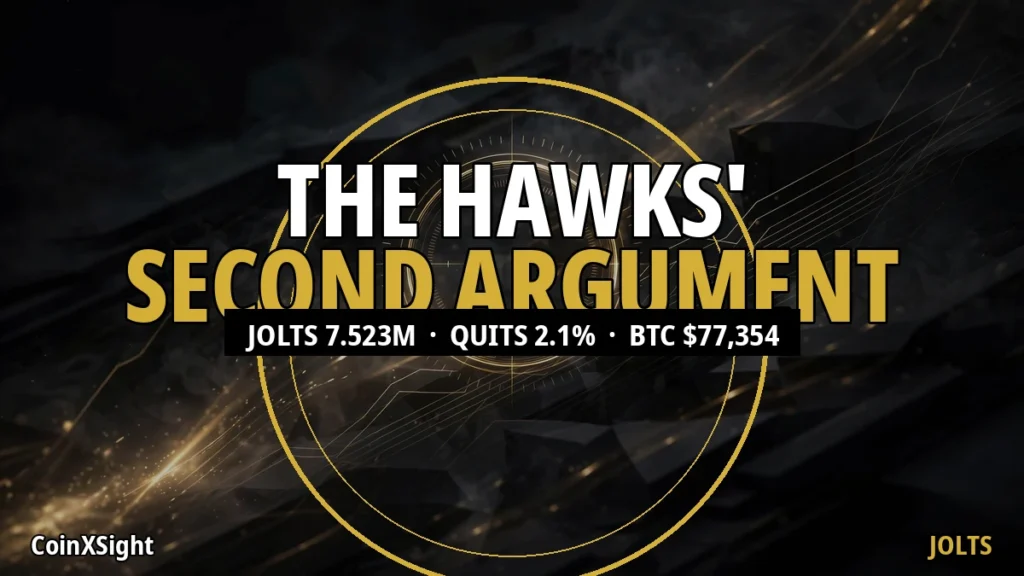
The labor market handed the hawks a second argument on Tuesday night. The vote count handed the market nothing yet — and will not, not by this article’s deadline. Bitcoin, caught between a firming jobs report and an undecided election, tested $76,500, slipped briefly through it, and climbed back above $77,000.
That is the honest summary of Wednesday morning, and the first correction to make is about the calendar. This article’s deadline, 10:30 Vietnam time, is 22:30 Eastern on election night. The last American polls do not close until 01:00 Eastern — 13:00 Vietnam time, two and a half hours after this article publishes. At publication, the Associated Press has roughly 0.5% of precincts reporting and has called none of the 35 Senate races. Control of neither chamber has been determined, and no credible decision desk has projected it. What follows is therefore not an election recap. It is a jobs report, a price line, and a count still in progress.
Start with the number that is actually final.
The labor verdict: a beat the BLS itself calls “little changed”
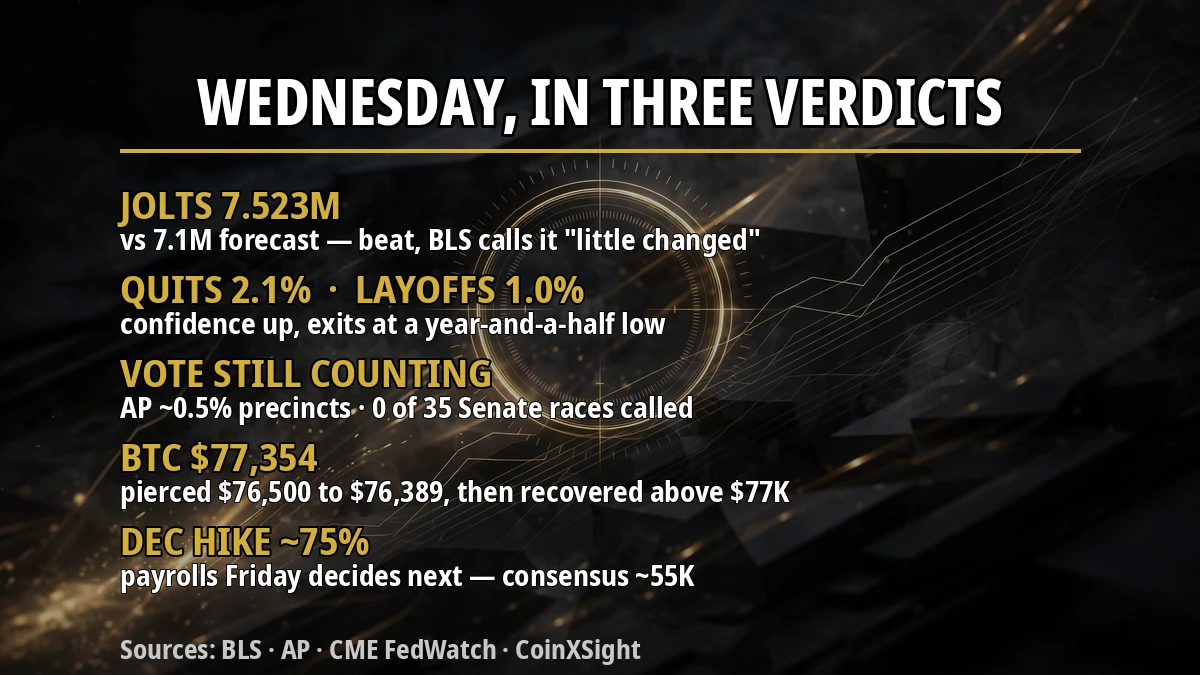
The Bureau of Labor Statistics reported 7.523 million job openings for September, up 333,000 from August’s revised 7.190 million. The openings rate rose to 4.5% from 4.3%. Economists polled by Reuters had expected 7.1 million; the Dow Jones consensus was 7.15 million. On that comparison, this is a beat — the highest openings level since May, and the third data point in a week that refuses to fit the softening story.
But the details matter more than the headline, and they cut in the same direction. Quits jumped to 3.365 million, a rate of 2.1% — the first quits rate above 2% since June 2025, and the largest number of resignations in nearly three and a half years. Workers do not quit in large numbers when they believe the next job is hard to find; a quits surge is a confidence signal, not a distress signal. Hires rose by 131,000 to 5.402 million. Layoffs and discharges fell to 1.641 million, a rate of 1.0% — the lowest in a year and a half, and below August’s upwardly revised 1.768 million. There were 1.06 openings for every unemployed person, up from 1.02.
Here is the nuance the headline writers will skip. The BLS itself, applying its statistical-significance standard, described openings as “little changed.” Both things are true at once: the move is within the survey’s noise band, and it still beat every published forecast while the internals — quits up, layoffs down, hires up — all pointed the same way. Reuters’ summary of the release was that the labor market remained “on firmer footing despite tepid employment gains,” and that is the right frame. September payrolls rose just 29,000, and the unemployment rate sat at 4.2%. Hiring is slow. But demand for workers is not collapsing, and workers are not being pushed out the door.
For the December rate debate, this is a second argument for the hawks, not a knockout. Monday’s ISM manufacturing report already showed factories running hotter than expected — headline 55.5, production at 59.0, its best since late 2021 — with prices-paid cooling to 75.2 from 77.9. Put the two together and the hawks’ case reads: growth is intact, price pressure is easing but not gone, and the labor market is firm enough that a December hike cannot be dismissed as overtightening. The doves’ reply is equally available: a 4.5% openings rate with payrolls at 29,000 is a market that is tight on paper and slow in practice, and one report does not make a trend.
Futures pricing reflects that unresolved argument. December hike odds sat around 75% on Tuesday — CME FedWatch near 74.9% for a quarter-point hike, Kalshi near 76% — down from about 85% immediately after the October 28 hold, and not drifting lower the way the early-week slide toward 71% had suggested. The JOLTS beat plus Monday’s ISM print held the odds in the mid-70s; they did not hand the doves fresh ammunition before Friday’s payrolls.
The vote, still counting: no control called, and the deadline proves it
At publication, control of the U.S. Congress has not been determined. That is not a hedge; it is the state of the count. The Associated Press shows about 0.5% of precincts reporting and zero of 35 Senate races called; independent trackers likewise show House control not yet projected. Western polls are still open. Anyone telling you the outcome of either chamber right now is selling you a forecast dressed as a result — and one low-credibility site has already published a claim of a Democratic House win that contradicts the AP data outright. Ignore it.
What we do know is the starting position and the arithmetic. Going in, Republicans held the House 218–214 with two seats vacant, and the Senate 53–47. All 435 House seats and 35 Senate seats were on the ballot — 22 of them Republican-held, 13 Democratic-held. Democrats need 17 of the 35 Senate seats to reach 51; Republicans need 19 to hold 50, which is enough with the vice president’s tie-breaking vote. Final pre-election ratings from Sabato’s Crystal Ball favored Democrats for 239 House seats and 53 Senate seats. Decision Desk HQ put Democratic control odds at 83% for the House and 62% for the Senate. Prediction markets leaned further: a Democratic sweep of both chambers traded around 71% to 72% on November 1.
Here is the part the market keeps getting wrong about its own base case. A Democratic sweep would not remove the Senate’s 60-vote hurdle for the CLARITY Act. Even a 53-seat Democratic Senate still needs seven Republican votes to move market-structure legislation to a final vote, unless the filibuster itself changes — and nothing in this election, however it lands, changes the filibuster on its own. What a sweep changes is the calendar: which bills get floor time, which committee chairs set the agenda, and how fast a compromise text can move. What gridlock changes is the opposite: a divided Congress parks crypto legislation in committee and leaves the regulatory fight to the agencies and the courts. The difference between those two worlds is real, but it is a difference in speed and venue, not in whether the 60-vote math disappears. Traders pricing a sweep as instant regulatory clarity are pricing the wrong thing.
So the trade this morning is not “who won.” It is “what does the market do while it waits.” Precedent says the wait could be long: the House took eight days to call in both 2022 and 2024, the Senate four days in 2022. The AP calls a race only when it judges the trailing candidate has no remaining path to victory, which is why tight contests can stay uncalled for days even after most votes are counted. Historically, the answer has been: not much, then a lot, then not much again. Bitcoin’s own post-midterm record — positive twelve-month returns after each of the last three midterms — is a curiosity, not a strategy; three observations across completely different market cycles do not make a rule. The cleaner read is positioning: a market that spent a week defending one price level does not need a political result to move. It needs a reason to stop defending and start choosing. The count, whenever it completes, will be that reason in one direction or the other.
Tested, pierced, recovered: what the $76,500 tape actually says
Bitcoin trades near $77,350 on Wednesday morning Vietnam time, up from a session open near $76,925. The overnight low printed near $76,389 — below the $76,500 marker this column has tracked all week, and right on top of the 200-day exponential moving average near $76,463. Then it recovered, and the recovery is the story — but read it precisely. The $76,500 level was tested and pierced intraday, to about $76,389, before price climbed back above $77,000. That is a test and a recovery, not an unbroken hold, and the distinction matters: the next test could just as easily stay pierced.
XRP trades near $1.27, up about 1.7% on the session, inside the same tight $1.20–$1.30 range it has occupied for a week. The Crypto Fear & Greed Index reads 26, down from 37 — fear, deepening, on a morning when two of the week’s three verdicts are already known. That combination — a reclaimed price level plus deepening fear — is the market’s way of saying it has not decided anything yet. Fear at 26 with price above support is not capitulation. It is a market waiting for the third verdict.
Binance: phase two opens, today’s snapshot is the next proof
The week’s second story kept moving while America voted. Binance opened the second phase of withdrawal restoration on Tuesday at 11:00 Vietnam time, covering nine networks — BNB Chain, Ethereum, Solana, XRP Ledger, Sui, Arbitrum, Optimism, Tron and Base — plus all tokenised stocks on BNB Chain, in a progressive rollout with details released as each wave opens. The first phase, completed Sunday, covered 15 networks and processed roughly $4.65 billion of withdrawals against about $1.01 billion of deposits. The second phase extends that reopening without, so far, a full published list of what comes next — and it is worth saying plainly that withdrawals are not fully restored. They are being restored, in phases, and the distinction matters for anyone with funds still queued.
Today brings the next dated milestone in the recovery: a fresh proof-of-reserves snapshot, planned for November 4, covering more tokens than the October 31 snapshot whose zero-knowledge proof Binance completed on Monday. That proof now lets holders of ten tokens — BTC, ETH, USDT, BNB, SOL, USDC, XRP, USD1, RLUSD and ZEC — verify their balances are backed at least 1:1, with bitcoin at 100.04%. The new snapshot’s own proof will take another 40 to 50 hours of computation, putting it around Friday, not today. Anyone writing that the new proof is already available is ahead of the exchange’s own schedule.
Two guardrails from the start of this story still apply. First, proof of reserves is a snapshot, not an audit: it verifies balances at a moment in time for the tokens covered, and it says nothing about the rest of the balance sheet. Second, the recovery is 95% complete by Binance’s own accounting, with the remaining 5% in less liquid tokens outside the top ten that take longer to source at scale. Issuers have frozen more than $1.1 billion in USDC and more than $1.567 billion in USDT tied to the theft, and analytics firms estimate the attackers still control roughly $3.28 billion, mostly in bitcoin and ether. The FBI has attributed the attack to North Korea’s TraderTraitor group. Verification is genuinely better than it was a week ago. It is not the same as whole.
The week’s verdicts, in one view
Verdict
Status at publication
What it said
Market read
September JOLTS
Out, 22:00 VN Tuesday
Openings 7.523M vs 7.1M Reuters forecast; quits 3.365M, first rate above 2% since June 2025; layoffs 1.641M, lowest since March 2025
Beat, not boom — BLS calls the change “little changed”; December hike odds hold near 75%; payrolls Friday decides next
Midterm results
Counting, control not determined
AP ~0.5% precincts, 0/35 Senate called; last polls close 13:00 VN, after this deadline; House took 8 days to call in 2022 and 2024
Market trades the forecast, not the result; sweep reprices the CLARITY calendar, not the 60-vote hurdle
Binance recovery
Phase two live since 11:00 VN Tue; snapshot due today
9 more networks reopened Tuesday; new snapshot November 4, proof ~Friday; 95% replenished
Verification improving, not complete; snapshot, not audit; 5% still outstanding
ISM bridge (Monday)
Already in
Headline 55.5, production 59.0, prices-paid 75.2
Growth intact, price pressure easing but unconvinced
XRPL fixCleanup3_4_0
Preview: earliest 21:46 VN tonight
33 of 35 validators (94.29%), above the 80% bar; a dip resets the 14-day clock
Technical fix only; does not activate native lending; follow-up fixCleanup3_5_0 unmerged
What comes next, in order
Tonight, two things land within fifteen minutes of each other in Vietnam time. The XRP Ledger’s fixCleanup3_4_0 amendment reaches its earliest activation window at 21:46, conditional on validator support holding above 80% — it sits at 33 of 35 tracked validators, a four-vote cushion above the minimum, after a dip to 26 of 35 on October 21 reset the clock once already. Treat it for what it is: a bundle of technical fixes, including closing a token-permission loophole, not a catalyst for native lending, which still waits on the unmerged fixCleanup3_5_0. Then, at 22:00, the ISM services report for September arrives, against a prior reading of 54.9 and a consensus near 54.7 — with September’s services prices-paid at 74.0 the number to watch, not the headline.
Thursday brings the Bank of England at 19:00 Vietnam time, where markets expect a first hike since August 2023, taking the rate to 4.00%. Friday brings the October payrolls report at 20:30, the week’s biggest slot, with consensus near 55,000. Between now and then, the midterm count will continue — the last polls close at 13:00 Vietnam time today, but control may take days — and the market will keep trading a forecast instead of a result. The $76,500 level survived its second test by recovery, not by never breaking. The third test, whatever it turns out to be, is unlikely to wait long.
For the week so far, the scoreboard reads: labor firmer than feared, price pressure cooling but not cooled, Congress undecided and uncounted, Binance verifiably better and verifiably unfinished, and Bitcoin back above a level it briefly lost. That is not a resolution. It is a market with one hard answer, one count still running, and a payrolls report on Friday that will probably matter more than either.
This article is for informational purposes only and does not constitute financial advice. Figures are cited from official releases and market data as reported at the time of writing and are subject to revision. Cryptocurrency markets are volatile; always do your own research before making investment decisions.
Disclaimer: This quantitative market analysis and macroeconomic recap is published strictly for educational and informational purposes and does not constitute financial, investment, or trading advice. Digital asset markets involve significant capital risk and volatility. Always conduct independent research and exercise disciplined risk management before making financial decisions.
CX
CoinXSight Alpha Desk
ALPHA // DESK
Quantitative Research Desk·Global Alpha Division
CoinXSight Institutional Research Desk produces quantitative crypto market intelligence, algorithmic models, and on-chain forensics.
QUANTITATIVE SUITE // DEEP ALPHA ENGINEACTIVE
BTC/USDT // LIVE SCANNER
CONFLUENCE 74
LIVE SPOT PRICE$82,807.47WEAK_BUY
TP2
$89,522.75
+9.07%
TP1
$85,056.42
+3.63%
ENTRY
$82,078.86
ZONE
SL
$80,590.09
-1.81%
Auto-detect Order Blocks, Fair Value Gaps and risk-adjusted DCA ladders in < 5s.