Learn to identify, cluster, and follow institutional crypto wallets with proven track records. A practical guide to copy-trading smart money using CoinXSight's on-chain intelligence.
DP
David ParkChief On-Chain Data Analyst·May 16, 2026 · 11 min read · Updated Oct 6
What Is Smart Money — And Why Is It Different from "Whales"?
The terms "whale" and "smart money" are often used interchangeably, but they represent fundamentally different concepts in on-chain analysis:
Whale: Any wallet holding or transacting large amounts (>$1M). A whale can be a lucky early buyer, a protocol treasury, or even an exchange hot wallet. Size alone doesn't imply skill.
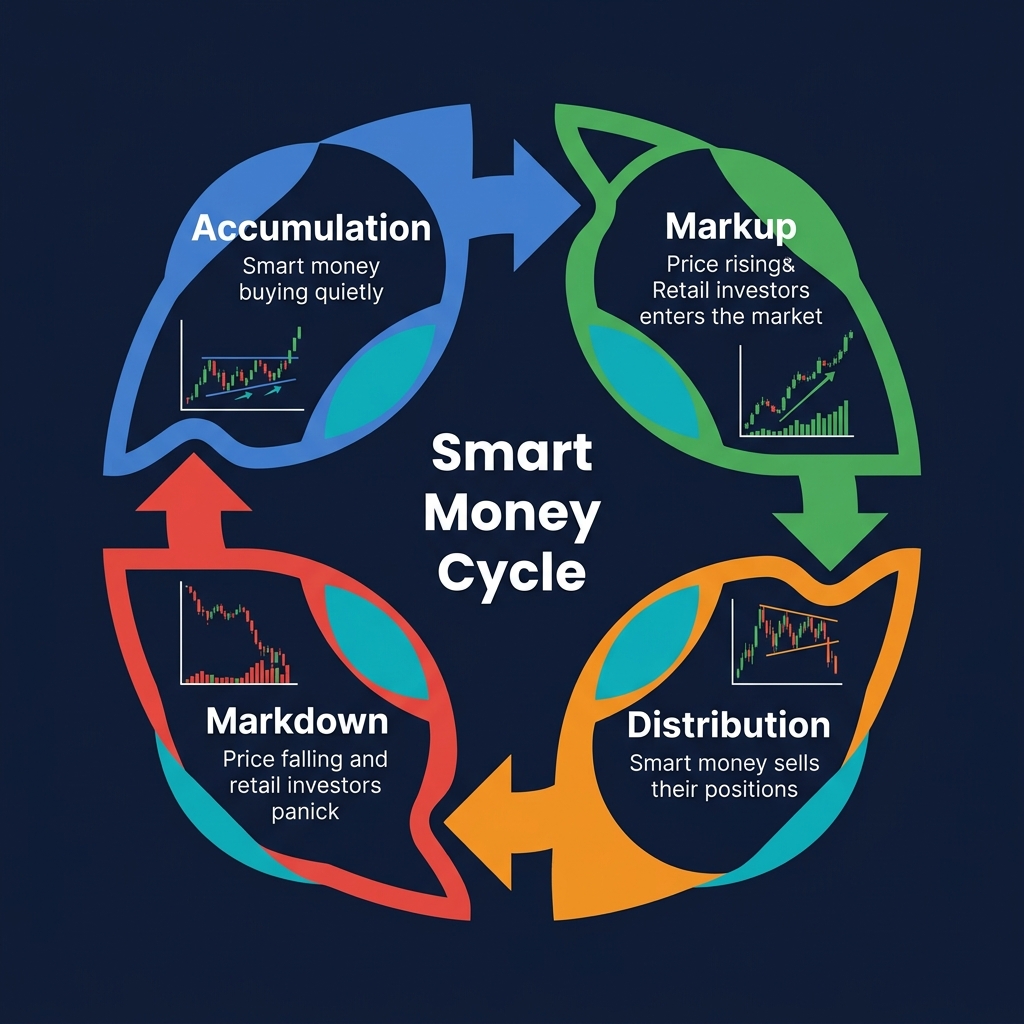
Smart money: A subset of whales whose wallets demonstrate consistently profitable transaction patterns over time. These are wallets that bought before rallies and sold before crashes — repeatedly, not just once.
The distinction matters because following a random whale who got lucky buying BTC in 2013 is very different from following a wallet cluster that has timed 12 major market moves in the past 2 years with 70%+ accuracy.
This guide focuses on the advanced skill of identifying, validating, and following genuinely smart money — not just tracking big wallets. For the basics of whale wallet identification and labeling, see the Whale Tracking Guide. For understanding aggregate exchange flows, see the Exchange Flow Analysis guide.
How to Identify "Smart" vs. "Lucky" Wallets
The Track Record Test
The only reliable way to determine if a wallet is "smart money" is to evaluate its historical performance. A wallet that has:
Accumulated before 3+ major rallies (>20% moves)
Distributed before 2+ major corrections (>15% drops)
Maintained profitability across both bull and bear markets
…is far more likely to be an informed institutional participant than a lucky retail trader.
CoinXSight's Smart Money Classification
CoinXSight's on-chain analytics classify wallets using a multi-factor scoring model:
Factor
Weight
Measurement
Historical accuracy
35%
% of accumulation events followed by 10%+ rally within 30 days
Timing precision
25%
Average days between wallet activity and subsequent price move
Consistency
20%
Standard deviation of returns — low variance = systematic, not lucky
Scale
10%
Total capital deployed — filters out noise from small wallets
Holding duration
10%
Average hold time — distinguishes investors from wash traders
Wallets scoring in the top 15% across these factors earn the "Smart Money" label. This is a rolling classification — wallets that degrade in accuracy lose the label over time.
Wallet Clustering: Finding the Network Behind Individual Wallets
Modern crypto analytics platforms integrate these signals with additional data layers — combining trading indicators, on-chain metrics, and AI analysis for higher-probability entries.
What Is Wallet Clustering?
Institutional players rarely use a single wallet. They distribute holdings across 5-50 addresses for security, privacy, and position management. Wallet clustering is the process of identifying which wallets likely belong to the same entity.
How Clustering Works
Clusters are identified through on-chain behavioral analysis:
Timing correlation: If wallets A, B, and C consistently transact within 10 minutes of each other over multiple events, they are likely controlled by the same entity or coordinated group.
Funding patterns: Wallets that receive initial funding from the same source address are likely related. If all 5 wallets were originally funded from the same Coinbase withdrawal, they belong to the same user.
Position consistency: Wallets that hold the same token distribution (e.g., 40% BTC, 30% ETH, 15% SOL, 15% stables) suggest a unified portfolio strategy managed by one decision-maker.
Token overlap: If multiple wallets participate in the same obscure token airdrop or governance vote, the overlap is too specific to be coincidental.
Why Clustering Matters for Copy-Trading
A single wallet buying $2M of ETH is a data point. A cluster of 8 related wallets collectively buying $16M of ETH over 5 days is a thesis. Clustered activity reveals the true scale of institutional conviction that individual wallet tracking misses.
CoinXSight's On-Chain module aggregates cluster-level activity, surfacing the aggregate net flow of identified wallet groups rather than just individual transactions. This prevents the common mistake of seeing a $2M buy as minor while missing that it's part of a $16M coordinated accumulation program.
The Copy-Trading Framework
Copy-trading smart money wallets isn't about blindly replicating every transaction — it's about using their positioning as a high-quality directional signal within your own trading system.
Step 1: Identify High-Quality Wallets to Follow
Selection criteria:
Smart money label active (top 15% by CoinXSight's scoring model)
Historical accuracy >65% over the past 12 months
Active in the past 30 days (dormant wallets provide no current intelligence)
Wallet type: Early Adopter, VC Fund, or institutional custody (avoid market makers and exchange wallets)
Step 2: Monitor Their Activity Patterns
Focus on directional shifts — when a wallet that has been passive for weeks suddenly makes a large move, that's a signal. Routine transactions (gas fees, small trades, governance votes) are noise.
Key activity to track:
New token accumulation (buying a token the wallet hasn't held before)
Position increases (adding to an existing holding significantly — >20% increase)
Position exits (moving to exchange or swapping to stablecoins)
Chain migration (bridging from Ethereum to Solana, for example)
Step 3: Validate Before Following
Never enter a trade based solely on smart money activity. Use their positioning as confirmation within a complete analysis:
4. If multiple confirmations → reduce or close position
Step 4: Position Sizing for Copy Trades
Copy trades should use smaller position sizes than your primary strategy signals because:
You're following someone else's thesis, which you may not fully understand
Smart money wallets have different risk tolerance and time horizons than you
Their entry price is likely different from yours (they may have started accumulating days ago)
Rule of thumb: Copy trade positions at 50-75% of your standard position size. If your normal trade is 2% of portfolio risk, use 1-1.5% for copy trades.
Real-World Scenario: Tracking a Smart Money Cluster on ETH
Scenario — ETH, March 2026:
Between March 1-10, 2026, ETH traded in a tight range between $3,100 and $3,300. Standard technical analysis showed no clear setup — RSI at 48, MACD flat, Confluence Score 5/10.
What CoinXSight's smart money intelligence revealed:
Three wallets labeled as "Early Adopter" addresses — wallets that had historically been accurate in timing ETH moves — began a coordinated accumulation pattern:
Date
Wallet
Action
Amount
Exchange
March 2
Early Adopter #A
Withdraw
$4.2M ETH
Binance → Cold
March 4
Early Adopter #B
Withdraw
$3.8M ETH
Coinbase → Cold
March 6
Early Adopter #A
Withdraw
$5.1M ETH
OKX → Cold
March 8
Institutional #C
Withdraw
$8.7M ETH
Coinbase → Multi-sig
March 10
Early Adopter #B
Withdraw
$6.2M ETH
Binance → Cold
Cluster analysis: Wallets #A and #B had behavioral correlation (timing within 48 hours), suggesting coordination or shared intelligence. Wallet #C was an independent institutional actor — confirming the thesis from a separate information source.
Total smart money accumulation: $28M over 8 days, all exchange-to-cold-wallet (no selling).
Technical picture at this point: Still nothing — flat consolidation, no breakout.
What happened: On March 14, ETH broke above $3,300 with 2.5x average volume and rallied to $3,850 over 12 days — a 16.7% move. The smart money accumulation preceded the price move by 4-10 days.
Key learning: The smart money gave a 4-10 day lead time. A trader who saw the pattern on March 6-8 and set alerts for a technical breakout above $3,300 would have been perfectly positioned when the move occurred.
Smart Money for Meme Tokens — Higher Reward, Higher Risk
Meme token smart money tracking is fundamentally different from large-cap tracking:
The Concentration Problem
In large-cap crypto, smart money represents a small percentage of total supply — a $20M whale position in BTC (0.002% of market cap) doesn't create supply concentration risk. In meme coins, a $500K position might represent 5-10% of total supply, creating extreme concentration risk.
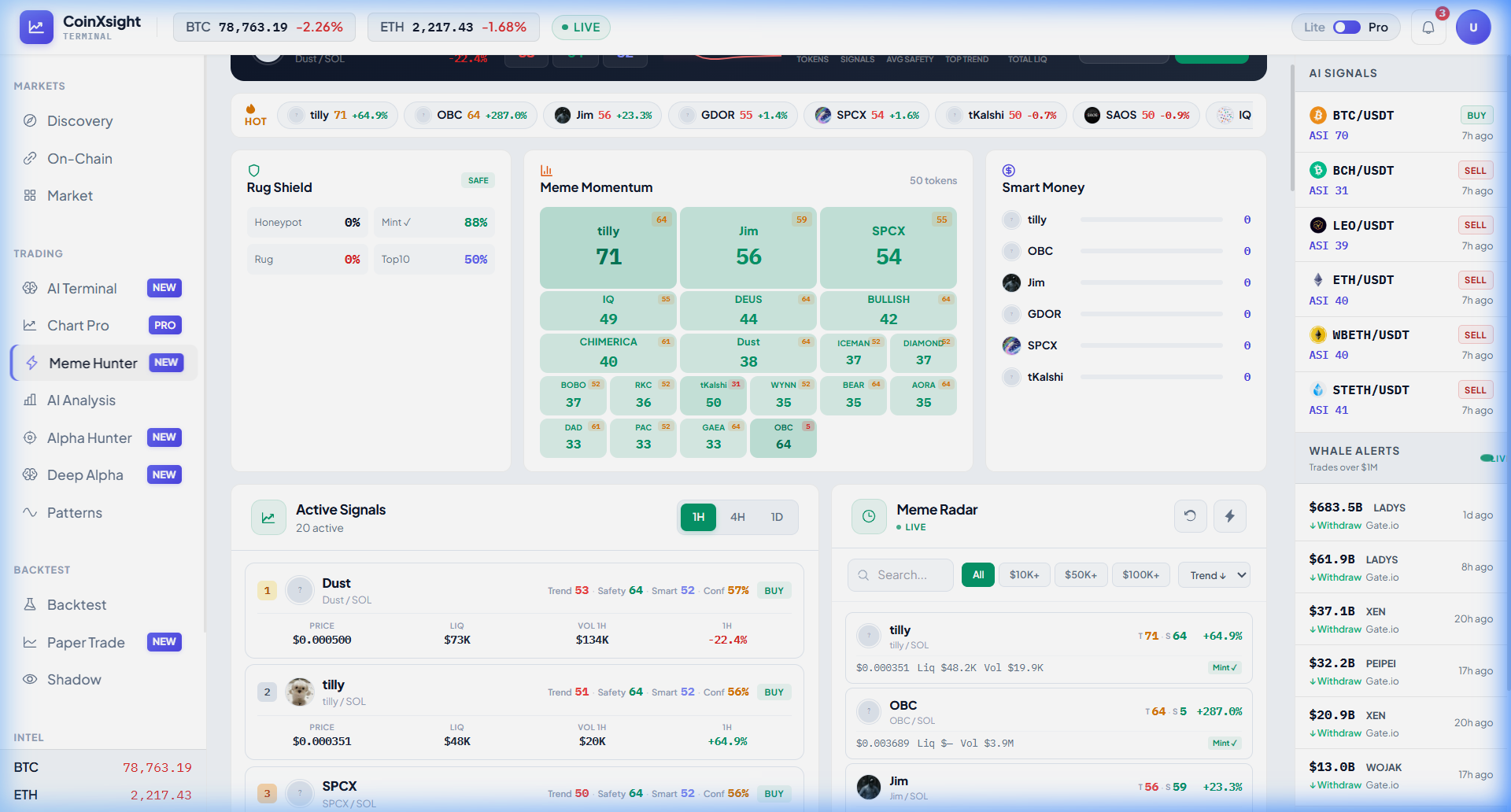
CoinXSight's Meme Hunter module addresses this with:
Safety Score (0-10): Incorporates wallet concentration, dev wallet activity, and LP lock status. A Safety Score below 5 means concentrated ownership — smart money "accumulation" may actually be a coordinated pump before dump.
Smart Money Panel: Shows which wallets with proven profitable track records are buying specific meme tokens, with their historical accuracy rate on meme trades specifically (not just large-cap performance).
Meme Token Copy-Trading Rules
Safety Score must be 6+ before following any smart money signal
Multiple smart money wallets required — a single wallet buying isn't sufficient for meme tokens (too easily manipulated)
Position size: maximum 0.5% of portfolio for meme copy trades (half your already-reduced copy trade size)
Time limit: 48 hours — if the expected move doesn't materialize within 48 hours, close regardless
Integrating Smart Money Flow into Your Trading System
Smart money flow is not a standalone strategy — it's a signal layer that enhances your existing system. Here's how it integrates with CoinXSight's other modules:
🔴 Low — everyone (including smart money) is reacting to the same event
Meme coin launches
🟢 High — but only with Safety Score >6
Common Smart Money Flow Mistakes
Assuming all whale activity = smart money. Most large wallets are not "smart" — they're exchanges, market makers, or lucky early buyers. Validate track records before following any wallet.
Ignoring time lag. Smart money accumulates over days and weeks. Expecting immediate price action after seeing a smart wallet buy is unrealistic. Build positions gradually, matching the smart money's timeline.
Oversizing copy trades. You don't have the same information, risk tolerance, or timeline as the wallet you're following. Use 50-75% of your standard position size for copy trades.
Following smart money against the macro trend. Smart money can be early — sometimes very early. If a smart wallet starts accumulating during a bear market, the thesis may take months to play out. Consider your own time horizon.
Conflating correlation with causation. Just because a smart wallet bought ETH and ETH went up doesn't mean the wallet caused the rally. The wallet may have had inside information, or it may have been coincidence. Always validate with technical and fundamental analysis.
Frequently Asked Questions
How do I know if a wallet is genuinely "smart money"?
Look for consistent profitability across multiple market cycles. CoinXSight's smart money classification requires wallets to demonstrate >65% historical accuracy, low return variance (consistency, not luck), and significant capital deployment. A wallet that was profitable in 2021 but inactive since then doesn't qualify.
How many wallets should I follow?
Focus on 5-15 high-quality wallets rather than 100 mediocre ones. Quality of the signal matters more than quantity. Following too many wallets creates noise that obscures genuine signals.
Can smart money analysis predict the next bull market?
Yes — historically, smart money accumulation during late bear markets has preceded major rallies by 2-6 months. When multiple independent smart money clusters start accumulating simultaneously during a period of retail despair, it's one of the strongest long-term bullish signals available.
How does smart money flow differ from whale tracking?
Whale tracking monitors all large wallets based on size — any wallet moving $1M+ is tracked regardless of their track record. Smart money flow filters for quality — only wallets with demonstrated historical profitability are considered. Whale tracking gives you volume; smart money flow gives you intelligence.
How does smart money flow relate to exchange flow analysis?
Exchange flow analysis tracks aggregate capital movements across all wallets — the macro picture. Smart money flow isolates the activity of proven wallets within that aggregate data — the micro intelligence. When aggregate exchange flow is neutral but smart money is strongly accumulating, that disagreement often precedes a breakout.
DP
David Park
ON-CHAIN // ALPHA
Chief On-Chain Data Analyst·On-Chain Forensics Desk
On-chain data engineer tracking entity-adjusted exchange netflows, smart money clustering, whale wallet accumulation, and liquidity cluster dynamics.
QUANTITATIVE SUITE // DEEP ALPHA ENGINEACTIVE
BTC/USDT // LIVE SCANNER
CONFLUENCE 93
LIVE SPOT PRICE$83,908.89STRONG_BUY
TP2
$89,725.68
+6.94%
TP1
$86,233.44
+2.77%
ENTRY
$83,905.28
ZONE
SL
$82,741.19
-1.39%
Auto-detect Order Blocks, Fair Value Gaps and risk-adjusted DCA ladders in < 5s.