Whale tracking is the practice of monitoring large cryptocurrency wallets — typically holding $1M+ in assets — to detect accumulation, distribution, and behavioral patterns before they impact market price. A "whale" is any entity (individual, fund, exchange, or protocol treasury) whose transactions are large enough to influence market conditions.
The premise is straightforward: whales move first, price follows. When a wallet holding 5,000 BTC begins transferring to a cold wallet, that is accumulation. When they move those tokens back to Binance, that is preparation to sell. Tracking these movements gives smaller traders an informational edge that no technical indicator can provide.
But here's the part most guides miss: not all whales are equal. A $10M transfer from a known hedge fund carries completely different implications than the same amount from an anonymous fresh wallet. The real edge in whale tracking isn't just seeing large transactions — it's knowing who is moving money and why.
Why Whale Data Is More Transparent in Crypto
In traditional stocks, institutional positioning is disclosed quarterly through SEC filings (13F). In crypto, every transaction is recorded on-chain in real-time. You do not need to wait 90 days — you can see large wallet movements within minutes.
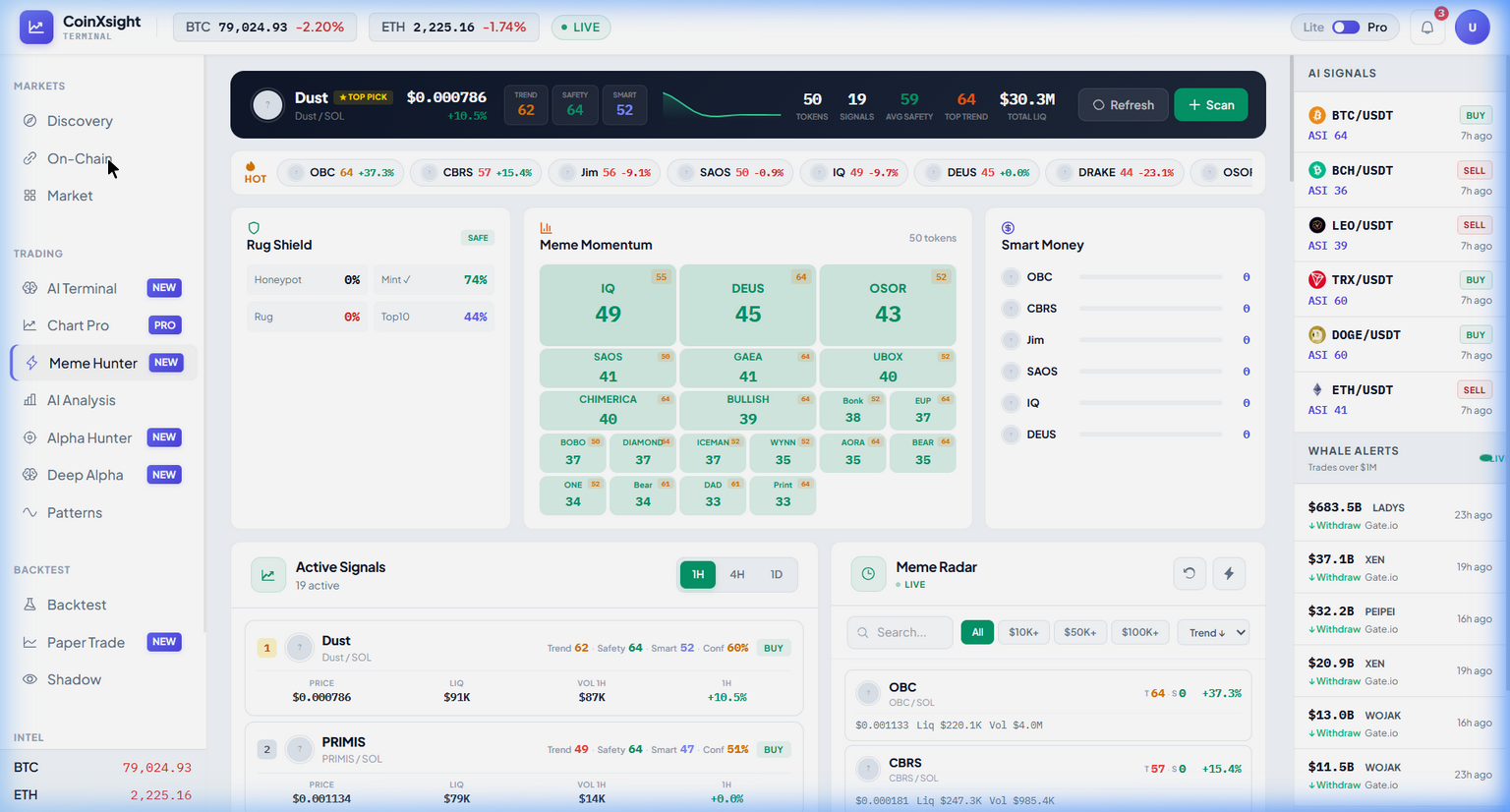
CoinXSight integrates whale tracking across four modules:
On-Chain — real-time whale transaction feed with wallet labels and routing
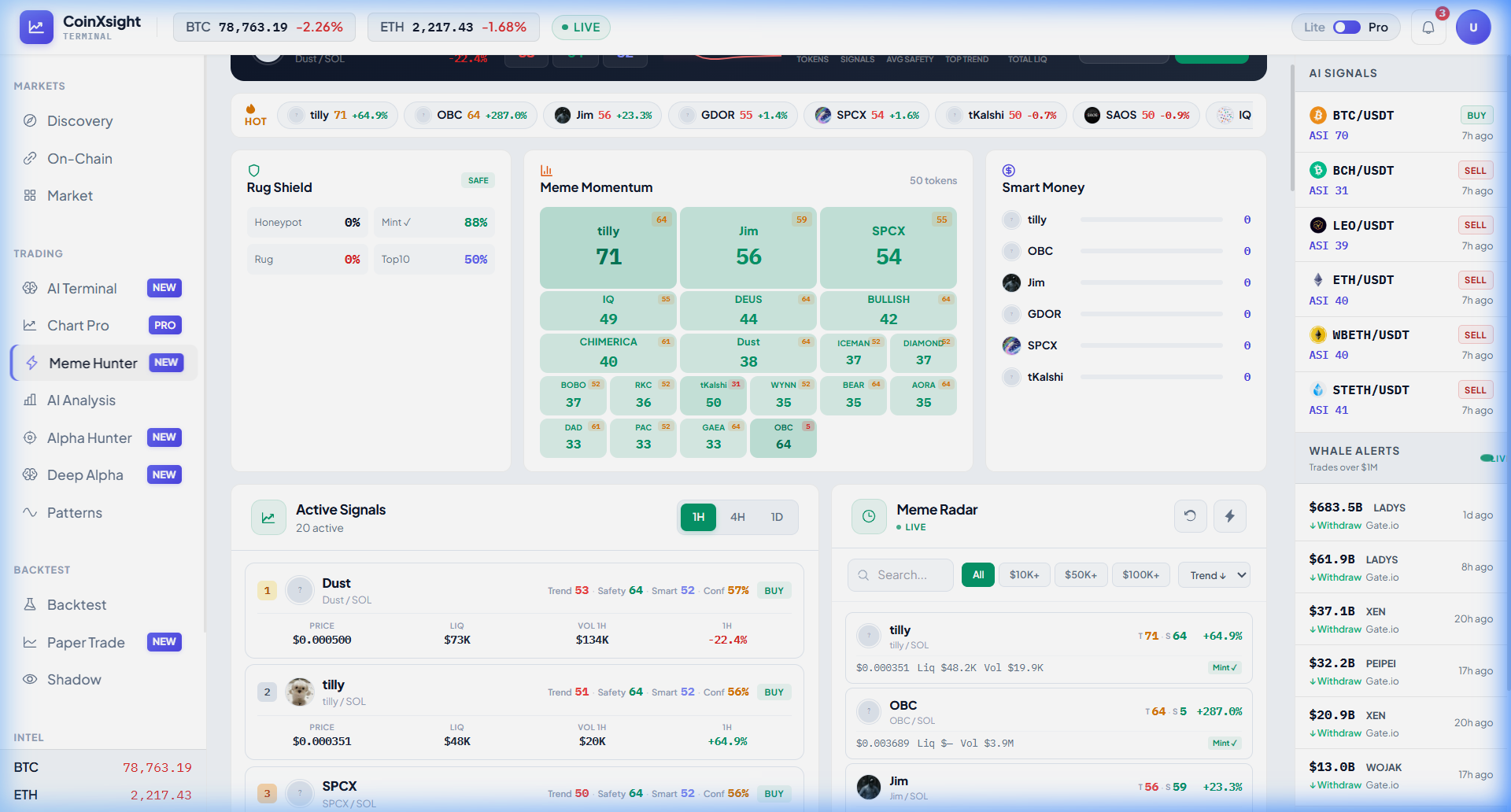
Whale Alerts sidebar — live >$1M transactions visible on every page
Deep Alpha — whale netflow integrated into the Confluence Score as a conditional bonus
Meme Hunter — smart money wallet tracking specifically for meme tokens with safety scoring
Whale Wallet Identification: Who Is Moving Money?
The most valuable skill in whale tracking isn't watching raw transaction volumes — it's identifying who is behind each wallet. A $50M transfer to Binance might be an exchange rebalancing hot wallets (zero market impact) or a major fund preparing to dump (massive sell pressure). The difference between these two scenarios is entirely about wallet identity.
Wallets linked to Grayscale, MicroStrategy, known custody providers
Infrequent large movements, typically one-directional for months
🟢 High — institutions have long time horizons
VC/Fund Wallets
Wallets that received tokens from known fundraising rounds
Lockup-aware — sell pressure after vesting cliffs
🔴 High — VC selling often signals cycle tops
Protocol Treasuries
Multi-sig wallets owned by protocol teams
Funding operations, grants, market making
🟡 Medium — selling for operations ≠ bearish thesis
Early Adopter Wallets
Wallets active since 2017-2020 with profitable history
Cycle-aware timing — buy fear, sell euphoria
🟢 Very High — historically best predictors
Market Makers
High-frequency wallets with balanced buy/sell patterns
Provide liquidity, profit from spreads
⚪ Neutral — they trade both sides
Fresh Wallets
New addresses with no transaction history
Unknown intent — could be anyone
🔴 Low — often used for wash trading or scams
CoinXSight's Wallet Labeling System
CoinXSight maintains a database of 500+ labeled whale wallets. When a transaction appears on the Whale Alerts sidebar or the On-Chain module, labeled wallets display their identity alongside the transaction details.
What you see for labeled wallets:
Entity name (e.g., "Binance Hot Wallet #3", "Known VC Fund", "Early Adopter")
Historical behavior pattern (net buyer/seller over past 90 days)
Wallet age and total value
What you see for unlabeled wallets:
Abbreviated address
Transaction amount and direction
Chain of origin
⚠️ Reality check: Approximately 40% of large transactions come from unlabeled wallets. These are inherently ambiguous — they could be institutions using fresh custody addresses, OTC desks, or individual whales. Treat unlabeled wallet activity as supporting evidence, not primary signals.
The 5 Whale Behavioral Patterns
Beyond simple "bought or sold" analysis, experienced whale trackers look for behavioral patterns that unfold over days to weeks. These patterns are more predictive than individual transactions.
Pattern 1: Systematic Accumulation
What it looks like: Multiple exchange outflows of $2-10M each, spread across 5-14 days, from the same or related wallets. Amounts are consistent (not random), suggesting a structured buying program.
Why it's bullish: Systematic accumulation indicates a planned entry strategy — the whale has done research and is executing a thesis. The gradual approach minimizes market impact, which means the buying pressure hasn't yet been fully reflected in price.
Signal strength: 🟢🟢🟢 (Strong) — Especially when occurring during a consolidation phase or slight pullback.
Pattern 2: Panic Dumping
What it looks like: A single large exchange inflow ($20M+) from a wallet that has been holding for months, often during a sharp price decline.
Why it's significant: This signals capitulation — a whale who was bullish has changed their thesis. However, capitulation often marks local bottoms because it represents the "last seller" leaving the market.
Signal strength: 🟡 (Contrarian) — Bearish in the moment, but watch for a reversal 24-72 hours later.
Pattern 3: Coordinated Distribution
What it looks like: Multiple large wallets deposit tokens to exchanges within a 24-48 hour window. The wallets may or may not be related, but the timing is clustered.
Why it's bearish: When multiple independent large holders decide to sell simultaneously, it suggests a shared assessment that the token is overvalued at current prices. This pattern often appears 3-7 days before significant corrections.
Signal strength: 🔴🔴🔴 (Very Strong) — The strongest bearish whale signal.
Pattern 4: Wallet Rotation
What it looks like: A whale transfers tokens from one private wallet to another (not to an exchange). The amount is large but the destination is another cold wallet.
Why it's neutral: Wallet rotation is a security practice — moving funds to fresh addresses for privacy or security. It has no directional implication. CoinXSight's labeling system helps identify these by tracking wallet lineage.
Signal strength: ⚪ (Neutral) — Ignore unless followed by an exchange deposit within 24 hours.
Pattern 5: Selective Accumulation During Distribution
What it looks like: The overall market shows net exchange inflows (distribution), but specific tokens show concentrated outflows from labeled "smart money" wallets.
Why it's extremely bullish: When sophisticated wallets buy a specific token while the broader market is selling, it suggests unique conviction based on information or analysis that the market hasn't priced in yet.
Signal strength: 🟢🟢🟢🟢 (Highest conviction) — This is the pattern that precedes major breakouts.
Real-World Scenario: ETH Whale Accumulation Before Rally
Scenario — ETH, March 2026:
Between March 5-12, 2026, ETH was trading sideways between $2,350-$2,420. No clear technical signal existed — RSI was neutral at 48, MACD was flat, and the Confluence Score sat at 5/10.
What CoinXSight's whale data revealed (Pattern 1: Systematic Accumulation):
On the Whale Alerts sidebar, three significant transactions appeared over 4 days:
March 6: $12.4M ETH withdrawn from Binance to an unlabeled cold wallet
March 8: $8.7M ETH withdrawn from OKX to a known fund wallet
March 10: $15.2M ETH withdrawn from Coinbase to a multi-sig wallet
Total: $36.3M in exchange outflows over 4 days, with zero corresponding large inflows. This was textbook Pattern 1 — systematic accumulation during consolidation.
On the On-Chain module:
Exchange reserves for ETH dropped by 0.4% in one week — a significant rate of decline
Whale transaction count (>$1M) was 3x the 30-day average
What happened: On March 14, ETH broke above $2,420 resistance with a strong volume candle and rallied to $2,680 over the next 10 days — a 13.8% move. The whale outflow data was the earliest signal, appearing 4 days before the technical breakout.
The multi-module confirmation path:
Whale Alerts sidebar → detected the $36.3M outflow pattern in real-time
Deep Alpha → whale netflow was "Bullish" → Confluence Score rose from 5 to 7/10 after breakout
Chart Pro → price broke resistance at $2,420 with volume confirmation
⚠️ Limitation: Not all large transactions are directional. Some are exchange rebalancing, OTC desk movements, or cross-chain bridges. A $50M transfer to Binance might be an exchange moving funds between hot and cold wallets, not a whale preparing to dump. CoinXSight's wallet labeling helps filter noise, but unlabeled wallets (~40% of large transactions) remain ambiguous.
Using Whale Data on CoinXSight — Multi-Module Workflow
Navigate to On-Chain — the primary whale intelligence module. The header shows macro exchange flow direction. Below, the Whale Transactions table lists every significant transfer with wallet labels and direction indicators.
What to focus on: Which tokens are being accumulated while the broader market is distributing? This is Pattern 5 — selective accumulation — and it produces the highest-conviction signals.
Take standout whale tokens and search them on Deep Alpha. Check whether the whale activity triggers the Whale Bonus (+0.5 on the Confluence Score). The bonus activates when net exchange outflows exceed the significance threshold for that specific token.
Once a whale-backed token shows strong confluence, find the chart entry. Load the token on Chart Pro and check if price is at a key level — EMA support, Order Block, or oversold RSI.
The ideal entry: Whale accumulation (3+ days) + price at EMA 89 support + RSI below 40 + Confluence Score 7+/10.
For meme tokens, whale tracking requires extra caution. The Meme Hunter treemap shows Safety Scores that factor in wallet concentration. A meme token with heavy whale buying but Safety Score of 2/10 means a few wallets control most supply — that "whale accumulation" may be a coordinated pump before a dump.
Rule: Only follow whale signals on meme tokens with Safety Scores above 6.
Common Whale Tracking Mistakes
Reacting to every whale alert. Not every large transaction is a trading signal. Exchange internal transfers create massive alerts with zero market impact. Focus on exchange-to-cold-wallet and cold-wallet-to-exchange movements from labeled wallets.
Treating single transactions as trends. A single whale deposit to an exchange means little in isolation. Look for patterns — 3+ large transfers over 2-3 days from different wallets is far more significant than one large transaction.
Assuming whales are always right. Whales can accumulate at $70K and watch BTC drop to $55K. The value is in the informational edge, not in blindly copying behavior. Always validate whale signals with technical analysis.
Ignoring wallet identity. A $10M transfer from a known VC fund (likely selling vested tokens) is bearish. A $10M transfer from an early adopter wallet (historically profitable timing) is bullish. The same dollar amount carries completely different implications depending on who is behind the wallet.
Confusing stablecoin flows with token flows. Large USDT deposits to exchanges can be bullish (preparing to buy crypto) or neutral (payment processing). Token deposits are more clearly directional than stablecoin deposits. For the full exchange flow framework, see Exchange Flow Analysis.
Frequently Asked Questions
What size qualifies as a whale transaction?
CoinXSight tracks transactions above $1M as whale-level. For smaller-cap tokens, even $100K-$500K movements can be significant relative to daily volume. The platform prioritizes the largest transactions and contextualizes them by token market cap.
How quickly should I act on whale signals?
Whale signals are not instant trade triggers. Accumulation patterns typically develop over 2-7 days before a price move materializes. Use whale data as a directional bias, then wait for technical confirmation before entering.
Can whale tracking work for meme coins?
Yes, but with important caveats. Meme coins have lower liquidity, so whale movements cause larger price swings. CoinXSight's Meme Hunter module specifically tracks smart money wallet activity for meme tokens with safety scoring to filter scams and concentrated ownership risks.
How does CoinXSight's whale bonus work in the Confluence Score?
When the platform detects net exchange outflows exceeding a significance threshold for the analyzed token, the Confluence Score receives a +0.5 conditional bonus (on a 10-point scale). The bonus only applies when whale flow aligns with the technical thesis.
Is whale data reliable for all tokens?
Whale tracking is most reliable for tokens with significant on-chain activity (BTC, ETH, SOL, major altcoins). For tokens traded primarily on centralized exchanges or with limited on-chain data, whale tracking may miss important activity. CoinXSight continuously expands its chain coverage and wallet database.
How does whale tracking differ from exchange flow analysis?
Whale tracking focuses on who is moving money — identifying specific wallets, their history, and behavioral patterns. Exchange flow analysis focuses on where money is going — aggregate inflows and outflows across all exchanges. They are complementary: exchange flow gives you the macro direction, whale tracking gives you the micro intelligence behind individual large transactions.
DP
David Park
ON-CHAIN // ALPHA
Chief On-Chain Data Analyst·On-Chain Forensics Desk
On-chain data engineer tracking entity-adjusted exchange netflows, smart money clustering, whale wallet accumulation, and liquidity cluster dynamics.
QUANTITATIVE SUITE // DEEP ALPHA ENGINEACTIVE
BTC/USDT // LIVE SCANNER
CONFLUENCE 93
LIVE SPOT PRICE$83,908.89STRONG_BUY
TP2
$89,725.68
+6.94%
TP1
$86,233.44
+2.77%
ENTRY
$83,905.28
ZONE
SL
$82,741.19
-1.39%
Auto-detect Order Blocks, Fair Value Gaps and risk-adjusted DCA ladders in < 5s.