Token Unlock Calendar: Trading the Supply Shock Events
Learn how to trade token unlocks in crypto. Understand cliff vs linear vesting, predict price impact, and build a strategy around scheduled supply increases.
DP
David ParkChief On-Chain Data Analyst·May 20, 2026 · 10 min read · Updated Oct 6
Token unlocks are scheduled events where previously locked tokens are released into circulation. Most crypto projects launch with only a fraction of their total supply available for trading — the rest is locked in vesting contracts for team members, early investors, ecosystem funds, and community incentives.
When these locked tokens become available, they can dramatically increase selling pressure and impact price. Understanding the unlock schedule is one of the most reliable edges in crypto trading, because unlike most market events, unlocks are predictable.
This guide teaches you how to track, analyze, and trade around token unlock events.
Types of Token Unlocks
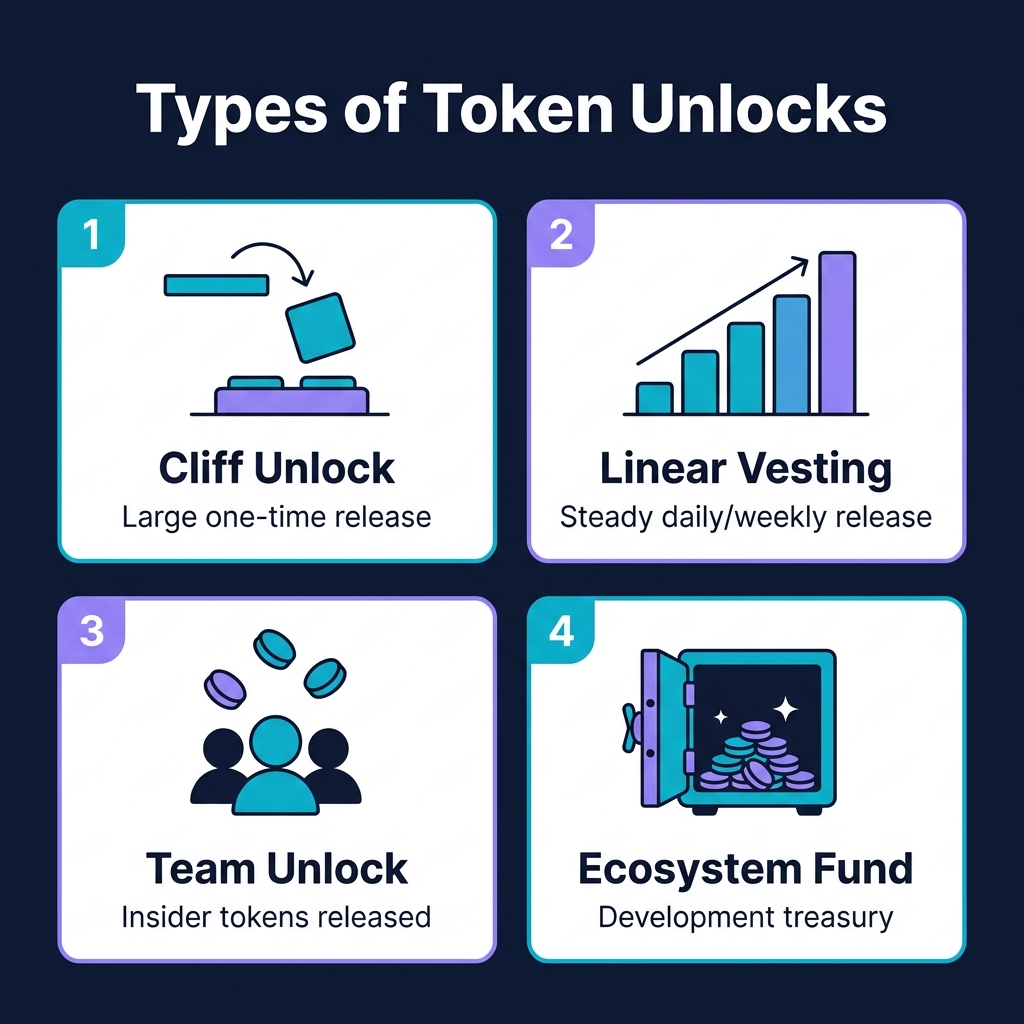
Cliff Unlock
A cliff unlock releases a large batch of tokens all at once after a set period. For example, a team's tokens might have a "12-month cliff" — meaning no tokens are released for the first year, then a large percentage (often 25-50%) unlocks on a single day.
Impact: Cliff unlocks create the highest price volatility because the supply shock is concentrated in a single event.
Example: A project with 100M circulating supply suddenly releasing 30M team tokens represents a 30% supply increase in one day.
Linear Vesting
Linear vesting releases tokens gradually over time — daily, weekly, or monthly. After an initial cliff, the remaining allocation might vest linearly over 24-48 months.
Impact: Lower per-day impact, but the constant selling pressure can create a sustained downtrend.
Watch for: The transition from cliff to linear vesting — the first large dump followed by steady daily selling creates a predictable price pattern.
Team and Advisor Unlocks
These are tokens allocated to founders, core team members, and advisors. They typically have the longest vesting periods (2-4 years) with significant cliff components.
Why they matter most: Team members are insiders who may have strong incentives to sell, especially if the token price has already appreciated significantly from launch.
Ecosystem and Community Fund Unlocks
Tokens allocated for ecosystem development, grants, liquidity mining, and community rewards. These often vest into multi-sig wallets controlled by foundations or DAOs.
Impact: Generally less bearish than team unlocks, because ecosystem funds are often deployed into productive use (grants, incentives) rather than sold on the market.
How Token Unlocks Affect Price
This is where crypto technical analysis becomes practical — a quality crypto analytics platform will display these signals in real time, helping you act on setups as they form.
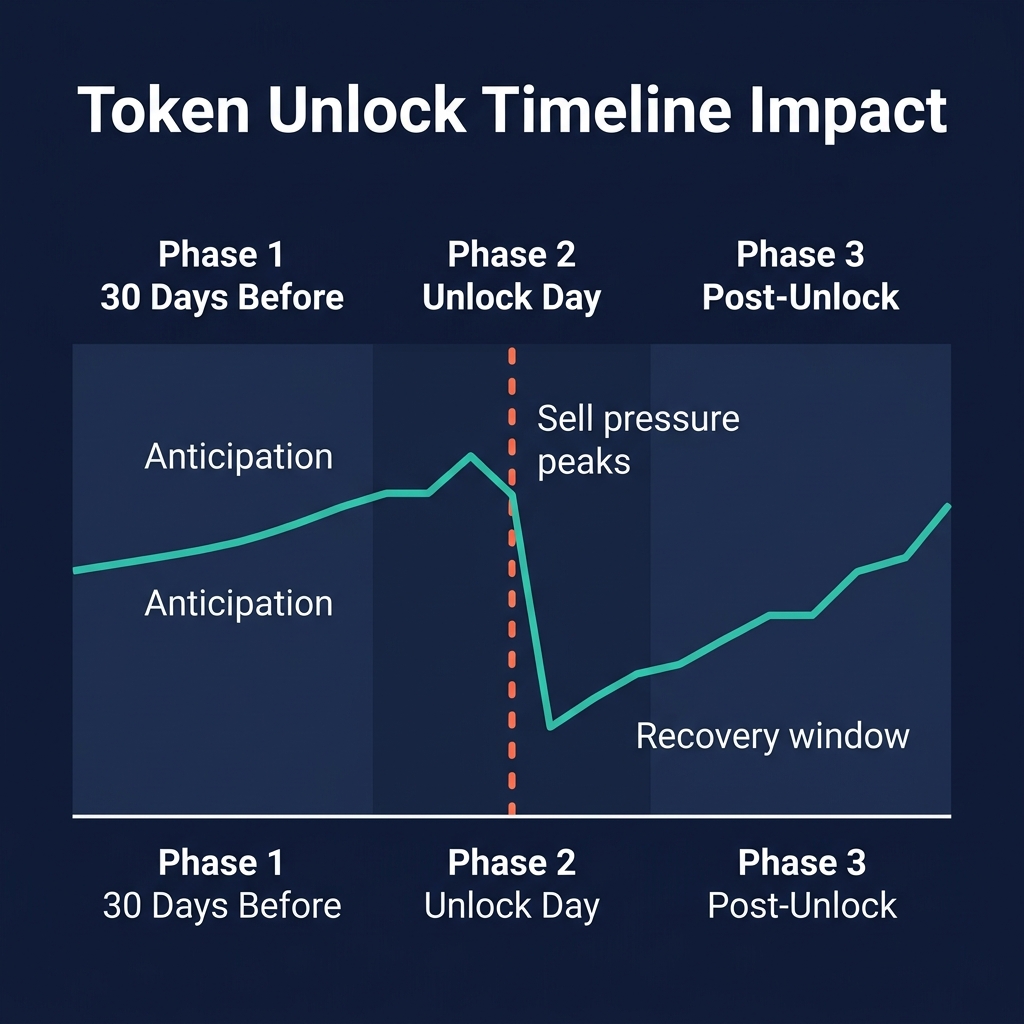
The price impact of token unlocks follows a predictable three-phase pattern:
Phase 1: Pre-Unlock Anticipation (7-30 Days Before)
Smart traders and algorithms begin positioning before the unlock. This phase typically shows:
Gradual selling pressure as informed traders front-run the event
Increased short interest on perpetual futures
Options market showing put activity increase
Price decline of 5-15% in the weeks leading up to large unlocks
The market partially prices in the unlock before it happens. This is why buying immediately after an unlock can sometimes be profitable — the "sell the rumor, buy the news" effect.
Phase 2: Unlock Day
The actual unlock day often sees:
Spike in exchange inflows as recipients transfer tokens to sell
Maximum selling pressure concentrated in the first 48-72 hours
Funding rates going negative on perpetual futures
Price drops of 10-30% for large cliff unlocks (>5% of circulating supply)
Not all recipients sell immediately. Team members and VCs may choose to hold if they believe in long-term value, or sell in smaller batches through OTC desks to minimize market impact.
Phase 3: Post-Unlock Recovery (7-30 Days After)
After the initial selling pressure subsides:
Price stabilization as weak hands finish selling
Potential recovery if the unlock was overpriced (common for ecosystem fund unlocks)
New support level established at the post-unlock price
Buying opportunity if fundamentals remain strong
The Token Unlock Trading Decision Framework
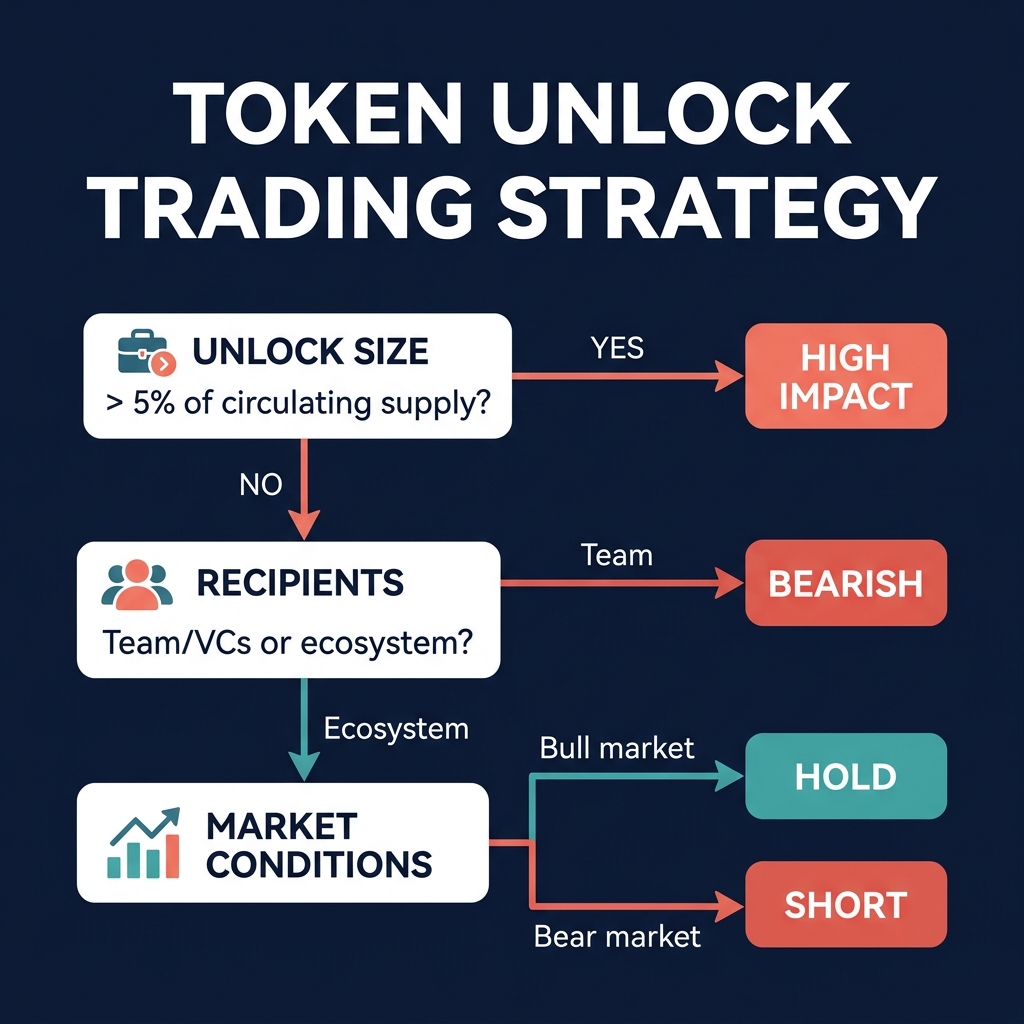
Not all unlocks are created equal. Use this decision framework to assess the likely impact:
Factor 1: Unlock Size Relative to Circulating Supply
The single most important metric. Calculate:
Unlock Ratio = Tokens Being Unlocked / Current Circulating Supply × 100
Unlock Ratio
Impact Level
Expected Price Move
< 1%
Negligible
< 2% price impact
1-3%
Low
2-5% potential decline
3-5%
Moderate
5-15% potential decline
5-10%
High
15-25% potential decline
> 10%
Severe
25%+ potential decline
Factor 2: Who Are the Recipients?
Highest selling risk:
Early-stage VCs with 10-100x gains sitting in profit
Team members who may need personal liquidity
Advisors with smaller allocations and less skin in the game
Lower selling risk:
Ecosystem development funds (usually deployed, not sold)
Community treasury (governed by DAO decisions)
Strategic partners with long-term alignment
Factor 3: Market Conditions
The same unlock event has different impacts depending on macro conditions:
Bull market: Unlocks are absorbed more easily. Selling pressure meets strong buy-side demand. Price impact is often 50% less than in bear markets.
Bear market: Unlocks amplify downward momentum. Recipients rush to sell, and weak buy-side liquidity means price drops are amplified.
Sideways market: Unlocks typically push price to the lower end of the range, sometimes triggering breakdowns.
Factor 4: Historical Selling Behavior
Track what recipients have done in previous unlock events:
Did team members sell immediately or hold?
Were tokens sent to exchanges or moved to staking?
Did OTC sales happen instead of market dumping?
On-chain analysis of previous unlock recipients' wallet behavior gives you a significant edge.
Trading Strategies Around Unlocks
Strategy 1: Pre-Unlock Short
Setup: Short 7-14 days before a large cliff unlock (>5% of supply) for team/VC tokens in a bearish or neutral market.
Entry: When price fails to break above a key resistance level in the pre-unlock window.
Target: The historical average post-unlock decline for similar-sized unlocks (typically 10-20%).
Stop-loss: Above the pre-unlock high + 5% buffer.
Risk: If the unlock is already fully priced in, the "sell the rumor, buy the news" effect can cause a post-unlock rally.
Strategy 2: Post-Unlock Buy
Setup: Buy the dip after a large unlock event when fundamentals remain strong.
Entry: Wait 48-72 hours after the unlock for selling pressure to peak. Look for:
Volume declining from unlock-day spike
RSI entering oversold territory (<30)
Exchange inflows returning to baseline
Target: Recovery to pre-unlock price levels (typically takes 14-30 days).
Stop-loss: Below the post-unlock low by 5%.
Strategy 3: Linear Vesting Trend
Setup: For tokens with ongoing linear vesting creating constant sell pressure, trade the trend.
Entry: Short on rallies toward the descending moving average while daily vesting continues.
Exit: When the vesting period ends or daily unlock amounts become insignificant relative to trading volume.
Strategy 4: Unlock Calendar Arbitrage
Setup: Track multiple tokens' unlock schedules and allocate capital to the best risk/reward setups each week.
Tools needed:
Token unlock calendar (Token Unlocks, CryptoRank)
Exchange flow monitoring to verify selling behavior
Futures open interest data to gauge how priced-in the event is
How to Track Token Unlocks
Free Resources
Token Unlocks (tokenunlocks.app): The most comprehensive unlock calendar with detailed vesting breakdowns
CryptoRank: Vesting schedule data with market cap context
Project documentation: Whitepapers and tokenomics pages contain original vesting terms
On-Chain Verification
Don't just rely on calendars — verify on-chain:
Identify the vesting contract address from the project's documentation
Track the contract's balance to confirm tokens haven't already been claimed
Monitor recipient wallets after unlock to see if tokens move to exchanges
Set alerts for large transfers from known team/VC wallets
CoinXSight Integration
CoinXSight's on-chain analysis module tracks:
Exchange inflow spikes correlated with unlock events
Whale wallet activity changes around scheduled unlocks
Smart money positioning shifts in the pre-unlock window
Real-World Examples
Case Study: High-Impact Cliff Unlock
A major L1 protocol unlocked 15% of circulating supply for early investors after a 12-month cliff:
Pre-unlock: Price declined 18% in the 14 days before
Unlock day: 40% of unlocked tokens moved to exchanges within 48 hours
Post-unlock: Price dropped an additional 22%, then recovered 60% of the drop over the next 30 days
Optimal strategy: Short pre-unlock, close at unlock + 48h, then buy the dip
Case Study: Ecosystem Fund Non-Event
A DeFi protocol unlocked 8% of supply to its ecosystem fund:
Pre-unlock: Price declined only 5%
Unlock day: Tokens moved to a multi-sig — no exchange transfers
Post-unlock: Price recovered within 3 days as market realized no selling occurred
Lesson: Always check who the recipient is, not just the size
Common Mistakes to Avoid
Mistake 1: Treating All Unlocks Equally
A 5% ecosystem fund unlock is fundamentally different from a 5% VC cliff unlock. Always analyze the recipient category before forming a thesis.
Mistake 2: Ignoring the Market Has Already Priced It In
Large, well-known unlock events are often priced in weeks before. If the token has already declined 20% ahead of the unlock, the actual event may have minimal additional impact.
Mistake 3: Not Verifying On-Chain
The calendar says tokens unlock, but that doesn't mean they'll be sold. Always verify:
Were tokens actually claimed from the vesting contract?
Were they transferred to an exchange, or moved to staking/DeFi?
Is there OTC activity suggesting private sales instead?
Mistake 4: Overleveraging
Token unlock price movements can be violent but temporary. Using high leverage on unlock plays can lead to liquidation on volatile wicks even if your directional thesis is correct.
Key Takeaways
Token unlocks are predictable supply events — one of the few edges that can be scheduled in advance
Cliff unlocks for team/VC allocations have the highest price impact
The unlock ratio (unlocked tokens / circulating supply) is the most important metric
Price impact follows a three-phase pattern: pre-unlock decline → unlock day dump → post-unlock recovery
Not all recipients sell — verify on-chain behavior rather than assuming the worst
The hybrid strategy of shorting pre-unlock and buying post-unlock captures the full cycle
Always consider market conditions — bull markets absorb unlocks far better than bear markets