Eight days. That’s all that separates crypto markets from the most consequential Federal Reserve decision of the year — and the market has already made up its mind.
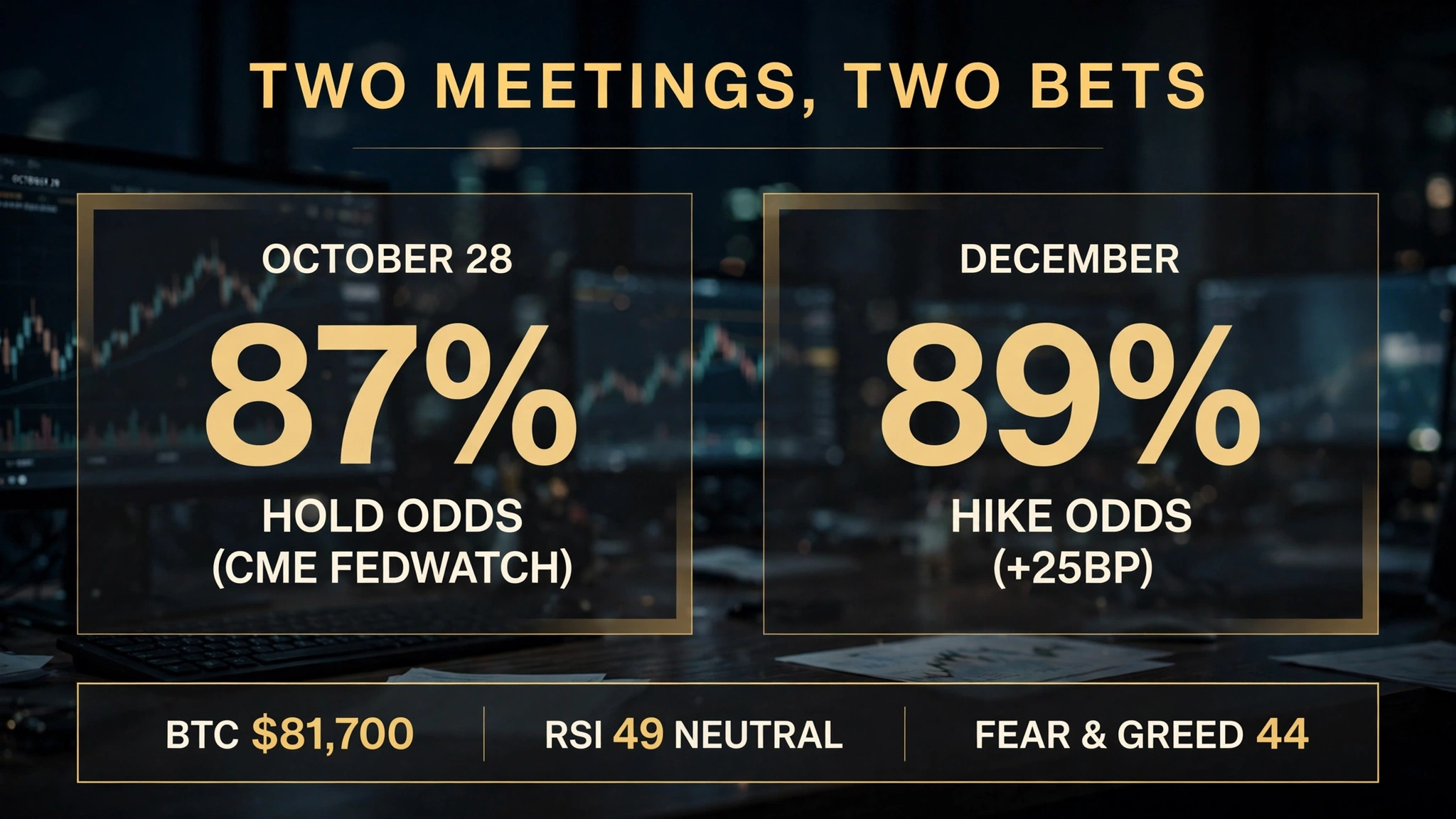
Futures tracked by CME’s FedWatch tool put roughly 87% odds on the Fed holding rates steady at its October 27–28 meeting, with only a 13% chance of a hike. Kalshi’s prediction markets agree: 83% hold. Fed funds futures: 84–85% hold. Three independent pricing mechanisms, one verdict — October is a pause.
But that’s the wrong trade to watch. The real number is December: ~89% odds of a 25-basis-point hike. The market isn’t debating whether the Fed tightens again — it’s debating when. That distinction is what decides whether Bitcoin’s $80,000 floor holds through year-end.
The wildest repricing in months
To understand how we got here, rewind six days. When September CPI printed hot — 3.7% headline, 2.6% core, both above expectations — the October hike odds didn’t just rise. They detonated. The CME tool showed hike probability doubling from 22% to 44% in a single session, with some trackers touching nearly 50%. The two-year Treasury yield jumped 15 basis points. Bank of America reaffirmed its call for an October hike. Goldman Sachs raised the probability while sticking to December as its base case.
Then the Fed talked — and the market listened.
Vice Chair Philip Jefferson and New York Fed President John Williams both signaled little urgency to move, and the odds collapsed. From nearly 50% to 13% in less than a week. Deutsche Bank strategists noted the probability falling from 30% to about 15% during the official pushback alone. New Fed Chair Kevin Warsh, for his part, kept markets guessing with a notably silent IMF fireside — no hawkish surprise, no dovish gift, just ambiguity the market chose to read as patience.
Date
Oct 28 hike odds
Oct 28 hold odds
What moved it
~Sep 20
~17-22%
~78-83%
Baseline: September hike digested
Oct 14 (post-CPI)
~44-49%
~51-56%
Hot CPI 3.7%/2.6%; BofA reaffirms hike call
Oct 16
~15%
~85%
Jefferson/Williams signal no urgency
Oct 19-20
~13%
~87%
Warsh silent; blackout begins Oct 17
Dec 9 (current)
~89%
~11%
16 of 19 officials expect another hike in 2026
The whiplash tells you something important about this Fed: the bar for an inter-meeting surprise is extremely high. It took the hottest CPI print in months to move October odds to a coin flip, and it took two speeches to walk them all the way back. With the Fed now in its October 17–29 blackout period — no official comments until after the decision — there’s nothing left on the calendar that can change the October outcome. The 87% is as close to locked as pre-meeting pricing gets.
Growth shock, not rate shock
Here’s the paradox the market has been living with for a month: the data is hot, but the rate reaction is calm. September PPI printed +1.3% month-over-month, 6.3% year-over-year — the hottest since March 2022. CPI came in above forecast. And yet 10-year Treasury yields fell after the prints, gold pushed toward all-time highs near $4,155, and October hike odds collapsed.
This is the “growth shock, not rate shock” regime we identified after the PPI print — and it has only strengthened since. The market’s read: inflation is running hot because the economy is running hot, not because policy is too loose. Services PMIs above 58, a labor market that hasn’t cracked, and corporate earnings holding up all point to an economy absorbing higher prices without breaking. In that world, the Fed can afford patience. The December hike is the market’s way of saying the tightening cycle isn’t over — it’s just not urgent.
For crypto, this distinction matters enormously. A rate shock — the 2022 playbook — means forced deleveraging and indiscriminate selling of risk assets. A growth shock means liquidity stays tighter for longer, but without the panic bid for dollars. Bitcoin holding $80,000 through two consecutive hot inflation prints is the market’s vote that we’re in the second regime. As we covered in our Crypto Weekly 42 roundup, the $80K line has now held through three separate tests — each on hotter data than the last.
Bitcoin’s technical cage
Strip away the macro narrative and the chart tells its own story of a market waiting. Bitcoin is trading around $81,700–$82,100, pinned in one of the tightest ranges of the year. The technicals read like a coiled spring that hasn’t decided which direction to release:
20-day SMA at ~$83,256 — overhead resistance, tested and rejected on October 19 when BTC touched $83,100 intraday and closed back below $82,000
50-day SMA at ~$81,485 — the floor that keeps catching every dip
14-day RSI at 49.23 — dead neutral, neither overbought nor oversold
Volume at 81% of the 30-day average — active but uncommitted
That’s a $1,800 corridor between the moving averages, and Bitcoin has been bouncing inside it for days. October 19 was the template: a push toward $83,100 that couldn’t hold into the close, price settling back under $82,000. Every rally meets supply; every dip meets demand. The market isn’t trending — it’s coiling.
The Fear & Greed Index sits at 44 (Fear), and Polymarket gives 96%+ odds that Bitcoin holds above $80,000 through today. The base case is clear: the range holds until the FOMC gives it a reason not to.
And zoom out far enough and the real context appears: Bitcoin remains ~35% below its all-time high of $126,080. This isn’t a market at the top of a cycle debating how much higher. It’s a market deep in consolidation, and the FOMC is the catalyst that decides whether consolidation resolves up or down.
What crypto actually needs from October 28
With the hold at 87%, the decision itself is the least interesting part of next week. What matters is everything around it:
The statement language. The single most important phrase will be whatever replaces or retains the “further adjustments” framing. If the statement keeps the door open for December — and with 89% priced, it almost certainly will — the market gets the worst of both worlds confirmed: no relief now, tightening later. If the statement softens, even marginally, it would be the first dovish surprise of the Warsh era.
The Warsh tone. This is Kevin Warsh’s second meeting as Chair, and the market still doesn’t know what a Warsh Fed sounds like under pressure. His silent IMF appearance was read as patience, but silence is not a policy framework. The press conference is where the market will try to price the next twelve months — listen less for what he says about October, more for what he implies about the terminal rate.
The December signal. Sixteen of nineteen Fed officials expect at least one more hike this year, and the market has it at 89%. The risk for crypto isn’t the hike happening — it’s the Fed signaling two more, or pushing the terminal rate higher into 2027. If Warsh validates that path, the “higher for longer” trade gets a fresh leg, the dollar strengthens, and Bitcoin’s $80K floor faces its hardest test yet.
QT and liquidity. Lost in the rate debate is the quieter question of quantitative tightening. Any signal on the pace of balance-sheet runoff matters for crypto more than most asset classes, because digital assets live and die on marginal liquidity. A slower QT path would be the stealth bullish outcome of this meeting.
The December trap
Here’s the scenario nobody wants to discuss: October holds exactly as priced, Warsh says nothing surprising — and crypto sells off anyway. Why? Because the market immediately pivots to pricing December, and December is where the real tightening lives.
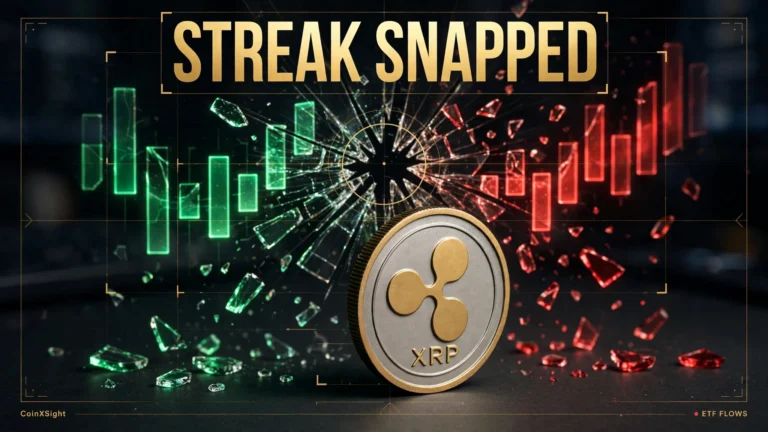
If you’re holding Bitcoin at $82,000 with an 89%-priced December hike ahead, the rational year-end move is to lighten up, not add. The XRP ETF flow data we analyzed yesterday tells the same story: the first weekly outflow in thirteen weeks arrived precisely as macro uncertainty peaked. Institutional crypto demand is pausing into the event calendar.
The trap is that a “dovish hold” in October does nothing to change the December math. The hike is priced, the officials want it, the data supports it. The only thing that derails December is a genuine growth scare — and nothing in the current data suggests one is coming.
The bottom line
Eight days out, the October FOMC is the most telegraphed non-event in recent memory: 87% hold, blackout in effect, no data left to change it. But the meeting matters for what it signals about December, about Warsh, and about the terminal rate — the three variables that decide whether Bitcoin spends the rest of 2026 above $80,000 or testing what lies beneath.
The market has priced patience for October and tightening for December. Crypto’s job between now and the 28th is simple: hold the range, don’t front-run the statement, and watch the language around “further adjustments” like a hawk. The 87% is already in the price. Everything else — the tone, the dots, the December setup — is still to be discovered.
In eight days, we’ll know whether the growth shock gets its pause, or whether the Fed decides that hot data can’t wait until December after all.
—
Disclaimer: This article is for informational purposes only and does not constitute financial advice. Cryptocurrency markets are volatile and carry substantial risk of loss. Interest rate expectations are subject to change based on economic data and central bank communications. Past performance does not guarantee future results. Always do your own research before making investment decisions. Data: CME FedWatch, Kalshi, Federal Reserve, CoinGecko.
CX
CoinXSight Alpha Desk
ALPHA // DESK
Quantitative Research Desk·Global Alpha Division
CoinXSight Institutional Research Desk produces quantitative crypto market intelligence, algorithmic models, and on-chain forensics.
QUANTITATIVE SUITE // DEEP ALPHA ENGINEACTIVE
BTC/USDT // LIVE SCANNER
CONFLUENCE 100
LIVE SPOT PRICE$82,617.68STRONG_BUY
TP2
$90,817.78
+10.15%
TP1
$85,796.52
+4.06%
ENTRY
$82,449.02
ZONE
SL
$80,775.27
-2.03%
Auto-detect Order Blocks, Fair Value Gaps and risk-adjusted DCA ladders in < 5s.