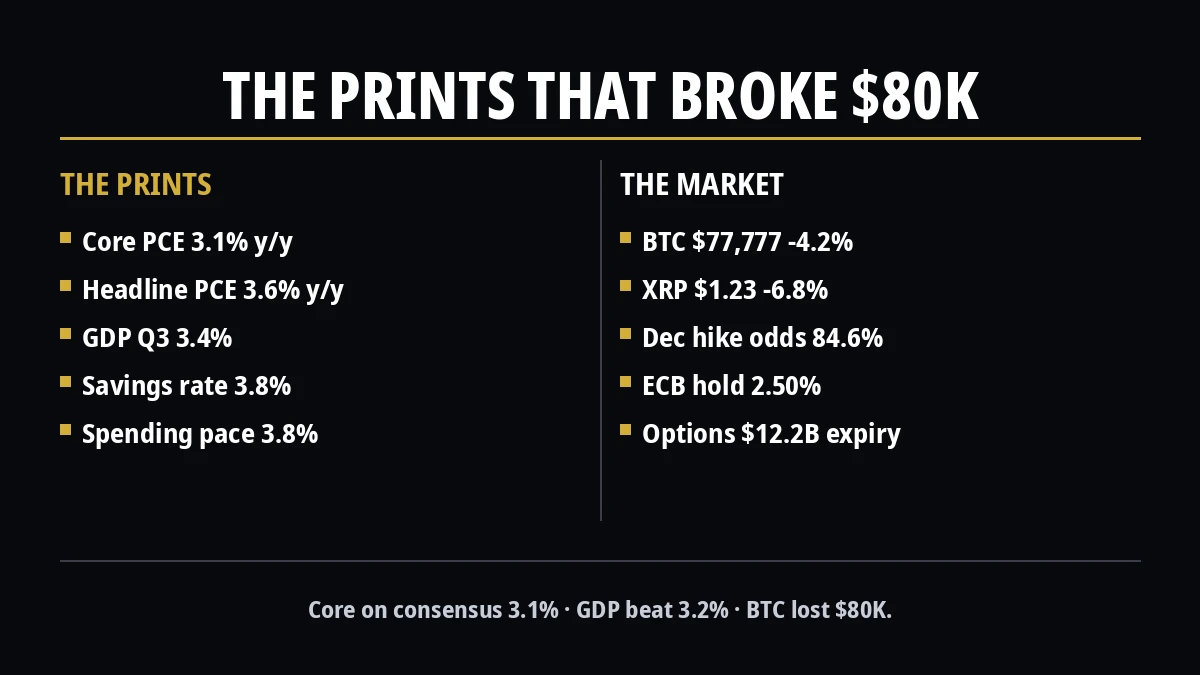
The data came in exactly as expected, and the market sold off anyway. That is the whole story of the last 24 hours in one sentence — and it tells you more about where this cycle stands than any surprise could have.
September core PCE rose 0.3% on the month, lifting the annual rate to 3.1% from 3.0% — precisely the FactSet consensus. Headline PCE rose 0.5% monthly and 3.6% year over year. Third-quarter GDP beat, growing at a 3.4% annualized rate against a 3.2% consensus. Nothing missed. Nothing shocked. And Bitcoin still closed the day at $77,777, down 4.2%, having lost the $80,000 level it had defended all week. Only 4 of the 50 largest crypto assets finished in the green; the median move was −6.8%.
In Line Was the Bad Outcome
Traders came into Thursday night positioned for a specific hope: that a soft core print — 0.2%, anything below consensus — would undercut the two Federal Reserve voters who dissented for a hike a day earlier and take December tightening off the table. The print gave them no such thing. Core inflation re-accelerated for the first time in months, August’s core reading was revised up to 0.3% from 0.2%, and headline inflation at 3.6% is now the highest since May.
Layer the GDP beat on top and the hawkish case from Wednesday’s FOMC meeting no longer needs arguing — the data argues it. Growth at 3.4% is not an economy asking for relief. Consumer spending ran at a 3.8% pace through the quarter. Chair Warsh, at his press conference, had already framed the Fed’s job as making sure energy-driven price rises “do not broaden out across the economy.” Thursday’s numbers — goods prices up 3.9% year over year, services 3.5% — are what broadening looks like in its early stages.
The market’s verdict was immediate: CME FedWatch moved the probability of a December rate hike to roughly 84.6%. What was a live possibility on Wednesday night is the base case on Friday morning.
The Household Data Underneath
Two details inside the release deserve more attention than the headline pair got. Real consumer spending was flat in September despite the strong quarterly pace — the growth was earlier in the quarter, and it was increasingly price, not volume. And the personal savings rate fell to 3.8%, the lowest since late 2022, down from 4.0% in August.
That combination — inflation re-accelerating while the household buffer thins to a four-year low — is the uncomfortable cell in the grid. It is not stagflation yet; 3.4% growth forbids the word. But it is the direction of travel the Fed’s dissenters warned about, and it leaves the consumer with less room to absorb exactly the energy prices driving the inflation. For crypto, whose marginal buyer in this cycle has been the institution rather than the retail household, the savings print matters less directly — but it caps how much speculative risk appetite can rebuild from below while policy tightens from above.
Frankfurt Added Its Own Twist
The European Central Bank held its deposit rate at 2.5%, unanimously — and then produced the day’s most underpriced headline. President Christine Lagarde confirmed the Governing Council had discussed a hike, said the situation could have warranted one, and signalled that if the data confirms the picture by the December 17 meeting, “the sense of direction was quite clear.” FXStreet’s desk read it plainly: a 25-basis-point hike to 2.75% in December, likely the terminal rate.
Hours before the decision, Lagarde also announced she will step down on February 7, 2027 — nine months before her term ends — landing a leadership transition in the middle of a tightening cycle, with euro-area inflation at 3.8%, energy inflation at 18.9%, and French borrowing costs at a decades-high premium over Germany’s. Europe’s December meeting now carries a succession contest inside a rate decision.
So the week’s central-bank scoreboard, final count: Canada hiked. The Fed held with two votes for a hike. New Zealand held with all seven members conceding tightening may come. The ECB held, discussed a hike, and pointed at December. And all of them — Washington December 8–9, Ottawa and Wellington December 9, Frankfurt December 17 — decide again within the same ten days.
What the Selloff Was — and Wasn’t
Bitcoin’s slide from $81,800 to a $77,777 close, with an intraday low near $77,650 this morning and price still around $77,700, looks violent. Context argues against calling it capitulation. Exchange flows on the day showed $4.9 billion of withdrawals against $2.9 billion of deposits — someone was moving coins off exchanges into the dip, not onto them to sell. XRP’s fall to $1.23 (−6.8%) unwound the entire Swell-week premium in a day, which says more about how much conference hope was embedded in that price than about Ripple’s fundamentals, none of which changed overnight.
One mechanical factor hangs over today specifically: roughly $12.2 billion of Bitcoin options expire at 08:00 UTC — 15:00 Vietnam time — with max pain at $79,000, above the current price. Expiry positioning has a habit of pulling price toward the strike cluster into settlement and releasing it afterward. Whether the afternoon brings a relief drift back toward $79,000 or a continuation lower will say a lot about how much of Thursday was positioning and how much was genuine repricing of the December path.
The honest summary is the one the data wrote: inflation is re-accelerating gently, growth is too strong to argue with, households are thinner than they were, and four central banks have all pointed at the same month. Bitcoin did not fall because a number missed. It fell because the number everyone hoped would rescue the dovish case arrived exactly on forecast — and the forecast was hawkish.
Release (Oct 29)
Actual
Consensus
Prior
Core PCE, September (y/y)
3.1%
3.1%
3.0%
Headline PCE, September (y/y)
3.6%
3.7%
3.4%
GDP Q3 advance (annualized)
3.4%
3.2%
2.2% (Q2)
December Fed hike odds (FedWatch)
~84.6%
—
~73–86% pre-meeting
ECB deposit rate
2.50% (hold, unanimous)
2.50%
2.50%
Bitcoin close, Oct 29 (UTC)
$77,777 (−4.2%)
—
$81,254 (Oct 28)
—
Disclaimer: This article is for informational purposes only and does not constitute financial advice. Figures are cited from official releases and market data as reported at the time of writing and are subject to revision. Cryptocurrency markets are volatile; always do your own research before making investment decisions.