Nvidia Reports Earnings Tomorrow With No CEO — and a Comeback Rumor It Won’t Confirm
Nvidia reports Q3 earnings on Tuesday 17 November with no permanent chief executive, its stock down 32% from its October high, and an unconfirmed report that Jen-Hsun Huang may return. What the print, the call and the board must deliver — and why it matters for a crypto market already below its 200-week line.
CX
CoinXSight Alpha DeskQuantitative Research Desk·Nov 16, 2026 · Updated Nov 18
Nvidia reports earnings tomorrow. It has no permanent chief executive, a stock down a third from its October high, and a weekend report that the founder it just lost might come back — a report nobody at the company will confirm. The numbers will matter. The leadership question matters more.
That is the setup for the most-watched earnings call of the year. Nvidia, the company that sells the picks and shovels of the artificial intelligence boom, reports third-quarter results after the US market closes on Tuesday, 17 November. Colette Kress, the long-serving chief financial officer who became interim chief executive a week ago, is expected to lead the call. What investors will hear is an open question: whether the quarter was strong enough to steady a stock that has lost roughly $1.7 trillion in market value in six weeks, and whether anyone at the top can say, with authority, what happens next.
A stock in free fall before the print
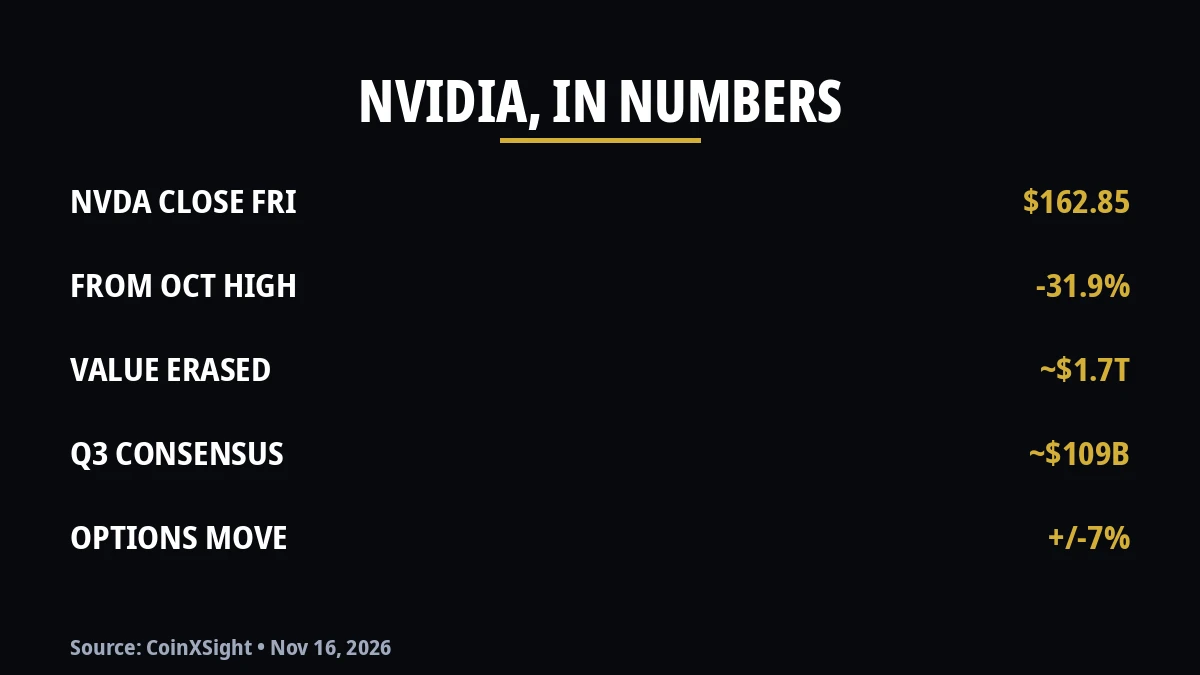
Start with the damage, because it frames everything else. Nvidia closed Friday at $162.85, down 2.01% on the day after trading as low as $158.39. The stock has now fallen for six consecutive weeks, losing 12.7% last week alone. From its 6 October high of $243.37, it is down 31.9%. November alone has taken about a fifth off the share price.
The market capitalisation tells the same story in bigger numbers. Nvidia was worth roughly $5.8 trillion in early October. Depending on the data provider, it is now worth somewhere between $3.9 trillion and $4.19 trillion — below the $4 trillion mark on the more conservative measure. That is roughly $1.7 trillion of market value erased in about six weeks.
Two of Wall Street’s big research houses moved after the resignation. HSBC cut the stock to Hold and slashed its price target to $170 from $365. Bernstein cut its target to $200 from $400. Neither downgrade questions the demand for Nvidia’s chips. Both question what a leadership vacuum does to a company whose valuation rested, in large part, on one man’s judgment.
Nvidia heads into Q3 earnings down 32% from October highs amidst leadership transition uncertainty.
The earnings number itself
Strip away the drama and the quarter is, on paper, expected to be enormous. The consensus compiled by LSEG puts revenue at roughly $109 billion, with earnings per share of $2.47 to $2.48. That would be revenue growth of roughly 89% to 91% year on year. The company’s own guidance, issued before the resignation, was about $108 billion, plus or minus 2%.
One note on the numbers: not every data provider agrees. Finnhub’s estimate is higher, at $111.2 billion in revenue and $2.52 per share. The gap is a reminder that consensus is a range, not a fact, and that a “beat” or a “miss” on Tuesday will depend on which yardstick the market uses in the first minutes after the release. The options market implies a move of about 7% in either direction on the print — roughly $280 billion of market value, swinging on one evening.
What the call needs to deliver goes beyond the quarter. Investors will listen for three things: guidance for the current quarter, any update on data-centre demand and the Blackwell chip ramp, and any word — even a sentence — about the search for a permanent chief executive. The first two are standard. The third is the one that will decide whether the stock finds a floor.
The three facts, and only the three facts
A week of extraordinary reporting has produced a fog of claim and counter-claim around Nvidia. It is worth stating plainly what is confirmed, because everything else in this story hangs on the distinction.
First, Jen-Hsun Huang resigned as president, chief executive and board member, effective immediately on 11 November. The board accepted the resignation the same day, and the company disclosed it in a Form 8-K filed with the Securities and Exchange Commission on 12 November.
Second, Colette Kress, the chief financial officer, is interim chief executive. Harvey C. Jones is board chair.
Third, Nvidia reports third-quarter results on Tuesday, 17 November, after the market closes. That is the first earnings report since the resignation.
That is the complete list of confirmed facts about the leadership change. The reason for the resignation has not been confirmed. The company gave no reason in its filing. Reporting about an alleged affair and about suspected espionage exists, and it is reporting — unproven, and in the case of the espionage claim, denied by China. It is not fact, and this article will not present it as the reason for anything.
The comeback report nobody will confirm
The most market-moving piece of news since the resignation arrived on Sunday, from the Financial Times: Huang has discussed a possible return to the company with confidants. The report moved the stock’s perpetual contract on Hyperliquid about 3% higher on Sunday evening. On Monday, the shares were little changed in early trading.
Here is what the report is not: confirmation. Nvidia has not confirmed it. The board has not announced any plan to reinstate Huang. No filing has been made. A founder talking to confidants about returning is a very different thing from a board deciding to bring him back, and the market’s first reaction — a small bounce in a thinly traded derivative — is a reaction to a headline, not to a decision.
The honest way to read it is as a sign of the pressure on the board. A company of this size does not usually conduct its succession planning in public, through weekend newspaper reports. That it is happening this way tells you how little room the board has, and how much the market wants the old order restored. It does not tell you the old order will be restored.
Bessent raises the stakes
Also on Sunday, Treasury Secretary Scott Bessent weighed in — and his intervention cuts in the opposite direction. Bessent said Nvidia should hire its next chief executive from outside the company, and he asked the board and outside lawyers to answer within 10 days whether the company has complied with US rules restricting chip exports to China.
That is a statement and a request, not a finding of wrongdoing. No violation has been established. But the combination matters: the Treasury Secretary is effectively telling the board that the next chief executive should be an outsider, at the same time as he is demanding answers on export compliance. If the board was leaning toward bringing Huang back, Bessent has just made that path more complicated. If it was leaning toward an insider, the same applies. The 10-day clock gives the story a second act, due before the end of the month.
Why crypto holders should care
This is, on its face, a stock story. It is also a risk-appetite story, and risk appetite is the air crypto breathes.
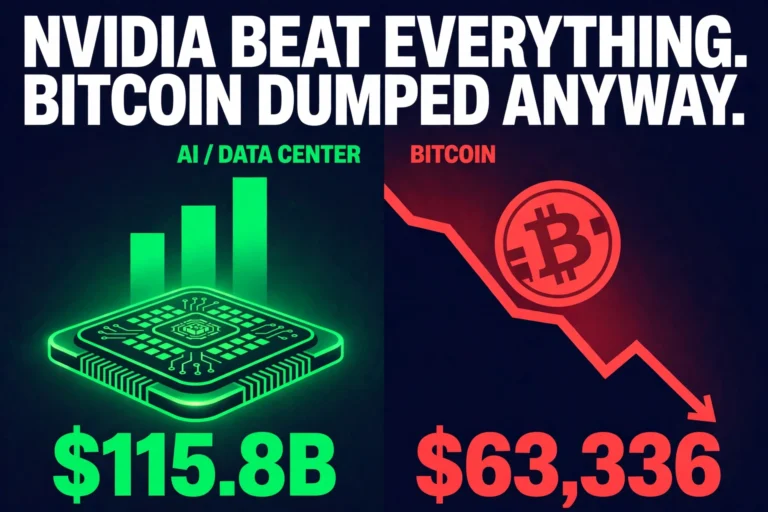
Bitcoin spent Monday trading around $64,569, below its weekly close of $65,510 and below the $65,000 level it briefly reclaimed on Sunday. The weekly close itself was a break: the first weekly close below the 200-week moving average, near $67,982, since October 2023, and the sixth straight red week. The next supports are $62,006, the week’s low, then $60,000 and $57,742. Ether traded near $1,812, and Solana near $71. The Fear & Greed index sits at 10, extreme fear, for the third consecutive reading.
The link between Nvidia and crypto is not direct, and it should not be overstated. Nvidia does not sell bitcoin. But the same money that has been selling Nvidia has been selling bitcoin, for the same reasons: a Federal Reserve that is now expected to raise rates in December, with futures pricing a hike at effectively 100% — roughly 87% to 89% for a quarter point and 8.5% to 11.5% for a half point — and a Chinese economy that disappointed again this morning. China’s October industrial output rose 4.8% year on year, against expectations of 5.3%; retail sales rose just 0.4%, against 0.8% expected; fixed-asset investment fell 8.1% in the first ten months of the year. ING called it “a worrying start” to the fourth quarter.
The forced selling has also slowed. The weekend’s liquidation wave totalled about $2.02 billion in the 24 hours to Sunday morning Eastern time, with longs accounting for $1.68 billion of it, according to CoinGlass data cited by the Wall Street Journal. By Monday morning the rolling 24-hour tally had fallen to roughly $290 million, according to Delta Exchange. The flush is over, for now. What has not arrived is a reason to buy.
That is why Tuesday matters beyond Nvidia’s shareholders. If the earnings call steadies the stock — a clean beat, credible guidance, a word on leadership — it would remove one of the largest sources of forced selling in the market. If it disappoints, or if the leadership question goes unanswered, the largest stock in the world keeps falling, and the risk-off mood that has pushed bitcoin below its 200-week line has one more reason to persist.
The week in numbers
Measure
Reading
Source / time
Nvidia close, Fri 13 Nov
$162.85 (−2.01% on the day)
Finnhub
Nvidia, week to 13 Nov
−12.7%; sixth straight down week
Finnhub
Nvidia from 6 Oct high ($243.37)
−31.9%
Calculated
Nvidia market cap
~$3.9–4.19T, from ~$5.8T in early Oct
LSEG / Finnhub
Q3 consensus (LSEG)
Revenue ~$109B; EPS $2.47–2.48
Reuters / LSEG
Company guidance
~$108B +/-2%
Nvidia
Options-implied earnings move
+/-7%
Options market
Bitcoin, Mon 16 Nov ~13:49 VN
$64,569; 24h range $63,777–$65,980
CoinGecko
Dec Fed hike odds
~100% hike; 25bp ~87–89%, 50bp ~8.5–11.5%
CME FedWatch / Kalshi / Polymarket, 14–15 Nov
Fear & Greed Index
10 — Extreme Fear
alternative.me, 16 Nov
What to watch on Tuesday
The print itself is the first test. Revenue near or above $109 billion, with guidance that holds up, would give the stock something to stand on. A miss, or guidance that hedges, would not — and in this market, a hedged guide reads as a warning.
The second test is the call. Kress has run Nvidia’s finances for years and knows the business cold. What she cannot do, as interim chief executive, is answer the question the market is actually asking: who runs this company in six months? Any hint — a timeline, a search update, even a firm “no comment” delivered with conviction — will be parsed word by word.
The third test is what is not said. If the board’s search is going well, someone will say so. If the return rumour has substance, the company will eventually have to address it. Silence on both fronts after Tuesday would be its own answer, and the market would not like it.
There is a fourth thing to watch, quieter than the rest: the guidance number. Nvidia’s own forecast was about $108 billion. If the company guides the current quarter below that, in a week when its chief executive has just resigned, the market will read it as a company that has lost its nerve. If it guides above it, the opposite. In a normal quarter, guidance is a detail. This is not a normal quarter.
The bottom line
Nvidia goes into its most important earnings report in years without a permanent chief executive, with its stock down a third from its high, with the Treasury Secretary telling its board to look outside, and with a weekend report — unconfirmed — that the founder might return. The quarter itself is expected to be enormous. But the slide has run for six straight weeks, and bitcoin has been falling with it: it lost the $70,000 level days ago and has since closed a week below its 200-week line, even as stocks rallied and bitcoin gave the gains back last Thursday.
For crypto, the stakes are indirect but real. Bitcoin is sitting below a line it had not closed under in three years, in a market defined by fear and by a Federal Reserve about to raise rates. A steady Nvidia would not fix that. A chaotic one would make it worse. Tuesday evening will tell us which one we get.
Disclaimer: This article is for informational purposes only and does not constitute financial advice. Figures are cited from official releases and market data as reported at the time of writing and are subject to revision. Cryptocurrency markets are volatile; always do your own research before making investment decisions.
Track tech macro correlation, cross-asset liquidity flows, and institutional positioning in real time with the CoinXSight Terminal.
CX
CoinXSight Alpha Desk
ALPHA // DESK
Quantitative Research Desk·Global Alpha Division
CoinXSight Institutional Research Desk produces quantitative crypto market intelligence, algorithmic models, and on-chain forensics.
QUANTITATIVE SUITE // DEEP ALPHA ENGINEACTIVE
BTC/USDT // LIVE SCANNER
CONFLUENCE 74
LIVE SPOT PRICE$82,807.47WEAK_BUY
TP2
$89,522.75
+9.07%
TP1
$85,056.42
+3.63%
ENTRY
$82,078.86
ZONE
SL
$80,590.09
-1.81%
Auto-detect Order Blocks, Fair Value Gaps and risk-adjusted DCA ladders in < 5s.