Nvidia Just Beat Everything. Bitcoin Dumped Anyway.
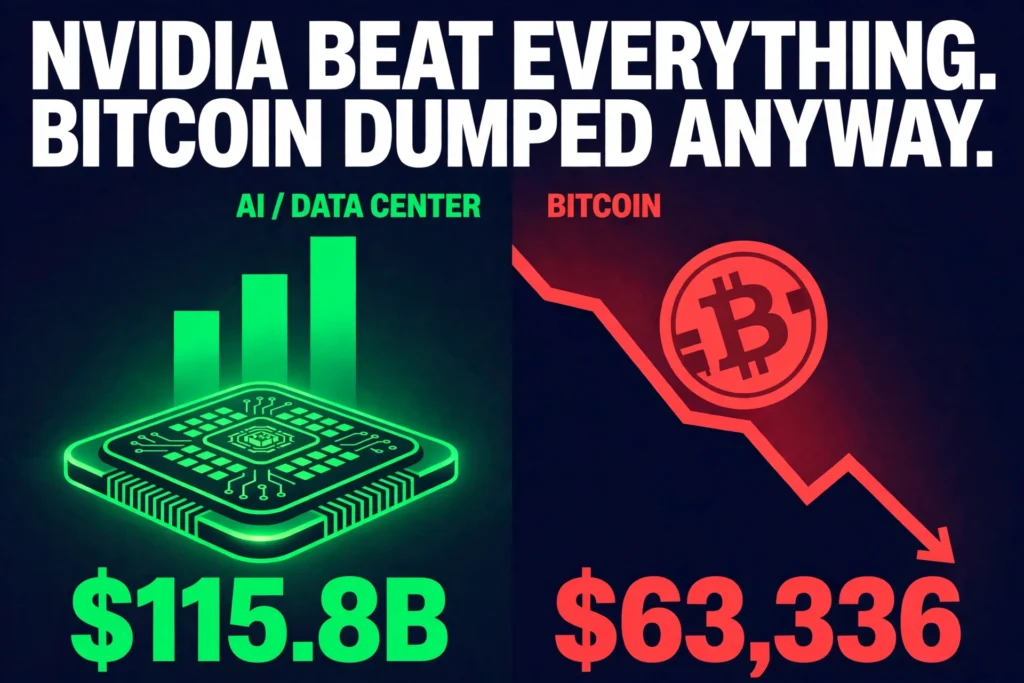
Nvidia reported $115.84B revenue (+103% YoY) and a $130B guide — and Bitcoin dumped to $63,336 overnight anyway. Why the best print of the AI era could not save crypto: the Fed is still hiking, ETF flows are still bleeding, and leverage is still thin.
CX
CoinXSight Alpha DeskQuantitative Research Desk·Nov 18, 2026
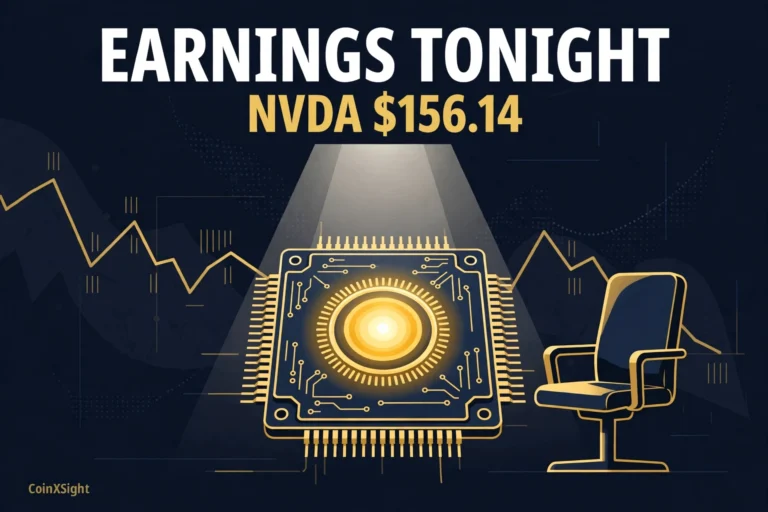
Nvidia reported the best quarter of the post-Huang era before Asia woke up — $115.84 billion of revenue, up 103% year on year, a $130 billion guide for the current quarter — and Bitcoin spent the night falling to $63,336 anyway.
That is the story of this morning in one sentence, and it is worth sitting with, because it breaks the reflex that has governed this market for two years: good AI news lifts everything. It did not. Not this time. The AI trade and the crypto trade have separated, and the gap between them is now a number you can measure in dollars. Nvidia beat consensus by roughly $7 billion. Bitcoin fell through $64,000 while the earnings call was still running.
The question this article tries to answer is not whether Nvidia’s numbers were good. They were extraordinary. The question is why the best print of the year could not save a market that has now fallen six straight weeks — and what that tells us about which force actually sets the price of Bitcoin right now.
The beat, and the three asterisks
Start with the numbers, because they deserve to be stated plainly. Revenue of $115.84 billion, against a consensus compiled by LSEG of roughly $109.1 billion and the company’s own guidance of about $108 billion. Adjusted earnings per share of $2.68, against roughly $2.47 to $2.48 expected. Data Center revenue of $107.6 billion, up 110% year on year, against a consensus near $101.8 billion. Gross margin of 74.8% on a GAAP basis, 74.9% adjusted. Growth of 103% year on year and 20% quarter on quarter, from a company that is now, by revenue, one of the largest in the world.
Then the guide. Fourth-quarter revenue of $130 billion, plus or minus 3%, against a consensus near $125 billion. Interim chief executive Colette Kress raised the outlook for fiscal 2028 revenue growth to roughly 75%, from 70% in August. On a first read, that is a company telling the market the AI build-out is not slowing down, not pausing, not digesting — it is accelerating.
The stock’s reaction tells you the second read. Nvidia closed Tuesday at $155.46, down 0.4% on the day, then rose after hours to a peak near $161.70 — about 4% — and gave back more than half of that move before the call had finished, trading around $157 to $159. A beat this large, in a normal tape, is a 6% to 8% gap-up. It was not, and the reason sits in three caveats that the release and the call made impossible to ignore.
First, the fourth quarter has a fourteenth week. On a like-for-like 13-week basis, the $130 billion guide is roughly $120.7 billion — growth of about 4% on the third quarter, not the 12% the headline implies. That arithmetic is an estimate from The Market MBA, not company guidance, and it should be read as such. But the direction is not in dispute: part of the beat is calendar, not demand.
Second, gross margin is guided down. The fourth quarter is expected at 71% to 72%, roughly three points below the 74.8% to 74.9% just reported. Margin compression at the top of the cycle is the kind of detail that does not matter when a stock is cheap and matters enormously when it is not.
Third, the guide assumes zero Data Center compute revenue from China. That is a clean assumption and a prudent one. It is also a reminder, written into the numbers themselves, that the largest growth market in the world for this company’s products is, for forecasting purposes, closed.
None of this makes the quarter bad. It makes it complicated — a record print with a softer underbelly, priced by a market that had already cut the stock 35.8% from its 6 October high of $243.37 and was looking for a reason to stop falling, not a reason to celebrate.
There was one more piece of news on the call, and it closes a story this column has followed for a week. Board chair Harvey Jones opened the call by saying the board does not intend to bring Jen-Hsun Huang back. The comeback rumour — reported by the Financial Times, petitioned by more than 175,000 signatories, endorsed in passing by the President — is, as a live question, over. Kress remains interim chief executive. The search continues. The release named no candidates. Yesterday’s column on the board’s position and the President’s endorsement is now, in that respect, history: the board has spoken, and it said no.
Bitcoin’s night: $63,336 and back
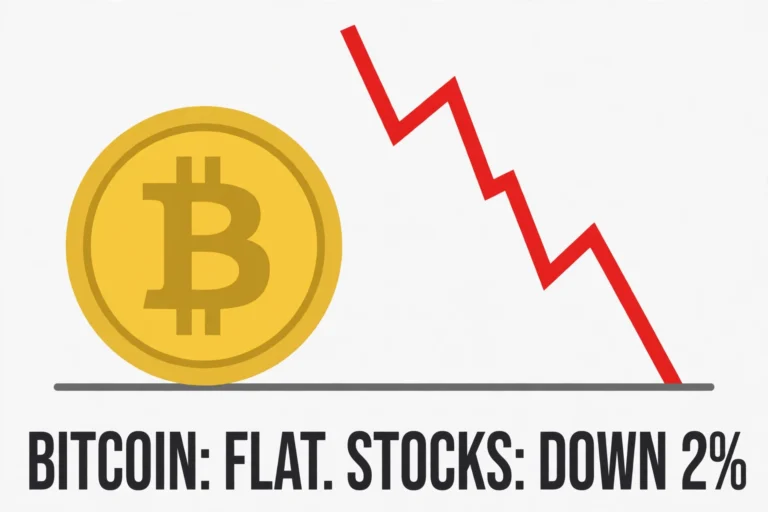
While Nvidia’s call was running, Bitcoin was making its own low. The overnight low was $63,336. By 08:08 Vietnam time, the price had recovered to $64,592, essentially flat on the day, with Ethereum at $1,815.37 and Solana the outlier at $74.71, up 4.5%.
A recovery to $64,592 should not be mistaken for strength. The weekly close that matters — $65,510.09, set on Monday — is still above the current price. The 200-week moving average near $67,982 is further above that. Bitcoin has now closed a week below that line for the first time since October 2023, and it is trading below it again this morning. Support sits at $62,006, the low of the weekly candle, then $60,000, then $57,742. None of those levels has been tested yet in this leg. All of them are close enough to matter.
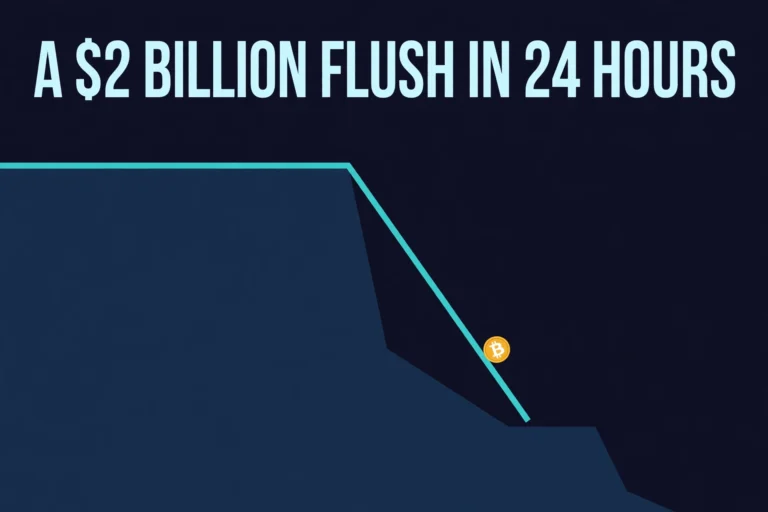
The tape underneath the price was thin and violent. In the hour to 16:14 UTC on Tuesday, $146 million of positions were liquidated across the market, according to CoinGlass data via KuCoin — $47.58 million of it in Bitcoin, $25.72 million in Ethereum, and $138 million of it long positions against just $7.55 million of shorts. A separate snapshot at 15:51 UTC put $76.1 million of liquidations in a single half hour, 95% of it long. Over 24 hours, roughly $195 million was liquidated, $114 million of it long.
Read those numbers together and the shape of the night is clear. This was not a crash driven by a headline. It was a slow bleed of leveraged longs, the kind that happens when a market has stopped believing its own bounces. The Fear & Greed Index reads 11 this morning — Extreme Fear, down from 12 yesterday and 10 on Monday. It has spent the week in single digits and low teens. There is no panic left to measure. There is only exhaustion.
That is why the Nvidia beat did not matter. A market in this state does not buy good news from another market. It waits for its own reasons to turn, and this morning it has none.
The morning in numbers
Measure
Reading
Source / note
Nvidia Q3 FY2027 revenue
$115.84B (+103% YoY, +20% QoQ)
Consensus LSEG ~$109.1B; company guide ~$108B ±2%
Nvidia adjusted EPS
$2.68
Consensus ~$2.47–$2.48
Data Center revenue
$107.6B (+110% YoY)
Consensus ~$101.8B
Gross margin (GAAP / adjusted)
74.8% / 74.9%
Q4 guide 71–72%, down ~3 points
Q4 revenue guidance
$130B ±3%
Consensus ~$125.1–$125.3B; includes a 14th week — ~$120.7B on a 13-week basis (The Market MBA estimate)
FY2028 revenue growth outlook
~75%
Raised from 70% in August; assumes zero China Data Center compute revenue
NVDA, Tuesday close / after-hours
$155.46 (−0.4%) / peak ~$161.70 (+4.0%), faded to ~$157–159
Down 35.8% from 6 Oct high of $243.37
Bitcoin, 08:08 VN Wed
$64,592 (−0.05% / 24h)
CoinGecko; overnight low $63,336; weekly close $65,510.09; 200-week MA ~$67,982
Ethereum / Solana, 08:08 VN
$1,815.37 (+0.03%) / $74.71 (+4.46%)
CoinGecko
Fear & Greed Index
11 — Extreme Fear
alternative.me, 18 Nov; 12 on 17 Nov, 10 on 16 Nov
Liquidations, 1 hour to 16:14 UTC Tue
$146M total; long $138M / short $7.55M
CoinGlass via KuCoin; BTC $47.58M, ETH $25.72M
Liquidations, 24 hours
~$195M; long $114M / short $81.1M
CoinGlass via KuCoin, 15:43 UTC Tue
US spot Bitcoin ETF flows, Mon 16 Nov
+$7.9M net inflow
Farside; IBIT +$76.5M, GBTC −$34.6M, FBTC −$11.3M
December Fed hike odds
25bp ~96% / 50bp ~4%
CME FedWatch methodology, as of 17 Nov evening ET
The consumer is fine. The Fed is not done. That is the whole problem.
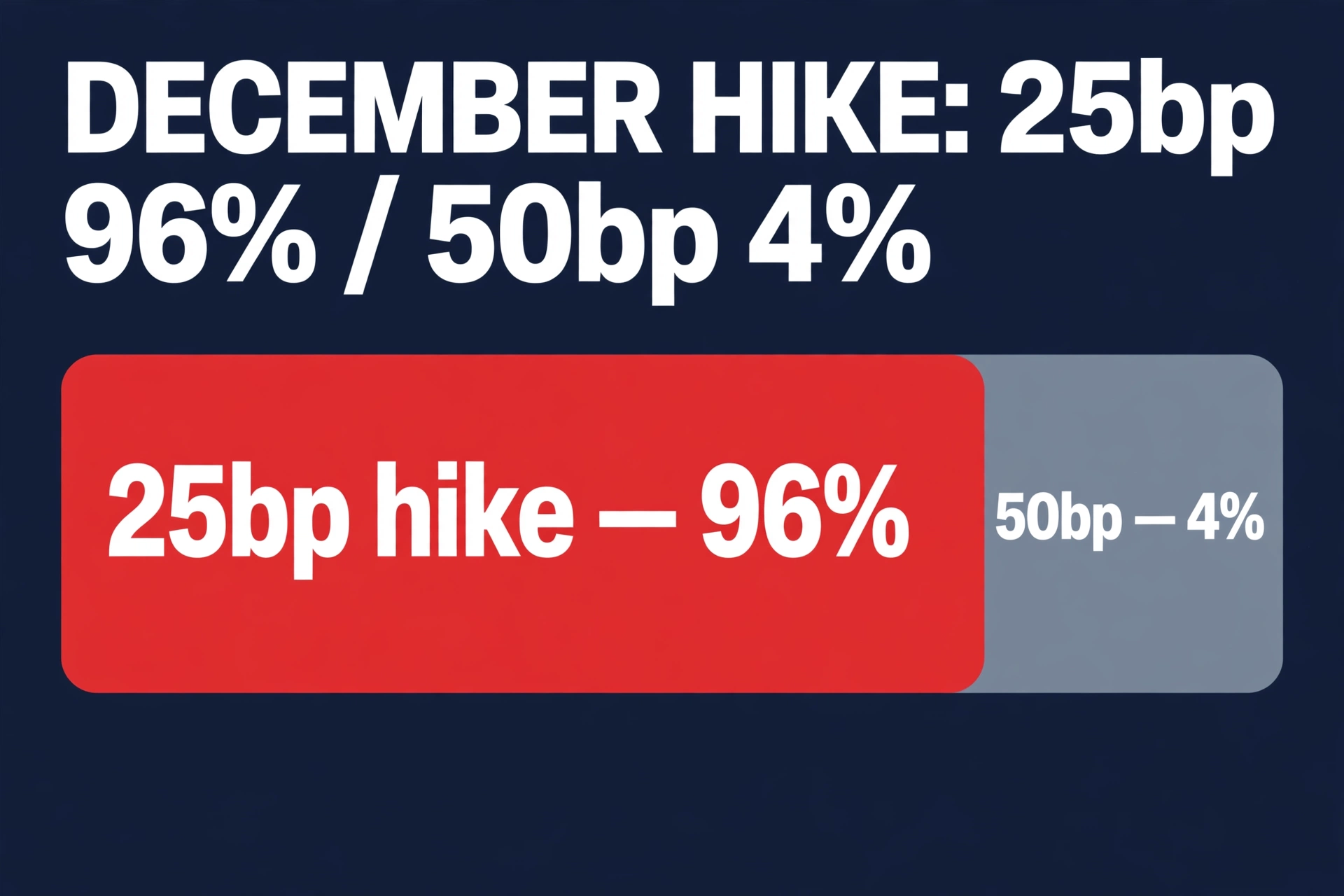
Federal Reserve rate path expectations remain anchored around hawkish policy as nominal retail sales obscure negative real consumer demand.
If Nvidia’s beat could not lift Bitcoin, the second half of Tuesday evening explains why: the American consumer is still spending, and the Federal Reserve is still not finished raising rates. Those two facts together are the worst combination for a risk asset that trades on liquidity.
Retail sales for October rose 0.2% month on month to $748.2 billion, matching consensus. The control group — the measure that feeds directly into GDP — rose 0.6%, beating a 0.4% consensus and marking its strongest reading since August. Excluding autos, sales were up 0.6%. September was revised up to 0.8%. On the surface, that is a resilient consumer.
The surface is misleading in one important respect, and it matters. These are nominal dollars, unadjusted for prices, and October CPI rose 0.4% month on month. In real terms, the headline gain is flat to negative. The Census Bureau itself notes that the 90% confidence interval for the headline includes zero — the data do not prove spending actually rose at all. The control group’s 0.6% is the genuinely strong number. The headline’s 0.2% is not. Import prices, meanwhile, rose 1.1% against a 0.7% consensus — inflation pressure arriving from abroad while domestic prices are already running hot.
Then came the Federal Reserve speakers, and they did not soften the message. Alberto Musalem of the St. Louis Fed said the economy “will likely require several interest rate increases before the spring of 2027 to achieve price stability in a timely manner,” estimating that the real rate needs to reach 2% to 2.5%, against 1% to 1.5% now. CNBC read that as up to four hikes. One caveat belongs here and it is not small: Musalem does not hold a vote on the FOMC until 2028. This is a personal view, not a committee signal — but it is a personal view from a policymaker who has been ahead of the curve on this cycle.
Beth Hammack of the Cleveland Fed, speaking at Brookings at 21:30 Vietnam time, said inflation is “heading in the wrong direction” and that price pressures are broadening. She prefers small steps — 25 basis points, not 50 — but left the door open in terms that should be quoted exactly: “If we get behind the curve and we need to put more restriction in, we absolutely can move in those larger increments.”
The market heard all of it and barely moved. December hike odds sit at roughly 96% for 25 basis points and about 4% for 50, on the CME FedWatch methodology as of Tuesday evening in the US — essentially unchanged from the start of the week. Kalshi reads about 95% for the quarter-point move, Polymarket about 97%. A Nvidia beat and a strong control group did not revive the 50-basis-point trade. They did not need to. The 25-point hike is already the base case, and the path after December — January, March, April, in Musalem’s telling — is where the tightening lives now.
This is the decoupling in its cleanest form. Yesterday’s lead-lag analysis on these pages showed crypto falling first and stocks catching down a week later. This morning the pattern has inverted in a way that is worse for crypto: stocks have a reason to stabilise — earnings are real, guidance is growing — and crypto does not. Bitcoin’s price is set by liquidity and leverage, and both are pointing the wrong way while the Fed is still hiking.
One green day does not end a $1.91 billion bleed
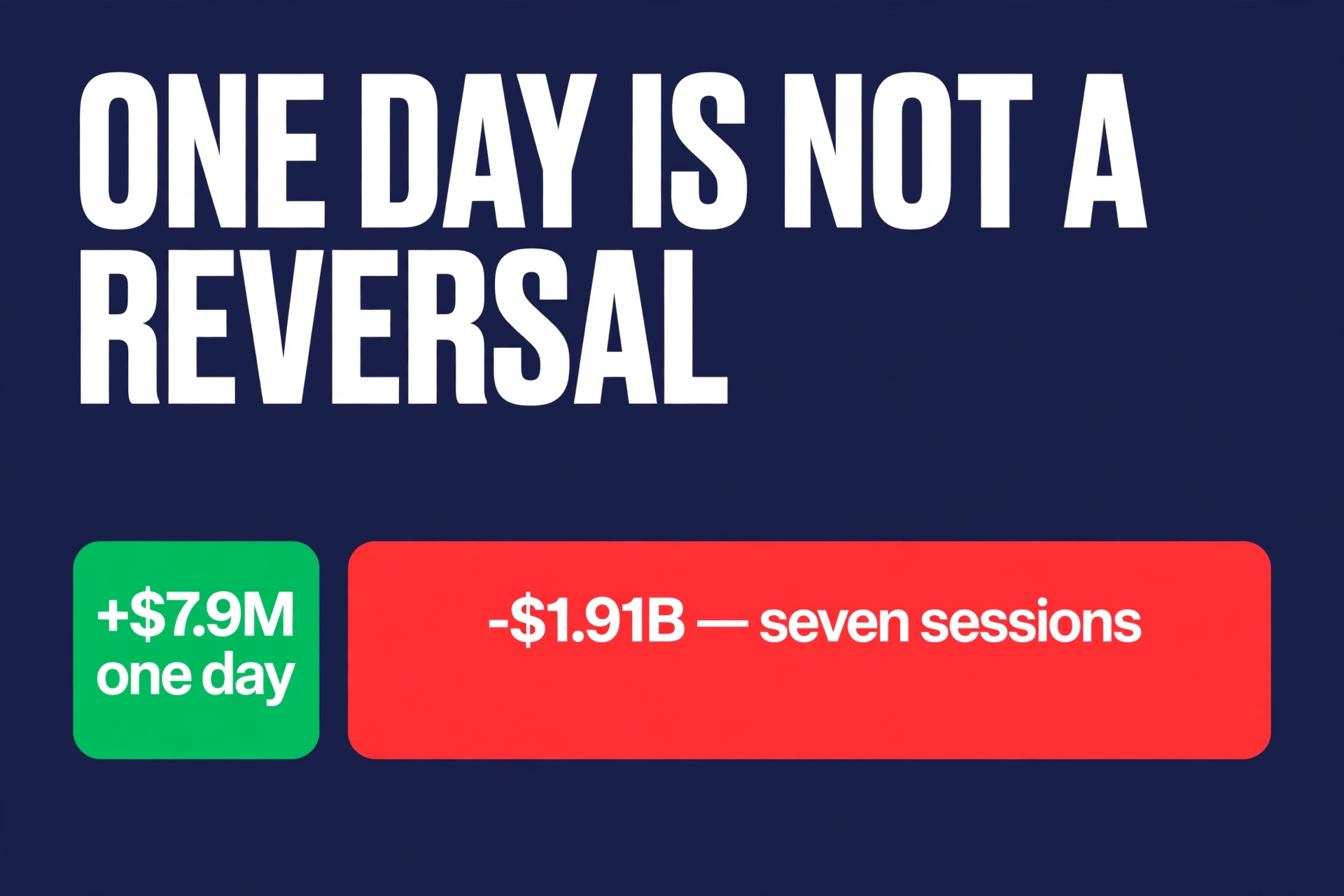
Spot Bitcoin ETFs recorded a modest +$7.9M inflow following seven consecutive sessions of heavy institutional bleeding totaling $1.91B.
There is one piece of good news for Bitcoin holders, and it is worth stating precisely because it is so small. On Monday, US spot Bitcoin ETFs took in a net $7.9 million — the first inflow in seven trading sessions. BlackRock’s IBIT drew $76.5 million, ending its own run of withdrawals. Most other funds still lost money: Grayscale’s GBTC gave back $34.6 million, Fidelity’s FBTC $11.3 million, and smaller outflows hit ARKB, BTCO, EZBC and the Grayscale mini trust.
Seven sessions before that single green day drained about $1.91 billion. One day of $7.9 million against that is not a reversal. It is a pause, and a pause funded almost entirely by one fund. The final numbers for Tuesday’s session had not been published by Farside at the time of writing, and they should not be guessed at. What can be said now is that a flow story does not turn on one inflow, any more than a price story turns on one bounce off $63,336.
That is the discipline this market demands right now. Every number that looks like a turn has to be held against the scale of what came before it. $7.9 million against $1.91 billion. A 4% after-hours pop against a 35.8% drawdown. A recovery to $64,592 against a weekly close of $65,510 and a 200-week average near $67,982. The proportions are the argument.
What today decides
Two data points will set the tone from here. At 14:00 Vietnam time today, UK CPI for October is released, with consensus at 3.6% year on year. A hot print there reinforces the global version of the same story — inflation not yet beaten, central banks not yet done — and it lands while London is open and American futures are still forming.
Then, at 02:00 Vietnam time on Thursday, the minutes of the October FOMC meeting are published. They pre-date the hot CPI print, so they will read as a document from a calmer world than the one we now live in. They are worth one line, not a thesis. The market that matters is the one pricing December at 96% and already asking about January.
For crypto, the afternoon brings the fuller autopsy of last night’s dump — the leverage, the levels, and the question of whether $63,336 was a floor or a waypoint — alongside the 13F filings that show who was buying while the price fell. The weekly close below the 200-week moving average remains the frame for all of it: six straight red weeks, a first close below that line since October 2023, and a market that has now watched the best earnings print of the year come and go without lifting it a dollar.
Nvidia did its job last night. It reported a record quarter and guided higher. The market that was supposed to be saved by it was busy liquidating $146 million of longs in an hour. That is not a verdict on Nvidia. It is a verdict on what moves Bitcoin now — and it is not earnings season.
Disclaimer: This article is for informational purposes only and does not constitute financial advice. Figures are cited from official releases and market data as reported at the time of writing and are subject to revision. Cryptocurrency markets are volatile; always do your own research before making investment decisions.
CX
CoinXSight Alpha Desk
ALPHA // DESK
Quantitative Research Desk·Global Alpha Division
CoinXSight Institutional Research Desk produces quantitative crypto market intelligence, algorithmic models, and on-chain forensics.
QUANTITATIVE SUITE // DEEP ALPHA ENGINEACTIVE
BTC/USDT // LIVE SCANNER
CONFLUENCE 74
LIVE SPOT PRICE$82,807.47WEAK_BUY
TP2
$89,522.75
+9.07%
TP1
$85,056.42
+3.63%
ENTRY
$82,078.86
ZONE
SL
$80,590.09
-1.81%
Auto-detect Order Blocks, Fair Value Gaps and risk-adjusted DCA ladders in < 5s.