Nvidia’s Board Isn’t Discussing a Huang Comeback. The President Just Endorsed One.
Nvidia reports Q3 FY2027 numbers tonight under interim CEO Colette Kress. On Monday, CNBC reported the board isn't talking about Jen-Hsun Huang coming back, Donald Trump said it isn't a bad idea, and the stock fell 4.12%. Here is the real earnings-day setup — for tech, macro, and crypto.
CX
CoinXSight Alpha DeskQuantitative Research Desk·Nov 17, 2026
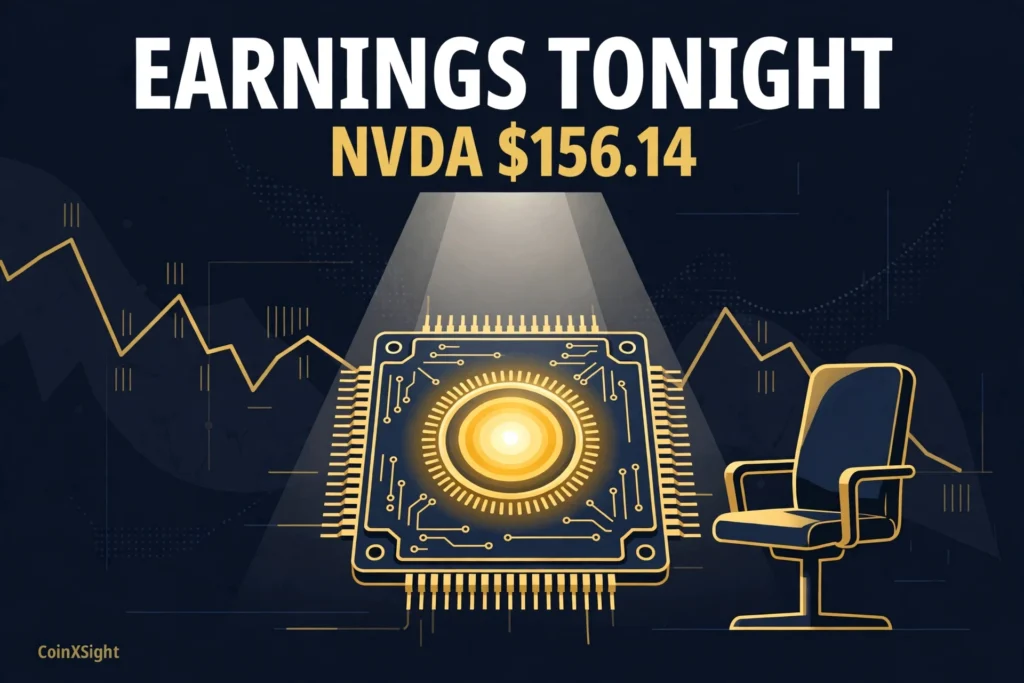
Nvidia reports the most consequential earnings of its life tonight, and the strangest part is what happened the day before the numbers. On Monday, CNBC reported that Nvidia’s board is not discussing bringing Jen-Hsun Huang back as chief executive. A few hours later, the President of the United States said a Huang return “certainly isn’t a bad idea.” The stock fell 4.12% anyway, to $156.14. Tonight, interim chief executive Colette Kress has to present a quarter built by the man half of Washington and Silicon Valley is now publicly arguing about — and guidance for a future nobody has agreed on.
That is the real setup for this print. Yesterday’s preview on these pages laid out the confirmed facts: Huang resigned on 11 November, Kress stepped in, and the numbers were expected to be enormous. What has changed since is not the numbers. It is that the comeback story — reported by the Financial Times on Sunday as private conversations between Huang and his confidants — has now been tested against the two institutions that actually decide it, and they point in opposite directions.
The board, according to CNBC, is not talking about it
Start with the report that moved the stock. CNBC, citing a person familiar with the matter, reported on Monday that Nvidia’s board is not currently discussing reinstating Huang. Read that sentence carefully, because every word of it is doing work. It is not a denial that a return could ever happen. It is not an on-record statement from the company. It is a sourced account of what the board is — and is not — doing right now, published the day before earnings.
The market treated it as the closest thing to an official answer it is likely to get this week. Nvidia fell 4.12% on Monday to close at $156.14, trading as low as $155.59 during the session. The Philadelphia Semiconductor Index fell 5.28% and the Nasdaq Composite dropped 2.49% into correction territory, so Nvidia was not falling alone — but it was falling on its own headline, in a tape where the leadership question, not chip demand, set the tone.
From the 6 October high of $243.37, the stock is now down 35.8%. Roughly $2 trillion of market value has been erased since early October. HSBC holds a $170 price target, cut from $365; Bernstein’s is $200, cut from $400. Neither house is bearish on demand for Nvidia’s silicon. Both are pricing a company whose story was, for three decades, inseparable from one founder — and whose board, if CNBC’s account is right, is not spending this week discussing his return.
The President has an opinion
Into that silence stepped Donald Trump. Speaking on Monday as he left the White House for a trip to Asia, the President said a Huang comeback “certainly isn’t a bad idea,” adding that “a large group of people” would like to see it happen.
Precision matters here as much as it does with the board. A presidential endorsement is not an appointment. Trump cannot put Huang back in the chief executive’s office, and nothing in his remarks suggested an attempt to direct the board. What the remark does is raise the political cost of every other option. A board that hires an outsider now does so against a publicly stated presidential preference. A board that brings Huang back does so with the White House’s blessing already on the record. Either way, a decision that would normally be made in a boardroom has acquired an audience of one very loud shareholder-by-proxy.
It also completes an unusual triangle. Over the weekend, Treasury Secretary Scott Bessent said Nvidia should hire its next chief executive from outside the company, and asked the board and outside counsel to answer within ten days whether the company has complied with US rules restricting advanced chip exports to China. That remains a request, not a finding — no violation has been established. But stack the week’s statements together and Washington has now told Nvidia, in public, three things at once: consider an outsider, answer for your export compliance, and, from the President, the founder’s return would not be a bad idea. The board has answered none of them. Tonight’s call is the first time the company speaks at length since all three landed.
President Donald Trump speaks on a potential Jen-Hsun Huang return to Nvidia before departing the White House. Source: CoinXSight Newsroom.
The campaign outside the boardroom
If the board is quiet, the campaign to change its mind is not. The Financial Times reported on Sunday that Huang has discussed a possible return with confidants, and that a group of Silicon Valley allies is organising support — described as a “war room” effort to lobby the board and build backing in Washington. Epic Games founder Tim Sweeney is among the public supporters of an open letter titled “Bring Jensen Back,” and a “Stand with Jensen” petition has passed 160,000 signatures, according to CNBC’s reporting.
All of that remains reporting, not decision. Nvidia has not confirmed any of it. The board has announced nothing. But the shape of the thing is worth noticing: petitions, open letters and presidential remarks are instruments for pressuring a board from outside, and they are being used because the normal channel — a succession process, run quietly, announced once — has not produced a name. Every day without a permanent chief executive is another day the argument is conducted in headlines instead of in the boardroom.
Meanwhile, the regulatory backdrop tightened again. The US Commerce Department has raised licensing thresholds for exports of advanced chips to several countries, a development summarised in reporting on Monday’s moves. For tonight’s purposes it is one line of context, not a revenue forecast: export rules were already the largest single policy risk in the Nvidia story before the resignation, and they have not loosened while the leadership fight plays out.
The quarter Huang built, the guidance Kress owns
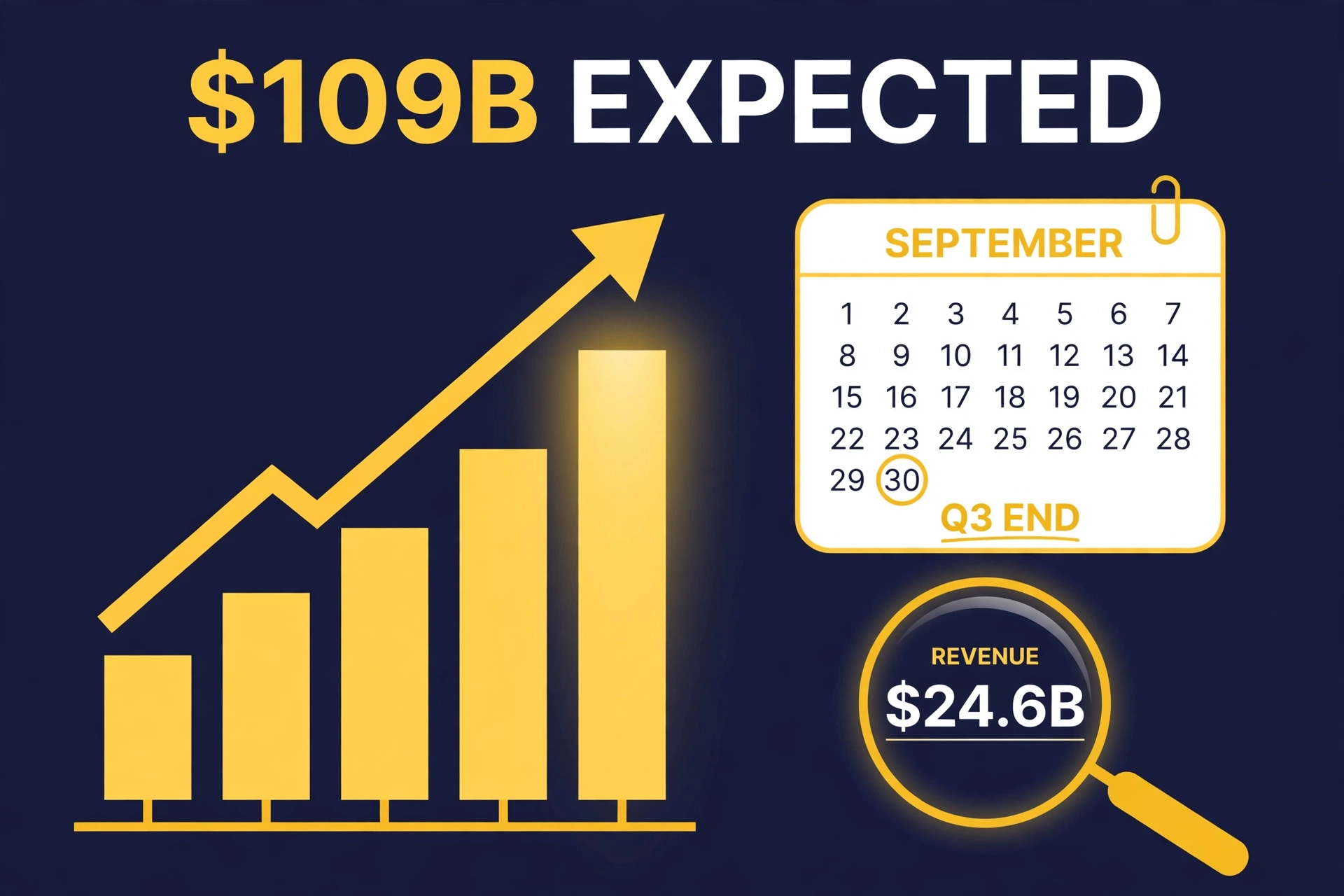
Now the numbers, because they still matter — and because their timing is widely misunderstood. Nvidia’s fiscal third quarter ended on 25 October. Huang resigned on 11 November. The results released tonight, at about 04:20 Vietnam time on Wednesday, describe a quarter that was planned, sold and shipped entirely under the old leadership. Whatever the headline figures say, they are a report card on the Huang era, not on the crisis that followed it.
The expectations are formidable. Consensus compiled by LSEG puts revenue at roughly $109 billion, up about 90% year on year, with earnings per share of $2.47 to $2.50. The company’s own guidance, given before the resignation, was about $108 billion, plus or minus 2%. A print in line with those numbers would confirm that the AI build-out’s central supplier had another record quarter. It would not, by itself, answer the only question the stock is actually asking.
That question sits in the guidance. The outlook for the current quarter — the first one owned, operationally and publicly, by Kress and the post-Huang board — is the real test tonight. So is any sentence, even a careful one, about the chief executive search. Kress, the long-serving chief financial officer now holding the interim role, leads the call at 05:00 Vietnam time. She cannot announce a successor she does not have. She can, if the board allows it, narrow the uncertainty: a process, a timeline, a criterion. The stock’s 35.8% slide says the market will pay for any of the three.
Nvidia Q3 FY2027 consensus estimates and guidance benchmarks ahead of the earnings call. Source: CoinXSight Financial Desk / LSEG.
Earnings day in numbers
Measure
Reading
Source / note
NVDA close, Monday 16 Nov
$156.14 (−4.12%)
Market data; intraday low $155.59
From 6 Oct high ($243.37)
−35.8%
Roughly $2 trillion of market value erased since early Oct
Q3 FY2027 consensus revenue
~$109 billion (~+90% YoY)
LSEG
Q3 consensus EPS
$2.47–$2.50
LSEG
Company guidance
~$108 billion ±2%
Issued before the 11 Nov resignation
Quarter end
25 October
Results pre-date the resignation
Report / call (Vietnam time)
~04:20 / 05:00, Wed 18 Nov
Kress, interim CEO, leads the call
Bitcoin, Tue 17 Nov 13:43 VN
$64,421
Finnhub; day range $63,905–$65,696
Fear & Greed Index
12 — Extreme Fear
alternative.me, 17 Nov
Why crypto is watching a chipmaker’s board fight
Bitcoin spent Tuesday doing what it has done for a week: not much, at a bad level. It touched $65,696 in the morning session and slipped back to $64,421 by early afternoon Vietnam time — below the $65,510 weekly close and far below the 200-week moving average near $67,982, as this week’s close below that line set the tone. The Fear & Greed Index sits at 12. Forced selling, at least, has gone quiet: one aggregator’s rolling 24-hour liquidation total was just $66.5 million, with shorts squeezed harder than longs — a market that has stopped panicking and started waiting.
What it is waiting for is the same thing equity traders are waiting for. Monday’s session made the linkage plain, as this morning’s lead-lag analysis showed: crypto fell first, a week earlier, and stocks spent Monday catching down. Nvidia is the largest single carrier of the AI risk trade that both markets now share. A strong print with steady guidance gives risk appetite a reason to stabilise into the December Fed meeting, where a 25-basis-point hike is priced at roughly 96% on the latest FedWatch readings and a 50-point move has faded to about 4%. A weak guide, or a call that dodges the leadership question entirely, tells two markets at once that the wobble has further to run.
What tonight decides
The evening runs in two acts. First, at 20:30 Vietnam time, US retail sales for October — consensus is a nominal gain of just 0.2% month on month, against an October CPI print of +0.4%. Read that correctly: an unadjusted +0.2% in dollar terms can still mean flat-to-negative real spending, and it lands hours before the Nvidia release as the undercard for the main event.
Then the print itself. Three things will decide how Wednesday opens: whether revenue lands on the $109 billion line the market has set; whether the current-quarter guidance holds the growth story intact under new management; and whether anyone on the call says anything — anything at all — about who leads this company next. The board, if Monday’s reporting is right, is not discussing the founder’s return. The President thinks it would not be a bad idea. Tonight, for the first time, Nvidia has to talk over both of them.
Disclaimer: This article is for informational purposes only and does not constitute financial advice. Figures are cited from official releases and market data as reported at the time of writing and are subject to revision. Cryptocurrency markets are volatile; always do your own research before making investment decisions.
CX
CoinXSight Alpha Desk
ALPHA // DESK
Quantitative Research Desk·Global Alpha Division
CoinXSight Institutional Research Desk produces quantitative crypto market intelligence, algorithmic models, and on-chain forensics.
QUANTITATIVE SUITE // DEEP ALPHA ENGINEACTIVE
BTC/USDT // LIVE SCANNER
CONFLUENCE 74
LIVE SPOT PRICE$82,807.47WEAK_BUY
TP2
$89,522.75
+9.07%
TP1
$85,056.42
+3.63%
ENTRY
$82,078.86
ZONE
SL
$80,590.09
-1.81%
Auto-detect Order Blocks, Fair Value Gaps and risk-adjusted DCA ladders in < 5s.