Three Central Banks, Three Answers: The Fed Held, Two Voters Wanted a Hike
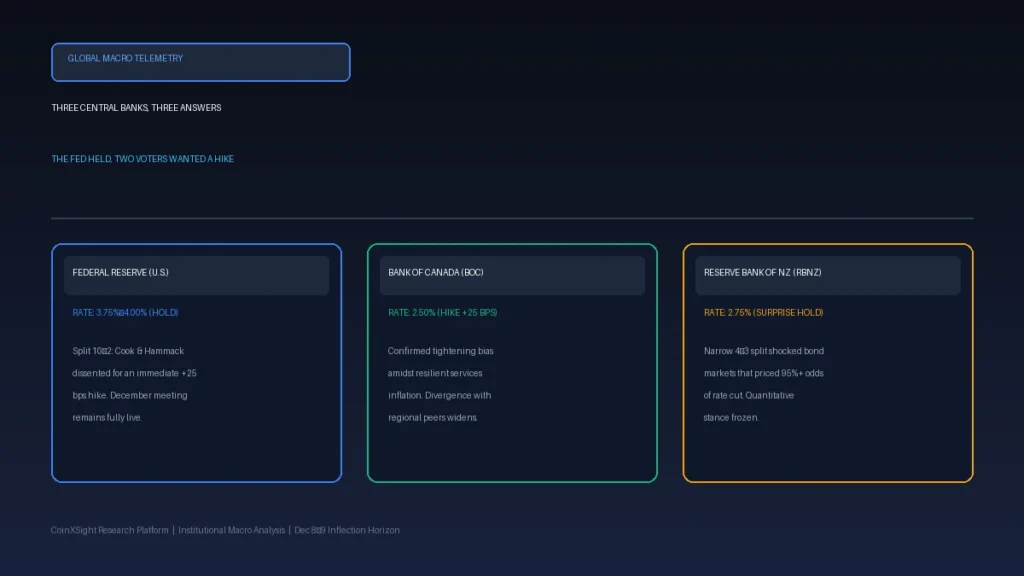
FOMC recap: the Fed held 3.75–4.00% but two voters dissented for a hike, Canada hiked to 2.50%, and the RBNZ shocked markets by holding at 2.75%. All three decide again on Dec 8–9 — and September core PCE at 3.1% confirmed the hawkish case.
CX
CoinXSight Alpha DeskQuantitative Research Desk·Oct 29, 2026 · Updated Oct 30
In the space of fourteen hours, three central banks looked at the same problem — energy-driven inflation that refuses to die — and gave three different answers. The Federal Reserve held and argued about it in public. The Bank of Canada hiked. The Reserve Bank of New Zealand was expected to hike almost unanimously, and held anyway.
For crypto, the headline is not the hold. Bitcoin took back $81,000 overnight and is holding it this morning, trading around $81,150 after closing October 28 at $81,254. The headline is that the world’s rate-setters have stopped moving together — and that every road now leads to the same week in December.
The Fed: A Hold With Two Votes for a Hike
The FOMC kept the federal funds rate at 3.75%–4.00% on Wednesday, as roughly nine in ten market participants expected. What the market did not fully price was the shape of the dissent: the vote was 10–2, and both dissenters — Lisa Cook, in her first dissent, and Cleveland Fed president Beth Hammack — wanted a 25-basis-point increase, immediately, because inflation remains too high.
Read the statement language alongside the vote and the “pause” framing falls apart. Growth was upgraded from September’s “solid” to a “strong pace.” The labor market was described as keeping up with the labor force, with unemployment little changed. Inflation “remains elevated.” The committee added a new sentence about accumulating more information to determine the stance — and a harder one: “The Committee will deliver price stability.” Chair Warsh’s press conference matched it. He did not promise a December hike, and he did not rule one out. KPMG’s summary was the cleanest: December is live.
The bond market heard it. The 2-year yield eased 3.8 basis points to 4.70% on the hold itself, but the long end sold off — the 10-year rose 5 basis points to 5.042% and the 30-year 6 basis points to 5.367%. Equities shrugged (+0.2% on the S&P 500 and Nasdaq). That is not a dovish-hold signature. That is a market being told the next move could genuinely go either way, with the burden of proof on the inflation data.
Ottawa Just Did It
While Washington debated, Ottawa acted. The Bank of Canada raised its policy rate 25 basis points to 2.50% — its first move in roughly a year, ending a run of seven straight holds — citing persistent, energy-led inflation pass-through, with September CPI running above the top of its 1–3% target band. Governor Macklem left the door open to more: there “could be a need to increase further,” though the bank would “proceed carefully.” Its 2027 inflation forecast was lifted to 3.1% from 2.0% in July.
Canada matters here less for the rate itself than for the precedent. A G7 central bank has now demonstrated that in this cycle, “higher for longer” can still become “higher.” That is the scenario the two Fed dissenters are arguing is already warranted in the United States.
Wellington Refused — Narrowly
The week’s genuine shock came twelve hours earlier, in Wellington. Markets had priced the Reserve Bank of New Zealand at roughly 95–100% to hike to 3.00%, and 23 of 25 economists in a Bloomberg survey agreed. The RBNZ held at 2.75%.
The split was 4–3, and the minutes are more hawkish than the decision. The majority pointed to third-quarter CPI easing to 3.7% from 4.1%, cooling wage growth, and the tail risk of a sharp global slowdown. The minority wanted the hike now. Critically, all seven members agreed tighter policy may still be needed — they differed only on timing. The bank’s own forecast has fourth-quarter CPI rising to 4.4% on fuel prices. The kiwi dollar fell through 0.5600 on the decision, but this was a deferral, not a reprieve: the RBNZ meets again on December 9, with a full Monetary Policy Statement.
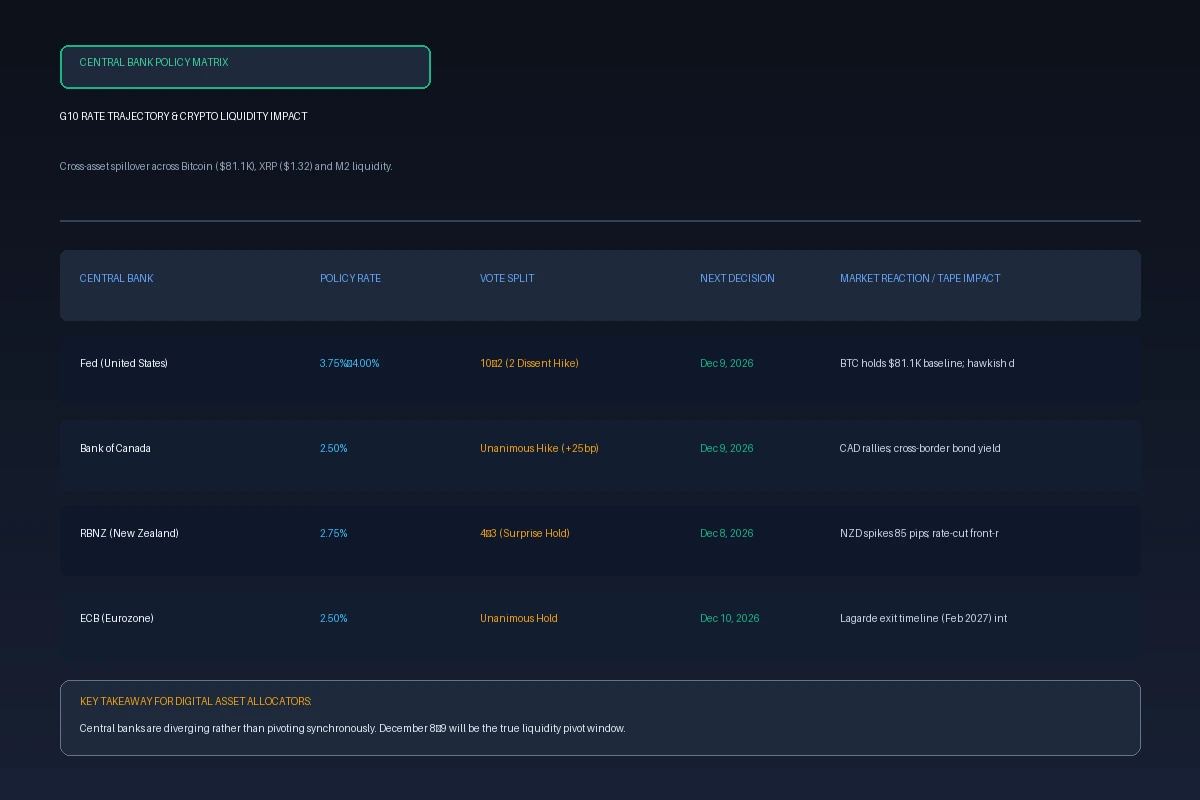
Central bank
Decision (Oct 28–29)
Vote
Signal
Next meeting
Federal Reserve
Hold at 3.75%–4.00%
10–2, both dissents for a hike
“Will deliver price stability”; December live
Dec 8–9
Bank of Canada
Hike +25bp to 2.50%
—
First hike since 2023; more possible, “carefully”
Dec 9
RBNZ
Surprise hold at 2.75%
4–3, minority wanted 3.00%
All 7 agree tightening may still come
Dec 9
Why Crypto Should Care About December 8–9
Three central banks, three answers — and one shared calendar. The Fed decides December 8–9. The Bank of Canada and the RBNZ both decide December 9. The global tightening question will be answered, in all three places, inside the same 36 hours.
Bitcoin’s price action overnight says the market is treating the Fed outcome as survivable: a reclaim of $81,000, a close at $81,254 (+0.8%), dominance steady at 60.2% of a $2.69 trillion market. XRP, in the middle of Ripple’s Swell conference in New York, is holding above $1.30 at about $1.32, inside a $1.31–$1.34 range. Neither asset is trading like a December hike is the base case — pre-decision pricing had it at roughly 73–86%, high enough to matter, low enough to keep hope funded.
The first real test arrives tonight, not in December. September PCE prints at 19:30 Vietnam time alongside the advance reading of third-quarter GDP. Consensus expects core PCE to re-accelerate to 3.1% year over year from 3.0%. If it does, the Cook–Hammack argument gets its receipt within 24 hours of the vote, and December hike odds reset higher into exactly the weeks when Swell’s headlines fade. A soft core print, by contrast, lets the hold breathe and keeps the current bid under Bitcoin into month-end.
One Swell note, kept in its proper box: on Day 2, Brad Garlinghouse answered the week’s rumor cycle directly — “we will never give up on XRP” — and Moody’s assigned RLUSD an A2 long-term rating. The rating is an assessment of the stablecoin’s reserves and redemption arrangements. It is not an endorsement of XRP’s price, and the two should not be traded as one.
The week began with three central banks diverging. It will end with one inflation print deciding whether that divergence was a disagreement about timing — or the first crack in the idea that this tightening cycle is over.
Disclaimer: This article is for informational purposes only and does not constitute financial advice. Central bank decisions, vote splits and market prices are cited as reported at the time of writing and may be revised. Cryptocurrency markets are volatile; always do your own research before making investment decisions.