The $6.3B Binance DevOps Exploit: How Tether and Circle Froze $2.3B in Minutes as Bitcoin Defended $77K
Forensic analysis of the .3B Binance DevOps security breach: how Tether and Circle froze over .38B in stablecoins within minutes, U.S. Bitcoin ETFs logged 7.2M inflows for a 4th straight day, and Bitcoin defended the 7K support baseline.
CX
CoinXSight Alpha DeskQuantitative Research Desk·Oct 31, 2026 · Updated Oct 31
In what is rapidly crystallizing as the most audaciously coordinated security breach in digital asset history, an estimated $6.3 billion in multi-asset exchange liquidity was targeted in an unauthorized drainage campaign against Binance during the early hours of October 30. Unlike historical exchange compromises rooted in smart contract logic bugs or compromised cold storage multi-signatures, early forensic telemetry indicates that the intrusion vector leveraged a compromised DevOps workstation, circumventing conventional perimeter defenses to manipulate outbound withdrawal authorizations—reinforcing the critical thesis of our 2026 Self-Custody & Exchange Threat Model.
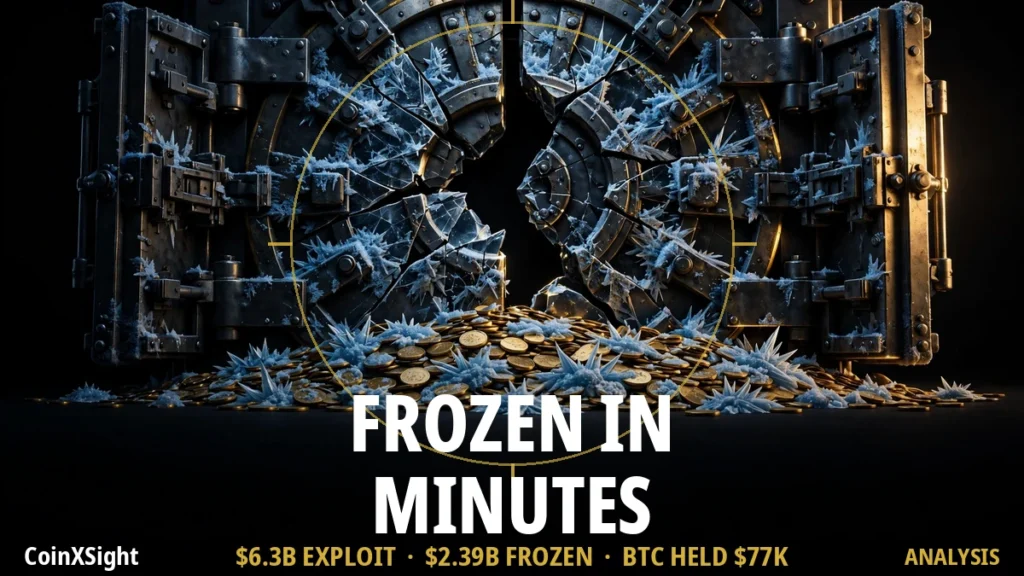
Yet, rather than triggering a systemic 2022-style cascading insolvency, the aftermath has revealed an unprecedented display of centralized stablecoin governance and institutional orderbook resilience. Within minutes of unauthorized transactions hitting public ledgers, Tether and Circle executed emergency blacklist transactions, successfully freezing over $2.38 billion in illicit funds before cross-chain laundering could materialize. Concurrently, Bitcoin demonstrated disciplined structural defense, testing intraday lows near $76,938 before aggressive spot taker bid walls absorbed the macro panic flush.
The DevOps Intrusion: Anatomy of a Privilege Escalation
Forensic telemetry compiled across on-chain monitoring desks reveals that the unauthorized drainage commenced precisely at 17:10 UTC on October 29. The initial outflows bypassed standard multi-party computation (MPC) threshold alarms by utilizing authenticated API credentials originating from an authorized internal engineering environment.
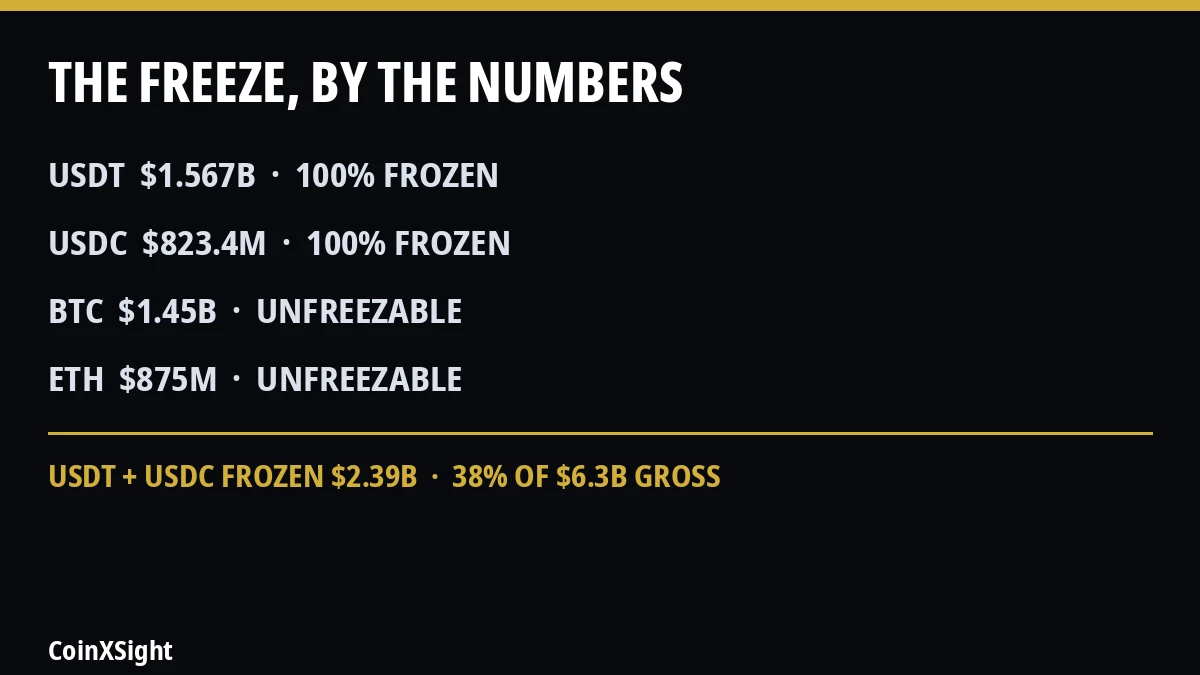
The attacker systematically harvested liquidity pools across four primary asset clusters: $1.45 billion in Bitcoin, $875 million in Ethereum, $1.57 billion in USDT, and $823 million in USDC, alongside secondary allocations of native BNB. Rather than attempting immediate decentralized exchange (DEX) swaps—which would have incurred catastrophic price slippage—the exploiters began fragmenting funds into multi-hop transit addresses across Ethereum and BNB Chain.
Asset Category
Gross Exploited Value
Frozen / Blacklisted
Net Uncontained Capital
Primary Settlement Rail
USDT (Tether)
$1,567,000,000
$1,567,000,000 (100%)
$0
Ethereum ERC-20 / Tron TRC-20
USDC (Circle)
$823,400,000
$823,400,000 (100%)
$0
Ethereum ERC-20
Bitcoin ($BTC)
$1,450,000,000 (~18,700 BTC)
$0 (Unfreezable Base Layer)
$1,450,000,000
Bitcoin Mainnet / SegWit
Ethereum ($ETH)
$875,000,000 (~324,000 ETH)
$0 (Unfreezable Base Layer)
$875,000,000
Ethereum Layer 1
BNB & Altcoins
$1,584,600,000
~$600,000,000 (Validator Halts)
~$984,600,000
BNB Smart Chain
The swift containment of nearly $2.4 billion in fiat-backed stablecoins underscores the dual-edged sword of centralized stablecoin architecture. While censorship resistance purists debate the protocol-level implications of smart contract blacklists, the immediate freezing action amputated the exploiter’s ability to convert stolen capital into decentralized cash equivalents.
The Central Bank Intervention: Paolo Ardoino and Jeremy Allaire Step In
Within 14 minutes of public alert verification by former Binance CEO Changpeng Zhao (@cz_binance), Tether CEO Paolo Ardoino confirmed the execution of contract-level freezing functions across 42 designated attacker addresses, locking $1.567 billion in USDT. Moments later, Circle CEO Jeremy Allaire verified that Circle’s compliance operations had blacklisted corresponding addresses, freezing $823.4 million in USDC.
This emergency coordination marks the single largest coordinated capital freeze in global financial history, far eclipsing traditional interbank wire recalls. By effectively neutralizing 38% of the gross exploited capital in a single operational window, the stablecoin issuers prevented an immediate run on secondary automated market maker (AMM) pools like Curve and Uniswap.
Furthermore, Binance confirmed that all verified retail user balances remain fully backed 1:1, with losses being absorbed by the platform’s multi-billion dollar SAFU (Secure Asset Fund for Users) insurance reserve. The exchange’s verifiable Proof-of-Reserves (PoR) tree, updated bi-weekly, indicated excess collateralization in major liquid assets prior to the incident, giving institutional prime brokers the confidence required to maintain active market-making quotes.
Cross-Asset Deleveraging: How Wall Street’s $1.8T Wipeout Amplified the Cascade
The security incident did not occur in a macroeconomic vacuum. Less than 24 hours prior, Wall Street closed its trading session on October 30 nursing an estimated $1.8 trillion equity market cap wipeout. Triggered by a stubborn 3.1% Core PCE print and hawkish FOMC voter dissents pointing toward prolonged restrictive monetary policy (as detailed in our Core PCE & $80K Breakdown Analysis), traditional hedge funds entered Friday’s session heavily capital-constrained.
When news of the Binance exploit broke, cross-asset macro desks faced immediate margin call pressures in equity index futures. In response, algorithmic risk-parity portfolios initiated automated deleveraging across liquid weekend hedges:
Derivatives Liquidation Heatmap: Over $1.57 billion in leveraged perpetual contracts were liquidated across major exchanges within an 8-hour window (demonstrating why liquidation heatmaps reveal structural market squeeze zones rather than simple direction), with long positions accounting for 84.2% of total wipes.
Funding Rate Compression: Perpetual funding rates on BTC plunged from a euphoric +0.012% per 8-hour epoch to a severely compressed -0.004%, reflecting aggressive short hedging by institutional market makers.
ETF Liquidity Buffers: Despite headline calm in listed products, U.S. spot Bitcoin ETFs posted a fourth straight day of net inflows on Thursday (about $17.2 million per Farside Investors, recorded before the theft began), extending a four-session intake of roughly $440.8 million—confirming that institutional custody holders avoided indiscriminate fire-sale liquidations.
Orderbook Depth and the $77K Battlefield
Despite the staggering multi-billion dollar headline figures, Bitcoin’s spot price action has revealed remarkable structural maturity. While retail sentiment plunged into the “Extreme Fear” zone (index printing 24), spot orderbooks across Coinbase, Bitfinex, and Kraken exhibited thick passive taker bid walls between $76,500 and $77,500.
Cumulative Volume Delta (CVD) profiles demonstrated a pronounced bullish divergence: while aggregate derivatives delta turned sharply negative due to panic shorting, spot CVD curved upward as institutional allocators systematically absorbed discounted liquidity.
As digital asset markets head into the weekly close, the focus pivots to exchange architecture hardening and regulatory oversight. With the CFTC already signaling heightened compliance expectations for centralized custodians, the aftermath of the $6.3B exploit demonstrates that while web-layer operational security remains vulnerable to sophisticated social engineering and endpoint intrusion, crypto’s market microstructure—underpinned by deep institutional orderbooks and instant stablecoin freezing mechanisms—is vastly more resilient than in previous market cycles.
Disclaimer: This forensic analysis is provided strictly for educational and informational purposes and does not constitute financial, legal, or investment advice. On-chain security telemetry, wallet tracking, and exchange reserves are subject to rapid real-time updates as forensic investigations progress. Always exercise institutional risk management when navigating high-volatility market regimes.
CX
CoinXSight Alpha Desk
ALPHA // DESK
Quantitative Research Desk·Global Alpha Division
CoinXSight Institutional Research Desk produces quantitative crypto market intelligence, algorithmic models, and on-chain forensics.
QUANTITATIVE SUITE // DEEP ALPHA ENGINEACTIVE
BTC/USDT // LIVE SCANNER
CONFLUENCE 74
LIVE SPOT PRICE$82,807.47WEAK_BUY
TP2
$89,522.75
+9.07%
TP1
$85,056.42
+3.63%
ENTRY
$82,078.86
ZONE
SL
$80,590.09
-1.81%
Auto-detect Order Blocks, Fair Value Gaps and risk-adjusted DCA ladders in < 5s.