👉 The Complete Money Flow Trading System(you are here — finale)
Bringing It All Together
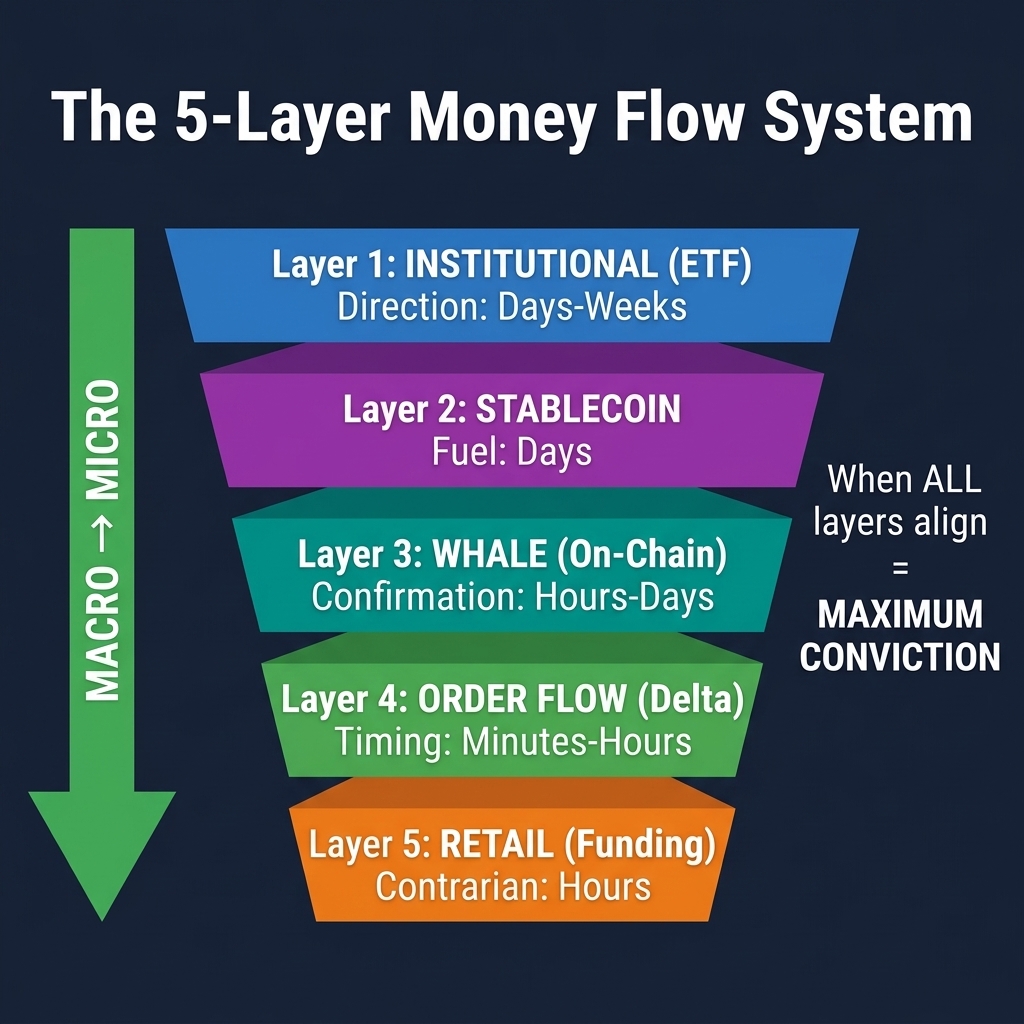
Over 6 parts, we have dissected every layer of crypto money flow — from institutional ETF capital moving billions per day, to micro-level order flow delta measured per tick. Now we assemble these layers into one complete, executable trading system.
This is not theory. This is a rules-based framework you can implement today on any crypto exchange using CoinXSight and free external tools. Every decision has a clear trigger. Every position has defined risk. Every exit has a plan.
The 5-Layer System Architecture
Layer
Signal Source
Timeframe
Role
Tool
1. Institutional
ETF flows, CME OI
Days-weeks
Direction — Are the biggest players buying or selling?
Open BTC and ETH 1H charts → Check CVD for divergences
Check CoinGlass → Funding rate + OI changes
CoinXSight Deep Alpha → Confluence Score for BTC, ETH, and watchlist
Decision Matrix
After the morning routine, classify the market state:
ETF Flow
Stablecoin
Whale
Order Flow
Funding
Action
✅ Positive
✅ Rising
✅ Negative (accumulating)
✅ Bullish divergence
✅ Neutral/negative
FULL LONG — Maximum conviction
✅ Positive
✅ Rising
✅ Negative
❌ No setup
✅ Neutral
WAIT — Direction right, no timing trigger
✅ Positive
✅ Rising
❌ Positive (distributing)
—
—
CAUTION — Smart money disagreement
✅ Positive
❌ Declining
—
—
—
LIMITED — No fuel for rally
❌ Negative
—
—
—
—
NO LONGS — Only shorts or flat
❌ Negative
❌ Declining
✅ Positive (distributing)
✅ Bearish divergence
✅ High positive
FULL SHORT — Maximum conviction
Real Example — 5-Layer Confluence on BTC Long (May 2026)
On May 8, 2026, all 5 money flow layers aligned bullish on CoinXSight:
(1) ETF inflows: +$620M over 3 days, (2) Stablecoin SSR dropped to
10.8, (3) Whale wallets accumulated 8,400 BTC, (4) Order flow delta:
+$120M net buying, (5) Sector rotation: BTC dominance rising +1.2%.
BTC was at $103,800. The 5-layer system scored 9/10. BTC reached
$112,400 (+8.3%) over the next 11 days — the strongest signal the
complete system produced in Q2 2026.
Real Example — False Signal Filtered by Layer Conflict (June 2026)
On June 1, 2026, ETH showed bullish order flow delta (+$45M) and
positive stablecoin flow, but whale wallets were distributing (18,000
ETH moved to exchanges) and sector rotation favored BTC over alts.
The 5-layer system scored only 3/10 — two layers conflicting. Traders
who followed the system and sat out avoided ETH's −4.2% drop from
$2,590 to $2,480 over the next 48 hours. The incomplete confluence
was the filter that prevented a losing trade.
Position Sizing Framework
Conviction-Based Sizing
Layers Aligned
Conviction Level
Position Size (% of trading capital)
5/5 layers
Maximum
10% per trade (up to 30% total exposure)
4/5 layers
High
7% per trade (up to 20% total exposure)
3/5 layers
Moderate
4% per trade (up to 15% total exposure)
2/5 layers
Low
2% per trade (single position only)
1/5 or 0/5
None
No trade. Wait.
Portfolio Allocation Model
Allocation
Purpose
Percentage
Core BTC Position
Long-term hold based on Layer 1-3 signals
40%
Active Trading
Swing trades using full 5-layer system
30%
Sector Rotation
Altcoin rotation based on TVL + narrative flow
15%
Stablecoin Reserve
Dry powder for high-conviction setups
10%
DeFi Yield
Staking rewards on idle stablecoins/ETH
5%
Risk Management Rules
Rule 1: The 2% Rule
Never risk more than 2% of total capital on a single trade. If your stop loss is 5% from entry, your position size should be no more than 40% of trading capital (2% ÷ 5% = 40%).
Position Size = (Account Balance × Max Risk%) / Stop Loss Distance%

Money Flow System Risk Rules:
- Full confluence (8-10/10): Risk up to 2% per trade
- Moderate confluence (5-7/10): Risk max 1% per trade
- Weak confluence (1-4/10): No trade — sit out
Rule 2: Correlated Exposure Cap
BTC and altcoins are highly correlated in downtrends. Never have more than 50% of total capital in correlated long positions simultaneously.
Rule 3: Flow Conflict = Reduce Size
If any layer conflicts with the others, reduce position size by 50%. If Layer 1 (institutional) conflicts, do NOT take the trade at all.
Rule 4: Time Stop
If a trade has not reached its target within the expected timeframe (defined by the entry signal's layer), exit at market:
Layer 4 (order flow) trades: 3-5 days max
Layer 3 (whale) trades: 2-3 weeks max
Layer 1-2 (macro) trades: 4-6 weeks max
Rule 5: Monthly Drawdown Circuit Breaker
If your account drops 10% in a calendar month:
Stop all new trades for 48 hours
Review all open positions — close any without 3+ layer support
Reduce position sizing by 50% for the remainder of the month
Resume normal sizing next month if drawdown recovered
The 6 High-Conviction Setups
These are the specific setups from this series with the highest historical win rates:
Confluence Score 5-7 → Moderate alignment. Trade with caution and reduced size.
Confluence Score 0-4 → Weak alignment. No trade or contrarian only.
The Confluence Score is not a replacement for manual analysis, but it serves as an excellent first filter — especially when you are monitoring 10+ assets on your crypto portfolio tracker via platforms like CoinGecko or Glassnode for on-chain metrics.
What to Do Next
You have now completed the Money Flow Trading Mastery 2026 series. Here is your action plan:
Week 1: Build Your Monitoring Stack
Set up CoinXSight account → configure Dashboard with Whale Netflow alerts
Bookmark CoinGlass (ETF flows, funding rates) and Coinalyze (CVD charts)
Practice the 15-minute morning routine for 5 consecutive days without trading
Week 2: Paper Trade
Identify which of the 6 setups appears during the week
Paper trade each setup with proper position sizing
Log every trade with entry reason, layers aligned, and outcome
Review at end of week — which setups worked? Which layers were most informative?
Week 3-4: Live Trading with Minimum Size
Start with 25% of your normal position size
Only take trades with 4+ layers aligned
Use strict stop losses per the risk management rules
Scale up position size only after 10+ trades with positive expectancy
Ongoing: Monthly Review
Calculate win rate, profit factor, and average return per setup
Identify which flow layers provided the most value
Adjust position sizing based on performance
Re-read relevant parts of this series when a setup underperforms
This is the culmination of the entire Money Flow Trading Mastery series. You now have a complete, rules-based system for trading crypto using money flow analysis. Whether you want to buy Bitcoin with maximum conviction or capture altcoin rotation gains, this framework works on any crypto exchange with any crypto wallet setup. The edge is not in any single signal — it is in the confluence of all five layers working together.
Secure your edge: As your trading system generates profits on the crypto exchange, consistently transfer gains to a hardware crypto wallet. Keep your trading capital on the platform, but protect your profits in cold storage. This discipline separates successful traders from those who give back their gains.
Attribution
The multi-layer confluence approach to money flow draws from Richard Wyckoff's composite operator theory and Marc Chaikin's money flow indicator work. CoinXSight's 5-layer framework extends these principles with modern on-chain and order flow data.
FAQ
How long does it take to learn the full 5-layer system?
Most traders become comfortable with Layers 1-3 (macro flow) within 2-3 weeks of daily practice. Layer 4 (order flow delta) requires 4-6 weeks of chart study to recognize divergences and absorption patterns reliably. Layer 6 (sector rotation) is ongoing learning. Budget 6-8 weeks of dedicated study and paper trading before committing significant capital. CoinXSight's crypto analytics platform Confluence Score helps accelerate learning by showing you what multi-layer alignment looks like.
Can I automate this system with a trading bot?
Layers 1-3 can be partially automated — monitoring ETF flows, stablecoin reserves, and whale netflow for threshold alerts. Layer 4 (delta analysis) is harder to automate because absorption patterns require visual pattern recognition. Layer 5 (funding rate) is easily automated. Full automation is not recommended; the system works best as a human-directed framework with automated monitoring and alerts from your trading bot.
What is the minimum capital needed for this system?
The system itself works with any capital size. However, proper position sizing (2% risk rule) and multiple simultaneous positions require at least $5,000-$10,000 in trading capital to be practical. Smaller accounts should focus on Setups 1-3 (fewer, higher-conviction trades with larger position sizes) rather than trying to run all 6 setups simultaneously on the crypto exchange.
Does this system work for day trading or only swing trading?
The full 5-layer system is designed for swing trading (holding 3 days to 6 weeks). Day traders can use Layer 4 (order flow) and Layer 5 (funding) for intraday entries, but should still check Layers 1-3 for macro context. Trading against macro flow on an intraday basis has a significantly lower win rate. Use CoinXSight's crypto portfolio tracker to monitor macro flow while executing intraday trades.
How do I handle conflicting signals between layers?
Layer 1 (institutional flow) always takes priority. If institutional flow is negative, do not take longs regardless of other layers. Beyond that, the rule is simple: the more layers that agree, the higher the conviction. If 3+ layers agree and 1-2 are neutral or weakly opposing, the trade is valid but with reduced size. If 2+ layers actively conflict, no trade. The Confluence Score on CoinXSight summarizes this analysis automatically.
Disclaimer: This article is for educational and informational purposes only and does not constitute financial, investment, or trading advice. Cryptocurrency markets are highly volatile and involve substantial risk of loss. No trading system guarantees profits — past confluence scores do not predict future results. Paper-trade or demo-trade before risking real capital. Always conduct your own research (DYOR) and consult a licensed financial advisor before making any investment decisions. CoinXSight provides analytical tools and data — not investment recommendations.