Understand Maximal Extractable Value (MEV) and how sandwich attacks, front-running, and liquidation bots extract profit from your trades. Learn practical protection strategies for DEX trading.
DP
David ParkChief On-Chain Data Analyst·May 19, 2026 · 11 min read · Updated Oct 17
MEV — Maximal Extractable Value (formerly "Miner Extractable Value") — is the profit that validators, miners, and specialized bots can extract by manipulating the order of transactions within a block. Every time you submit a transaction on Ethereum, Solana, or any blockchain, it enters a waiting area called the mempool before being confirmed. During this window, your pending transaction is visible to everyone.
This visibility creates an opportunity: bots scan the mempool for profitable transactions and insert their own orders ahead of, behind, or around yours to extract value from your trade.
How much MEV is extracted? Since the merge in 2022, over $600 million in MEV has been extracted on Ethereum alone. On Solana, where speed makes MEV even more aggressive, the numbers are growing rapidly. If you've ever noticed worse-than-expected execution on a DEX swap, MEV extraction may be the reason.
Who extracts MEV?
Searchers: Specialized bots that scan the mempool and construct profitable transaction bundles
Builders: Block builders who assemble transaction orders to maximize MEV extraction
Validators: The final gatekeepers who include (or exclude) transactions from blocks
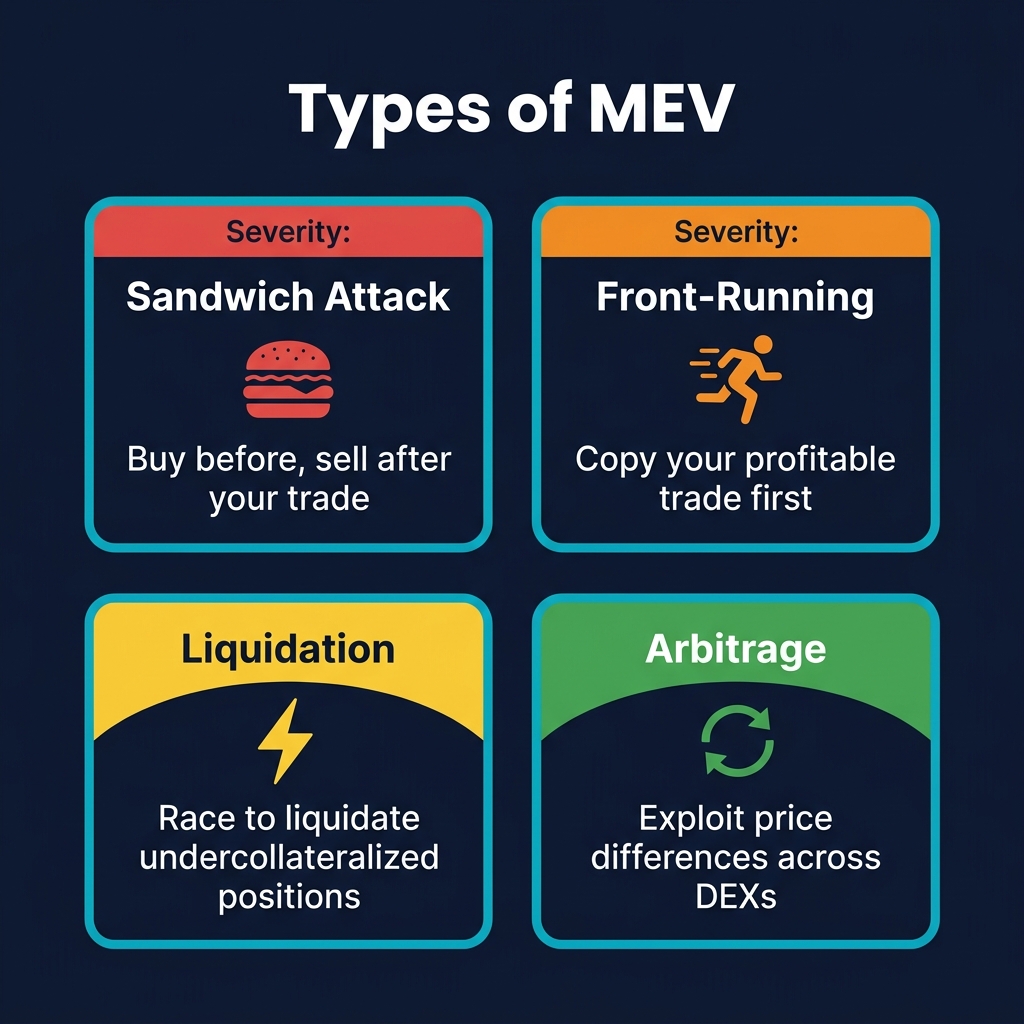
The 4 Types of MEV Attacks
1. Sandwich Attacks (Most Common)
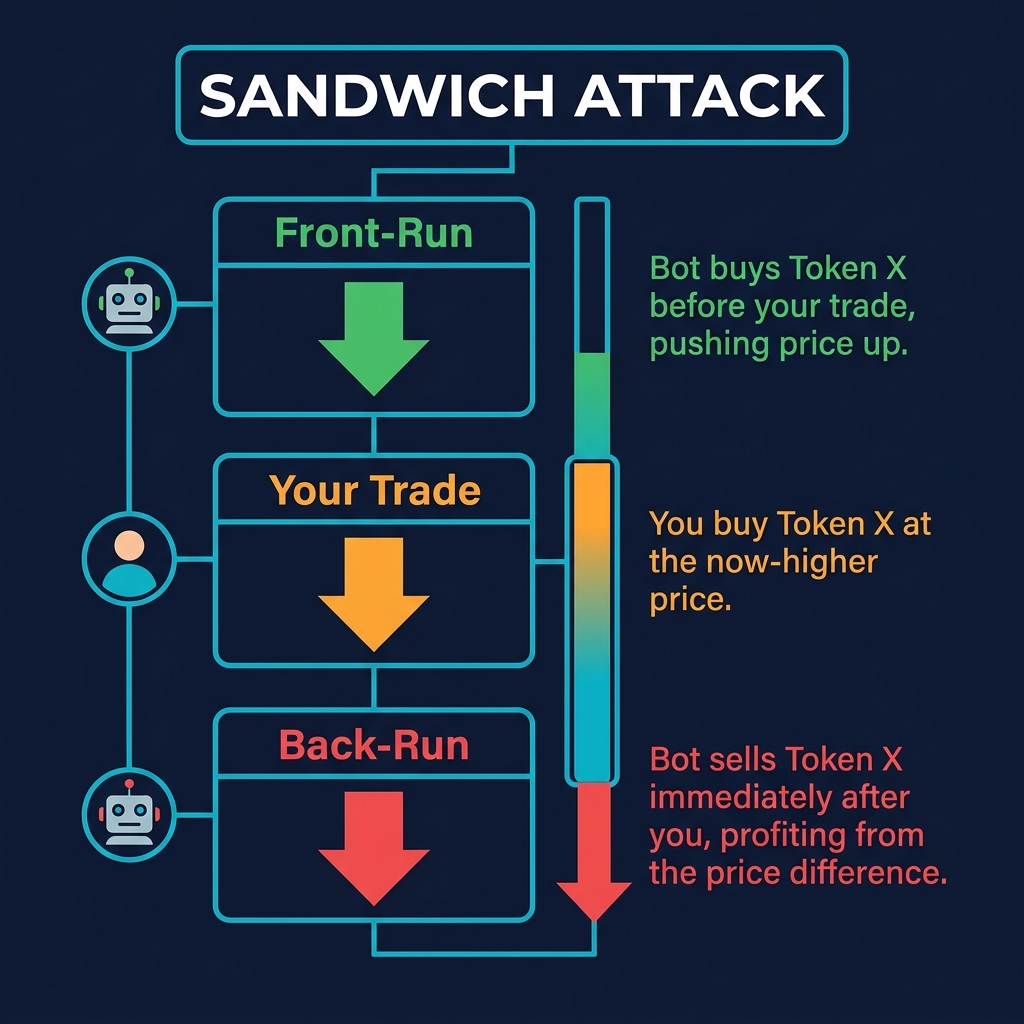
The sandwich attack is the most prevalent form of MEV extraction targeting retail traders on DEXs like Uniswap, Jupiter, and Raydium.
How it works:
You submit a swap: Buy 10 ETH worth of Token X on Uniswap
A bot detects your pending transaction in the mempool
The bot submits a BUY order for Token X before your transaction (front-run), pushing the price up
Your transaction executes at the now-higher price
The bot immediately submits a SELL order after your transaction (back-run), profiting from the price difference
Your loss: You paid a higher price than you should have. The difference between the fair price and the inflated price is the bot's profit — extracted directly from your trade.
Real-world example:
You: Swap 5 ETH → Token X at price $1.00
Bot front-run: Buys Token X, pushing price to $1.03
Your trade: Executes at $1.03 instead of $1.00 (3% worse)
Bot back-run: Sells Token X at $1.03, pockets the difference
Your loss: ~$150 on a $5,000 trade
Bot profit: ~$120 (after gas fees)
2. Front-Running (Transaction Copying)
Front-running occurs when a bot detects a profitable pending transaction and copies it, executing first to capture the profit.
Common targets:
Large buy orders on DEXs (bot buys first, sells to you at higher price)
Arbitrage transactions (bot copies your arbitrage trade before you)
NFT mints (bot mints before you on popular launches)
Token launches (bot buys tokens at launch price before retail)
How it differs from sandwiching: Front-running is a single transaction placed before yours. Sandwiching involves two transactions (one before, one after). Front-running is simpler but also profitable.
3. Liquidation MEV
In DeFi lending protocols (Aave, Compound, MakerDAO), positions become liquidatable when collateral value drops below a threshold. Liquidators earn a reward for closing these positions.
The MEV angle: Multiple bots compete to be the first to liquidate, creating a gas price auction (Priority Gas Auction or PGA). This competition wastes gas and can cause network congestion, but it also ensures liquidations happen promptly, which actually helps protocol health.
For traders, liquidation MEV matters because:
During market crashes, liquidation cascades can amplify price drops
Large liquidation events create temporary price dislocations that CoinXSight's Whale Stream can detect
Understanding where liquidation clusters sit helps predict support/resistance levels
4. DEX Arbitrage
When the same token is priced differently across DEXs (e.g., ETH/USDC is $2,450 on Uniswap but $2,453 on SushiSwap), arbitrage bots simultaneously buy low and sell high to capture the difference.
Is this harmful? Unlike sandwich attacks, DEX arbitrage is generally positive for the ecosystem — it keeps prices consistent across exchanges. The "MEV" aspect comes from the competitive race to execute arbitrage first, which can cause gas price spikes.
How MEV Affects Your Trading
On Decentralized Exchanges (DEXs)
Trade Size
MEV Risk
Typical Impact
Under $1,000
Low
Bots rarely target small trades (gas costs exceed profit)
$1,000 – $10,000
Medium
Sandwich attacks become profitable for bots
$10,000 – $100,000
High
Actively targeted, significant slippage
Above $100,000
Very High
Multiple bots compete, maximum extraction
On Centralized Exchanges (CEXs)
MEV as described above doesn't exist on centralized exchanges like Binance or Coinbase because order matching happens on private servers, not on a public blockchain. However, similar concepts exist:
Order flow payment: Exchanges can sell information about pending orders
Internal matching: Some exchanges match orders internally before routing to the public order book
Latency advantages: Co-located servers gain millisecond advantages
CoinXSight's Exchange Flow Analysis focuses on on-chain movements between exchanges and wallets, which are fully transparent and not subject to MEV.
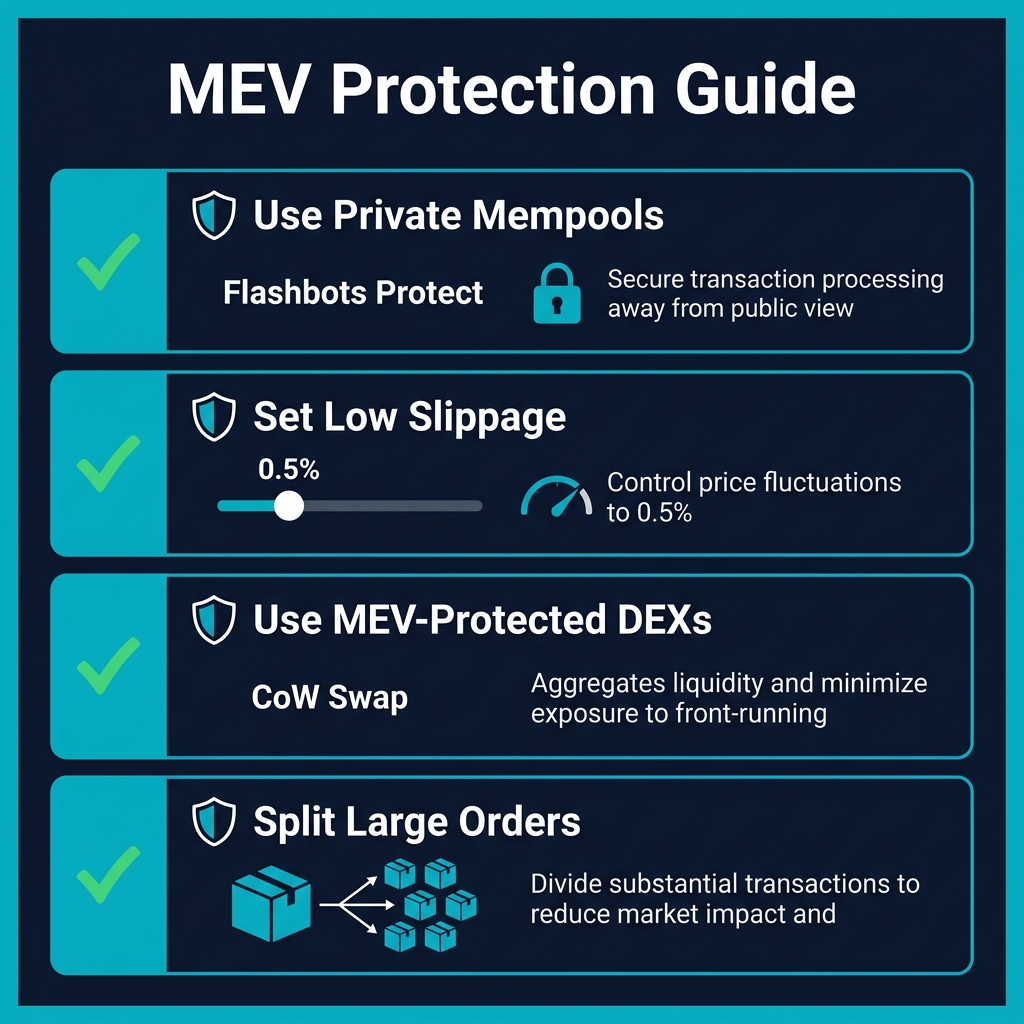
How to Protect Yourself from MEV
1. Use Private Transaction Pools
Flashbots Protect (Ethereum): Instead of submitting your transaction to the public mempool, Flashbots routes it through a private channel directly to validators. Bots can't see your transaction until it's already confirmed.
How to use it:
Add Flashbots Protect RPC to your wallet: https://rpc.flashbots.net
All transactions automatically bypass the public mempool
No extra cost — validators include your transaction normally
Jito (Solana): Jito provides MEV protection on Solana through bundle auctions. Transactions submitted through Jito-protected RPC endpoints get block-space allocation without public mempool exposure.
2. Set Tight Slippage Tolerance
Slippage tolerance determines how much price movement you'll accept. If you set 5% slippage, bots can profitably sandwich you for up to 5% of your trade value.
Recommended settings:
Pool Type
Slippage Setting
Stablecoin swaps (USDT→USDC)
0.1%
Major pairs (ETH→USDC)
0.3-0.5%
Volatile altcoins
1-2%
Memecoins with low liquidity
3-5% (only if absolutely necessary)
Trade-off: Lower slippage reduces MEV risk but increases the chance your transaction fails (reverts) if the price moves naturally during confirmation.
Remaining orders go through MEV-protected channels
Often provides better execution than Uniswap directly
Jupiter (Solana) with MEV Protection:
Jupiter offers "MEV Protect" mode that routes trades through Jito
Recommended for all swaps over $1,000 on Solana
1inch Fusion:
Routes trades through a network of professional market makers
Market makers compete on price, removing MEV extraction opportunity
4. Split Large Orders
Instead of swapping $50,000 in one transaction:
Split into 5 × $10,000 over 5-10 minutes
Each smaller trade is less profitable for bots to sandwich
Reduces total MEV extraction significantly
Use DCA (Dollar Cost Average) DEX features:
TWAP orders on CoW Swap
Jupiter DCA on Solana
These automatically split your order over time
5. Use Limit Orders on DEXs
Limit orders on DEXs (via 1inch, CoW Swap, or Uniswap interface) execute at your specified price or better. Since they don't sit in the mempool as market orders, they're inherently protected from sandwich attacks.
MEV and CoinXSight: What You Need to Know
For Alpha Hunter Users
When CoinXSight's Alpha Hunter generates a BUY signal, and you execute on a DEX:
Use Flashbots Protect (Ethereum) or Jito (Solana)
Set slippage to 0.5% for major tokens
If the position is over $10,000, split into 2-3 transactions
Monitor execution price vs. CoinXSight's displayed price — any gap may indicate MEV
For Whale Stream Monitoring
Large whale transactions visible in CoinXSight's Whale Stream can attract MEV bots attempting to front-run:
If you see a whale buying and want to follow, use a private RPC to avoid the attention
Whale movements on CEXs (exchange deposits/withdrawals) are not affected by MEV
On-chain DEX whale trades ARE subject to MEV — factor this into your copy-trading strategy
For DeFi Yield Farming
If you're providing liquidity based on insights from CoinXSight's DeFi module:
Adding/removing large LP positions on-chain is subject to MEV
Use private transaction routing for all LP management transactions
Monitor your actual execution vs. expected tokens received
The MEV Ecosystem: An Evolving Landscape
MEV-Boost (Ethereum)
MEV-Boost separates block building from block proposing. Validators outsource block construction to specialized builders who compete to create the most profitable block. This centralizes MEV extraction but also creates a more orderly system than the chaotic gas wars of the past.
Flashbots SUAVE
An upcoming protocol designed to create a "fair ordering" system where transactions are processed in the order received, eliminating the ability to reorder for profit.
Solana's MEV Challenge
Solana's architecture (leader-based block production, no public mempool by default) was supposed to reduce MEV. In practice, MEV bots discovered alternative methods — private relays, validator relationships, and latency optimization — making Solana MEV a growing concern.
Frequently Asked Questions
Does MEV affect all blockchains?
Every blockchain with publicly visible pending transactions is susceptible to MEV. Ethereum and Solana are the most affected due to high DeFi activity. Bitcoin has minimal MEV because its UTXO model and limited smart contract functionality create fewer MEV opportunities.
How much money have I lost to MEV?
Check your past DEX trades using tools like Flashbots MEV Explorer (Ethereum) or Jito's block explorer (Solana). Compare your execution price with the fair market price at the time of your trade. Any significant gap may indicate MEV extraction.
Are CEX trades safe from MEV?
Centralized exchange trades are not subject to blockchain-level MEV because transactions are matched on private servers. However, CEXs have their own form of order flow manipulation through internalization and payment for order flow.
Will MEV eventually be eliminated?
Unlikely. MEV is a fundamental consequence of transaction ordering power. Solutions like Flashbots Protect and CoW Swap mitigate MEV for individual users, but MEV extraction at the protocol level will likely persist in some form. The industry is evolving toward "fair extraction" models where MEV profits are distributed back to users or protocols.
Is MEV legal?
MEV exists in a regulatory gray area. Unlike insider trading in traditional finance (which is illegal), blockchain transactions are publicly visible by design. There's no expectation of transaction privacy in a public mempool. However, regulations are evolving, and some jurisdictions may classify certain MEV strategies as market manipulation.
Summary
MEV is the invisible cost of on-chain trading. Sandwich attacks, front-running, and liquidation bots extract hundreds of millions of dollars from traders annually. Understanding MEV is essential for any crypto trader who uses DEXs.
The good news: practical protection exists. Using private RPCs (Flashbots, Jito), setting tight slippage, choosing MEV-protected DEX aggregators, and splitting large orders can eliminate most MEV exposure.
For CoinXSight users, the key integration point is execution. CoinXSight's AI modules identify WHAT and WHEN to trade — MEV protection ensures your HOW (execution method) doesn't silently erode your edge.
Key takeaways:
MEV bots extract profit by reordering your transactions in the blockchain
Sandwich attacks are the most common threat — the bot buys before you and sells after
Use Flashbots Protect (ETH) or Jito (SOL) to bypass the public mempool
Set slippage to 0.5% or lower for major tokens
Split orders over $10,000 into smaller transactions
Disclaimer: This article is provided for educational and informational purposes only and does not constitute financial, investment, or trading advice. Digital asset markets carry significant volatility and capital risk. Always conduct your own independent research (DYOR) before making any financial decisions.
DP
David Park
ON-CHAIN // ALPHA
Chief On-Chain Data Analyst·On-Chain Forensics Desk
On-chain data engineer tracking entity-adjusted exchange netflows, smart money clustering, whale wallet accumulation, and liquidity cluster dynamics.
QUANTITATIVE SUITE // DEEP ALPHA ENGINEACTIVE
BTC/USDT // LIVE SCANNER
CONFLUENCE 75
LIVE SPOT PRICE$81,504.32MODERATE_SELL
TP2
$90,021.17
+8.94%
TP1
$85,590.64
+3.57%
ENTRY
$82,636.95
ZONE
SL
$84,113.79
1.79%
Auto-detect Order Blocks, Fair Value Gaps and risk-adjusted DCA ladders in < 5s.
The DeFi yield farming landscape has fundamentally shifted from inflationary token rewards to sustainable, real-yield models. Learn which strategies generate…