DeFi Yield Farming in 2026: What Changed and What Works
The DeFi yield farming landscape has fundamentally shifted from inflationary token rewards to sustainable, real-yield models. Learn which strategies generate genuine returns in 2026, how to evaluate protocol risk, and how to optimize yield without excessive exposure.
DK
Daniel KimHead of Curriculum & Trader Development·May 19, 2026 · 14 min read · Updated Oct 6
Yield farming in 2021-2022 was simple: deposit tokens, receive inflated governance rewards, sell rewards for profit. APYs of 500-5000% were common. The problem was obvious in hindsight — those yields came from printing new tokens, diluting existing holders. When the music stopped, farm tokens lost 90-99% of their value and the "yield" evaporated.
By 2026, the DeFi yield landscape has matured. The dominant model is real yield — returns generated from actual economic activity: trading fees, lending interest, liquidation proceeds, and increasingly, real-world asset income. APYs are lower (5-25% typically), but they're sustainable and backed by genuine revenue.
Understanding Yield Sources
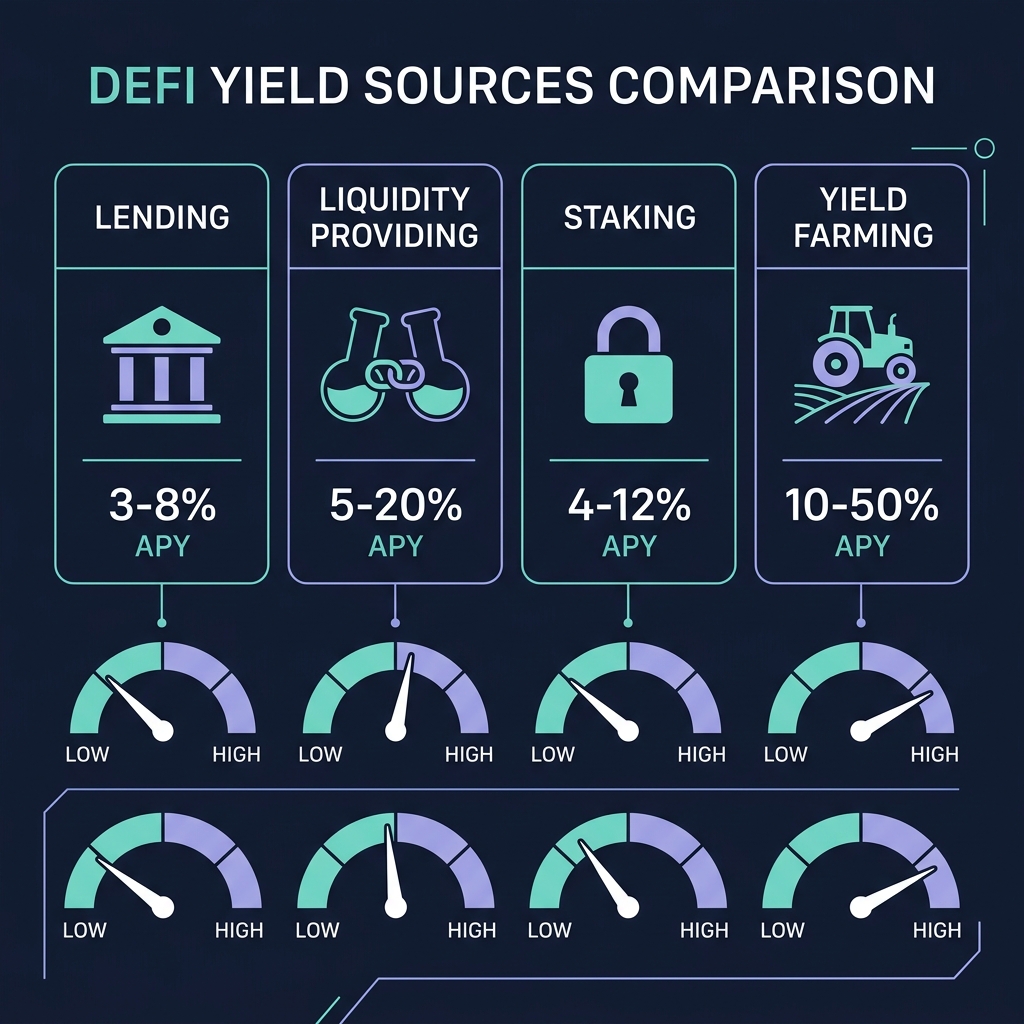
Every yield source in DeFi ultimately comes from one of these categories:
1. Trading Fee Revenue (Sustainable)
When you provide liquidity to a DEX (Uniswap, Raydium, Orca), you earn a share of trading fees proportional to your liquidity contribution. This yield is sustainable because it comes from real user activity — people are paying to swap tokens.
Typical APY: 5-30% depending on the pair's trading volume and your position range
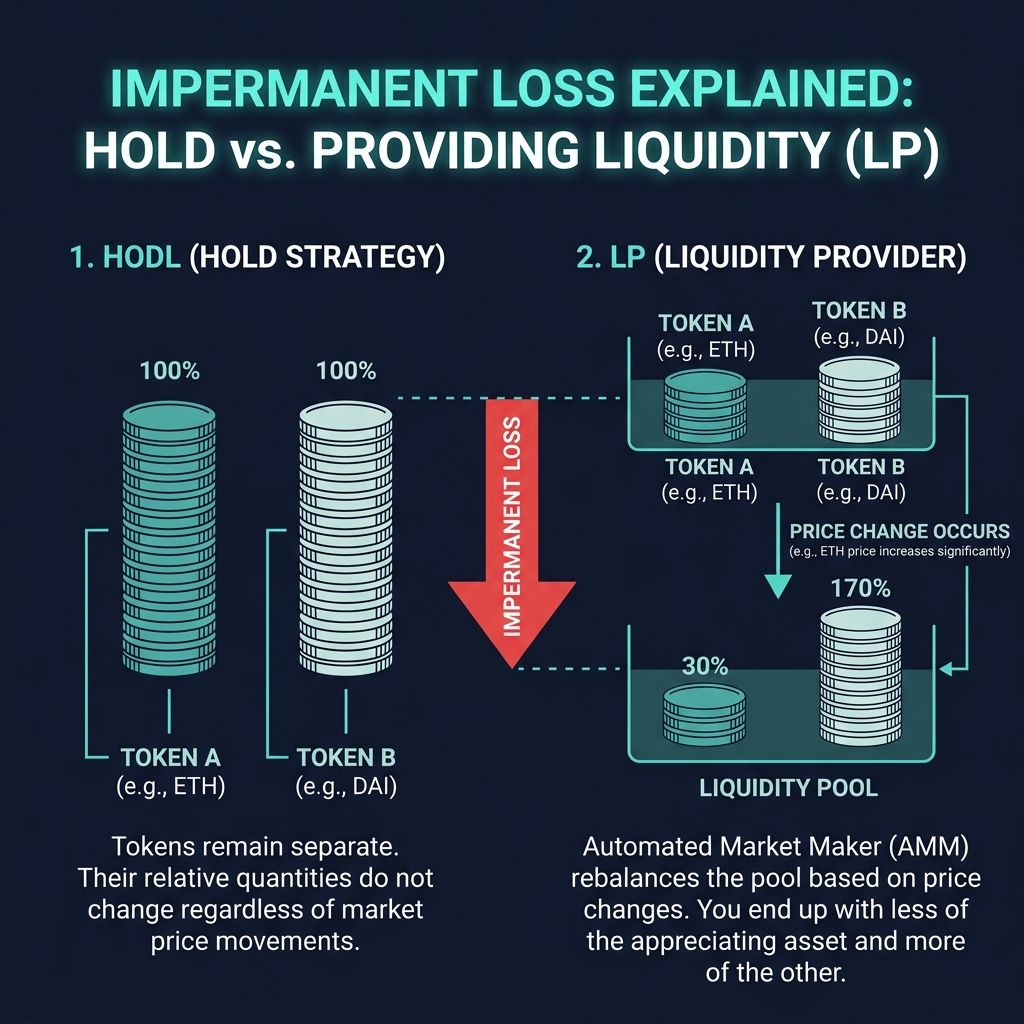
Risk: Impermanent loss when token prices diverge. High-volume pairs with correlated assets (ETH/stETH, USDC/USDT) offer lower IL risk.
2. Lending Interest (Sustainable)
Lending protocols (Aave, Compound, Morpho) pay depositors interest funded by borrowers. Borrowers pay to access leverage or short exposure. This is traditional banking economics on-chain.
Typical APY: 3-12% for stablecoins, 1-5% for ETH/BTC
Risk: Smart contract risk and liquidation cascade risk (if mass liquidations cause bad debt).
3. Staking Rewards (Semi-Sustainable)
Proof-of-stake networks pay validators and stakers for securing the network. These rewards come from new token issuance (inflationary) and transaction fees (sustainable).
Typical APY: 3-8% for ETH, 6-10% for SOL, varies by network
Risk: Slashing (validator penalties), lock-up periods, and the inflationary component diluting returns.
4. Token Emission Incentives (Unsustainable)
Protocols distribute their governance tokens to attract liquidity. This is the "old" yield farming model and still exists, but experienced farmers now treat emission rewards as a bonus, not the primary return.
Typical APY: Highly variable, often inflated
Risk: Emission tokens usually decline in value over time. The real APY is often much lower than displayed after accounting for token price depreciation.
5. RWA-Backed Yield (Sustainable, New in 2026)
Protocols that deploy capital into real-world assets (US Treasuries, corporate loans) distribute the interest to token holders. This is the fastest-growing category.
Typical APY: 4-15% depending on underlying asset risk
This is where crypto technical analysis becomes practical — a quality crypto analytics platform will display these signals in real time, helping you act on setups as they form.
Strategy 1: Stablecoin Yield Stack
Goal: Earn 8-15% on stablecoins with minimal directional risk.
How:
Convert idle USDC to a yield-bearing stablecoin (USDY, sDAI, or similar)
Deposit the yield-bearing stablecoin into a lending protocol as collateral
Borrow USDC at 3-5% interest
Deploy borrowed USDC into a stablecoin LP pair earning 8-12% in trading fees
Net yield: 8-12% LP fees + 4-5% collateral yield – 3-5% borrow cost = 9-12% net
Risk level: Low-Medium. Risks include smart contract exploits, stablecoin depegs, and liquidation if collateral ratios shift.
Strategy 2: Liquid Staking + DeFi Composability
Goal: Stack staking yield with DeFi yield for 10-20% combined returns.
How:
Stake ETH via a liquid staking protocol (Lido, Rocket Pool) → Receive stETH/rETH (earning ~4% staking yield)
Deposit stETH into Aave as collateral → Borrow ETH at ~2%
Risk level: Medium. Risks include stETH depeg, liquidation on leveraged positions, and smart contract risk across multiple protocols.
Strategy 3: Concentrated Liquidity Management
Goal: Maximize trading fee revenue through active LP management.
How:
Identify high-volume trading pairs on Uniswap V3/V4 or equivalent
Set a narrow price range around the current price to concentrate your liquidity
Monitor and rebalance when price moves outside your range
Use automated vault managers (Arrakis, Gamma) if you don't want to rebalance manually
APY potential: 15-50%+ for actively managed positions on volatile pairs
Risk level: Medium-High. Concentrated liquidity amplifies both fee income and impermanent loss. Requires active management or trusted vault automation.
Goal: Earn future token airdrops by using emerging protocols early.
How:
Identify protocols in their "points" phase (pre-token, accumulating user activity data)
Deposit capital and actively use the protocol
When the token launches, convert points to tokens and sell or hold
Expected value: Highly variable. Major airdrops (Arbitrum, Jupiter) returned 5-50x on deposited capital. Most smaller airdrops return 1-3x or less.
Risk level: High. Capital is locked in unproven protocols. Smart contract risk is elevated in early-stage projects. Many points programs dilute rewards over time.
Protocol Risk Assessment Framework
Before deploying capital to any DeFi protocol, evaluate these five dimensions:
1. Smart Contract Risk
Factor
Low Risk
High Risk
Audit count
3+ independent audits
0-1 audit
Time in production
12+ months
< 3 months
TVL
$100M+
< $10M
Open source
Fully verified
Unverified contracts
Bug bounty
$1M+ program
No bug bounty
2. Economic Risk
Is the yield sustainable (fee-based) or inflationary (emission-based)?
What happens to yields when TVL increases 10x?
Is there a death spiral risk (token price drop → yield drop → TVL exit → further token drop)?
3. Oracle Risk
What price feeds does the protocol use?
Is there a single point of failure in the oracle?
What happens if the oracle reports a wrong price?
4. Governance Risk
Can the protocol team upgrade contracts without a timelock?
Is there a multi-sig, and how many signers are required?
Have there been any controversial governance proposals?
5. Liquidity Risk
Can you exit your position instantly, or is there a cooldown period?
What's the slippage on a $100K withdrawal?
Are there redemption queues during high-demand periods?
CoinXSight's Discovery module tracks DeFi protocol metrics including TVL trends and smart contract scores, helping you identify both opportunities and risks.
Yield Farming Mistakes to Avoid
Mistake 1: Chasing the Highest APY
The highest displayed APY almost always comes from unsustainable token emissions or low-liquidity pools with inflated calculations. A "genuine" 10% APY from trading fees is worth more than a "displayed" 500% APY from rapidly depreciating farm tokens.
Mistake 2: Ignoring Gas Costs
On Ethereum L1, gas costs for entering/exiting positions, claiming rewards, and rebalancing can consume a significant portion of yield on small positions. Calculate your break-even period before depositing.
Rule of thumb: On Ethereum L1, positions under $10K may not generate enough yield to cover gas. Use L2s (Arbitrum, Base, Optimism) or Solana for smaller positions.
Mistake 3: Not Accounting for Impermanent Loss
LPs in volatile pairs often show attractive APYs that don't account for impermanent loss. Always calculate your total return including IL, not just fee income.
Mistake 4: Over-Concentration in One Protocol
"Don't put all your eggs in one basket" applies doubly in DeFi. A single smart contract exploit can drain your entire position. Spread capital across 3-5 protocols.
Mistake 5: Forgetting About Taxes
Every swap, LP entry/exit, reward claim, and harvest is potentially a taxable event. Track everything. See the upcoming Crypto Tax Guide 2026 for jurisdiction-specific details.
Summary
DeFi yield farming in 2026 is defined by real yield — returns backed by actual economic activity rather than token inflation. The most effective strategies combine multiple yield sources (staking + lending + LP fees + RWA yield) while maintaining strict risk management through protocol diversification and continuous monitoring.
Master risk management for crypto trading. Learn position sizing formulas, stop-loss strategies, and how CoinXSight's Portfolio module tracks your risk…